Year: 2009

Total 161 Posts

Just One Example: Stock Photography

It would be interesting to open the floor up for discussion of one of the hottest memes in education presentation: the stock photo / quote combo. They’re inspirational. They’re ominous. They’re ironic. You can find them from the highest-trafficked level of edublogging to the lowest.

We collectively obsess over the tools to create these imagesPhoto source. Quote source. And, incidentally, yes, stock photography adds extra artifice to your image and, consequently, weakens your thesis. (Unless, for example, your thesis is that stock photography adds distracting artifice to a thesis.). We obsess over the technology that lets us publish them globally. Yet, if someone has asked the essential question, “Do these images distract from or enhance our theses,” I haven’t seen it.

I realize that, in the stadium of Essential Skills For Educators, visual literacy sits somewhere up in the mezzanine. There are many more important things to discuss than how best to use an image in the service of a thesis. But it sits much, much closer to the field than any of the publishing tools which depend on and amplify your existing visual literacy.

I’m trying to convey my frustration that you’re somewhere on the order of ten times more likely to find a post in the edublogosphere celebrating SlideRocket or Prezi than you are a post soliciting feedback on your pre-existing visual literacy condition which these presentation apps utterly depend upon.

Want to shut me up? Let me see you not just post the slidedeck of your last education presentation, but the audio also. Next, don’t just tell yourself that you’re open to visual literacy instruction but tell that to your readership explicitly. Ask for feedback. Describe your thesis โ€“ what were you aiming for with those slides? โ€“ and ask for criticism. Ask people to post alternative visual approaches to your own thesis. And then โ€“ because a lot of people equate “criticism” with “hurting someone’s feelings” โ€“ reward their criticism. Thank them.

And then hype whatever new tool lets you publish your slides through Twitter’s API (or whatever) with my blessing.

But first things first.

[photo credit: Francis Yannick De Ocampo]
The Latest Web 2.0 App For Education

Charles Eames:

Choose your corner, pick away at it carefully, intensely and to the best of your ability and that way you might change the world.

I receive comments occasionally asking me if I have ever heard of SMART boards. I attended a district-wide SMART sales pitch earlier this school year before we became very broke. And I thought to myself the entire time, please, please, someone just help me get a grip on how to use pictures โ€“ moving and static โ€“ in a math classroom. Maybe then I’ll move along to something else that doesn’t change and after I have done everything I can for my classes with each of those, maybe then I’ll have need of a SMART board, which can play clapping sounds on command.

What Won’t Work: Harvard’s Movie Math

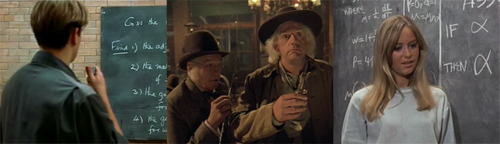
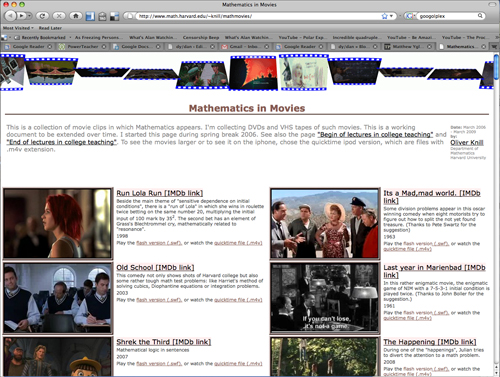
Harvard’s Oliver Knill extracts clips from movies that evoke math. To whomever first tipped me to this site last year and for the dozen recommendations I have received since, thanks, but I have no idea what to do with it. There is value here, certainly, but rarely is it of the WCYDWT? variety, which has kids actually getting dirty with math.

Basically, this is mathematical pornography, where handsome people in movies use the same math I’ve been telling you kids that people in the real world use all the time.

For example, check out the Straw Dogs clip in which a blackboard with some astrophysical equations appears! Or the time that Doc Brown uses the term “googolplex” in Back to the Future III! Even Matt Damon enjoys solving linear equations!

Like I said, there is value here, I’m sure, but I’m looking for fruit on higher branches. Because every single one of those clips begs the question:

What do the students do with it?

If you can’t build an interesting activity out of the a/v material, something to challenge and perplex your students over a sustained stretch, I have little use for it. The thesis of both this post and the last is that we have to make the really useful stuff ourselves.

What Won’t Work: FlickrCC

What Can You Do With This? is the most fun I’ve had this school year. I could do week after week of times table review if my students and I were allowed just thirty minutes per week to sharpen our minds with mathematically rich multimediaIf you’re the sort who sees potential in these blog things for professional development then the fact that I developed this classroom fixture organically, spasmodically, like a wobbly baby giraffe, here on this blog, in full public view with full public input, might be a useful data point..

I have received two suggestions recently I wanted to address, two suggestions that would put us off a useful trail and into the bramble. Here is one.

FlickrCC Won’t Work

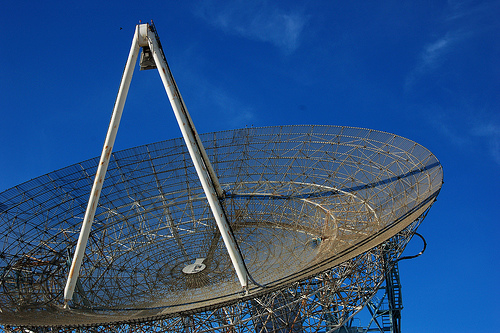
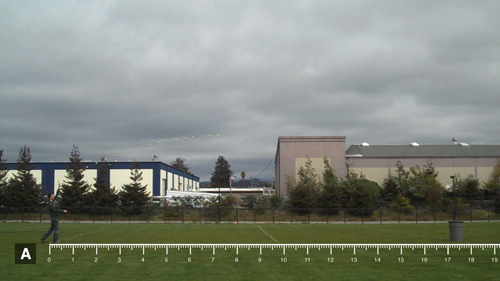
Scanning Creative Commons-licensed photography databases for math media simply isn’t a scalable solution. These media must be unaffected. The student must lift the heavy weights. The student must decide for herself what is important about an image, audio sample, or video. Most photographers, meanwhile, are very interested in artistic expression, in affectation, in imposing their own point of view on a scene, rather than stripping the scene of their point of view entirely, which is essential for classroom work. So instead of something unaffected, and artistically value-neutral like this:

You get expression like this:

… with the camera positioned at an artistically interesting but academically unhelpful angle. You can’t model a parabola onto this. You can’t model a circle onto this. The photographer was (naturally) unconcerned with measuring the scene, which rules out basic photogrammetry. It begs the question, “who shot this?” rather than an interesting question about the parabola itself.

This is a generalization, true, but a useful one. You can’t find the really effective WCYDWT? media. You can derive surface-scratchers like “what shapes do you see here?” from Creative Commons-licensed Flickr media but if you’re looking to propel a meaningful discussion or a rigorous activity, you have to make it yourself.

Will The Ball Hit The Can?

I pick up a huge static charge whenever six words, paired with the right a/v material, can motivate an hour of mathematical exploration.

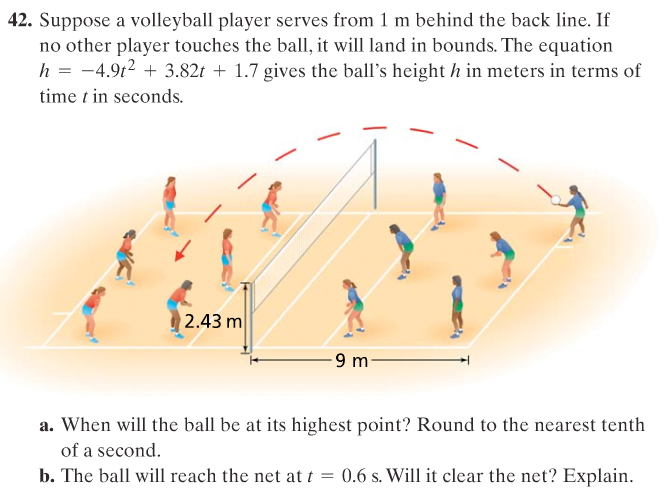
Here is the opposite of that static charge, a loud sucking sound as my brain deflates, the old way of doing real-world relevance:

As a student, I’m like “cool, volleyball, volleyball’s fun” but the problem is already dumping questions and formulae and mathematical structure on top of me before I have ever once considered the reality that projectile motion follows a parabola.

You have to earn that.

So I shot four of these images [partial, full] โ€“ร‚ย one that ultimately went long, one that went short, one that went in, and one that looked like it went in, but really veered to the side, provoking a discussion of errors in 3D projections onto a 2D plane.

I shot ’em plain. Nothing fancy, plenty of room along the edges, no soundtrack, no narration, nothing overtly helpful. I set them up so I could ask the students a clear, visceral question: “Will the ball hit the can?”These guidelines are all in the manual.

Because this is a question which everyone wants to answer, regardless of mathematical ability. Everyone has an opinion. Everyone gets invested. It’s also a question that has a visual answer, one which we can compare against their predictions. So the first thing I had the students do after they paired up in front of laptops was divide a piece of paper into quarters and make a bet on each throw. I gave them the digital files, next, on top of which they modeled parabolas in Geogebra, revising their guesses afterward.

Then we played the answer videos and called it a pretty good day.

Perhaps now that they’re really, really invested into the idea that projectile motion follows a parabola, now that they’re comfortable with Geogebra, we’ll take Geogebra away. We’ll change the constraints now, superimposing a grid or a protractor, deriving the parametrized equations, but I just want to impress upon you, if nothing else, that this is a very deliberate, very sacred (to me) process, a process which most textbooks desecrate whenever possible.

If one of my students could successfully answer that scanned textbook problem above, but hadn’t on her own wondered, “What if we knew the equations of the parabola, what then?” I really don’t know how accomplished I’d feel.