Year: 2009

Total 161 Posts

Liberal Arts 2.0

This Snarkmarket post, proposing an updated liberal arts degree for the 21st-century, would seem to be up the alley of everyone on my reading list:

I think the best way to think about this is not to think of the โ€œnewโ€ liberal arts as supplanting the โ€œold,โ€ but as a complementary set, like painting, architecture, and sculpture as the new, humanist plastic arts during the Renaissance. Like the trivium and quadrivium, we have the octet of โ€œmodernโ€ liberal arts and a set of newer concerns.

They’re looking for contributors to a book.

Don’t Let Your Students Use Music In Their Video Projects

Adding a music track to film used to be a technically strenuous task requiring an optical printer to run a transparent strip alongside your film print. Now, your computer’s stock video editor (iMovie or Windows Movie Maker), VoiceThread, or PhotoStory will import a track from your iTunes library in seconds. Here, again, we have conquered the technical hurdle but we have underestimated the height of this particular creative hurdle.

When you make videos, vodcasts, and montages, you are attempting to create meaning.

You create meaning โ€“ whether that’s a thesis or a tone โ€“ when you write scripts, cast actors, place cameras, use lights, direct actors, and edit shots. Not one of those creative tasks is value neutral. If you can align each of those creative tasks to your thesis or tone, then music will be redundant at best, distracting at worst, serving only to remind your audience that they are watching a movie.

In our classrooms, when we make movies, we write a sloppy plot outline, a soft script, we act unskillfully, direct unskillfully, edit unskillfully, and then trowel a soundtrack onto our movie to fill the gap between what it is and what we wanted it to be. We wanted something buoyant so we add Louis Armstrong. We wanted to convey menace so we add John William’s soundtrack to Jaws, or the Creative Commons-licensed equivalent. When we let our students use music in their videos, we let them outsource the truly difficult creative work to industry professionals.

Four Illustrative Examples

  1. No Country For Old Men featured smart suspense, fat-free plotting, and some truly terrifying set-pieces, all without the shock chords and shrieking notes that horror schlock has to trowel onto otherwise unscary sequences. The movie was silent.
  2. The Wire and The Shield were, for my money, two of the best dramatic television series of the current millenium. Both of them established complicated characters and rich drama without soundtracks.
  3. I used music in exactly one of my ten dy/av episodes and I blew it. The CC-licensed track I selected was far too ponderous and far too mopey for the footage it was working against.

Harmless Anecdote

I witnessed a montage at ILC 2008 featuring a Frankenstein medley of “Highway to the Danger Zone,” “Ride of the Valkyries,” “Dare You To Move,” “Don’t Stop Thinking About Tomorrow,” “New Soul,” and “Requiem for a Dream,” the lyrics and songs straining to carry the weight which the photos, themselves, couldn’t carry, photos of students unboxing laptops.

Far better there, to play ambient audio of the students excitedly unboxing their laptops or of student testimonials and, beneath that, if absolutely necessary, a track that functions not as an emotional signpost (“hey hey! feel happy! yeah, you!”) but as an emotional lubricant, something pleasant but inexpressive on its own.

Finally

If your students can demonstrate that all of their creative decisions from pre-production through editing support their thesis or tone, and they still need music, then let them have at it. Otherwise, you’re letting them off easy and they need to cut Louis Armstrong in on the grade.

BTW: Ken Loach, director, winner of Palmes d’Or:

I think film music that tells you what to think is cheap โ€” the film should do that without that prompting.
I Do Not Get Assessment At All Sometimes

I let Chuck, Shelley, and Robert skip the final exam. We logged fifteen concepts in the first semester of Algebra 1 and those students studied them, practiced them, and demonstrated mastery on all of them. Take a break, kids.

But what if I had given them all fifteen of those concepts again. How accurate is my ranking not just of those three kids but of all of my kids? I have ranked everyone on a four point scale on each of those concepts. Will a student ranked at 2 (“major conceptual errors”) again score a 2?

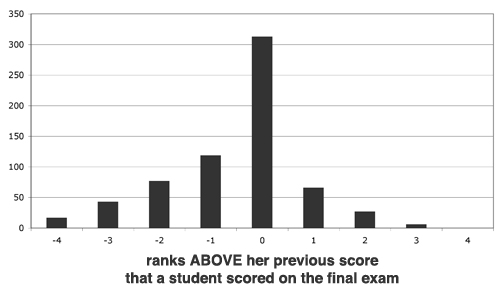
In lieu of a 50 question scantron final, I re-assessed every student on every concept, entered the current ranking into Excel alongside the student’s old ranking, and took the difference.

Should’ve left well enough alone, right?

How Accurate Were The Old Rankings?

  • Okay, so big sigh of relief that, in 313 instances, my old ranking was an accurate assessment of a student’s current knowledge. Could’ve been worse.
  • Could’ve been a lot better. That’s only 47% accuracy. And in 43 instances, my old ranking was three levels too high. That would be putting a student at a 3 (“minor mechanical errors”) and watching the student stare totally blankly at the question on the final forty-three times.

What Does Mastery Mean?

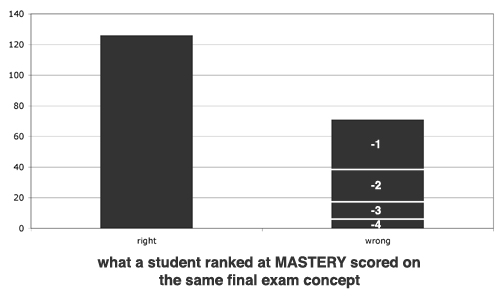
If I have a student ranked at mastery, would she master the same concept on the final exam?

  • This isn’t awful. This isn’t great. I don’t know at what point I should be unhappy.

Enduring Questions

  • What do we mean when we say “mastery”? Does that mean a student will score perfectly on the same concept every time? Should I be unhappy that the correct/incorrect balance wasn’t 100/0?
  • What do we mean when we say “retention”? This is a common question of my assessment strategies. “Don’t kids forget?” Obviously, I can now answer that question, “yes, sometimes.”
  • What do we mean when we say “grades”? I don’t know what kind of results here would prompt me to pack up the shop and dole out monthly, summative unit exams (“Chapter 6 Test”) with the rest of my department. The fact is that this kind of precision analysis isn’t even possible under a unit exam model, which puts other teachers in an enviable position; the question “do these assessment scores represent my students’ current knowledge?” cannot be answered so it goes unasked. The answer, I’m afraid, is that their assessment scores underestimate student knowledge since Chapter 7 clarified many of Chapter 6’s concepts but these teachers have no mechanism for class-wide re-assessment. So they lower assessment’s grade weight beneath that of homework, instead, and inflate their grades with a few extra credit assignments. Look, I’m open to absolutely anything. I just want my grades to mean something. And I need to respect what few guiding principles for assessment make sense to me.

I Do Not Get Homework At All Sometimes

I give my students two problems a night โ€“ challenging, standards-based, assessment-grade cuts off Algebra’s prime rib. They can choose from the easier or harder problem. It drives me nuts that some students will still blow off such a low-volume assignment.

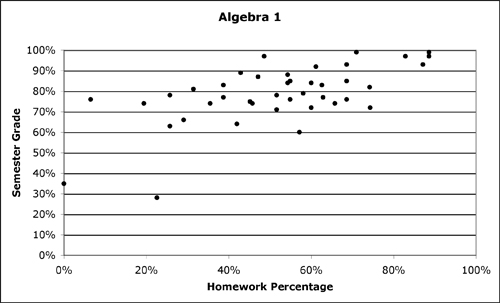
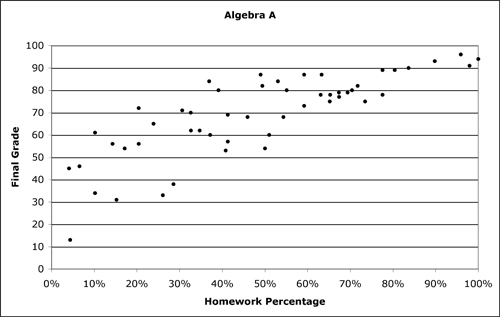
I was threatening my Algebra 1 sections with an increased problem count, increased reward for completion, and increased penalties for non-completion as of the second semester, which started today. Then I graphed their first semester grades against homework completion and gave up.

Then you have my three sections of remedial Algebra, which behave more or less as you’d expect.

It’s all very troubling.

My Annual Report 2008

We have entries from Collette Cassinelli, Simon Job, Fred Knauss, Alice Mercer, and Sam Shah (did I miss a trackback?) with five days remaining in competitionEntry page here.. I finished my own (out of competition) entry last night while recovering from a flu / bronchitis combo and posted it here.

I abandoned it, to a certain extent. My content means a lot to me, if only because I bothered to track the data all year long, but my design work is simply functional โ€“ร‚ย a staid set of bar charts and line graphs. See you next time.