Title: How To Save Math Education Subtitle: (And A Tiny Piece Of The World Along With It) Time: 10h00 PST Duration: 60 minutes Price: Free
It’s an overwrought title, sure, but it’s hard for me to overestimate the damage I did in my first five years teaching. I thought I was building up intellectually adventurous learners who would be patient with problems that didn’t resolve neatly or conform quickly to any of the example problems I’d already coached them through when, point of fact, I was doing the opposite. I don’t have any illusion that five hours of sturdy, problem-based math education each week will counteract the intellectual Novocaine our students consume throughout the other 163, but we can at least do no harm.
The timing of this session is unfortunate as it’s squarely in the middle of the North American school day. It would be nice to see some familiar names on the participant list, though, so if you’re able to attend, please register.
I’ve moved nearly a dozen times since I broke this record in 2004 and the tapes have followed me everywhere: 24 hours of non-stop monotonous paper clipping minus twelve gaps where one of my friends (probably Steve) changed the reels. Five minutes of this footage will make you sorry you ever spoke an unkind word about grass growing or paint drying, which are each several orders of magnitude more exciting than this.
So I compressed those 24 hours into three minutes, which meant transferring the footage from Hi-8 tapes to DV tapes (time cost: 24 hours) and then importing the DV tapes to Final Cut Pro (time cost: 24 hours). There were no shortcuts. The project took weeks.
I worry about video teachers who would encourage the student to mute the ambient noise – the chaos, the laughter, the occasional grim silence, all of which is essential documentary detail – and instead apply a thick lacquer of Creative-Commons-licensed pop electronica. Something chosen carefully, no doubt. Something propulsive to match what passes for content here. But I’ll point out, again, that a) controlling ambient noise is its own necessary kind of skill, and b) laying a music track beneath a video track without worrying about how the two tracks play with each other – how the aural ebbs and flows with the visual – will strike certain segments of your audience as, artistically speaking, soulless.
This particular case is easy. If your audio track doesn’t shift gears or climax or do something at exactly one minute and 21 seconds into this video – when the sun rises – you’ve missed the moment and essentially filed for divorce on behalf of your audio and video track, citing irreconcilable differences.
[The next two posts discuss some of my technical notes from two video projects I completed this summer – one professional, one personal. If these are too far off the beaten path for your tastes, please check back in next week.]
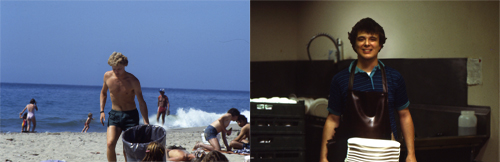
My first video project this summer was a montage celebrating the fortieth anniversary of a local camp. This was complicated. No video existed from the 1970s. I thought, initially, to interweave older photos and newer video but, instead, went strictly with photography.
This was also challenging. There is only so much you can do with still photos. You can cross fade them. You can apply filters. You can edit them to music. You can go the Animoto route. You can go the Ken Burns route. But those techniques do very little to enrich the content. Ken Burns enriches his photos, for instance, with research, narration, and editing. Without those, the motion across the screen would grow tiresome.
I took a familiar path. Several years ago I posted a photo montage that exists somewhere between 2D and 3D. The technique is straightforward.
You take as many photos of the scene as you need plates (or layers). You keep your camera in manual mode so that when you move subjects out of the way (to get an unobstructed shot of the background) the aperture doesn’t change.
In this case, I wanted a layer for each of the brothers and the background. You use the pen tool in Photoshop to cut out each plate from the background and then import the composited file (with three total layers, in this case) into Adobe AfterEffects where you tell your computer, this layer is closer to the camera, this one is farther away, here’s how to move the 3D camera around the scene. Once you outline your scenes, it’s only a question of how much free time you have for the digital carving.
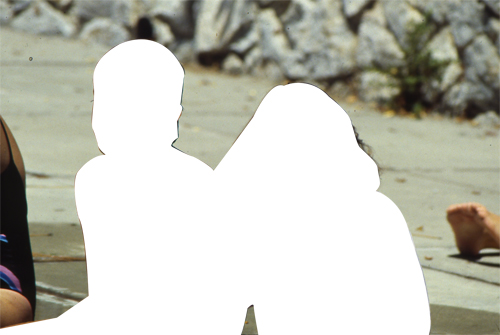
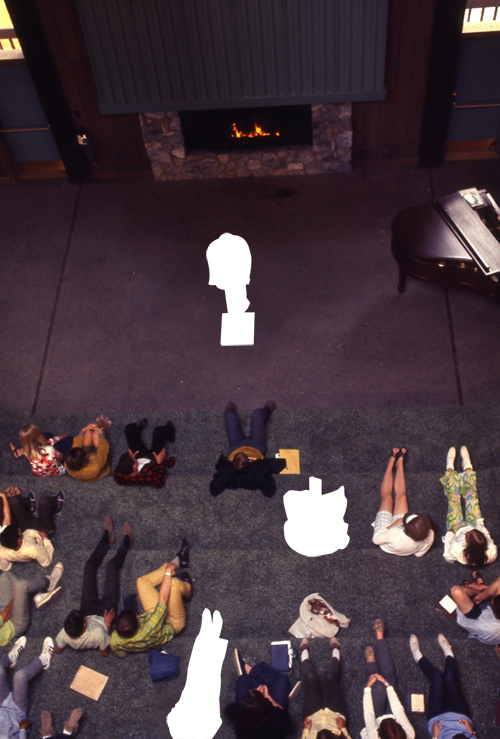
This project was different. I couldn’t go back in time to shoot the two brothers separate from each other and from the background. I spent four hours scanning slides from the 1970s. After I masked the subject from the photo there was … nothing. Just white space. I had to guess at and then recreate the background.
So I got cozy with the clone tool, which is exceptionally easy to use poorly. As often as I could, I set myself up with subjects standing in front of solid colors or simple textures, which are easy to clone.
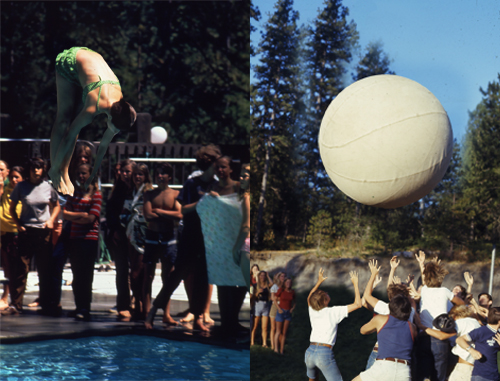
These two were especially difficult. The sandy ridge behind the campers is almost entirely fake. If you look closely at the pool photo, you’ll notice I had to clone an onlooker’s entire face.
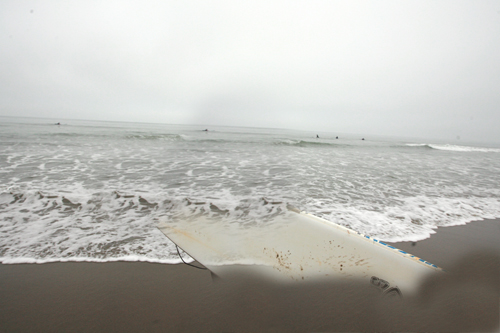
I thought sand would be easier to clone but the light fell across it unevenly and had me pulling out tufts of hair trying to compensate. Stay away from sand.
It’s difficult to stretch a single technique across an entire film. It gets tired. So I waited to deploy that one until the bridge of the audio track kicked in. Beforehand and afterwards, I went for a ghostly, melancholy vibe with subjects drawn into the campground at the start and then drawn out at the end.
One of my most vivid memories of childhood is carpooling with Brad’s mom to a church group when I was ten. It was early fall and we were talking about the changing seasons when she quoted her husband, an amateur astronomer: “We’re losing a minute of sunlight every day.”
That remark was so traumatizing that even now, almost twenty years later, I can recall the exact cross-street we passed when she said it.
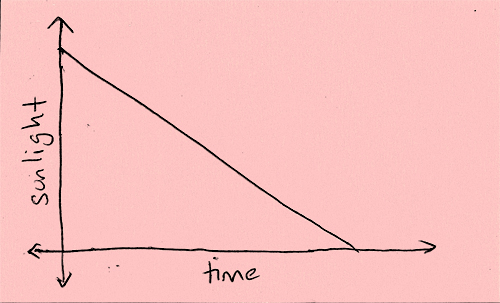
I pictured neverending darkness. Riots. I wondered if we should maybe skip church group and stock up on flashlight batteries before the rest of town found out. Even at that age, my sense of patterns (and what a math teacher years later would call “indirect variation”) was developed enough to understand that we didn’t have much time left.
This is what I used to know:
.
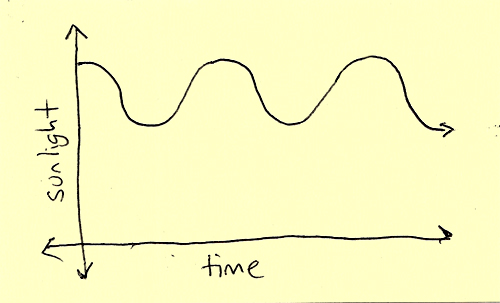
That was a perfect, teachable moment for someone to step in and show me that what I used to know wasn’t good enough. “Not everything works like a line. Some things work like a cycle, getting bigger, getting smaller, getting bigger again. Can you think of anything else that works like a cycle?” Et cetera.
It has taken me six years to rewire my teaching to approach new knowledge as the solution to the limitations of what we used to know, rather than as an entry on a list of standards or “what we’re learning today.”