You can’t be a change agent if you’re an expert. [..] Experts have a different aura about them. That aura of expertise is intimidating for neophytes. The aura of “not quite an expert”, the sense of newness associated with someone learning something they’ve just learned, is motivating for newbies. We need less experts, more neophytes. Actually, a constant influx of neophytes to provide a continuous stream of models to engage new learners.
Having had my own crisis of faith, recently, I can concede most of Darren’s premise while at the same time criticizing his conclusion as overly defeated. As Larry Bird became Larry Bird, were more or less people inspired to take up a basketball? Larry Bird became a figure of aspiration, which is what Darren is to a lot of educators. But Larry Bird, to a greater degree than most aspirational figures in the NBA, was also an educational figure, collaborating with coach Red Auerbach on several volumes of video tutorials.
Darren thinks his situation requires more novices when instead it requires better experts. Hungry experts. Experts who empathize with the novice, who constantly re-evaluate their own assumptions from the perspective of a novice, who get outside their own heads as much as possible and as often as possible. This is the fun and the challenge of what we do.
I am taking a leave of absence next year to join the faculty of the University of Arizona. I will be working with elementary and middle school teachers teaching them how to teach mathematics, and developing an online curriculum to do the same.
The Daily Show made great work last week out of our tendency to confuse short-term fluctuations with long-term trends, shining a particularly bright spotlight on the it’s-cold-outside-so-global-warming-isn’t-real crowd. I found the clip so effective, I downloaded it, and tucked it safely away in my vault.
Nick Hershman is running laps with this one. Check the blog post or the screencast, in which he explains how he built a Python script around an algorithm from the comments.
I’m very impressed by the commentary in the kick-off post. The default WCYDWT stance has the eager math teacher stroking his chin and musing that “we should really tie this into gas prices somehow … ” while studiously avoiding the essential, practical details of constructing a framework for that learning. Instead, at freaking last, our commenters are starting to attack those logistics with a certain thrilling mania, developing full-bodied worksheets, manipulatives, and Geogebra appletsHats off to: Steve Phelps, Jack Bishop, Josh Giesbrecht, Dan Schellenberg, Nick Hershman, and Justin Lanier. Great work..
I’m not exactly sure of the best route through this problem. In fact, the one that interests me most is one I don’t know how to solve. I hope you can help me with that. I only know one thing:
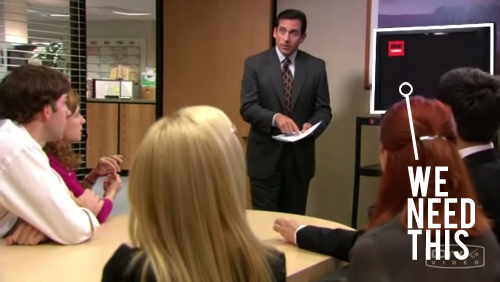
We can’t learn much from an obscure background element of a video clip unless we drag it into the foreground. We need our own copy of that bouncing DVD screensaver. So I made one in AfterEffects. [download clip]
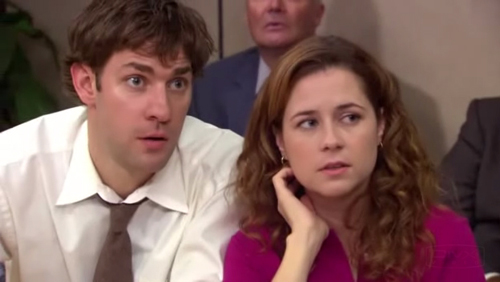
Your goal with these intro clips should be to infect your students with as much of PB&J’s anticipation as you can:
Take bets: will it hit a corner with five minutes? Ten minutes? Put a few students on record.
Now ask your students, “what matters here?” There are nearly ten variables you can define together. Ask, “what are good ways to measure what matters?” Pixels, angles, speed, time, etc.
The formulation of a problem is far more often essential than its solution, which may be merely a matter of mathematical or experimental skill.
Back To Our Show
Play this clip. It features information that should, ideally, surprise no one. Your students have abstracted all this information already. You’re just taking their hard wor and pressing play. [download clip]
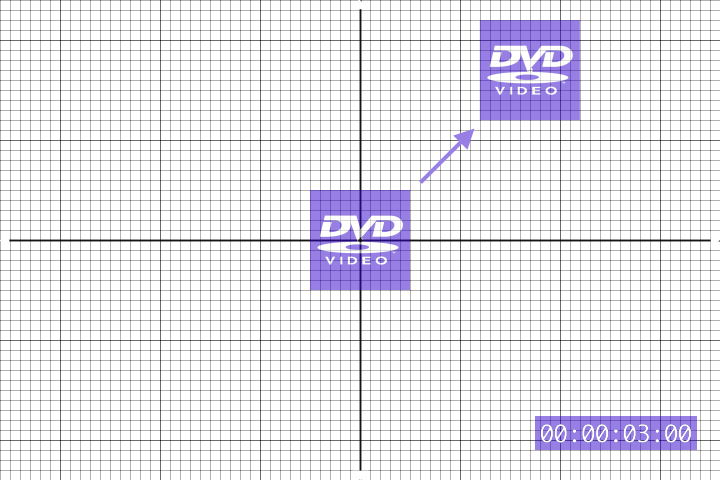
From there, take your pick. You could give them something fairly explicit like this [download image]:
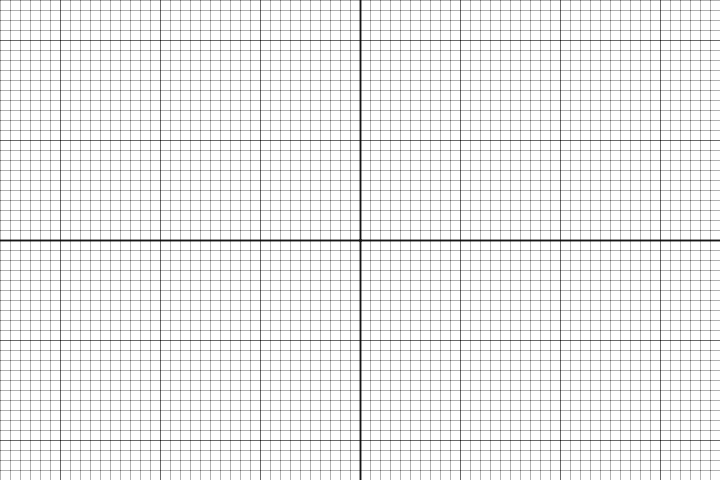
Or you could just give them this grid, 720 by 480 with ten-pixel increments, go frame-by-frame through the movie, and pick out some data points together. [download image]
The awesome observation they should make, regardless of what route they take, is that, once that icon starts moving, the rest of its natural life is foretold. It’s totally predictable in this frictionless environment.
By my count, we’re still missing a clip.
We need video of the solution. It’s one thing for you to consult your answer key (the full measure of your authority) and confirm a student’s answer. (A: lower-left corner at 1:34.) It’s another thing entirely to say, “It doesn’t matter what I think. Let’s check the tape.”