Month: February 2010

Total 16 Posts

What Can You Do With This: Will It Hit The Corner?

Click through to view embedded content.

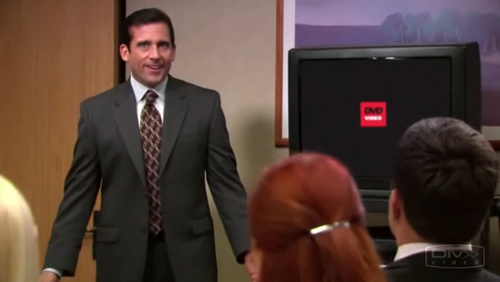
So here’s one where no one gets any credit for guessing the question. The question is obvious. The question is scattered throughout this entire clip (from the fourth season of The Office). I made the question explicit in the post title.

Will the DVD icon ever ricochet into a corner?

But what are the supplementary materials? How do you make this experience real to your students? What do they have in front of them? How are they getting their hands dirty with the math?

It doesn’t matter if you don’t know how to make the supplementary materials. Just name them. This is a big-hearted community. We’ll find someone who does.

BTW: Here is the high-res download, which Kate tracked down for us after I questioned her digital bonafides.

Two Excellent Entries For The WCYDWT Course Catalog

Kate Nowak:

Here’s what basically has to happen to make a successful WCYDWT lesson:

  1. Lighting strikes (you observe something).
  2. You recognize that lightning has struck (you say “holy *&^%”).
  3. You investigate by building layers of abstraction on your observation.
  4. You realize that that particular abstraction fits in your curriculum.
  5. You strip away all those layers to a core question interesting to a 15 year old, who (I’m sorry and draw whatever conclusions you will about me or my school system) are the least interested people on the planet.
  6. You rebuild the abstraction in a way that will support the questions you successfully predict they will ask.
  7. You make attractive keynote slides out of it.
  8. You extend your original abstraction to questions that they will want to pursue to enhance their understanding.

mg:

there seem to be two corners of necessary student experience here. first, engaging with the instructor in “recreating mathematical reasoning”…using cooperative examples to learn how to ask useful questions, and making visible the math already there to find solutions. but those presented scenarios, in turn giving birth to the useful questions, are still coming from the heart/experience of the teacher, even if covertly. the most valuable part of WCYDWT to me is giving students the confidence and skills to recognize within their own spherespassionsinterestsloves specific places where those useful questions can be posed.

The Weak WCYDWT Brand

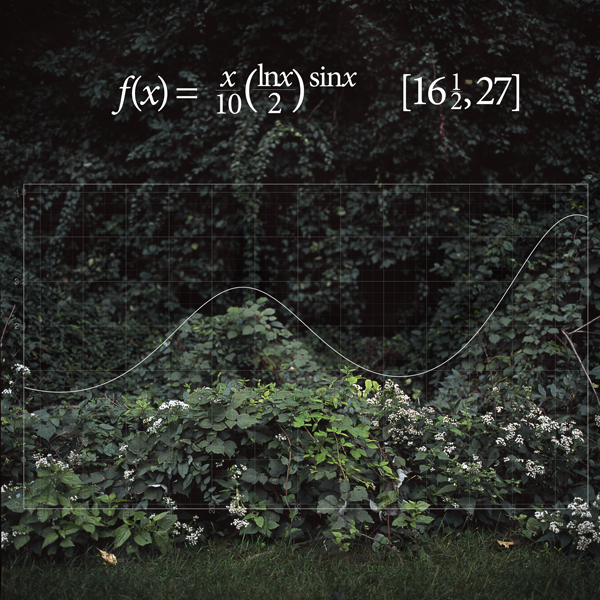
Let me be clear, first, that Nikki Graziano’s Found Functions are beautiful, subtle invocations of math and nature. They make me happy.

But two people have forwarded Graziano’s work my way in the last 12 hours under the heading “WCYDWT?” so I’d like to point out, for whatever it’s worth, that this is significantly narrower in scope than what I’ve been proposing for the last few years. The same goes for most tweets tagged #WCYDWT, which typically link to:

  1. a picture of a mathematical shape.
  2. an article that deploys mathematical analysis.

Meanwhile, I am trying to:

  1. recreate mathematical reasoning for my students as I find it in the world around me.
  2. involve students in both the solution to and the formulation of meaningful questions.
  3. exploit my students’ intuition and prior knowledge in the solution of those questions.

I don’t have any problem using Graziano as a classroom conversation piece, but there isn’t a question here. I don’t know how to turn this interesting thing into a challenging thing.

Yes, I could go out and take a few photographs and have students model different equations also. But in the service of what higher-order question? It’s like asking “what shapes do you see here?” It isn’t worthless but it isn’t far from the bottom of Bloom’s taxonomy either.

I’m trying to get this blog feature to a place where teachers ask themselves, “what extra resources do I need to create to make this question accessible and challenging for students?” but, for the most part, teachers aren’t even asking themselves “what is the question here?” They’re applying this #WCYDWT tag to an exhilarating feeling of connection between math and the real world. Which is great, but it’s an entirely different (and entirely more difficult) task to translate that exhilaration into something a student can discover and experience for herself.

I’m frustrated. I have no idea how to make this any clearer.
In Defense Of Busy Work

Yesterday’s opener question:

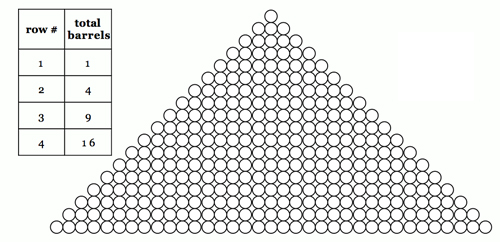
Count the circles.

Several students tallied the left half of the pyramid, doubled it, and then added the middle column. One student not only counted the circles one-by-freaking-one but kept a current tally inside each circle.

There are 324.

He was somewhere in the low hundreds when I drew his attention to the numbers at the end of each row: 1, 4, 9, 16 ….

“What do you notice? How can we use that to save ourselves time?”

The tedium of busy work can motivate student invention.

Two Minutes On Teacher Education

In advance of their EduCon presentation, Dean Shareski and Alec Couros put out the call for brief interviews on teacher education, addressing these two questions:

  1. What are your general views on the status of teacher education in preparing teachers, especially in regards to innovative teaching? What positives, negatives, or general views can you share? Please do pull in your own experiences if applicable.
  2. What is the ideal role of teacher education in developing teachers who are media literate and technologically savvy?

For whatever reason, they decided to bury the submissions at the bottom of a wiki, which taught us all a valuable lesson. Here is mine:

Two Minutes On Teacher Education from Dan Meyer on Vimeo.