Year: 2010

Total 151 Posts

What You Can Expect From This Blog For The Next Week

[BTW: A quick welcome to my new NCSM / NCTM buds — if you’re looking for some of the curriculum development ideas I mentioned in my talks, you can find those in the What Can You Do With This? category.]

A lot of conference blogging.
The national conferences for both math teachers and math supervisors are in my state this year. Generally speaking, I’d still take a pass but a miraculous coincidence of funding and timing was tough to ignore. Key Press is covering travel in exchange for one of those five-minute Ignite sessions and Friend Of The Blog, Ihor Charischak, hooked up a spare registration badge.

Plus, my school is enjoying the full battery of standardized tests this week so, clearly, the universe wants me in San Diego.

I’ll toss out a single daily dispatch, probably nothing more. Gratuitous technical note: I’m going at this one iPad only — both for blogging and presenting. The experience typing this out in the San Jose airport has already been plenty annoying (owing mostly to the lack of copy/paste in the WordPress app) so I wouldn’t be surprised if these daily dispatches turn into something less than daily.

“F–k The Exposition”

Sorry. It isn’t my quote but, seriously, can anyone do better than that for the mandate of the 21st-century social studies teacher? Put it on a mug.

Highly recommended: Emily Nussbaum’s profile of David Simon, creator of fine teevee products like The Wire, Generation Kill, and now Treme, his show about New Orlean’s jazz musicians three months after Hurricane Katrina which debuted on Sunday:

“F–k the exposition,” he says gleefully as we go back into the bar. “Just be. The exposition can come later.” He describes a theory of television narrative. “If I can make you curious enough, there’s this thing called Google. If you’re curious about the New Orleans Indians, or ‘second-line’ musicians–you can look it up.” The Internet, he suggests, can provide its own creative freedom, releasing teachers writers from having to overexplain, allowing history to light the characters from within.

Treme‘s pilot, true to Simon’s challenging aesthetic, dumps the viewer into an unfamiliar-but-compelling environment full of unfamiliar-but-compelling people and trusts that, because the whole thing is so damn compelling, you’ll be back the next week to learn more.

Simon outsources the teacher’s usual role as classroom expositor to the Internet while claiming for himself the role as classroom storyteller, turning the unknown into something challenging, enticing, and compelling.

Tell me that division of labor isn’t ideal. Tell me you couldn’t dedicate a career to that mission statement. Tell me you couldn’t do it for social studies or science or even math.

BTW. Also highly recommended: a memo (allegedly) from David Mamet (another first-rate storyteller) to his writing staff.

The Penny Determination Algorithm

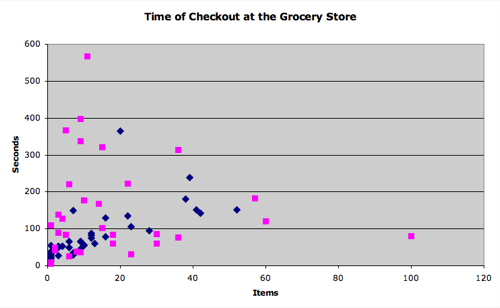
Some of my students fabricated their data, that much was obvious. The question was, which ones? I passed this graph out to my students and asked them to come up with a definition for cheating.

Most of them circled the same four extraordinary outliers but very few students could come close to verbalizing why they chose those outliers. It was just … obvious. The formula for statistical error was so intuitive they couldn’t verbalize it.

Something I enjoy about computational thinking (the focus of my position with Google) is that it asks you to explicitly verbalize processes that may only exist in your intuition, processes that are too obvious for words.

Case in point: which of these is a US penny?

100% of my students would correctly select I. But if I asked them, “Why? How do you know?” and requested a “Penny Determination Algorithm,” the sort of thing you could give to an alien race to identify our one-cent currency, it would drive them crazy.

“I don’t know. It’s just … obvious.”

My particular students may not be ready for that conversation but it would be a good one. We’d prioritize algorithms that used cheap inputs. After all, we could scan every coin and apply some kind of edge-finding filter in Photoshop, but that would be too expensive and time-consuming for the machine that counts your change at the supermarket. Once students completed their algorithms, we’d trade them around the room and try to throw exceptions at each other.

These conversations are very difficult to have with students whose teachers for the last eight years have a) defined the inputs for their students (“The area of a triangle depends on its base and its height.”) and b) given them the algorithms (“The area is half the product of the base and height.”).

Those students just want you to give them a sack of thirty objects so they can use the algorithm you gave them to answer the question, “which of these is a penny?” They don’t want to answer the question, “how do you know?” They wouldn’t know where to start.

Save The BetterLesson Blog!

Eight of the last ten BetterLesson blog posts have been teacher interviews. “Interview” is a misnomer, though, since the prefix “inter-” implies some kind of dialogue between two parties. These are “surveys,” a one-way conversation between a person and an fixed list of ten questions. (eg. “Coffee, tea, or caffeine free?”)

I’m not even skimming them anymore so let me drop some public encouragement into their suggestion box: if you see someone upload an exceptional lesson, ask the teacher how she did it. Ask her to describe her motivation and creative process. Or, if you see someone using your site exceptionally well – downloading lots of material, leaving comments everywhere, ratcheting her “impact” rating past “high” all the way to “jackhammer” – interview her about that.

I’m pretty sure I’m ripping off Kathy Sierra here but it seems empirically true to me that the point of your company blog should be to make your users more powerful, more enthusiastic, and happier about whatever brought them to your site in the first place. They should walk away from an entry on the BetterLesson blog inspired, excited about their career choice, and eager to reach “jackhammer” status on your site.

If this doesn’t make sense, check out Kickstarter which has – bar none – the best company blog around – killer interviews, tutorials, and podcasts, all of which make you want to sign up and get that hard cider business out of your head and funded on their site.

Nothing but love, BL buddies. Stay strong.