Year: 2010

Total 151 Posts

[PS] The Hot Air Balloon Thing Again

Advanced Mathematical Concepts: Precalculus with Applications. Glencoe. 2006.

Pseudocontext

Amanda Dean:

It asks students to ignore reality in order to solve it. The wind would probably be moving the balloon as the balloonist tried to take these measurements, and it’s unlikely that the two angles could be measured from exactly the same vantage point. The problem also assumes that Groveburg is a flat city, or at least that the elevation of the soccer fields is the same as that of the football field.

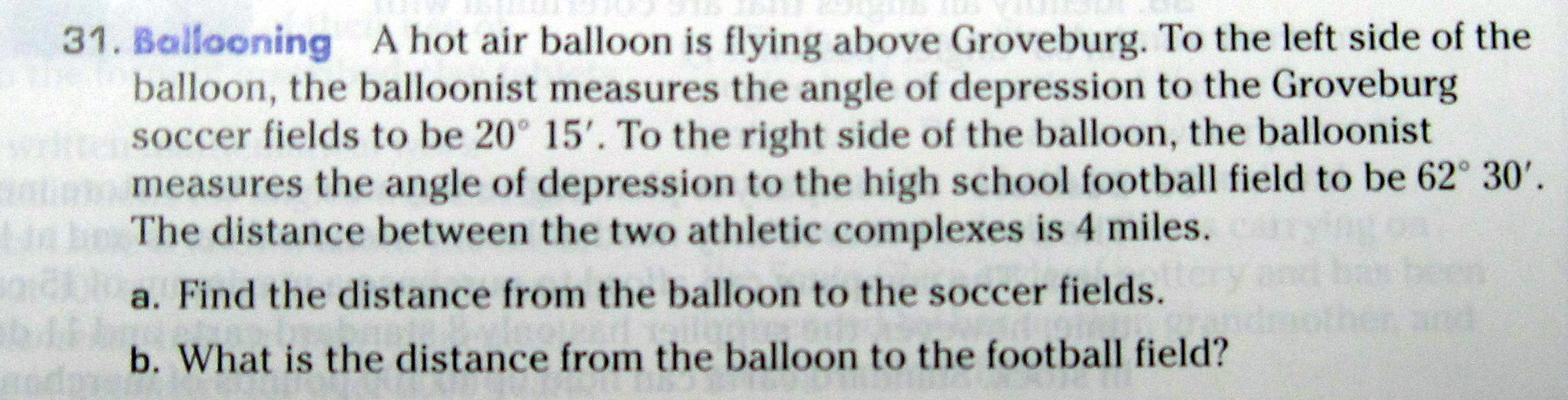
And, while not pseudocontext, we have another situation where the author asks the student to solve for inconsequential measurements and ignore the consequential one:

The questions aren’t what you want to know. You want to know how high up the balloon is! It’s not like you can’t figure it out from the info given either. It can be done with the Law of Sines, which is the focus of the lesson.

And then we’re back to the pseudocontext:

If you do calculate the balloon’s height, you find that the balloon is about 1.24 miles above Groveburg, which is also unlikely since an average hot air balloon ride only goes up to 2000 feet.

Transcription:

A hot air balloon is flying above Groveburg. To the left side of the balloon, the balloonist measures the angle of depression to the Groveburg soccer fields to be 20ยฐ 15′. To the right side of the balloon, the balloonist measures the angle of depression to the high school football field to be 62ยฐ 30′. The distance between the two athletic complexes is 4 miles.

  1. Find the distance from the balloon to the soccer fields.
  2. What is the distance from the balloon to the football field?

Assignment:

  1. Scan an example of pseudocontext.
  2. Email it to dan@mrmeyer.com
  3. List the textbook title, edition, and publisher.
  4. Give me your interpretation of the term “pseudocontext.”
  5. Let me know if you’d like credit (name, blog or twitter) or if you’d prefer anonymity.
An Open Video Message To Steve Leinwand And Jerry Becker

Urli.st Tutorial from Dan Meyer on Vimeo.

After the third day at NCTM I wrote:

It struck me several times throughout both conferences that we need to counter-program a session across from the “Newcomer’s Orientation.” I’m not talking about “Rolling Your Own Backchannel with Twitter.” Scale that back. Way back. Something more like, “How to Make National Presentations a Lot Less of a Chore for Presenters,” featuring URL shorteners, Delicious, PDFs, basic FTP. maybe drop.io. You name it.

I wrote that, largely, on behalf of these two presenters, both of whom seemed stymied by the task of distributing resources (links, in Leinwand’s case; PDFs in Becker’s) to a large group.

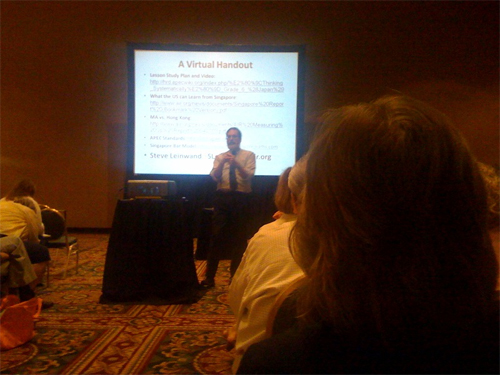
Note the “virtual handout” solution from Leinwand:

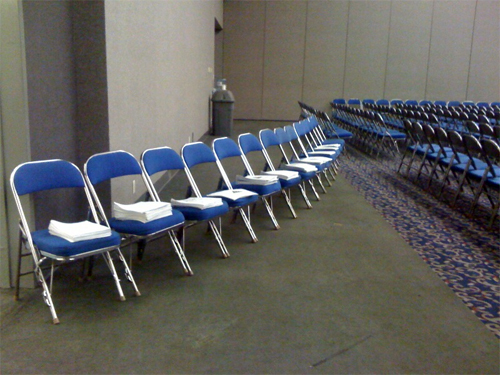
And the paper-chair-piles from Becker:

So I created a quick tutorial introducing them to urli.st. Is there a contribution you can make to this conference pre-session?

CMC-North: Session Line-Up!

[BTW: Owing to a death in my family, I had to cancel my participation in CMC-North this year.]

CMC-North a/k/a Asilomar is on us and my expectations are impossibly high. I’m not heavy into conference-going so take this for what it’s worth but CMC-North is my favorite meet-up of educators all year.

Here’s where I’ll be Friday through Sunday. If you’re going, drop a line in the comments. If you spot an omission in my schedule, drop a line in the comments. The indented bullets reflect a back-up session in case my primary turns into a snooze or a pitch for Scientology or something.

Friday

Lucy West, Academic Discourse It Ain’t Just for Kids โ€“ Keynote

Saturday

Ed Zaccaro, 5 Real-Life Math Investigations That Will Astound Students
Michael Fenton, Imagine: Wikipedia for Mathematics Assessment Questions

Dan Meyer, Math Curriculum Makeover
Steven Leinwand, Glimpses of Instructional Excellence

Phil Daro, Common Core Standards: What is the Difference?
Marty Bonsangue, Surprising Problems for Those Not Easily Surprised

Sheldon Erickson, Conceptual Algebra: Teach More, Better, Faster
Harold Jacobs, Mathematical Snapshots of 2010

Michael Serra, Investigations in Geometry for 2010

Various, incl. yrs trly, Ignite

Sunday

Jo Boaler, The Psychological Prisons From Which They Never Escape? How School Mathematics Shapes Children’s Lives. (Keynote)

And, yeah, I can’t freaking believe they counter-programmed me against Steve Leinwand, who has never disappointed whenever he’s turned up on my conference schedule. If you’re flipping a coin between the two of us, watch this and pick Steve. On the off chance I start boring myself, I’ll see you there.

[PS] Check For Understanding

Jason Dyer passed me Richard Feynman’s essay, Judging Books by Their Covers, via email.

Which of the two parts of our working definition of pseudocontext does it exemplify? Justify your answer.

[BTW: I’d say this exemplifies both definitions nicely. I’ve highlighted the passages.]

Anyhow, I’m looking at all these books, all these books, and none of them has said anything about using arithmetic in science. If there are any examples on the use of arithmetic at all (most of the time it’s this abstract new modern nonsense), they are about things like buying stamps.

Finally I come to a book that says, “Mathematics is used in science in many ways. We will give you an example from astronomy, which is the science of stars.” I turn the page, and it says, “Red stars have a temperature of four thousand degrees, yellow stars have a temperature of five thousand degrees . . .” — so far, so good. It continues: “Green stars have a temperature of seven thousand degrees, blue stars have a temperature of ten thousand degrees, and violet stars have a temperature of . . . (some big number).” There are no green or violet stars [def’n #1 – dm], but the figures for the others are roughly correct. It’s vaguely right — but already, trouble! That’s the way everything was: Everything was written by somebody who didn’t know what the hell he was talking about, so it was a little bit wrong, always! And how we are going to teach well by using books written by people who don’t quite understand what they’re talking about, I cannot understand. I don’t know why, but the books are lousy; UNIVERSALLY LOUSY!

Anyway, I’m happy with this book, because it’s the first example of applying arithmetic to science. I’m a bit unhappy when I read about the stars’ temperatures, but I’m not very unhappy because it’s more or less right — it’s just an example of error. Then comes the list of problems. It says, “John and his father go out to look at the stars. John sees two blue stars and a red star. His father sees a green star, a violet star, and two yellow stars. What is the total temperature of the stars seen by John and his father?” — and I would explode in horror.

My wife would talk about the volcano downstairs. That’s only an example: it was perpetually like that. Perpetual absurdity! There’s no purpose whatsoever in adding the temperature of two stars. Nobody ever does that [def’n #2 – dm] except, maybe, to then take the average temperature of the stars, but not to find out the total temperature of all the stars! It was awful! All it was was a game to get you to add, and they didn’t understand what they were talking about. It was like reading sentences with a few typographical errors, and then suddenly a whole sentence is written backwards. The mathematics was like that. Just hopeless!

Toaster Regression, Ctd.

Okay, so if you let the toaster cool down in between rounds, it is (more or less) linear. (Contra Dave’s experiment.)

Meyer โ€“ Toaster Regression from Dan Meyer on Vimeo.

Here, also, is an array of toast:

Try this:

  1. Equalize the white balance on the toast photos,
  2. Desaturate them,
  3. Blur the heck out of the images,
  4. Sample the center point of each slice, and then
  5. Check the brightness value.

You get, well, rather uninteresting results. Had to scratch that itch, though.