Year: 2010

Total 151 Posts

Multimedia Inoculates Pseudocontext, Ctd.

Here’s what I’m trying to say. It’s easy enough to write the following pseudocontextual problem:

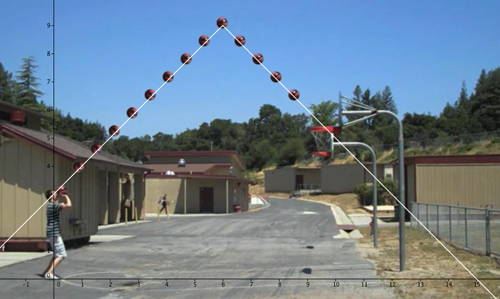
Dan shot a basketball from the three-point line. The ball followed the path given by the equation:

.

How many units high will the ball be at its highest point?

Try to commit that pseudocontext to a photo, though. It isn’t impossible, but it’s much, much harder.

That’s all I meant. Not that I think Star Wars is real.

Multimedia Inoculates Pseudocontext

I owe Brian Caine a debt of gratitude for flipping my switch on the question of “what is multimedia doing for us, anyway?

Multimedia makes it really, really hard to lie.

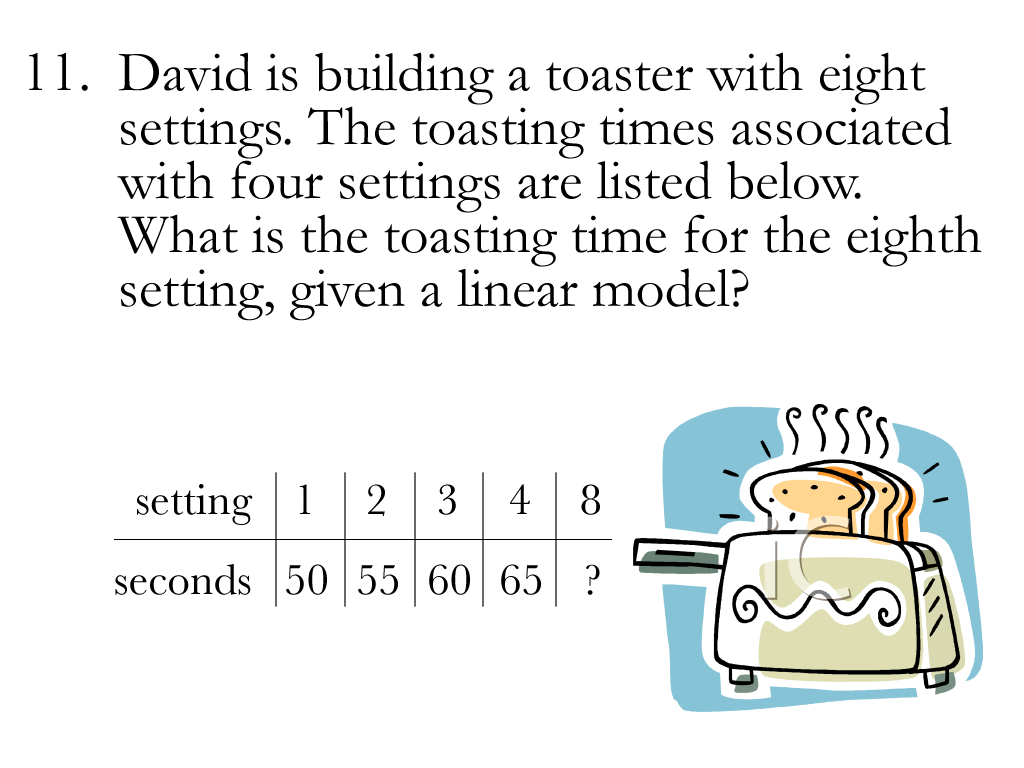
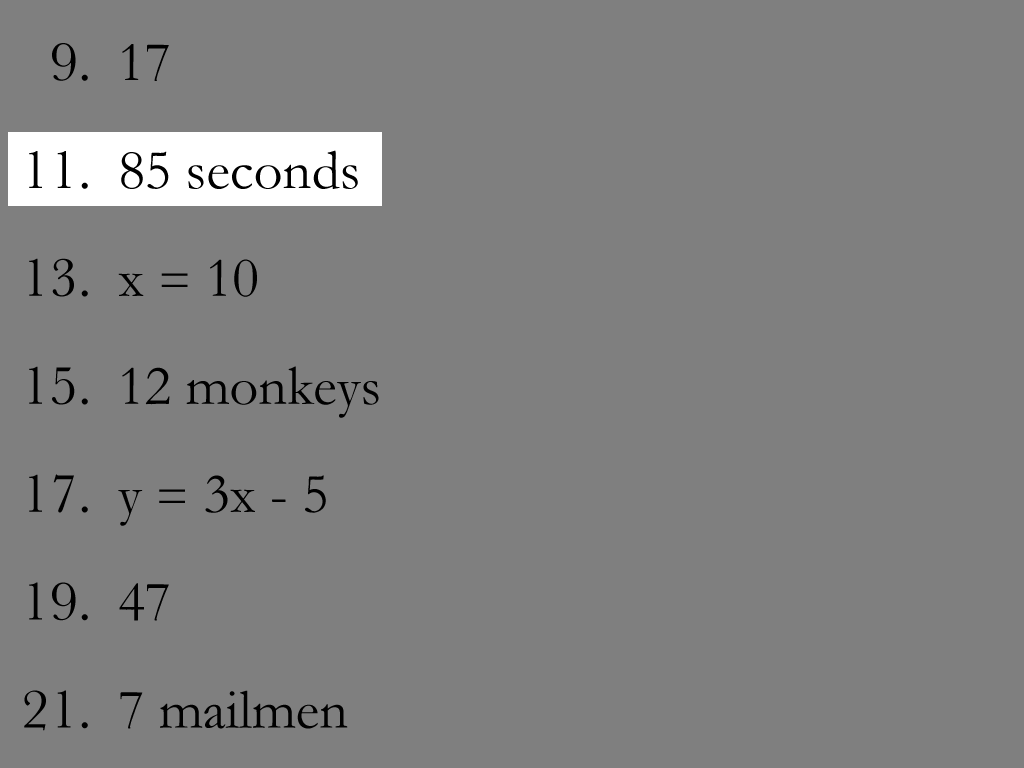
Witness David Cox’s toaster regression. It doesn’t work. We thought it was linear. It isn’t. It isn’t worthless for classroom inquiry. Maybe it’s exponential. But the linear model is a dead end.

If you’re writing the problem in a textbook, though, it isn’t a dead end. You grab some clip art of a toaster. You create a table with values that are linear because who’s going to stop you? Even though the real context isn’t linear, you’re the god of your textbook’s pseudocontext.

Then you fabricate a conclusion that supports the pseudocontext.

For whatever other good it does for problem posing, multimedia keeps you honest. How do you (easily) film pseudocontext? How do you take a picture of a premise that is false? Even harder, how do you take a picture of the conclusion of that false premise in a way that doesn’t belie the premise itself?

[PS] Swedish Yoghurt

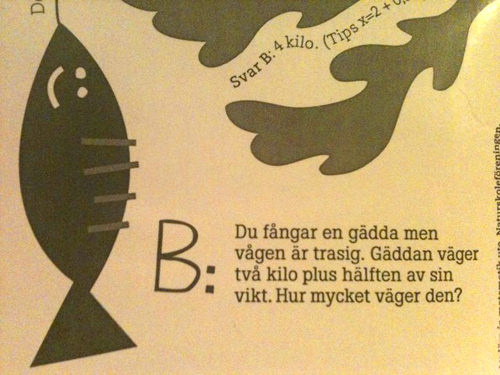
Arla, a Swedish yogurt producer.

Translation:

You catch a pike but the scales are broken. The pike weighs two kilograms plus half its weight. How much does it weigh?

Pseudocontext

At this point I’m comfortable with two definitions of pseudocontext:

  1. context that is flatly untrue: “a basketball team scores two points every minute for the duration of the game.”
  2. operations that have nothing to do with the given context: “the age of Mark’s dad is three more than four times Mark’s age.”

We’ve worked hard for those two categories. We’ve digested some really untasty mathematics in their development. They indicate problems that aren’t just boring or irritating but problems that are actually alienating, problems that disrupt a student’s innate and true sense of the world.

Pseudocontext Saturdays will run their course eventually. For now, though, the intellectual challenge of identifying different levels of badness (and, in many cases, redeeming it) is too invigorating to give them up. Those of you who have invested time and effort on these features in the comments and in your submissions โ€“ thanks.

Assignment:

  1. Scan an example of pseudocontext.
  2. Email it to dan@mrmeyer.com
  3. List the textbook title, edition, and publisher.
  4. Give me your interpretation of the term “pseudocontext.”
  5. Let me know if you’d like credit (name, blog or twitter) or if you’d prefer anonymity.

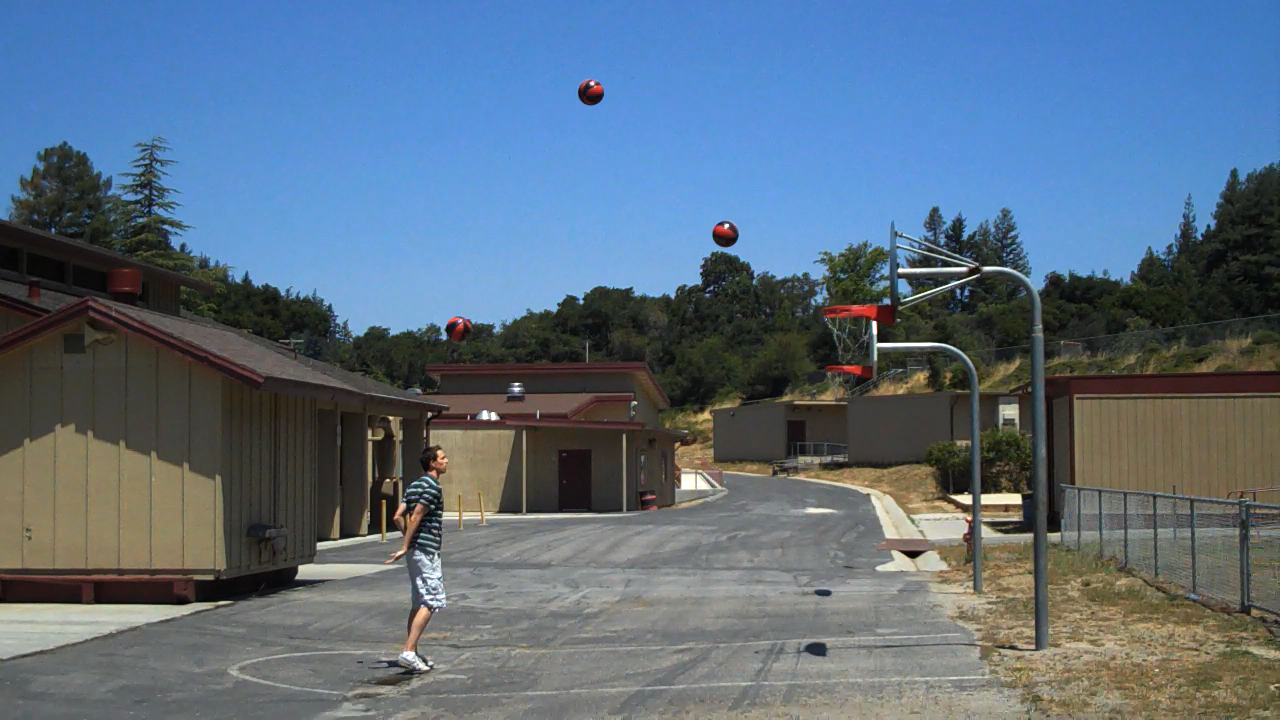
[HOWTO] Projectile Motion Strobe Effect

I had a few requests for a tutorial for this treatment. Here goes. Also, a text summary after the jump.

Projectile Motion Strobe Effect from Dan Meyer on Vimeo.

1. Record video from a stationary source. Like a Flip cam on a tripod, for instance.

2. Trim the video to one shot.

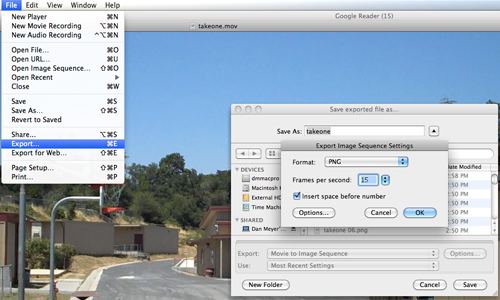
3. Export that clip to an image sequence. 15 frames per second gets you pretty clean motion.

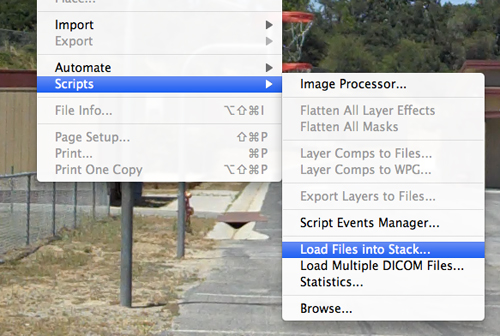
4. Load those images into a stack in Photoshop.

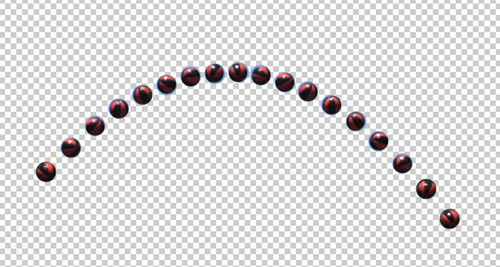
5. Mask off the basketballs. (It’s tough for me to explain this step without video.)

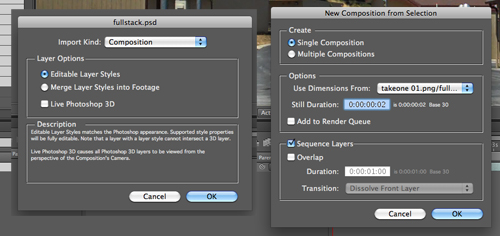
6. Import all these resources into Adobe AfterEffects.

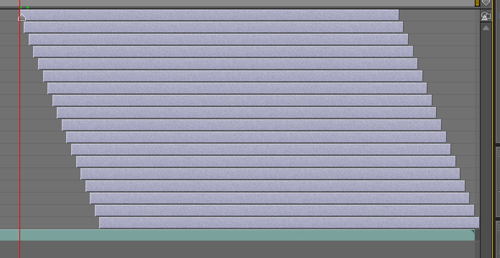
7. Extend the masked basketball layers to the end of the composition. Otherwise they won’t hover in mid-air. They’ll just disappear after two frames.

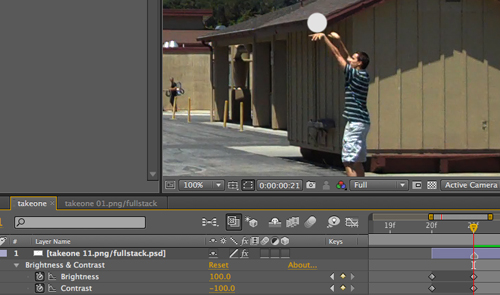
8. Keyframe the brightness of each basketball layer to give yourself one frame of pure white at the start of each layer.

2013 Mar 18. Chris McCaffrey offers a less expensive method for creating the images (if not the video also).

[WCYDWT] Will It Hit The Hoop?

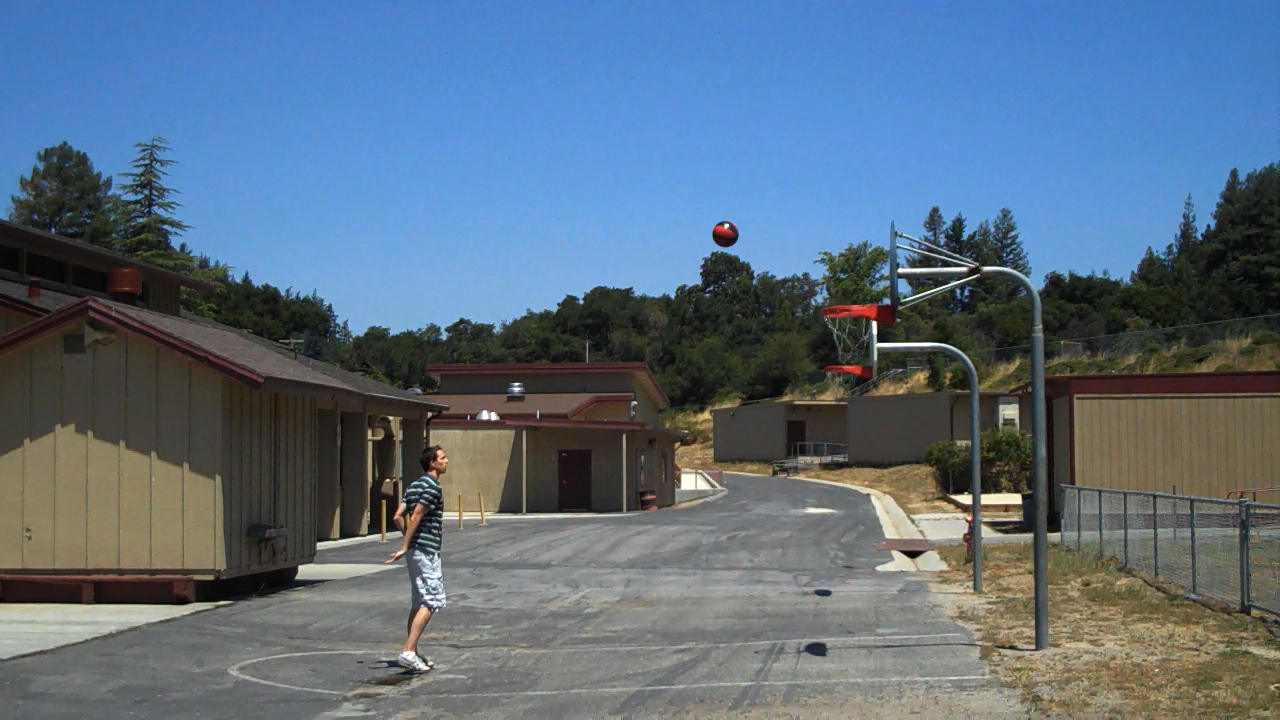
Is he going to make it? Can you draw me the path of a shot that will make it? That will miss it?

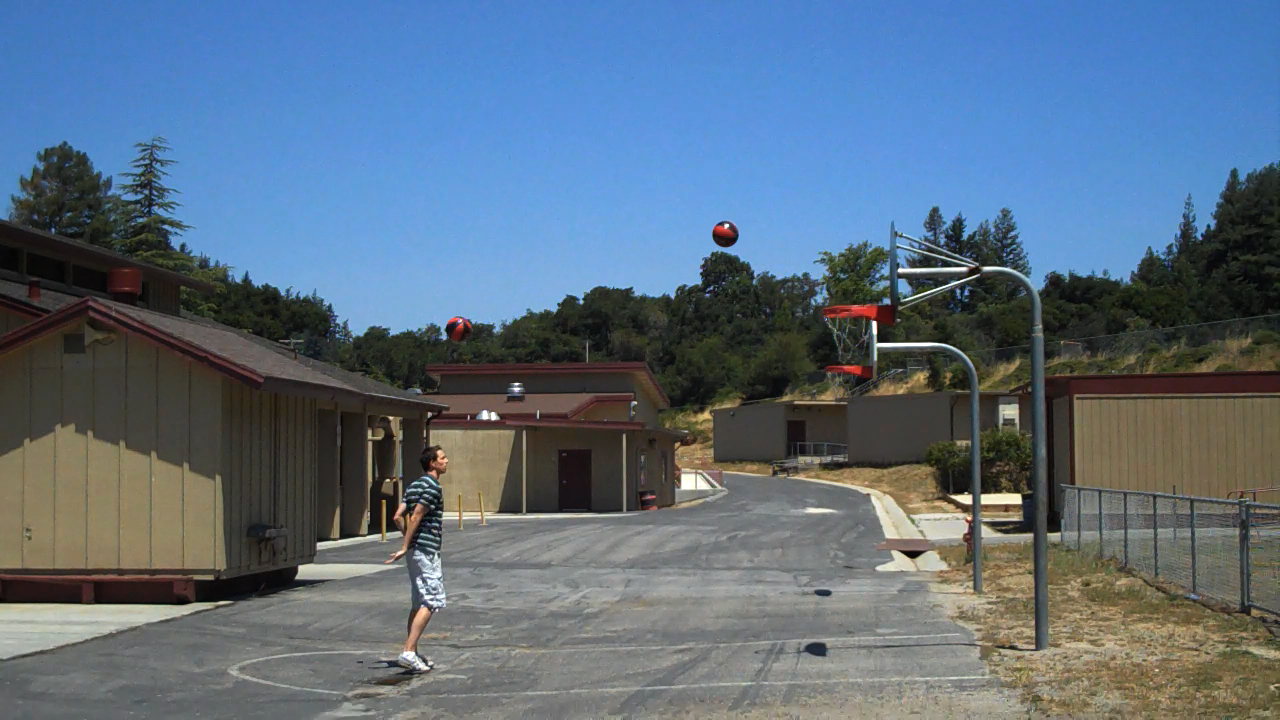
How about now? Can you draw me the path of a shot that will make it? That will miss it?

How about now? Can you draw me the path of a shot that will make it? That will miss it?

A little more obvious, isn’t it? And like that, we’ve derived illustrated the fact that, while one point is enough to define a point, and while two points are enough to define a line, you need three points to define a parabola.

Basketball Strobes โ€“ Full Take 4 from Dan Meyer on Vimeo.

Here are seven versions of the same problem. Each one contains:

  1. the half video, for asking the question,
  2. the half photo, for giving the students something to work with,
  3. the geogebra file, one use for the half photo, featuring a dynamic parabola in vertex form.
  4. the full video, for showing the answer,

Attachments