Month: January 2011

Total 18 Posts

[PS] Pseudorejects

These are submissions I received that didn’t seem to fit the criteria. This isn’t to say they’re great problems. This isn’t to say that I’d throw water on any of these problems if they were on fire. This isn’t to say that they’ve even represented or examined their context well, just that the context itself isn’t pseudocontext.


Breedeen Murray

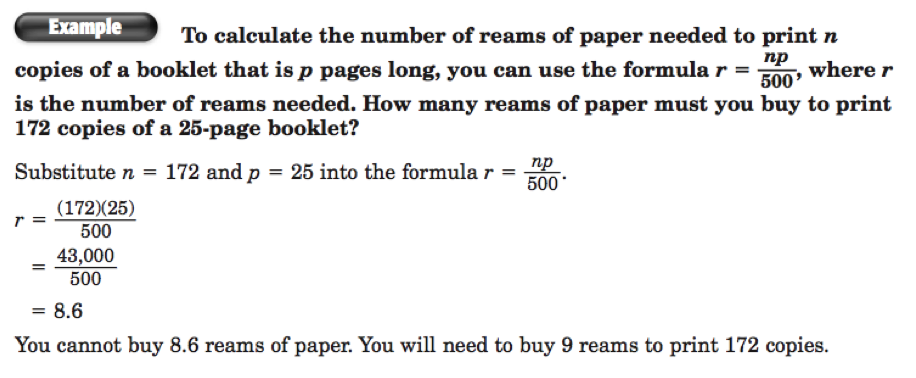
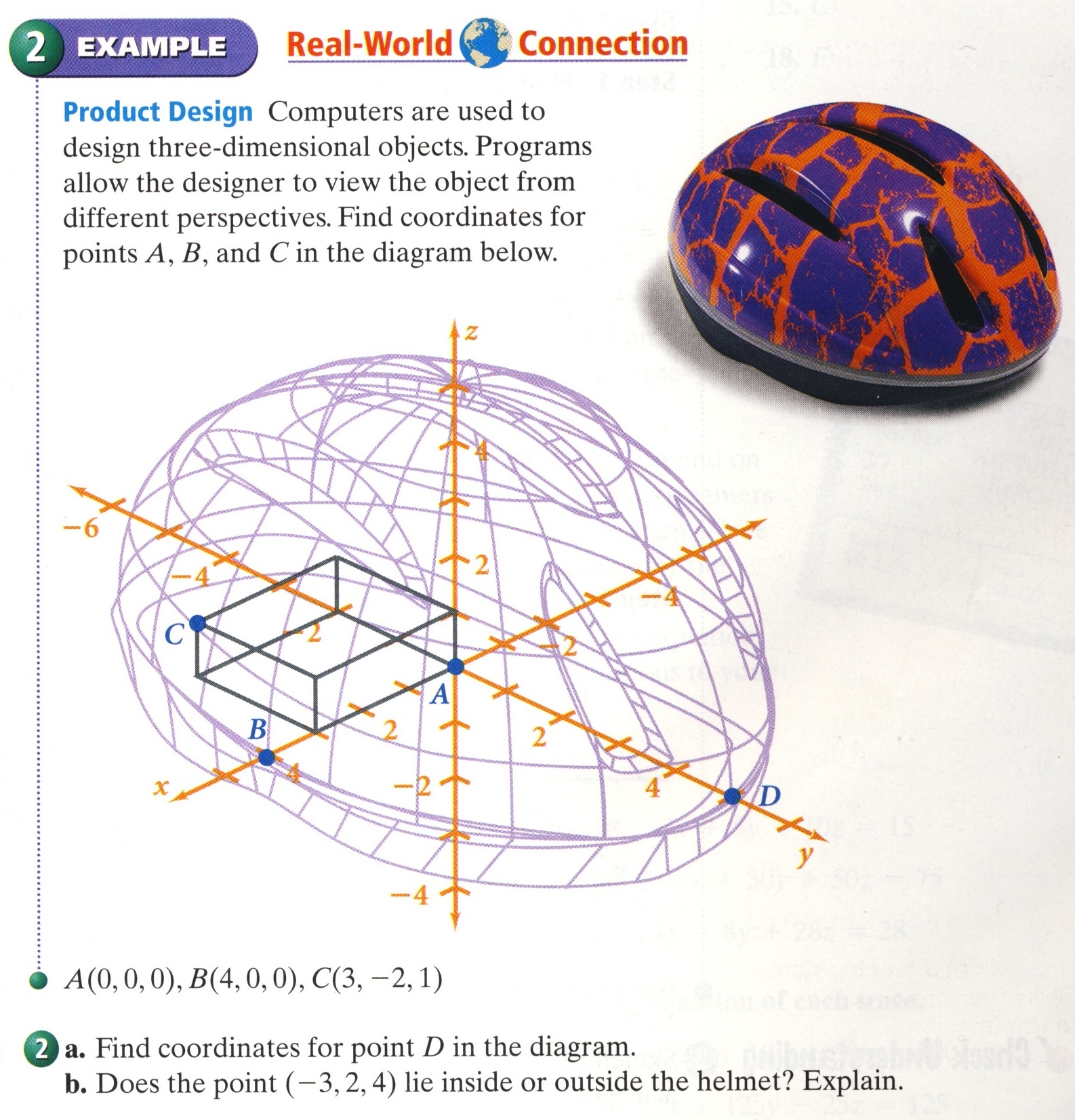
McDougal Litell’s Math Course 1:


Barbara Panther

McGraw-Hill’s Total Math – Grade 6:

Bill goes to a farm and sees cows and chickens. He counts 6 heads and 18 legs. How many of each animal does he see?


Melissa Griffin

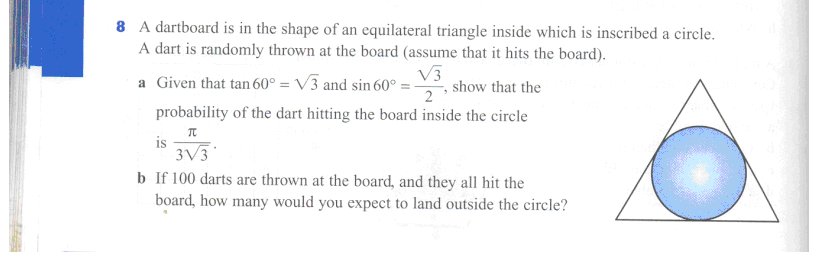
Haese and Harris Mathematics for the International Student.:


Jeff Bowlby

McGraw-Hill’s Algebra 1:


Phil Aldridge

EdExcel International’s Longman Mathematics for IGCSE Book 1:


Iain Mackenzie

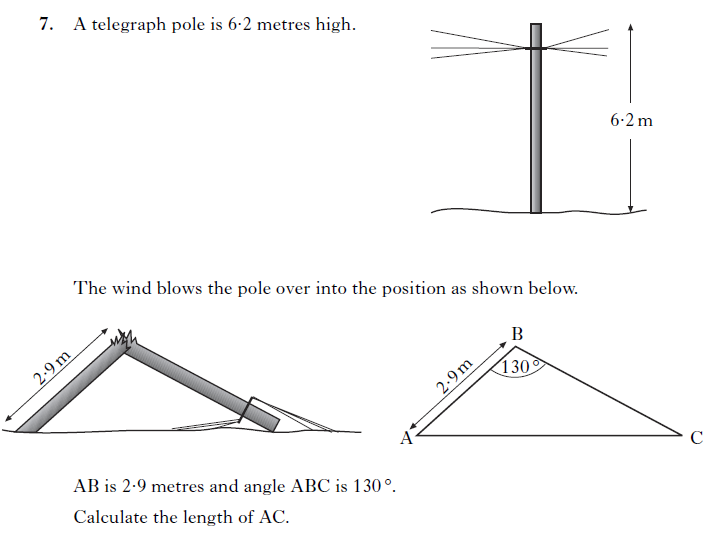
Scotland National Examination:


Christine Lenghaus

Australian Year 12 Exam:


Amulya Iyer

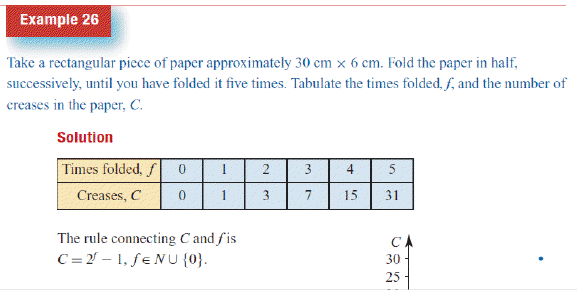
Pearson’s Algebra 2:


Steve Bullock

Unknown:


Fall Quarter Wrap-Up / Winter Quarter Kick-Off

Brief Encapsulating Remarks

  1. Academic writing is hard, especially if you’ve grown accustomed for the last five years to posting whatever random 450 words pass through your head at a given moment. Writing even something as basic as a literature review was like trying to run a marathon on sixteen tabs of Benadryl.
  2. Too many units. Someone on the welcome weekend panel โ€“ none of us can remember who it was โ€“ told us all to max out our units. Never again.
  3. Blogiversity. I was talking to Jo Boaler last night (name drop!) and she admitted she didn’t really get the whole blogging thing. I said I didn’t really get the whole peer-reviewed journal thing. Then I recommended blogging in two ways. First, I showed her the time I asked you to help me identify a core practice of teaching and you came through with 100 (mostly) measured responses. Second, I showed her our ongoing soon-to-end-I-swear investigation of pseudocontext. I’m sure it would’ve taken me many months more to come up with my working definition of pseudocontext had you all not come through with so many examples.

Current Coursework

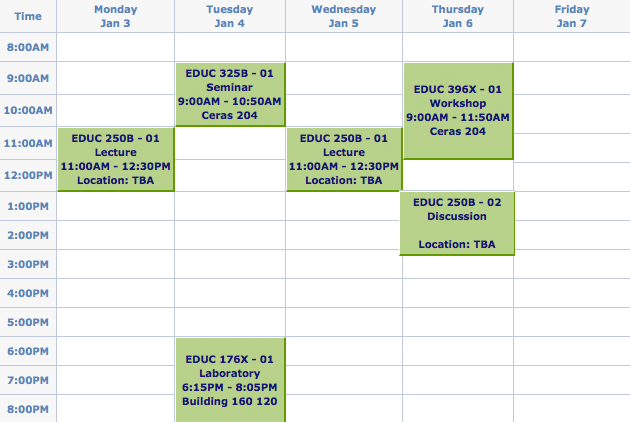
I’m putting in the minimum this quarter, units-wise:

  • EDUC250B – Statistical Methods in Education. Eric Bettinger. Required.
  • EDUC325B – Proseminar. Hilda Borko, Brigid Barron. Required.
  • EDUC396X/176X – Casual Learning Technologies. Shelley Goldman. With an emphasis on iPhone apps in education. This one’s candy. Here’s the syllabus.

Fall Quarter #GradSkool Tweets

Favorite Papers

These are the ones I gave my highest rating in my aggregator.

Winter Speaking & Workshops

[Help Wanted] Seattle Qwest Stadium Beer Cups

Are any of my readers headed to Seattle’s Qwest Stadium anytime soon? If you are, see if you can score a small and a tall beer cup and take them home. If you’re game, I need three photos:

  1. the menu with beer prices visible.
  2. both cups side-by-side on a counter.
  3. both cups side-by-side on a counter with a centimeter ruler in the same visual plane.

And, yeah, my request ticket has everything to do with this fantastic clip:

[h/t @mcjhn]

[BTW: Bummer. Qwest has already pulled my math unit. Gotta admire their spin, though. “We weren’t ripping off the tall-cup customers. We were giving the short-cup customers a bonus!”]

[PS] Operations That Have Nothing To Do With The Given Context

Here are three problems that satisfy the second half of the working definition of pseudocontext. I cop to a lot of guilt at the end of this post.


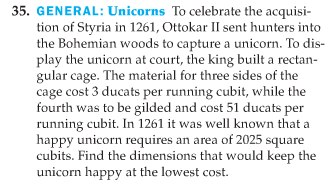
@sophgermain

Prentice Hall’s California Mathematics โ€“ Pre-Algebra:


Kevin Krenz

McGraw-Hill’s Mathematics: Applications and Concepts, Course 3:


Wing Mui

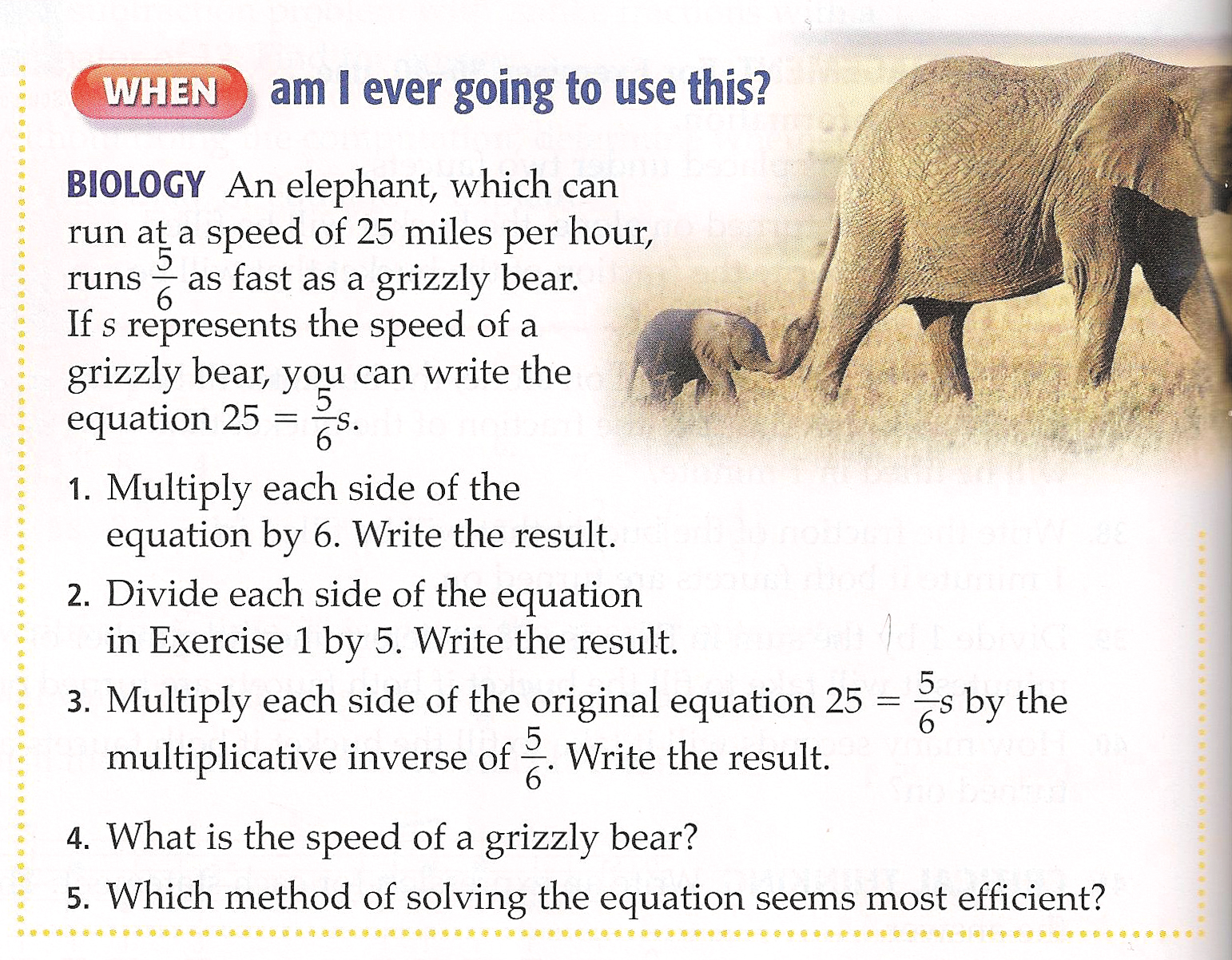
McGraw-Hill’s Algebra 1:

Can you spot the common problem?

The author has fit an equation to a context that doesn’t want or need it. Does anybody think the elephant/grizzly problem would be any less engaging if we just described “a mystery number, five sixths of which is 25?”

And I’m guilty. When it comes to systems of equations, I shake a handful of coins and ask students to write down how many coins they think they hear. We trade guesses and I tell them “40 coins.” The best guesser gets some love from the class. Then I ask them to tell me how much cash they think I have in my hands. They ask me for the denominations of the coins. (“Nickels and dimes.”) We trade guesses again, reveal the answer again (“$2.75”), and congratulate the winner again. Then I ask them if they think there’s more nickels or dimes and why. Then we figure out the answer exactly, first by guess-and-check, then by systems of equations as I introduce an unmanageable number of coins. Then I confirm the answer visually.

But seriously: nothing inherent to a handful of nickels and dimes would lead a student to formulate and solve this system of equations.

n + d = 40
5n + 10d = 275

Nothing. Our arrival at that system of equations was painless only on account of a lot of coy teacherly showmanship. Does that theatricality โ€“ the shaking coins, the cocked eyebrow, the dramatic pause before the question, none of which is included in the problem as written in the textbook โ€“ inoculate the pseudocontext? Am I absolved if I don’t pretend this is (as elephant/grizzly puts it) “when you’re going to use this?” I’m not sure. I’m only sure that implicit in my use of pseudocontext here, whether I’ve inoculated it or not, is the admission that I’m empty-handed when it comes to a real context for systems of equations. I’m admitting that we only use this stuff in silly games.

[It Got Away] Ladder Spreaders

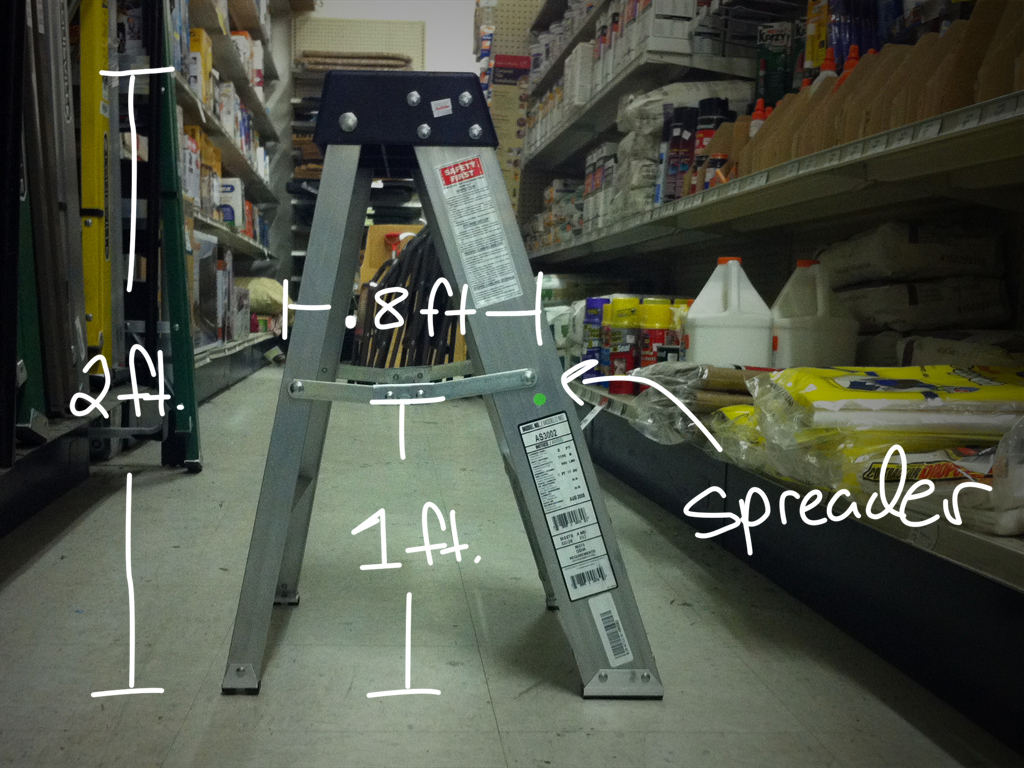
So I’m looking at this ladder and I’m wondering why they positioned the spreader at that exact height off the base and at that exact length.

I know that OSHA and ANSI each have lengthy manuals governing every dimension of a ladder. I figure there must be some kind of specification for those spreaders, something involving angles, geometry, maybe some trig if I’m lucky.

Maybe I’ll ask the students where they’d find the spreader on a 15-foot tall ladder and at what length. Then I’ll go find a 15-foot ladder and photograph it to verify their answer.

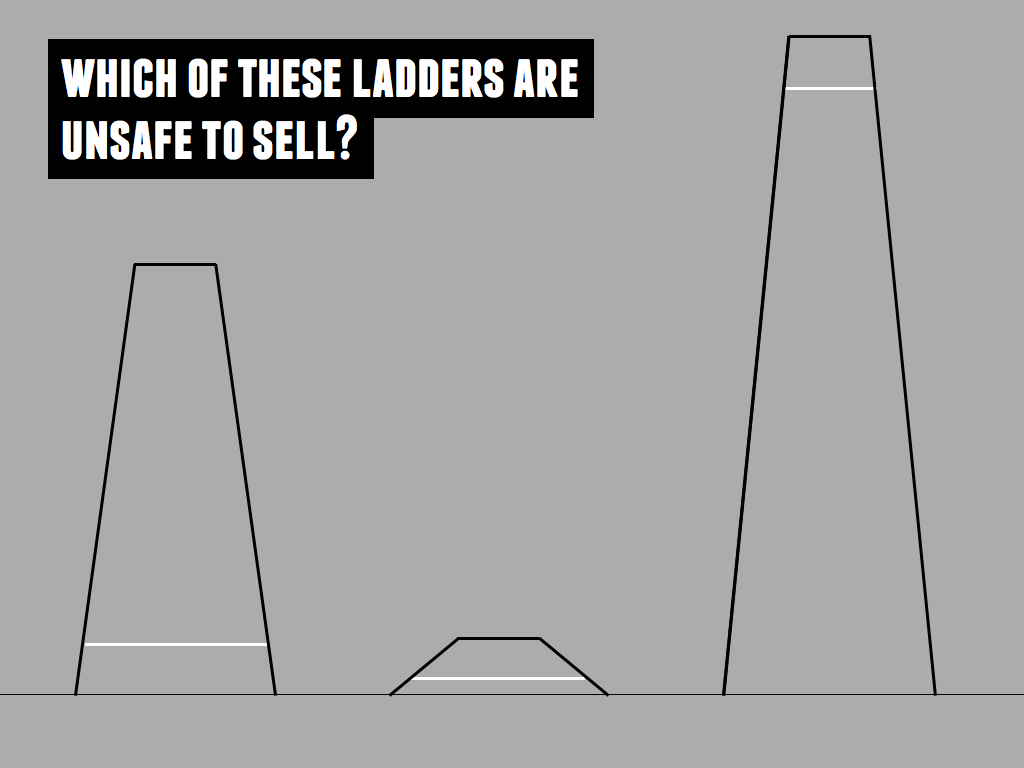
Or maybe we’ll develop an algorithm together, converting our intuitive sense that this ladder isn’t safe into a formula for the safe construction and placement of a spreader.

It Got Away

So I check the OSHA manual for stairways and ladders. Nothing on spreaders. Then I call Werner Ladder Co. to see if they have some kind of internal specification on the spreaders. Two days later, an engineer calls back to tell me that, nah, the spreaders are pretty much irrelevant to safe ladder usage. They only exist, this guy tells me, to guide the sides of the ladder to a specific location, at which point your body weight โ€“ not the spreader โ€“ keeps the ladder’s position fixed.