I was working with Wisconsin’s math teachers this afternoon, making the case that good storytelling is a first cousin to good math instruction. I challenged them at the end:
Give yourself one photo or one minute of video to tell a mathematical story so perplexing that all of your students will want to know the ending, without you saying a word or lifting a finger.
I’m talking about photos and video that provoke a vast majority of your class to wonder the same question without any explicit prompting. For instance, minutes before the presentation began, I tweeted:
Dear Twitter: what’s the first question that comes to mind? http://vimeo.com/23242866 #anyqs
[anyq] Stacking Dolls from Dan Meyer on Vimeo.
In the last minutes of my presentation – nervous as hell – I showed the group my Twitter feed. Here’s what we saw:
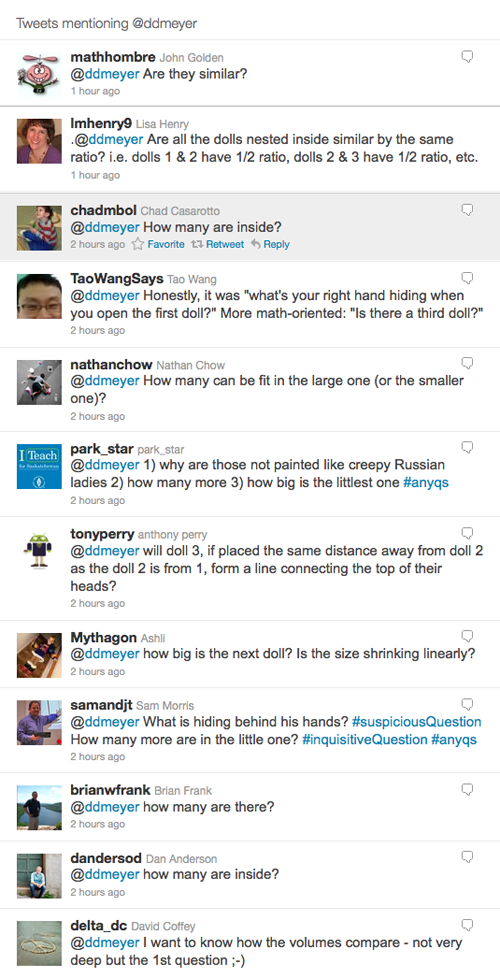
This kind of user feedback is invaluable. The results are mixed. There is a degree of consensus around one question but I still may head back to the drawing board to reshoot the problem in a way that makes “How many are there?” the most natural, perplexing question to ask.
So I’m pitching the same challenge to you. I have my hawk eyes on the #anyqs hashtag and I can promise you’ll get a question from me, at the very least.
PS:
You know which group of students seriously doesn’t hate it when you pose intriguing mathematical questions without words? English language learners. I know it’s some kind of cliché to say that a picture is worth a thousand words, but seriously: the more scene-setting you can embed in a photo or video the better for everybody.
PPS:
Consider how bizarre the #anyqs challenge would appear to your textbook’s publisher. They work in a world where it’s totally normal to take some cheap clip art or stock photography and ask a question about it that would occur naturally to nobody else in the world. I’m challenging you to flip every aspect of that around.
2011 Dec 01. Essential follow-up reading. Don’t try to get your students to guess the question in your head.