Year: 2011

Total 140 Posts

[WCYDWT] Obama Botches SOTU Infographic, Stock Market Reels

Sorry to be all post-y today but reader Ryan Bavetta sent in a hot tip and I had to jump on it before Drudge did. Here’s Obama delivering his State of the Union address. Ryan says, “I don’t think they got the sizes of the circles right.”
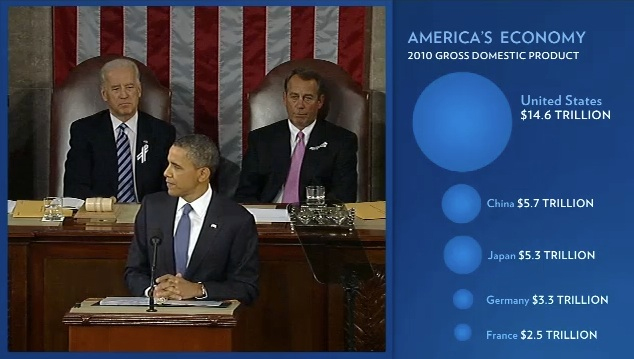
So I go all Woodward and Bernstein with my compass and protractor. I measure off the diameters.
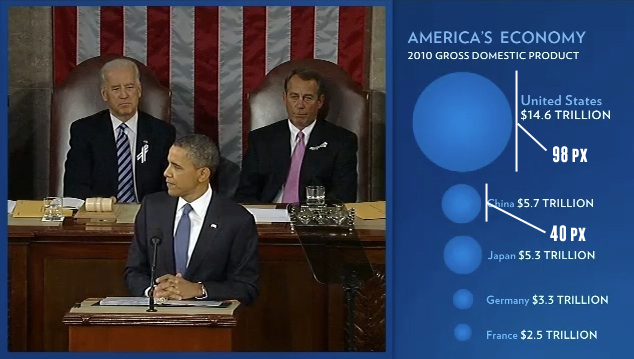
The ratio of the diameters is 2.45, which means the ratio of the areas is going to be (2.45)^2 or 6.00. But the ratio of America’s GDP to China’s GDP (14.6T/5.7T) is only 2.56! The US circle is too big! What’s the progressive propaganda machine trying to sell us here?!

Here’s how it should have looked:
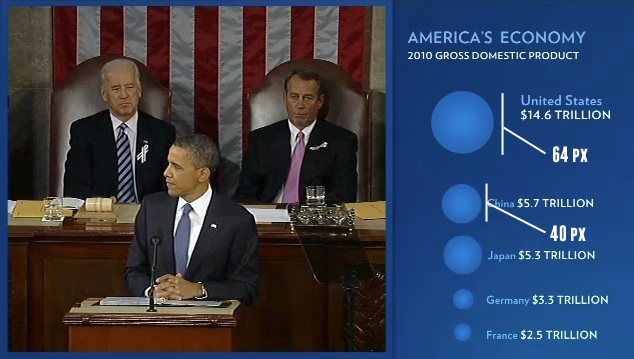
For Classroom Use

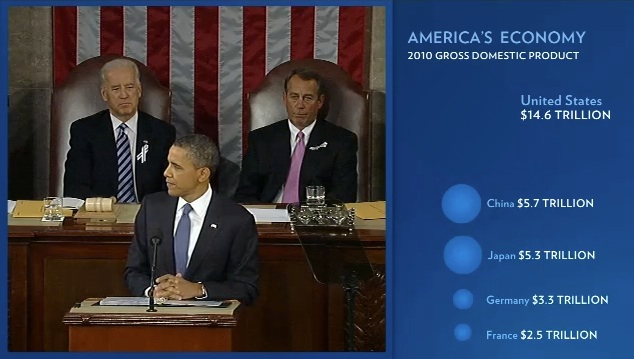
I think you have to get rid of one of the quantities, ask the students to determine it, show them the full SOTU screenshot, and then encourage them to marvel at the difference. You can give them Obama’s circle and ask them to tell you what that should make the GDP.
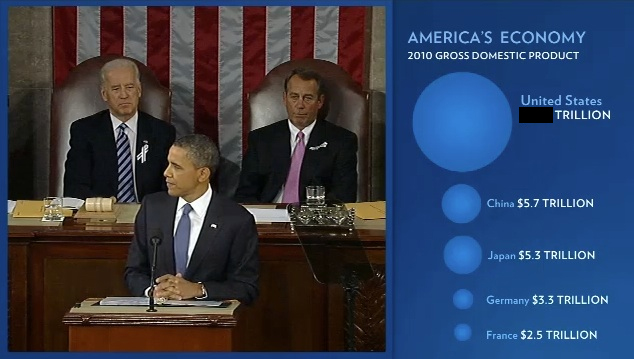
Or you can give them the GDP and ask what that should make the circle.
I don’t know how to get excited about the difference when Jon Stewart’s probably trying to call my booking agent right now.

The Goods

The problem archive, including:

  1. the original image,
  2. the image without the GDP,
  3. the image without the circle,
  4. video from the speech itself,
  5. an extension problem.

2011 Feb 16: Updated to add higher-resolution images, video from the speech itself, and an extension problem.

Also: I Need To Get A Collection Of These Going

Reject The Premise

BetterLesson:

Because documents are the building blocks of a good lesson, we’ve recently made them more prominent on the lesson page.

I’m dumbfounded by the premise. I read and re-read the post and I trip over the first ten words every time. BetterLesson asserts the superiority of worksheets like it’s a matter of fact and not up for debate. Even within that debate, I’m not sure I’d put worksheets inside the top ten sturdiest building blocks of a good lesson. Ahead of Wordle, maybe, but definitely behind a can of Play-Doh.

But that’s what’s most interesting to me watching BetterLesson and Edufy sort themselves out. A pedagogical decision hides behind every design decision. When they nudge the worksheets section to the top of the page, they are making an assertion about what they think teaching is. When they ask you to create a course and then a unit and then a lesson, they are making an assertion about the best organization of learning.

Nat Torkington said, “The secret sauce to social software is the invisible walls that steer people towards productive behaviour.” You get what you make easy.

So if worksheets aren’t the building blocks of a good lesson, what is? And, more to the point, is it possible to design a user experience online that promotes it, that makes good pedagogy the easiest, most natural thing to share on your site?

[WCYDWT] Orbeez

I’m really grateful for the deep bench I have on this blog, the readers who take the time to share with me the mathematical objects that intrigue them. Adam Poetzel, secondary math ed prof at the University of Illinois, sent along Orbeez, which is pretty aptly described by this commercial:

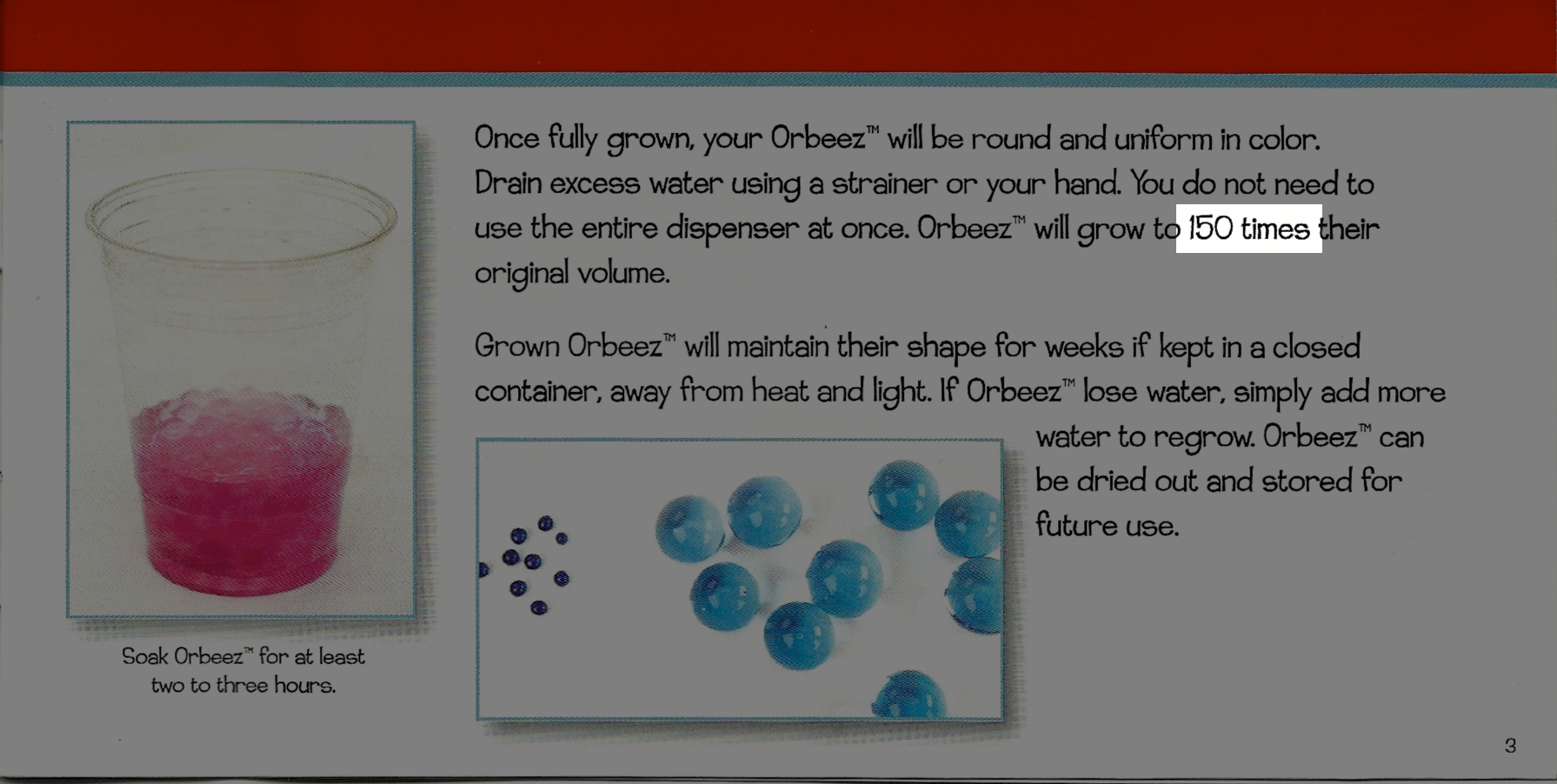
Basically, small things that grow big in water. The Orbeez website puts the volume increase at a factor of 100 while the instructional manual puts it at 150. Controversy! Which is right? Or are they both wrong?


I went to Toys R Us and bought a starter pack for $8.00.

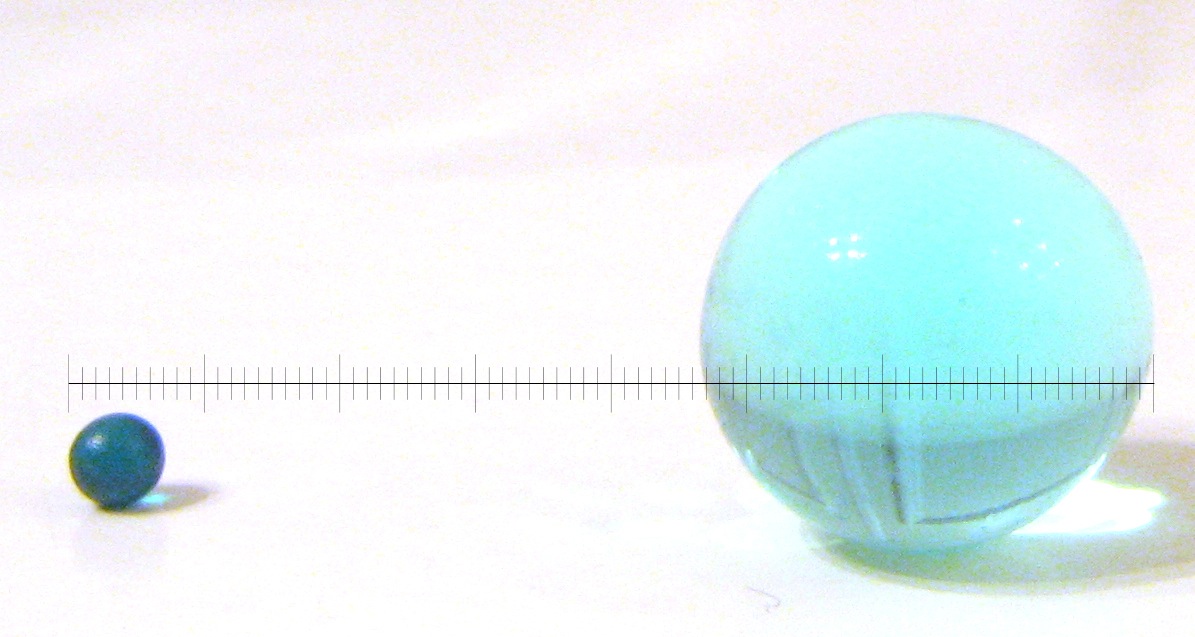
I dunked ’em for a few hours and got this:

A few ideas here. Start informally. Move from the concrete to the abstract. The informal question is, “how many times bigger is it, really?” Ask the students to write down guesses. Write a few up on the board. Perhaps print that photo out and have them draw what they think “150 times the volume” would look like. (Am I alone in thinking this looks way way smaller than 150 times bigger?)

Ask them what information they need to answer the question exactly. Put up this photo.

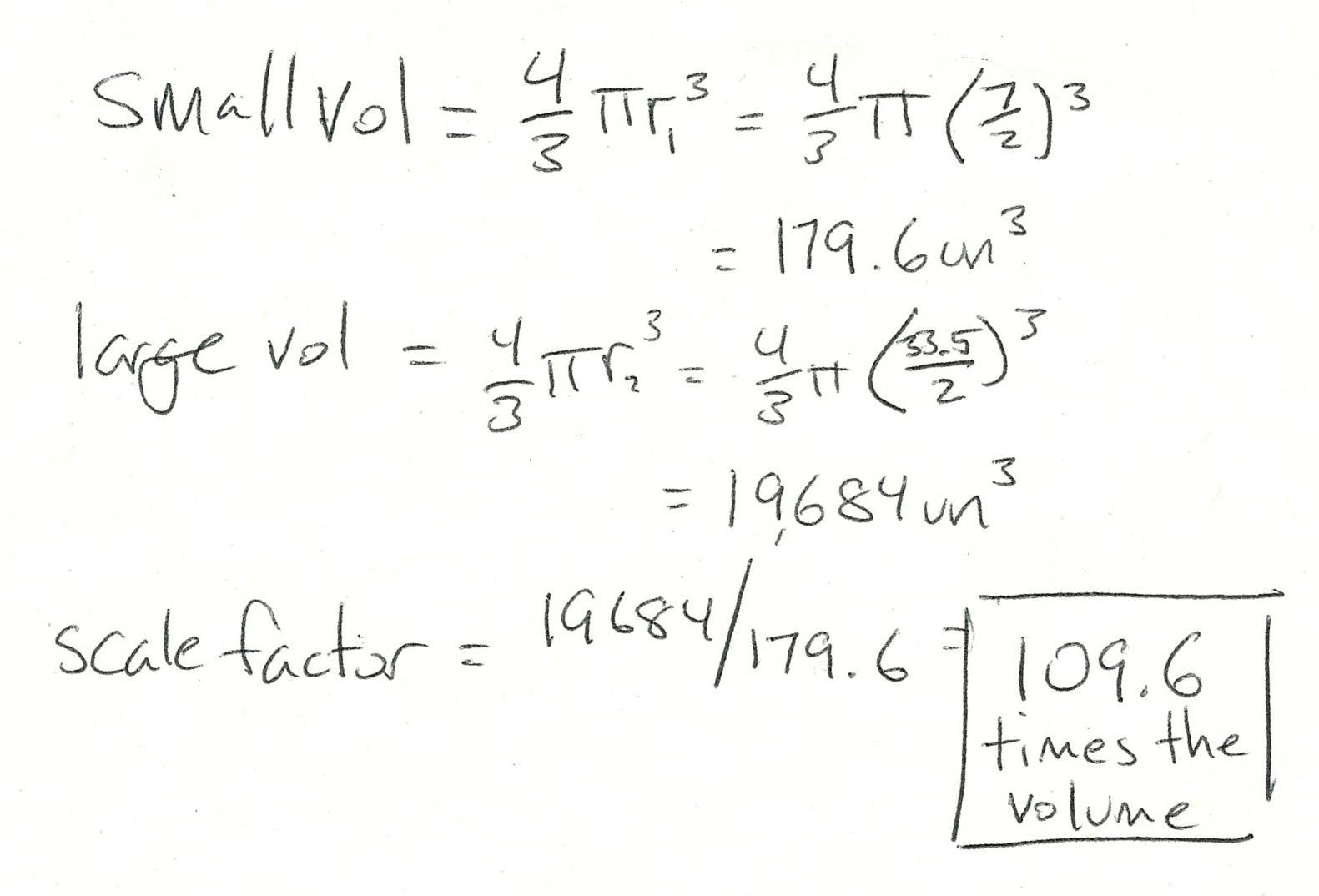
Here’s the math:

Okay, Orbeez, just watch yourself, that’s all I’m saying.

Ideally, you’ll move from the relatively laborious calculation of volume to the relatively simple comparison of the diameters using scale proportions. ie. if the large volume is really 150 times the small, then the large radius has to be at least 150^(1/3) = 5.3 times the small.

The Goods

The problem archive, including:

  1. the commercial,
  2. the manual,
  3. the website screenshot,
  4. before / after photo of Orbeez,
  5. before / after photo of Orbeez with ruler.
  6. Orbeez’ internal expansion measurements (given different water sources) [see this post].

Addendum

This is the rare WCYDWT investigation that would be even better with real stuff rather than all these digital replications of real stuff. Buy some Orbeez off Amazon. Let your students dunk their own Orbeez on day one. Perform the investigation on day two.

2011 Jan 11: Sharon Cohen, the brand manager of Orbeez, stops by to drop some knowledge on us all.

Kate’s Urban Legend

Kate Nowak, on the grand finale of Pseudocontext Saturday:

I realize this is going to sound urban legendy, but I know someone who knows the teacher who wrote this question [..] And, the story goes she wrote this question as a joke. As in, as a lark she wrote something so bad and ridiculous that it would never be used. And then they put it on the exam.

Nope nope nope. No way. Not buying.

[PS] The End

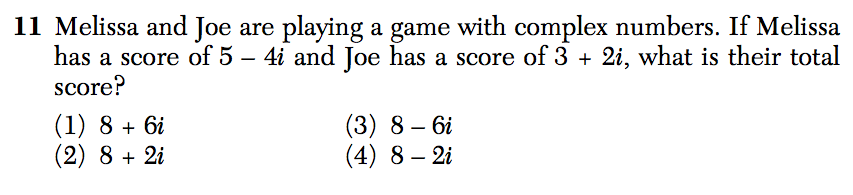
This is completely subjective, but Peter Brouwer sent in the problem that I thought satisfied both halves of the working definition of pseudocontext in the most spectacular fashion. This is it. This is as bad as it gets.

From the June 2001 Math B New York Regents examination [PDF]:

Jo Boaler gets the last word:

Students do however become trained and skillful at engaging in the make-believe of school mathematics questions at exactly the “right” level. They believe what they are told within the confines of the task and do not question its distance from reality. This probably contributes to students’ dichotomous view of situations as requiring either school mathematics or their own methods. Contexts such as the above [pseudocontext], merely perpetuate the mysterious image of school mathematics.

That’s it. Thanks for pitching in.