Year: 2012

Total 137 Posts

I Need A Physics Tutor

I need you to calculate the total time it will take this ceiling fan to come to a stop, and then explain your calculations. I think the keywords are “rotational kinematics” but I’m way out of my depth here. I’ll call this off and post the third act (the answer) when someone gives an answer that’s inside a 10% margin, paired with an explanation. The winner gets the keys to my heart.

Here’s a video that (I hope) will simplify your analysis. [download]

BTW: Let’s get a few guesses in there also. Totally from the gut, informed by experience only. I’m interested to see who gets closer โ€“ the analysts or the guessers.

BTW: Don’t hesitate to get your students in on this also.

BTW: Yes, I already gave this a try but I was undone by the fact that I gave both the first and third act in advance which led to a lot of handwaving and glossy explanation.

2011 Mar 9. Frank Noschese gets inside the 10% envelope. His explanation, screencast, and Python script. Here’s the answer video, also.

[3ACTS] March Tasks

I designed two tasks this month:

Some process notes:

  1. It’s a lot to ask someone to click those links and look at a lesson plan. The reader has to decipher the structure of the plan and decode its particular jargon. (ie. “What language does the author use to indicate the point of the task and where on the page can I find it?”) All of that may be necessary at some point in the plan but I’m trying to do my material a favor by isolating what about it is a) most perplexing, b) most visual, c) least verbal, and opening with that. If twenty seconds of video make you curious how many yellow Starbursts are in that huge pile of candy, you’ll be more inclined to wade through my structure and jargon than if I opened with that structure and jargon.
  2. Math tasks imitate life. I imagine math teachers overestimate how often they practically use math in their daily life. It’s easy to say that “math is everywhere,” because it’s true, but most of that math is performed by computer chips that are embedded in everything from your car to your toaster. So whenever you find yourself wielding math like a saber to cut through one of life’s hassles, pull out a camera and capture that moment. Pose the problem to your students as you experienced it.
  3. More where those came from. I’m slowly building up a spreadsheet that lists all these tasks. Something more organized and visually appealing is somewhere in the works, but this will have to do for now.
  4. Behind the scenes. I can’t imagine who’d be interested in the notes I wrote up as I designed these tasks but here are PDFs for Starbursts and Chocolate Milk, for Future Dan if nobody else.

When You’ll Ever Use Math

A bachelor party on Catalina Island.

We spent the weekend under a system of penalties and proposition bets. It cost you a dollar if you inadvertently said your wife or girlfriend’s name, for instance, while everyone paid you a dollar for a hole-in-one on the mini-golf course.

Then there were the proposition bets you set up on the side of that system.

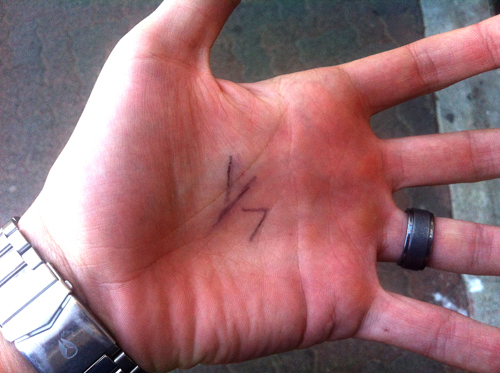
“I have a number written down on my hand,” I said during some downtime. “It’s between 0 and 10. I’ll pay out 11:1 to anybody who can guess it. Who wants that action?”

Zac took me on for a dollar and guessed 5. I took his money.

Expect To See A Lot More Of This

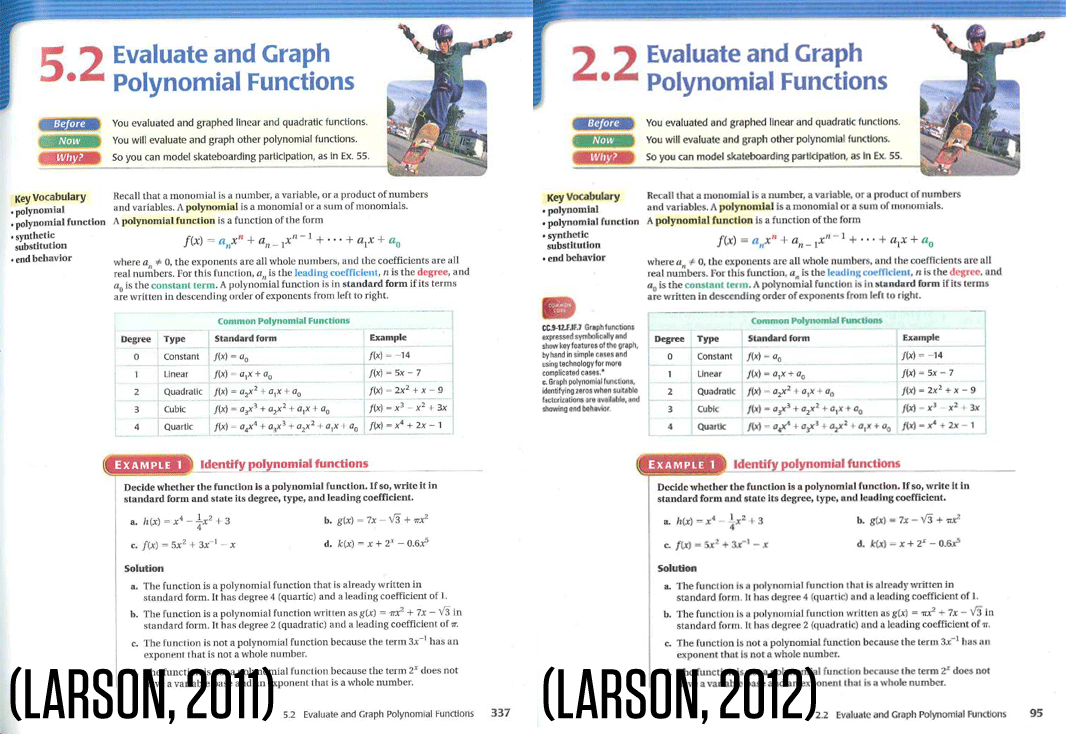
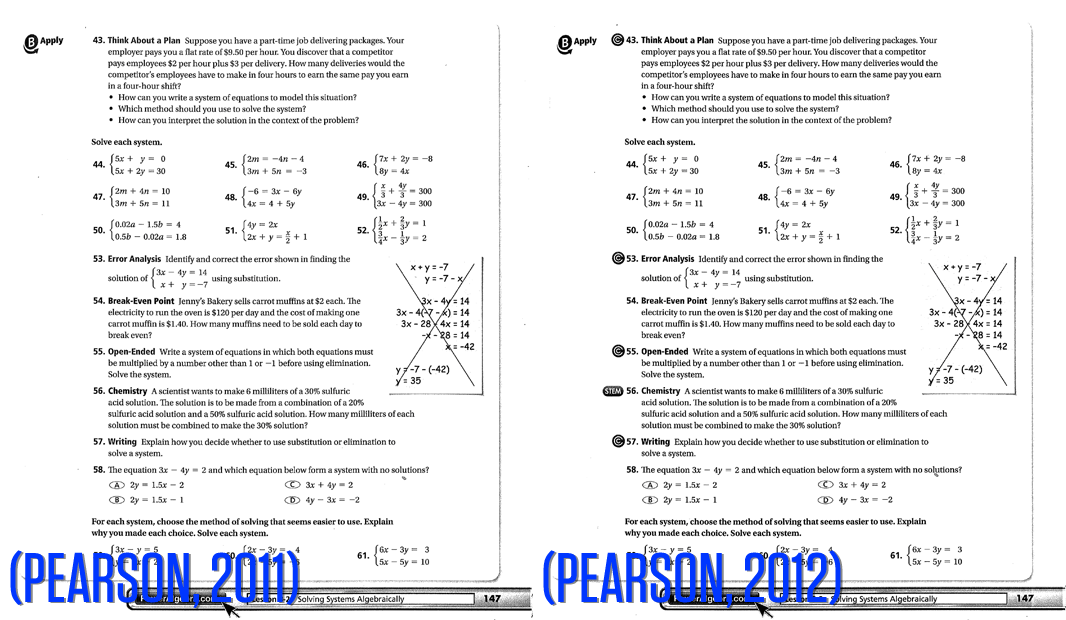
Jeanette Stein, on the difference between textbooks in the pre- and post-CCSS era:

I have been able to look at the differences between the textbooks that our district bought and the CCSS textbooks by the same publisher. The only difference, other than “Common Core” stamped all over the cover, is that every time it used to say “Application” it now says “Common Core.” They did not even fix some of the typos that were there from five years ago.

If anyone wants to send me a scan of a page pre- and post-CCSS makeover, I’d be obliged: dan@mrmeyer.com.

2012 Feb 29. Here’s a winner authored by Larson, via Greg Schwanbeck.

2012 Mar 05. Strong work published by Pearson, via Mark Watkins.

Three Stories About The Same Thing

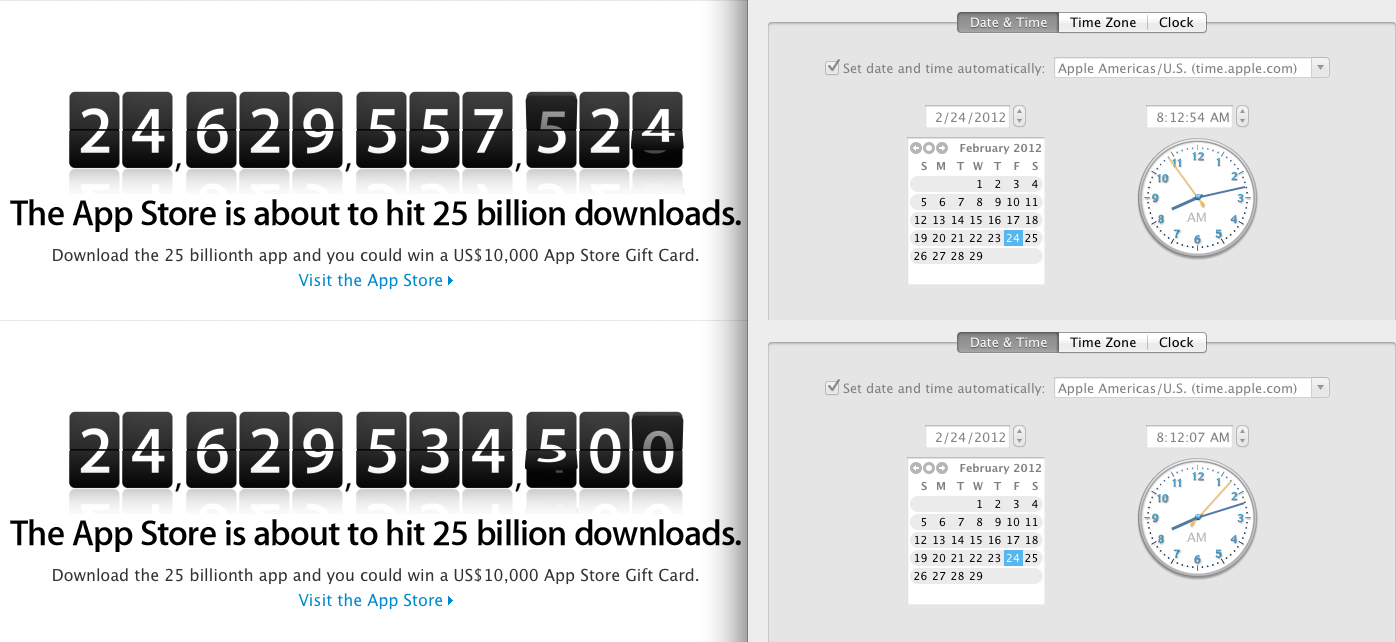
Apple’s count-up to 25 billion apps struck the same chord for several of us last week. Three of us tried to represent that moment for students with photos and video. I don’t find the question, “Who did a better or worse job?” as interesting as “What were the principles that organized each of our work?”

Mine


[link]

Dan Anderson

[link]

Sean Dardiss


[link]

Sean has a timer rolling in the foreground. Dan has superimposed his computer’s clock over the counter. Those design choices interest me. When he first saw the counter, I’m wagering Dan didn’t have his clock open. I’m positive Sean added that timer later in AfterEffects. What were they trying to accomplish with those additions?

A guess? They were trying to make the problem solvable, which is probably the most natural inclination for a math teacher designing a task for a math class.

I want to be explicit about my M.O. here without calling it better or worse than theirs. I’m still trying to figure this out.

  1. I want to recreate as exactly as possible the moment when Apple’s counter perplexed me, when it dialed the pressure in my head up to eleven and made the question irresistible, “When should I start bombarding the app store with downloads if I want to win $10,000?”
  2. I want to separate the tools, information, and resources I used to answer that question from the perplexing moment itself.

The first point argues for a recording of the screen just the way it was when I first found the counter. Nothing extra.

The second point argues for postponing โ€“ not eliminating โ€“ a) data samples, b) a table, c) graphing paper, d) the slope formula, e) a lecture about the point-slope form of a line, etc., until after we’ve settled on a perplexing question that needs those tools, resources, and information.

This is a more accurate representation of how I solved the problem. (I had to decide that a table and a graph would be helpful. I had to decide that a linear equation would be the best model. No one gave me any of that.) It’s also more perplexing to see a problem as it exists in the wild, “posed simply and innocently, not flayed alive by terminology, labels, and notation.”

One More Example

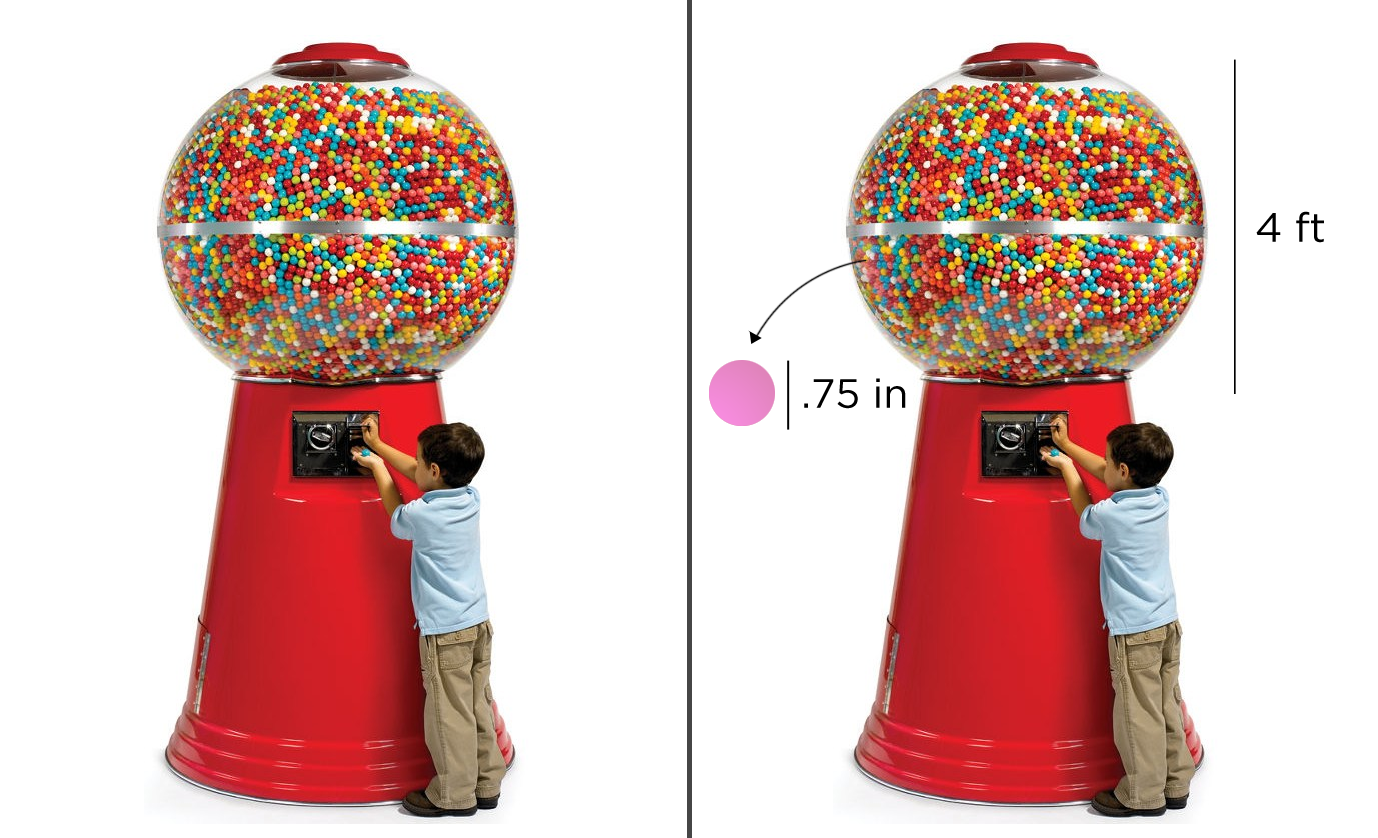
I’ve created two visual prompts for the same question, “How many gumballs are in the machine?” (This picture is from Dan Anderson, also.) One version abstracts the problem at the same time that it tries to perplex students. The other postpones that abstraction for just one moment. Both will result in (more or less) the same mathematical analysis. I’m curious which one would perplex students more.

It would be nice to have a website to test out the difference a little more empirically.

Featured Comment

Eric:

I had kids staring at the screen with their iPhones out waiting to download at the beginning of class. It was hilarious. One of the most engaging problems weโ€™ve done all year!