Year: 2013

Total 117 Posts

The Unengageables, Ctd.

It’s like reading a survey of firefighters in which, when asked about the greatest limitation on how they fight fires, 38.79% responded “all the fires” and 23.56% responded “being a first responder.”

130711_1lo

See those top two are part of doing your job, not an impediment to it. Even better, while the firefighters have no influence over the number of fires they fight, teachers have plenty of influence over a student’s interest in mathematics.

[via Chris Shore]

Previously:

2013 Jul 11. The Wire’s Lester Freamon:

Detective, this right here, this is the job. Now, when you came downtown, what kind of work were you expecting?

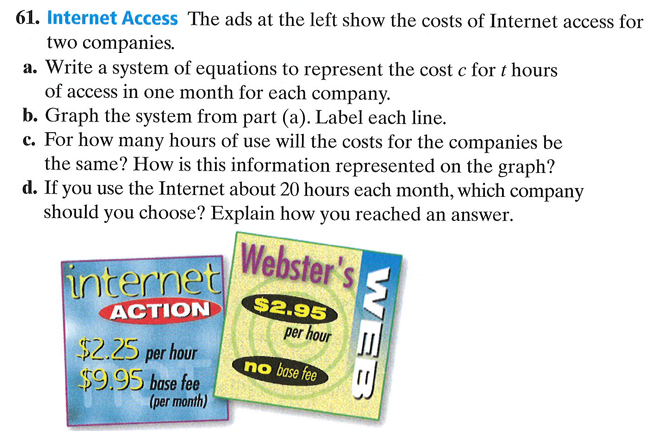
[Makeover] Internet Plans

The Task

130702_1lo

What I Did

  • Change the context. I’m generally pessimistic about the effect of grafting different real-world contexts onto a task that is rotten at its core. But we have to correct pseudocontext when we see it or students will come to believe that this math thing is a lie. This isn’t the only change we’ll make, though.
  • Put students in the shoes of the person who might actually experience this problem. It’s striking to me that the question “Which company should you choose?” only emerges at the end of the problem when that’s probably the first thing someone would wonder when presented with two competing plans.
  • Lower the floor on the task. The task starts at a very abstract level with the construction of linear equations and then proceeds down the ladder of abstraction to a very concrete level by asking students to evaluate their plans for 20 hours of Internet use each month. It’s like asking someone to lift less weight the more they exercise. We need to turn that around.
  • Raise the ceiling on the task. The task quits too early. We can develop the concept further.
  • Provoke an intellectual need for the solution. The finale of the task asks students which plan they’d choose if they used the Internet for 20 hours each month, a question that requires none of the work preceding it. Seriously, you just evaluate both plans for x = 20 and you’re done. We need to provoke some kind of need for creating and graphing a system of equations.

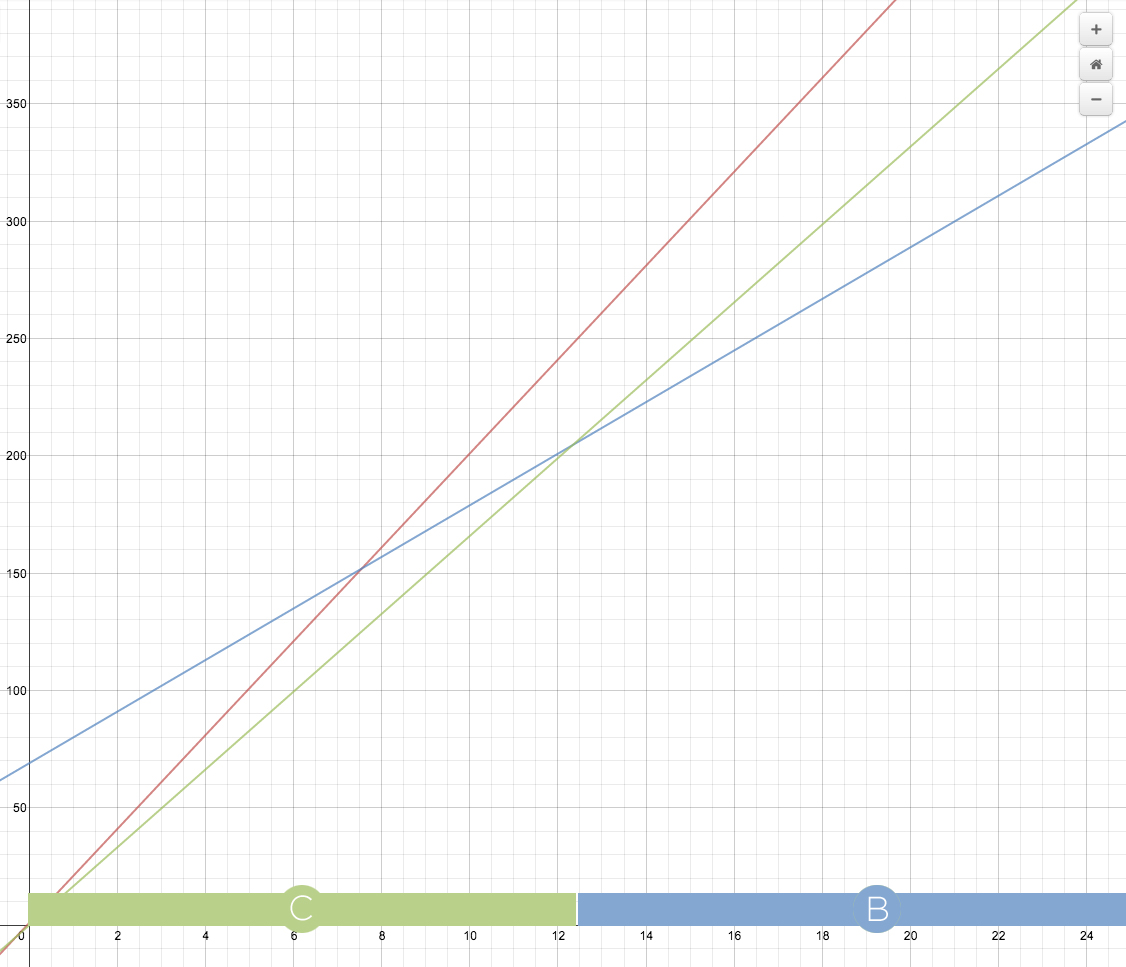
When they come into class ask them to write down any number between 1 and 25. Then show them this flyer (courtesy Frank Noschese):

130702_1lo

Tell them, “If you were going to workout for that many months, and all you cared about was cost, which plan should you pick?”

Now they’re doing the concrete step first, the easier evaluation, and we’re setting ourselves up to need a generalization.

As they finish, ask them to come up and write their answer on a number line above their number of months. If students finish quickly, ask them to double check a few of their classmates. Assessment should be fairly straightforward here, after which the board will look something like this:

130702_1lo

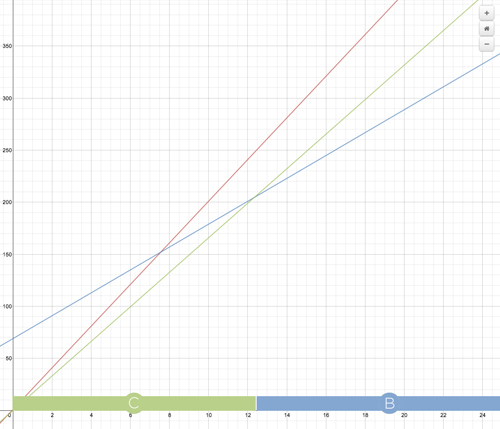
The clumping of answers will be expected for some students but surprising to others. “It seems like there’s a point where the plans switch over.” Finding that point will make linear equations seem like more of a necessity than they do in the original task.

Graphing the equations is the least essential aspect of this task. (What purpose does it serve?) Those graphs become more interesting, however, once we’ve located the switch-over point.
130702_1lo

I’ll try to position my students as hired experts for some consumer who needs their expertise. So when they write down “x = 12.3” and circle it, I can say, “Come on, man. They’re never going to understand that. You have to spell it out for them. And tell them why plan A will never be the better deal, also, or they’ll get confused.”

We can extend the task by asking students to come up with two plans that switch over only after two years. Now they’re exercising a little more creativity and working their algorithms in reverse.

What You Did

Over on the blogs:

Twitter is just the wrong medium for this kind of writing prompt, I’m finding. With only 140 characters, a lot of people default to “less helpful” stances like, “Well I wouldn’t give them anything except the subject of internet cafes and then see where they took it!” But the “unhelpfulness” I’m diagramming here is kind of a lot of work and takes more than 140 characters.

That said, I think Nicholas Chan managed to fit something actionable and important into the tight space:

Call for Submissions

You should play along. I post Monday’s task on Twitter the previous Thursday and collect your thoughts. (Follow me on Twitter.)

If you have a textbook task you’d like us to consider, you can feel free to e-mail it. Include the name of the textbook it came from. Or, if you have a blog, post your own makeover and send me a link. I’ll feature it in my own weekly installment. I’m at dan@mrmeyer.com.

2013 Jul 9. Eric Biederbeck reminds me of Kyle Pearce’s Detention Buy Out lesson, which is a perfectly functional makeover in its own right.

Featured Comments

I think these comments illustrate what’s fun, useful, and difficult about modeling. I respond below.

Matt H:

The equation for plan A doesn’t take into account the possibility of working out “More than 24”³ days in a month

Stephanie Reilly:

Plan C is a one-time charge of $199 and you get to go for 12 months, right? I think I would graph that as a straight line at y=199 (for 0-12 months) and then a straight line at $398 for 13-24 months.

Jason Dyer:

Note the fine print which says you can’t sign up for less than 12 months on plan A. All three plans also seem to have a $29 maintenance fee per-year and a $10 card fee.

l hodge:

The fitness decision depends a lot on how much value you place on the different add-ons for each plan. These details are harder to quantify and not incorporated into the graphical model (the model stinks).

Timfc:

we only graph them as nice continuous linear equations because it makes our lives easier, but we should really graph them as piecewise linear?

I mean, it’s not like you can pay for pi months (although how awesome would that be?) and so evaluating the equation at pi is not going to give an output that’s meaningful. Maybe that’s the next step for students?

The Fault-Tolerant School

Uri Treisman gave a near-perfect talk on race, poverty, and equity at NCTM 2013 (which I trust you’ve now seen at least once) but he left one crucial thread dangling.

He spoke of fault-tolerant systems by way of a metaphor to commercial air travel. The early airplanes developed by Concorde would respond to the most trivial hairline fractures by plummeting from the sky. British air dominance ended, according to Treisman, when Boeing simply assumed there would be lots and lots of those fractures and then built a system to tolerate them. This process culminated in a wind tunnel where Boeing engineers dialed up the wind speed on a prototype, started its engines, dropped a guillotine on the nose of the plane, and then watched the airplane continue to hum along regardless.

Here’s Treisman:

Guess what? Poverty really sucks. It’s incredibly hard. All the lifespan studies going back to the 1920s show that poverty in youth is a very hard force. We need to build fault-tolerant schools and systems if we’re actually going to address equity.

Treisman left the design of those schools and systems as an exercise to the viewer. He doesn’t even specify the faults explicitly, though it isn’t hard to define some.

For one example, the poor are more itinerant than the wealthy. They change jobs, locations, and schools more often. Any system that doesn’t find some way to recover from that liability, to induct students into new routines and ameliorate lost class time as quickly as possible can’t be considered “fault-tolerant.”

Dan Goldner has picked up the conversation where Treisman left it and I hope he continues it. His school has targeted five areas for fault tolerance ranging from students taking the wrong course to intermittent attendance. Head to his post and read their tentative solutions. Then help us with the question:

What are the policies of the fault-tolerant school? The fault-tolerant classroom?

Featured Comments:

Chris:

Having a National Curriculum means pupils and students who have to move around have at least some continuity to their education.

Bob Lochel:

Just like we talk about math problems having multiple entry points, students should have multiple opportunities to re-craft their math plan. The idea that you must take courses A, B, C and D or else you will never get to course E is antiquated. The fault-tolerant school provides opportunities, and encourages students to pursue them, rather than maintaining artificial obstacles.

Wendy Menard:

I am not absolving schools of the responsibility of finding ways to keep these students on track, but the task is almost Sisyphian in many cases. In areas where poverty is the rule, a school needs to be a community center, providing health-care related services, afterschool opportunities, and family programming; many students need this range of services in order to stay in school. Academic support beyond the school day could be made available in this type of setting as well, providing the tutoring that struggling students from more affluent families may receive privately. We can talk about engagement, perseverance, and productive struggle all day long, but truthfully, there is a huge block of students for which these issues are completely secondary to surviving their circumstances.

Hot Links

Comments closed here. I’ll check in with you over there.

[Makeover] Bedroom Carpet

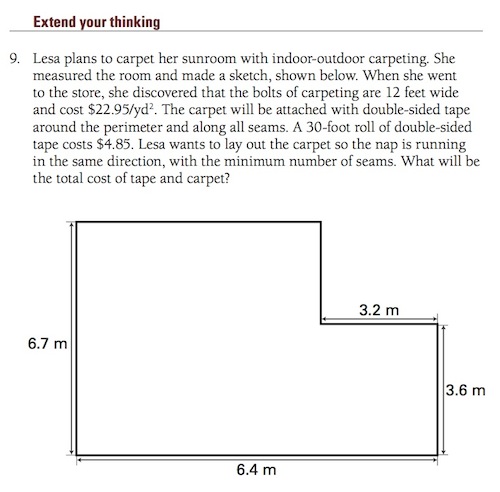
The Task

130626_1

This task comes from MathWorks, which, as I understand it, is intended for Canada’s vocational track math students. I purchased PDFs of the curriculum in Saskatchewan because it featured a lot of interesting applications of secondary math, even if the print medium did those applications no favors.

What I Did

  • Not a lot. The last makeover took it out of me and it’s summer. Let’s do something a little simpler.
  • Put students in the shoes of the person who might actually experience this problem. Perhaps that person is a homeowner. The homeowner either doesn’t have a carpet or has a carpet in need of replacement. She knows only one thing at this point: “I want carpet.” She wonders several things at this point: “How much will it cost me?” and “How much time will it take me?” and “How will I do it?” are probably high on the list. What she doesn’t have yet are all these facts, figures, and dimensions the problem includes.
  • Add intuition. Our homeowner might try to ballpark the cost of the installation before she does anything else. Let’s ask students to do that.
  • Raise the ceiling on the task. We need to extend this task at the top end for students who need the challenge.

Let me run this by you.

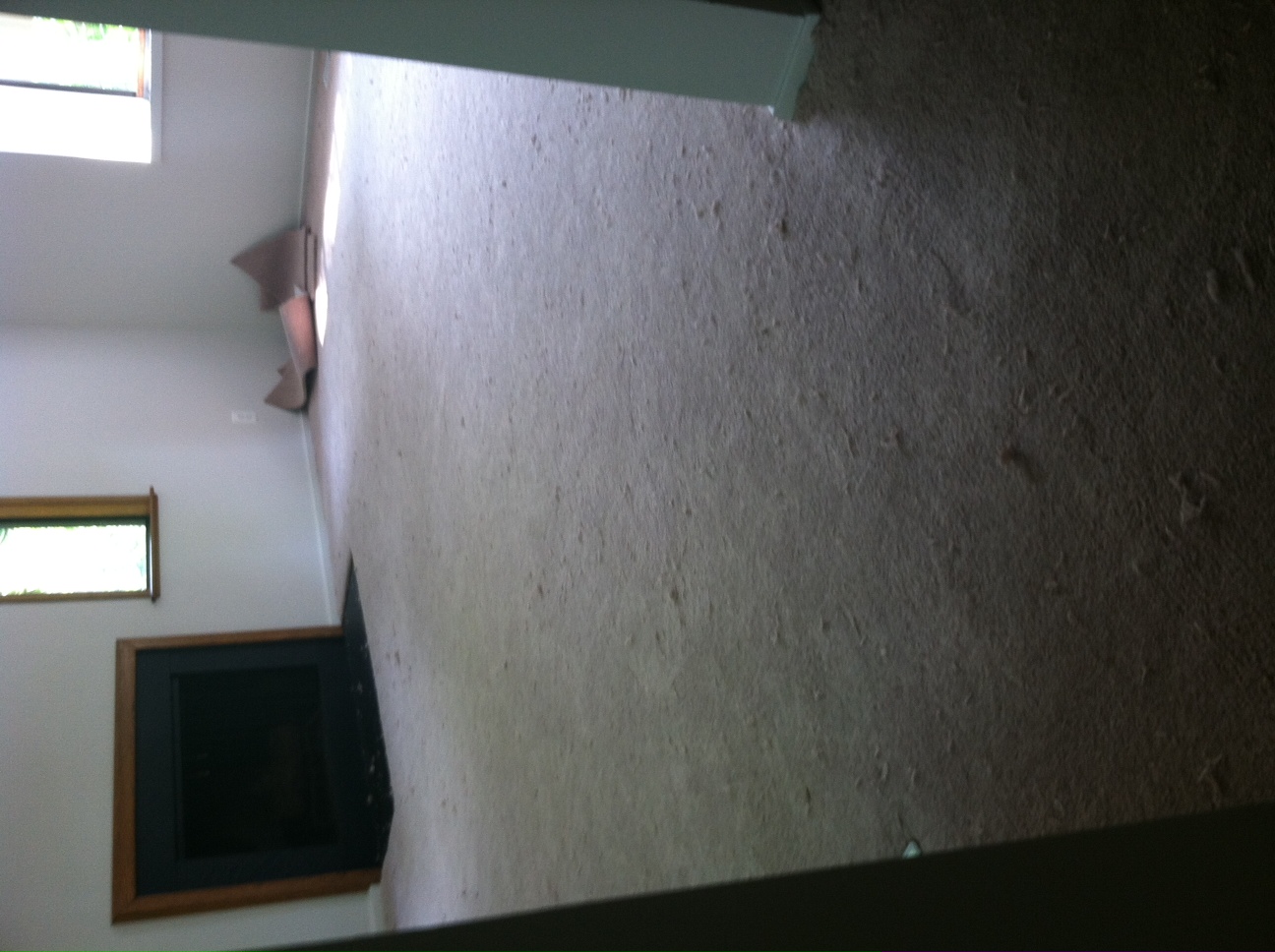
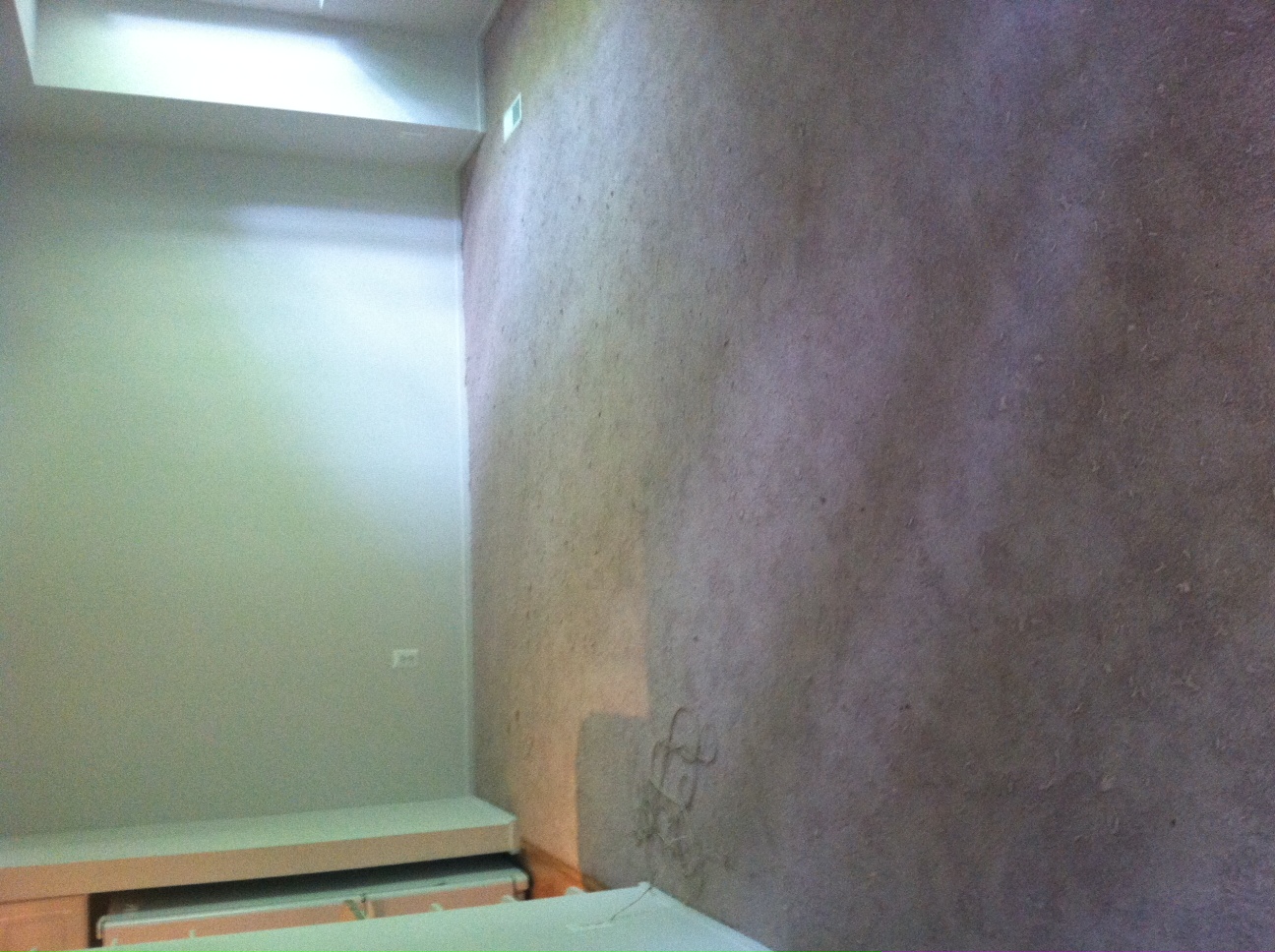
Shoot some quick video of a room in a house that has a similar design — composite rectangles. If it’s emptied of furniture so much the better. (Anybody moving this summer? Get at me.) Tell students, “We need new carpet in this room. Can you give me a guess how much it’ll cost?” Some of them won’t have a clue, but we’d like them to take their intuition as far as it’ll go, even if that’s just to say, “It’s definitely going to cost less than $10,000.”

Then ask them to brainstorm in groups: “What information will be important here? What skills will you need?” Because that’s the question our homeowner is likely asking herself and we’re trying to put our students in her shoes. (Also because the first task in “modeling” according to the Common Core is to “identify essential variables.”)

I have no trouble imagining the student response here because my own knowledge base for home handiwork is pretty much comparable.

  • What kind of carpet are we buying?
  • How much does it cost?
  • How much does it cost to install?
  • How do you get carpet?
  • Are there any other costs we’re forgetting?

I’m sure I’d be (pleasantly) surprised by what students ask for. At this point, offer them information they want. Teach them about carpet installation. Show a YouTube video. (Or have them research all of the above online, though I’m not inclined to sacrifice the time myself.) Basically give them the same information given in the task, only after they’ve had a minute to think about why they’d need it and how they’d get it.

I’d probably pass out a floor plan of the room without dimensions. An interesting observation the original task glides past is that you don’t have to measure every single side of the room. You can measure some and use them to find the others. So ask them what sides they’d want or what’s the fewest sides they’d need?

As students work, some will need more of your help and others will finish quickly. My first attempt at an extension problem for the latter group is to switch the known and unknowns of the original problem. So previously we gave students dimensions and we asked for cost. Now give them cost and ask for dimensions.

“Tell me about a scenario where the total bill for the carpeting job was $1,000,000.” They can change anything they want.

What You Did

Over on the blogs:

Over on Twitter:

Call for Submissions

You should play along. I post Monday’s task on Twitter the previous Thursday and collect your thoughts. (Follow me on Twitter.)

If you have a textbook task you’d like us to consider, you can feel free to e-mail it. Include the name of the textbook it came from. Or, if you have a blog, post your own makeover and send me a link. I’ll feature it in my own weekly installment. I’m at dan@mrmeyer.com.

2013 Jul 2. Jennifer Orr sends in two pictures we can all use.