Year: 2013

Total 117 Posts

Makeover Monday: Introduction

2013 Jun 26. See every edition of Makeover Monday.

Here is a “high-leverage teaching practice,” according to Deborah Ball:

Teachers appraise and modify curriculum materials to determine their appropriateness for helping particular students work towards specific learning goals. This involves considering students’ needs and assessing what questions and ideas particular materials will raise and the ways in which they are likely to challenge students. Teachers choose and modify materials accordingly, sometimes deciding to use parts of a text or activity and not others, for example, or to combine material from more than one source.

So every Monday this summer, I’ll post a problem from a textbook and start a conversation about how we could modify it. The details of that makeover may take the form of a loose sketch or something more formal. In either case, I’m going to be explicit about the goal of the makeover.

Fawn Nguyen, who’s been on an absolute tear lately, illustrated this process recently. She took this task:
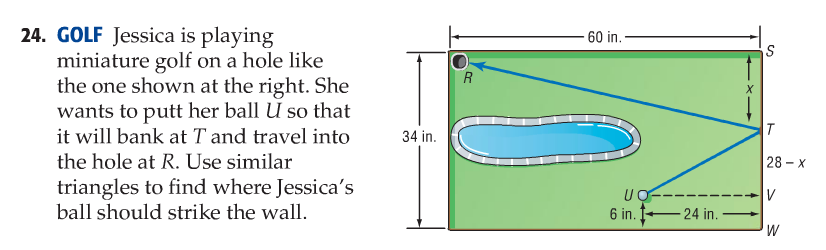
130609_1

And then she showed how she implemented it with her students. Her goal wasn’t something formless along the lines of, “Well this sucks and I want to make it more engaging.” In the title of her post, she says explicitly she wanted students to have some personal, creative input on the constraints of the problem. So she had her students start by drawing their own golf course. She set a high bar for the rest of us.

You should play along. You can feel free to e-mail me a textbook task you’d like us to consider. Include the name of the textbook it came from. Or, if you have a blog, post your own makeover and send me a link. I’ll feature it in my own weekly installment. I’m at dan@mrmeyer.com.
The Do You Know Blue Student Prizewinner

Rebecca Christainsen had the highest score of any student on our Do You Know Blue machine learning activity. Yesterday was her last day of school at Terman Middle School in Palo Alto, CA, so Evan Weinberg, Dave Major, and I sent her math class a pizza party in her honor.

Because we’re keeping the activity available for you and your students to use as they study inequalities, we aren’t going to go into much depth on all the different rules contestants used. But I asked Rebecca how she came to her final, game-winning rule, and she told all:

My teacher first showed me the website, and I decided to try it out. My first attempt scored me only around 18%, but since hardly anyone had tried it out yet, I was ranked 33rd. After that, I was encouraged to try more equations, and suddenly thought of all the different types of equations that I could use, and moved to squared terms. One of the first equations that I came up with was b2>r2+g2. I simply used trial and error to come up with new equations, and I recorded each equation that I used and the percentage. I combined different equations together, and a few different combinations even had the same percentage.

Nobody beat that.

Extra Credit: How many of the Standards of Mathematical Practice does Rebecca evoke in that quote?

Great Moments In Mathematical Invention

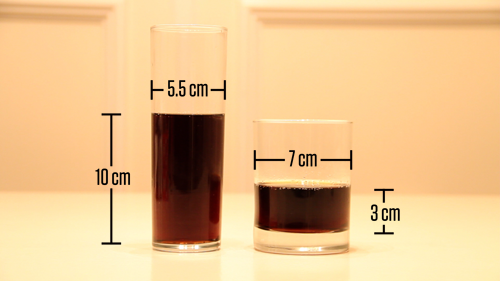
I was in Australia this last week, working with some teachers at MYSA on You Pour, I Choose. It’s a task that asks which of two glasses has more soda and involves, among other skills, a fairly straightforward application of volume.

130528_1

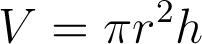
A teacher in the workshop called me over. “I’m not a math teacher,” she told me, and then pointed to the person next to her who had calculated the formula for volume of a cylinder.

130528_2

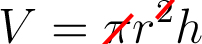
“But that seems like more work than you need to do,” she said. “We don’t care about the exact amount. We care which one has more. With both glasses, we multiply by pi and square the radius. So all you really need to do is multiply the radius by the height for both glasses and compare the result. That’ll tell you which one has more.”

130528_3

This was a rather stunning suggestion, made all the more impressive by the fact that this woman doesn’t immerse herself in numbers and variables for a living like the rest of us.

I have two questions:

  • Is she right? She’s certainly right in this case. Both the volume formula and her shortcut indicate the left glass has more soda.
  • As her teacher, what do you do next?

I’ll update this post tomorrow.

2013 May 29. I knew just telling her, “That’s wrong.” would be unsatisfying because, explicitly, she said, “Am I wrong?” but, implicitly, she was saying, “If I’m wrong, then make me believe it.” I knew the current problem wasn’t helping me out because her shortcut actually worked.

I knew this woman had dropped me off deep in the woods of “constructing and critiquing arguments” but I didn’t know yet what I was going to do about it.

“Whoa,” I said. “Does that work? If that works that’s going to save us a lot of time going forward. Let me bring your idea to the group and see what everybody thinks.”

In the meantime I stewed over a counterexample. It took me more than a minute to think of one because a) I was kind of adrenalized by the whole exchange, and b) I don’t do this on a daily basis anymore so my counterexample-finding muscle has become doughy and underused.

I posed her shortcut to the group and said, “What do you think? Does this work?” I gave them time to think and debate about it. Someone came back and said, “No, it doesn’t work. Imagine two cylinders with different heights and a radius of one.”

Awesome, right? This particular counterexample doesn’t disprove the rule. The square of one is also one so her rule works here also.

Eventually someone suggested two examples where the product of the radius and height were the same but where the radius and the height were different in each cylinder. The shortcut says they should have the volume. The formula for volume says they’re different.

Final note: students are often asked to prove conjectures that are either a) totally obvious (“the sum of two even numbers is even” in high school) or b) totally abstract (“prove the slopes of two perpendicular lines are negative reciprocals” in middle school). It’s rare to find a conjecture that is both easily understood by the class and not obviously correct or incorrect. I’m filing this one away.

Great Lessons: Evan Weinberg’s “Do You Know Blue?”

If you and I have had a conversation about math education in the last month, it’s likely I’ve taken you by the collar, stared straight at you, and said, “Can I tell you about the math lesson that has me most excited right now?”

There was probably some spittle involved.

Evan Weinberg posted “(Students) Thinking Like Computer Scientists” a month ago and the lesson idea haunted me since. It realizes the promise of digital, networked math curricula as well as anything else I can point to. If math textbooks have a digital future, you’re looking at a piece of it in Evan’s post.

Evan’s idea basically demanded a full-scale Internetization so I spent the next month conspiring with Evan and Dave Major to put the lesson online where anybody could use it.

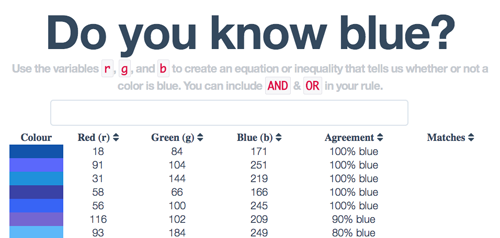
That’s Do You Know Blue?

Five Reasons To Love This Lesson

It’s so easy to start. While most modeling lessons begin by throwing information and formulas and dense blocks of text at students, Evan’s task begins with the concise, enticing, intuitive question “Is this blue?” That’s the power of a digital math curriculum. The abstraction can just wait a minute. We’ll eventually arrive at all those equations and tables and data but we don’t have to start with them.

Students embed their own data in the problem. By judging ten colors at the start of the task, students are supplying the data they’ll try to model later. That’s fun.

It’s a bridge from math to computer science. Students get a chance to write algorithms in a language understood by both mathematicians and the computer scientists. It’s analogous to the Netflix Prize for grown-up computer scientists.

It’s scaffolded. I won’t say we got the scaffolds exactly right, but we asked students to try two tasks in between voting on “blueness” and constructing a rule.

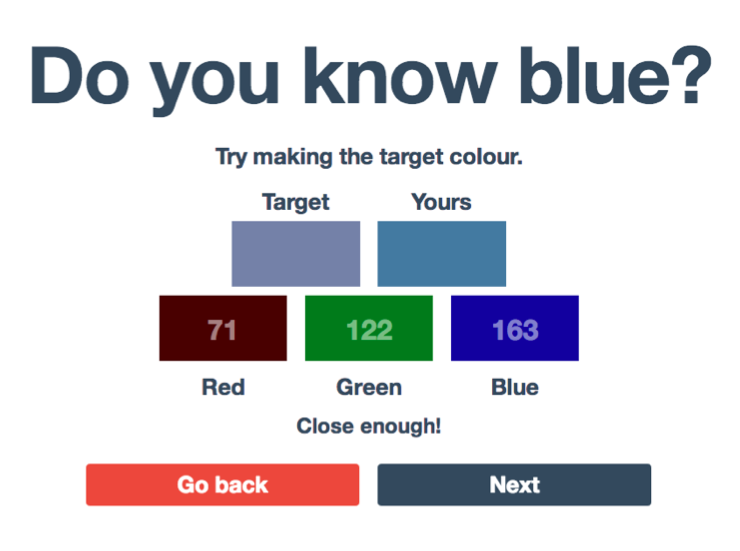
  1. They try to create a target color from RGB values. We didn’t want to assume students were all familiar with the decomposition of colors into red, green, and blue values. So we gave them something to play with.
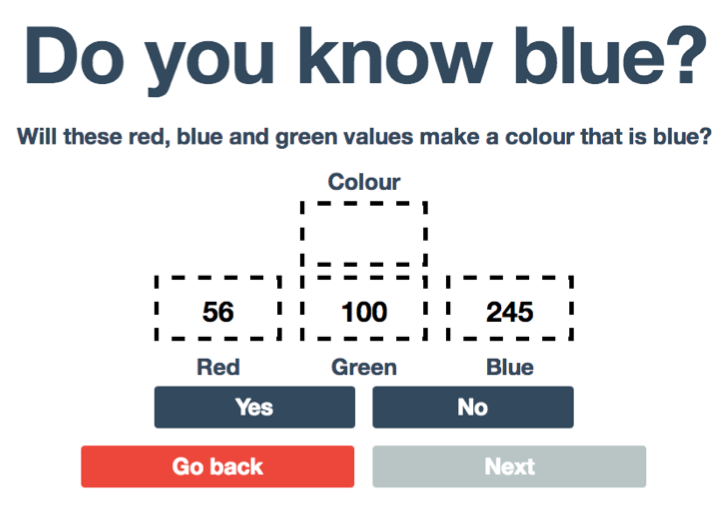
  2. They guess, based on RGB values, if a color will be blue. This was instructive for me. It was obvious to me that a big number for blue and and little numbers for red and green would result in a blue color. I learned some other, more subtle combinations on this particular scaffold.

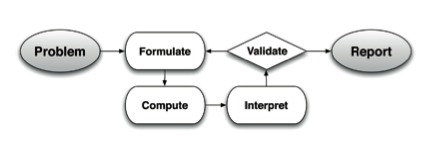
This is the modeling cycle. Modeling is often a cycle. You take the world, turn it into math, then you check the math against the world. In that validation step, if the world disagrees with your model, you cycle back and formulate a new model.

160518_3

My three-act tasks rarely invoke the cycle, in contrast to Evan’s task. You model once, you see the answer, and then you discuss sources of error. But Evan’s activity requires the full cycle. You submit your first rule and it matches only 40% of the test data, so you cycle back, peer harder at the data, make a sharper observation, and then try a new model.

The contest is running for another five days. The top-ranked student, Rebecca Christainsen, has a rule that correctly predicts the blueness of 2,309 out of 2,594 colors for an overall accuracy of 89%. That’s awesome but not untouchable. Get on it. Get your students on it.

Contest: Do You Know Blue?

160518_2

a/k/a A Netflix Prize for K-12 Math Students
a/k/a Let Dave Major, Evan Weinberg, and Me Buy Your Class A Pizza Party

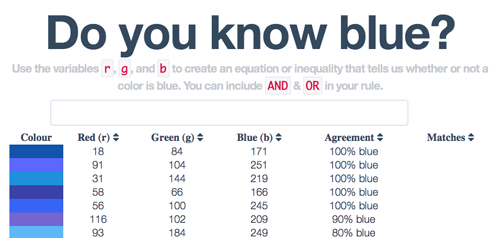
Can you teach a computer to recognize the color “blue”? Head to Do You Know Blue? and find out. If you do the best job teaching the computer, we’ll send your class a pizza party in appreciation.

Enter the contest as many times as you want. Come back and check out your standing at this page.

You have until Monday 5/27 at 7:00AM Pacific Time.

Disclaimers

  • Anybody can participate but the winning entrant will need to be a K-12 student in the US.
  • $100 maximum on the pizza party.
  • You’ll have to include an e-mail address, school name, and teacher name if you want to compete for the pizza party.
  • If multiple people take the top spot we’ll draw the winner randomly