Year: 2013

Total 117 Posts

Uri Treisman’s Magnificent Speech On Equity, Race, And The Opportunity To Learn

On April 19, 2013, the third day of NCTM’s annual meeting in Denver, Uri Treisman gave a forty-minute address on equity that Zal Usiskin, director of the University of Chicago’s School Mathematics Project, called the greatest talk he’d ever heard at the conference in any year. Stanford math professor Keith Devlin would later call it our “I have a dream” speech. At least one participant left in tears.

I’ve personally seen it three times. I got the video feed from NCTM and the slides from Treisman. I then spent some time stitching the two together, resulting in this video. His message is important enough that I’d like to use whatever technical skills I have, whatever time I have, whatever soapbox I can stand on, to help spread it.

You should watch it.

If you’re interested in equity, you should watch it.
If you’re interested in teacher evaluation, you should watch it.
If you’re interested in school reform, you should watch it.
If you’re interested in charter schools, you should watch it.
If you’re interested in understanding which student outcomes teachers can control and which they can’t, you should watch it.
If you’re interested in the trajectory of math education in the era of the Common Core State Standards, you should watch it.

If none of those conditions apply to you, well, I can’t imagine the series of misclicks that brought you to my blog. Watch it.

Here’s a fair enough summary from Treisman himself:

There are two factors that shape inequality in this country and educational achievement inequality. The big one is poverty. But a really big one is opportunity to learn. As citizens, we need to work on poverty and income inequality or our democracy is threatened. As mathematics educators … we need to work on opportunity to learn. It cannot be that the accident of where a child lives or the particulars of their birth determine their mathematics education.

That was his destination and the talk took only three stops along the way:

  1. What did education reform groups like Achieve, the Gates Foundation, et al, recommend in their “Benchmarking for Success” document in 2008?
  2. How does TIMSS and NAEP data contradict or clarify those recommendations?
  3. What should we actually do about equity, as teachers and citizens, if those recommendations prove unfounded?

Highly Quotable

  • [A]s math people we know that if we’re going to work on a problem, we have to formulate it clearly. And as math people are wont, we need to swaddle ourselves in the numbers and the data because that’s what gives math people direction, strength, and courage.
  • Let’s look at “Benchmarking for Success” and see its analysis of the problem. Then let’s look at the data and see how it actually lines up with what we know today. And then let’s see where we need to go to really enact the vision of NCTM for equity.
  • So the notion was: “Let’s focus on teachers as the central driver of reform and rethink how we evaluate teachers.” They had the view that teachers were the single most important in-school factor in student achievement. And math people know that was just an artifact of the way they modeled the problem.
  • I’m now going to show you two graphs that I don’t believe anyone in the math community has seen. It’s the PISA data disaggregated by child poverty rates.
  • About one half of students who go from high school to college are referred to remediation and mostly developmental math. Fewer than a quarter of those students will ever get a credential. Those students are more likely to end up with debt than a credential. [..] Those remedial programs are burial grounds for the aspirations of students. And it’s mostly math that’s the key trigger. 35,000 students in California two years ago repeated a developmental course for the fifth or greater number of times. So no one can say those students don’t have persistence.
  • So states — where you go to school — are a profound influence on what you actually get to know.
  • Low income student scores in Texas were the top in the country in 2011. It’s really good for Texas to be the top of the country. Because whenever Texas does something well, everyone else is positive that they can do better. When Massachusetts is at the top, people go, “Ah, it’s just Massachusetts.”
  • Again, two and a half years difference in opportunity depending on where you happen to go to school. This is something that, as a math teaching profession, we can influence. Poverty is something we need to work on as citizens. Opportunity to learn is something we need to work on as math educators. That’s a core message for this talk.
  • So you would think that charters would fix this. Almost all the charters in Texas produced 0% of students who are college-ready. There are a few of them — one KIPP, one YES Prep, one IDEA, one Harmony — that are pretty good. Most of them are well below the public schools. So this theory of Achieve, NGA, CCSSO, Race to the Top, that charters were the answer? Not so clear when you actually climb into the numbers. The reverse looks true.
  • When you visit most math classrooms it’s like you’re in a Kafkaesque universe of these degraded social worlds where children are filling in bubbles rather than connecting the dots. It’s driven by a compliance mentality on tests that are neither worthy of our children nor worthy of the discipline they purport to reflect. That is the reality. That’s something that we as math educators can control.
  • What this shows is that the current theory about school improvement — that charters, Common Core, value-added measures of teaching are going to solve the problem — is profoundly wrong. That doesn’t mean we can’t use the Common Core powerfully to reboot our systems but it’s not the solution to the basic problems of schooling.
  • Guess what? Poverty really sucks. It’s incredibly hard. All the lifespan studies going back to the 1920s show that poverty and youth is a very hard force. We need to build fault-tolerant schools and systems if we’re actually going to address equity.
  • Just think about it. The great majority of our children finish our schools positive that there’s a whole list of things they’re not. They come out of schooling believing they’re not mathematical, they’re not artistic, they’re not philosophical, they’re not athletic. And these self-imposed beliefs undermine your sense of personal freedom, the font from which all freedoms come.
  • You have to remember that when the Common Core was created, they didn’t come to NCTM. They got David Coleman to write it and he brought his friend Jason Zimba to do the math. They did not come to NCTM. It’s time for us now — the professional societies — to talk about what standards should be and how to reshape the Common Core so that it reflects our best practice knowledge of schooling. Hard message, but a necessary message.
  • What is the determinant of whether you have a high-skill job in the US? Overwhelmingly it’s mathematics. It’s the single biggest factor in upward social and economic mobility. It’s our beloved subject. It would be wonderful if it were music instead of math. Think how great the country would be if everyone were striving to learn to play an instrument instead of factor quadratic equations but the fact is it is our discipline that is the primary determinant.

Featured Comments

Bill McCallum, chair of the CCSS math writing committee, responds:

A beautiful speech by Uri and a great contribution by Dan to put the slides with the video.

However, the quote about how the Common Core was written garbles the history badly. Here is a summary of the process.

CCSSO and NGA appointed a work team of about 50 people–educators, mathematicians, teachers, policy people–and asked me to lead it. They also appointed a writing team of 3 people–Phil Daro, myself, and Jason Zimba–to draft the standards. We solicited progressions documents from selected individuals or groups in the work team. The three lead writers produced a first draft based on these progressions. There was also a feedback group of about 20 people. You can find the pdf with the names of all these people by googling “Common Core State Standards Work Team”.

Minor iterations of the standards were circulated to the working team for comment and critique, of which there was an abundance. Major drafts (about 3 or 4) were circulated to the feedback group and the 48 participating states, which also produced a huge amount of commentary. Finally, a public comment period starting in March 2010 elicited about 10,000 comments, of which we looked at every single actionable comment.

There were also numerous organization reviews, including one by NCTM. I spent a weekend in DC with a team from NCTM listening to their concerns, which resulted in significant changes to the standards. Jason and I also spent a weekend with teachers from AFT, one team for each grade band, who gave us detailed feedback that also resulted in changes to the document.

For more context, take a look at Jason’s Ed Week interview with Rick Hess.

Michael Pershan calls into question the data behind one of Treisman’s conclusions:

I’m now going to show you two graphs that I don’t believe anyone in the math community has seen.

That slide with PISA data is missing a bunch of countries. Where’s Japan? Where’s Hong Kong? Singapore? Canada?

All of these countries do well on PISA even though they have considerable child poverty. I put together a fuller picture of the data in this post, with links to the data that (I think) Treisman used.
“How To Learn Math,” An Online Course From Stanford Math Education Professor Jo Boaler

Enrollment is open:

The course is a short intervention designed to change students’ relationships with math. I have taught this intervention successfully in the past (in classrooms); it caused students to re-engage successfully with math, taking a new approach to the subject and their learning.

Who else is up for some summer professional development?

Teaching With Three-Act Tasks: Act Three & Sequel

Table of Contents

  1. Teaching With Three-Act Tasks: Act One
  2. Teaching With Three-Act Tasks: Act Two
  3. Teaching With Three-Act Tasks: Act Three & Sequel

I taught using a three-act math task in Cambridge last winter. The good folks at NRich posted the video so I’m highlighting some of the pedagogy behind this kind of mathematical modeling. Ask questions and share suggestions.

Act Three & Sequel

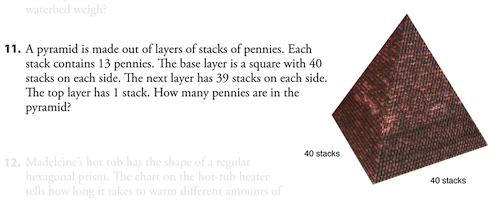
  • [18:36] “This guy wants to make a pyramid out of a billion pennies. And I’m curious how big that would be. Help me with that if you’re completely finished here. Or tackle some of the other questions we had up there earlier.”
  • [20:20] “Is that number in between your high and low from earlier? Does it fit in the range of possible numbers for you? If it didn’t we should go back and ask ourselves ‘do we trust the mathematics here?'”
  • [20:45] “I’m going to show you the answer here.”
  • [21:00] “Who guessed closest to that? Margaret or Eddie. Let’s all give one clap to Eddie.”
  • [21:16] “Who got the closest guess overall? Who is closer? 250,000 or 300,000? One clap for these two.”
  • [21:50] “Let’s look at other questions we had back here.”
  • [23:00] “How could we figure out how long it would take?”

Post-Game Analysis

Show the answer. There’s the bombastic, visual element, the part that results in students cheering the answer to their math problem. It’s hard for me to overvalue that reaction.

But there’s another reason why students ought to see the answer to modeling tasks. (I’m not picky about answers to other tasks.) The Common Core’s modeling framework asks students to “validate the conclusions” of their models. Showing the answer acknowledges the messiness inherent to mathematical modeling and allows students to discuss possible sources of error and then account for them with newer, better models.

Make good on the promises from act one. Earlier I asked students for numbers they knew were too high and too low so I asked them here to check their answer against those numbers. I said I was curious who had the closest guess so I had to find out who did and show them some appreciation. I said I hoped we would get to everybody’s questions by the end of the day so I returned to those questions. If I fail to make good on any of those promises, I know they’ll seem awfully insincere the next time I try to make them.

Good sequels are hard to come by. The goals of the sequel task are to a) challenge students who finished quickly so b) I can help students who need my help. It can’t feel like punishment for good work. It can’t seem like drudgery. It has to entice and activate the imagination.

I have one strategy I’ll try on instinct: I flip the known and the unknown of the problem and see if the resulting question is at all interesting. In this case, I originally gave students the dimensions of the pyramid and asked for the number of pennies. So now I’ll give them the number of pennies (one billion) and ask for the dimensions. Then I try to activate their imagination around the sequel, asking “Would you be able to build it in this room? Would it punch through the ceiling?” Etc.

In some cases, the initial task just serves to set an imaginative hook for the sequel, which is much more demanding and interesting. Once students have a strong mental image of the pyramid of pennies, I can ask them to manipulate it in some flexible and interesting ways. (Nathan Kraft has written about this recently.)

What’s Missing

Formalize the math. Because I’m working with adults, I gave the math a brief treatment here. In general, act three is where the math is formalized and consolidated. Conflicting ideas are brought together and reconciled. Formal mathematical vocabulary is introduced.

Title the lesson. Lately, taking inspiration from this Japanese classroom, I ask students to provide a title that will summarize the entire lesson. Then I offer my own.

All of this happens at the end of the lesson, not the start. I’m not defining vocabulary at the start of the lesson and I’m not greeting students at the start of class with an objective on the board. Those moves make it harder for students to access the lesson, lofting interesting mathematics high up on the ladder of abstraction.

Homework

130512_1

Here’s my best guess how this kind of task would look in a print-based textbook. How does it differ from the task I did in Cambridge? Try to resist easy qualifiers like, “It’s more boring,” etc. How is it more boring? How is the math different? What are the downsides? What are the upsides? (I can think of at least one.)

Your Analysis

What did you see in that clip that I didn’t talk about here? What was missing? What would you add? What would you have done differently?

Featured Comments

a different dave:

As soon as I know I have all the data, the exploring side of my brain just checks out. I go straight to my brains list of formulas and start looking for ones that will fit together to solve the problem. When I don’t have the numbers yet, I can almost feel synapses firing all over my brain.

Steve:

That first sentence is sure a doozy. “A pyramid is made out of layers of stacks of pennies.” If you have a picture of what that means, then sure, it makes sense, but if you don’t, it doesn’t exactly give you a lot of clarification about what it means.

2013 May 25. James Key has created a nice visual proof of the formula for the sum of squares.

Teaching With Three-Act Tasks: Act Two

Table of Contents

  1. Teaching With Three-Act Tasks: Act One
  2. Teaching With Three-Act Tasks: Act Two
  3. Teaching With Three-Act Tasks: Act Three & Sequel

I taught using a three-act math task in Cambridge last winter. The good folks at NRich posted the video so I’m highlighting some of the pedagogy behind this kind of mathematical modeling. Ask questions and share suggestions.

Act Two

  • [07:36] “What information do you need from me? What information will be necessary here?”
  • [08:36] “I want to go ahead and capitalize ‘stack’ here. Does everybody know what stack means? Tell me how stacks and layers are related.”
  • [10:10] “Are all the stacks the same?”
  • [10:30] “Did you use all the same coins?”
  • [11:00] “What is your estimate of how many coins are in the stack?”
  • [11:45] “I’m gonna add a question to the list here: ‘Why 13?'”
  • [12:15] “How many on the base layer do you think?”
  • [12:47] “So what’s on the next level up? 38 by 38? 39 by 39? What am I looking for if it’s 38 by 38?”
  • [13:52] “That’s everything you said you needed. You asked for this info because you had some kind of fuzzy plan in your head. Might not have been a perfect plan. But you had some need for this information. So I want to see you put that information into play somehow.”

Post-Game Analysis

This is the guts of modeling right here. Try to find a framework for modeling in mathematics that doesn’t include a line like, students need to “identify variables that represent essential features.” If students aren’t grappling with the question, “What’s important here and how would I get it?” they may be doing lots of valuable mathematics, but they aren’t modeling.

We’re attending to precision. When students ask me for information, I press them on units or I press them to clarify what they’re after, exactly. We coin vocabulary terms like “stack” and “layer” and emphasize that we need those terms to communicate about the task.

Lots of different students get status in these tasks. We’ve done a great job convincing students that they’re good in math class if and only if they’re able to memorize operations and perform them quickly and accurately. That’s it. That’s the sum of mathematical proficiency as we’ve defined it in the US.

So I love moments when I get to compliment a student for coming up with a useful vocabulary word like “stack.” Or for asking an interesting question about the pyramid. And, for totally personal, subjective reasons, my favorite moment of the whole task comes at 10:10 when a student asks, “Are all the stacks the same?” (I explain why here.)

That is a kid who is totally unwelcome under traditional modeling curriculum. With traditional modeling curriculum all the information is given already. The problem is stretched tight. And then along comes this bored kid who amuses herself by poking at the problem, by asking about exceptions and corner cases. That kid has low status, generally. She irritates teachers.

But with actual mathematical modeling, when there isn’t any information given, we need that student’s input. Her questions about exceptions and corner cases are invaluable. And I get the chance to turn a classroom loser into a classroom hero, to compliment that student on her sharp eye, and to turn my reproachful stare on the other students and say, “Did the rest of you just assume all the stacks were the same size? You can’t just assume that stuff!”

Moments like that. What a job, teaching.

Look to the primary sources for answers and ask for guesses first. The students ask me “how many pennies are in each stack?” and “how many stacks are on the base of the bottom layer?” In both cases I could have just said the answer (“Forty stacks along the base. Thirteen pennies per stack.”) but instead I direct their attention back to the raw media, taking me out of their relationship to math and the world. I also ask for guesses on both questions. Because guesses are cheap and easy and motivating for a lot of students.

This is where I’d lecture. Because these are teachers and not students, I don’t have to do a lot of explanation. But I begin something of a lecture here, as the teachers get blocked up. They’ve done the creative work of conceptualizing the pyramid as a sum of forty squares. No one wants to crunch those numbers by hand, though.

In the last post, Yaacov asked when these kinds of problems are useful — before or after learning skills. I said they’re most valuable to me before learning skills, or rather as the motivation for learning skills. I don’t expect that students will just figure everything out on their own, though. Act one helps generate the need for the tools I can offer them here in act two.

Your Analysis

What did you see in that clip that I didn’t talk about here? What was missing? What would you add? What would you have done differently? Go ahead and constrain your analysis to the second act of the task.

Teaching With Three-Act Tasks: Act One

Table of Contents

  1. Teaching With Three-Act Tasks: Act One
  2. Teaching With Three-Act Tasks: Act Two
  3. Teaching With Three-Act Tasks: Act Three & Sequel

I get nervous when I see long-time blog readers in my workshops on mathematical modeling with three-act tasks. I tend to assume they’ll be bored. I assume that the pedagogy around these tasks has been self-evident or overly blogged-about these last few years. I should know better. It’s one thing to read about these kinds of tasks. It’s another to do one as a student. After a Saskatoon session last week, for instance, Nat Banting said that the process seemed tighter, and more engineered than he assumed from reading about it.

More than a few people have approached me with the impression that you simply show a photo or a video and then pursue student questions in any direction they take you. Sean Geraghty just asked me to script one of these tasks out with every question I’d ask. I’ll seize that opportunity to post some video of a session I facilitated with teachers this winter around Penny Pyramid in Cambridge and clarify what I think are the important teacher moves in a three-act math task, starting today with act one.

Act One

  • [00:43] “Here it is. First, I just want you to watch this very brief video.”
  • [01:27] “Would you go ahead and write down the first question that comes to your mind, if any? No question? That’s perfectly fine.”
  • [01:45] “Would you introduce yourself to your neighbor and share your question? See if it’s the same question, or a different question.”
  • [02:28] “I’m really curious what questions are out there. Just toss one out. Who else finds that question interesting?”
  • [03:04] “I like that you coined a vocabulary term there for us. ‘Layers.'”
  • [04:24] “I would love to get to all these questions but given limited time we’ll start with these ones up here.”
  • [04:43] “I want you to write down on a piece of paper your best, gut-level guess for how many coins there are. I’m curious who can guess the closest.”
  • [05:32] “Would you also write down a number you know is too high — there couldn’t possibly be that many pennies — and a number you know is too low — there couldn’t possibly be that few pennies. Share them with your neighbor.”
  • [06:09] “I’m very curious in here who has our highest guess. “
  • [06:53] “What’s our lowest guess in here?”

Post-Game Analysis

Act one attempts to lower barriers to entry. It’s visual. It requires very little literacy from the student. (Notice that I’m using very little formal mathematical vocabulary.) It’s perplexing.

Now look at the student tasks. Students are asked to to watch a video. Students are asked to pose a question. (But if you don’t have one, that’s okay!) Students are asked to decide if they find someone else’s question interesting. Students are asked to guess at a correct answer. Students are asked to decide what an incorrect answer would look like. No one is throwing a hand up saying, “I don’t know where to start.” I don’t know how to make it easier to start a modeling task than this.

I make three promises during act one.

  1. I tell students I’m very curious who guessed closest to the answer.
  2. I tell students I hope we’ll get around to answering all the questions on their list.
  3. I ask students to set an error check on their answer.

I’ll need to make good on each of those promises by the end of act three.

I ask for student questions, but that doesn’t mean you have to. (You don’t have to do any of this of course.)

I have two competing goals in my head in act one. One, I want students to answer the question, “How many pennies are there?” Two, I want to know what questions students have when they see that stupid-huge pile of pennies.

I want to know their questions because students are interesting creatures and, while they spend a lot of time answering questions, they don’t get a lot of opportunities to pose their own. Asking for student questions orients our community around curiosity as a shared value.

But those goals are in conflict. How do you ask students for their questions while knowing, in the back of your head, the question you’re going to pursue. I know some teachers will ask for student questions and then “wait for” or “nudge students towards” the question they want to ask. I suspect this drives students crazy. It drives me crazy, this sense that there’s some question the teacher wants me to ask even while she’s insincerely asking me for my questions.

The quick way around this is to say, “Great. Love these questions. I hope we get to all of them. Here’s one I’ll need your help with first.”

Your Analysis

What did you see in that clip that I didn’t talk about here? What was missing? What would you add? What would you have done differently? Go ahead and constrain yourself to the first act of the task. We’ll pick up tomorrow where I say, “What information do you need here?”

2013 May 9. As usual, a pile of great follow-ups in the comments. Kate Nowak points out a few details that I missed in my discussion. James Cleveland suggests asking for a high and low range before the more precise guess. Great call! Lots of commenters struggle to balance asking for student questions with their curriculum objectives and I respond. So does Math Forum Max. Elaine Watson maps this task to the Standards of Mathematical Practice.

2013 Jul 15. Kevin H:

One thing I do when I ask students to guess some of the given information (like the fact that each stack is 13 pennies) is to have each student write their guess on the whiteboard and then have everyone simultaneously show one student, “Bryan.” Then Bryan is tries to ball-park an average of the numbers everyone showed him. It takes about 45 s., but they seem to enjoy the process.