Year: 2013

Total 117 Posts

Geoff Krall’s Problem-Based Learning Starter Kit

Geoff Krall:

You’ve seen the tasks. You’ve read the research. You’re basically bought in. But how do you begin?

Almost shockingly free of buzzwords, platitudes, soft descriptions, or anything close to moralizing. Bookmark it and send it around.

Related: Geoff Krall Combs The Internet For Lesson Plans So You Don’t Have To

Great Palm Springs Action

131103_1

I’m just now back from CMC South in Palm Springs where attendance was about 1,000 people higher than the organizers expected. My already-pretty-high expectations for California math education conferences were also exceeded several times over. What follows are resources and takeaways from the sessions I attended and from one I didn’t.

Robert Kaplinsky

Real-World Problem-Based Learning Using Perplexing Tasks

Robert showed us this image and asked us to figure out how much it cost.

131103_2

I’ve seen his lesson plan before but it didn’t prepare me for how interesting the math became.

We used the In-N-Out prices for a hamburger, a cheeseburger (a hamburger + cheese), and a Double-Double (a cheeseburger twice over) to figure out the cost of the 100×100 burger.

Our calculation was exactly right but we arrived at it differently. I used a system of three linear equations. My seatmates used a bit more conceptual creativity and got the same answer with a lot less computation. Robert highlighted all of these methods.

My takeaway: it’s really, really hard to describe in a text-based lesson plan all the awesome, heady moments it may provoke. I knew the lesson would be fun and productive. I didn’t know it would be this fun and productive. How do we create lesson plans that convey all those highs, rather than just the nuts and bolts of their implementation?

Breedeen Murray

Telling Stories, Teaching Math

Bree claimed that stories are a useful medium for student learning. She backed this up with lots of citations that I hope she’ll share somewhere. [Update: She has.] She posed ideas for filtering our own lessons through the logic of stories — setting context, adding conflicts, etc. She closed by asking us try to create story-based lessons for exponentials and fraction division.

My thoughts went to St. Matthew Island, which I’ll link without elaboration.

Allan Bellman

Manipulatives vs. Technology: Bring Your Bias and an Open Mind

Great premise for a session:

Pose two lesson objectives. For instance:

  1. Students will be able to understand why the angles in a triangle always add to 180 degrees.
  2. Students will be able to understand how to calculate the shortest distance from a point to a line and then back to another point.

Allan then brought any resource you’d want, from low-tech to high-tech, everything from tracing paper and scissors to a class set of TI-Nspire’s. We used what we wanted to explore those objectives and then debated the merits of the analog and digital technologies.

The debate hit a high register pretty quickly. For the 180 degrees question, people tended to favor the diverse ways you could demonstrate it with paper. (Cutting, tracing, drawing, etc.) With the NSpire, you had one. You downloaded an applet from Allan and moved vertices around, watching the angle sum stay constant.

For the shortest path problem, most people preferred the calculator because you were able to set up the constraints and then drag a point around to see where the distance bottomed out. The only analog method we discussed was to draw the scenario and then use string to measure the different possibilities, slowly narrowing in on the answer.

For my part, I was bothered that we never discussed a) any other digital technology, aside from Texas Instruments calculators, or b) the cost of a class set of any kind of technology.

Granted, I probably make sport of Texas Instruments too much (and I’m hardly unbiased here) but truly I just find the user experience miserable. From the untouchable, low-DPI screens, to the time it takes me to find the right button out of the millions, to the mindless, button-pushing worksheets teachers have to pass out just to make the devices comprehensible, to the lurching way the cursor moves across the screen in Cabri, I find the whole experience pretty painful.

It would have been great to see the same problems approached with Geogebra or Desmos, for instance. Or even an Excel spreadsheet.

Then there’s the cost. All other things held equal, the high-tech solution will still cost thousands of dollars more per classroom. So we shouldn’t be talking about which solution comes out barely ahead of the other. Technology should shoulder the greater burden of proof here.

Michael Serra

Polygon Potpourri

Five interesting investigations with polygons [pdf]. Michael spent ten minutes prefacing the set, then let us investigate them for twenty minutes, and then asked a volunteer to debrief each one at the end.

If nothing else, it was a nice morning moment to talk about math with Internet friends. That was enough. But I’ve been struck also by how hard it is to make a given math concept more challenging for students and more interesting at the same time. We use bigger numbers. We mix in fractions and decimals. We lengthen the problem set. We time it.

For instance, once students understand how to find the sum of the interior angles of a polygon, it’s like, what do you do to make this more challenging and more interesting?

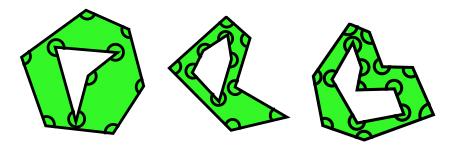
Michael introduced donut polygons:
131103_4

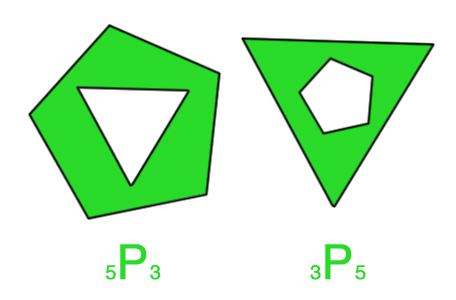
Finding the interior angle sum of a donut polygon makes the original task more challenging and more interesting at the same time. In particular, it has a great stinger at the end when you find out whether or not a triangle inside of a pentagon has the same angle sum as a pentagon inside of a triangle.
131103_9
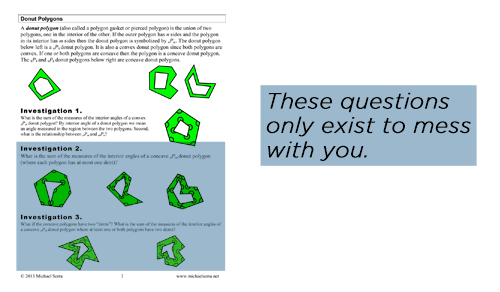
Michael had two questions at the end that asked, basically, “Do your conclusions hold if there’s a dent in the polygon?” Then, “What about two dents in the polygon?” This messed me up a little bit, because, no, it shouldn’t matter, but then why would Serra include the two questions? Basically, Serra had your correspondent feeling briefly but completely off balance.
0.2.HO.Polygon Potpourri.CMC-S.11.2.13

Featured Comment

Cates:

The absolute value was a pleasant surprise. Now I have ammunition when a student says, “When am I ever going to use absolute value?” “Well, when calculating the interior angles of a n-sided star polygon, of course.” ;)

Avery Pickford

Proof Doesn’t Begin With Geometry

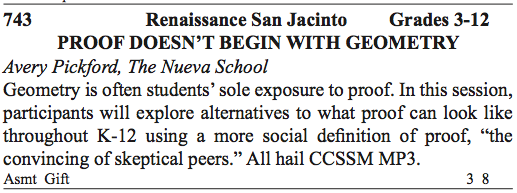
Avery wins the prize for Best Session Description by sneaking in the totally droll line, “All hail CCSSM MP3.”

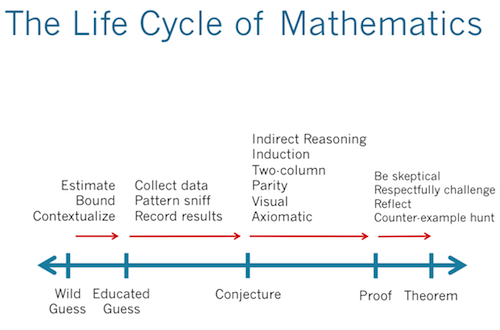
He briefly dinged two-column proofs, the Disaster Island where we usually sequester conjecture and argument. I’m all for broading and deepening the definition of proof but I think Avery stretched it too far to include skills like estimation and asking us to justify our answers to the Locker Problem. Is “justify your answer” any different than “prove your conjecture”?
131103_10

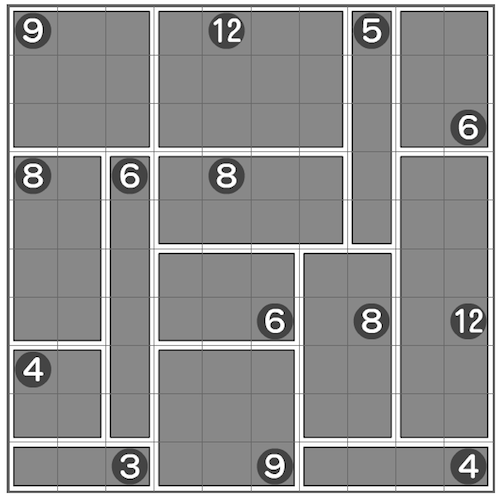
Later, he got into territory I found challenging and really well-thought-out. He showed how simple puzzles like Shikaku could be used to introduce the difference between axioms and theorems. He showed a Shikaku puzzle and its answer (below) and asked us, “What are the rules here?”
131103_11
“The numbers define the area of a rectangle” and “the side lengths of those rectangles are integers” are axioms, without which the game wouldn’t make any sense. Theorems are the consequences of the axioms, like “Prime-numbered areas result in long, skinny rectangles with side-length 1.”

He also used a variation on the old game Mastermind to create a class-wide context for conjecturing, contradicting, and proving. Great stuff. Wish you were here.

2013 Nov 4. Avery elaborates on all of this in a blog post.

2013 Nov 6. Avery continues his self-recap.

Brent Ferguson

Geometry, Numeracy, & Common Core: A Vigorous Hands-On Task

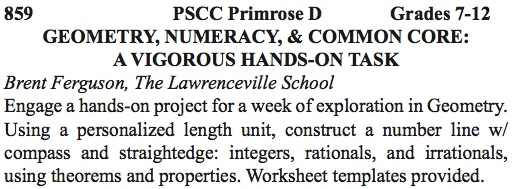
I didn’t actually attend Brent’s session, but he explained it to me in the coffee shop and I wished I had. Basically, you give your kids a number line with 0 and 1 marked off. What other numbers can they construct with a compass and a straightedge?

The other integers fall pretty quickly. A lot of irrational numbers fall when students learn the Pythagorean theorem. Trisecting an angle is impossible but trisecting a line is possible using similarity and the properties of parallel lines and the constructions are varied enough to be interesting.

This seemed like a task that could extend through a good stretch of a Geometry course, drawing in lots of conjecture and proof along with some good review of numbers and operations.

The odd thing: I found Brent’s personal description totally engrossing. But this is a really tough idea to sell in a 500-character workshop description.

Takeaway: I probably skip over loads of really interesting, but hard-to-describe sessions at conferences.

Mine
131103_13

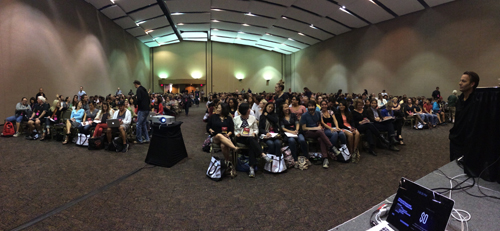
I’ll be giving this talk a few more times and then posting video here. I cited these resources. People were real nice to stop by even though it was the last session on a very pretty day. Thanks for the hospitality, everybody.
Great Classroom Action

131025_1

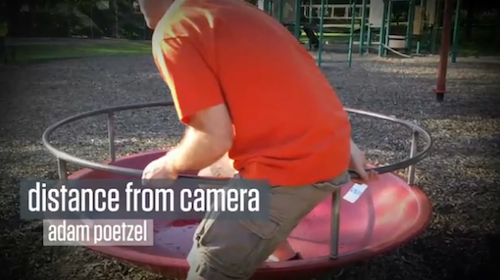
Cathy Yenca gives Graphing Stories a go and the going gets tough (and interesting) when she runs into Christopher Danielson’s step-function:

The last video we tried today was Ponies in Frame. I heard the most awesome muttering as soon as the video began. “Oh! I get it. This one’s discrete.” [..] It wasn’t all lollipops and rainbows. A comment laced with negativity that resonated with Lauren and me was an outburst that “graphing used to be so easy, and this just made it hard.” How would you take a comment like that? What does that comment say about the student’s true level of understanding?

Jonathan Newman has his students analyze parametric motion by creating stop-motion videos.

Nicora Placa reminds us that the one of the best ways to assess a student’s understanding of direct proportions is to give her an indirect proportion and see if she treats it directly.

At a workshop last week, the following task caused a bit of confusion. “If a small gear has 8 teeth and the big gear has 12 teeth and the small gear turns 96 times, how many times will the big gear turn?” Several participants were convinced it was 144.

Megan Schmidt uses one of the Visual Pattern tasks and surprises us (me, at least) with all the different interesting equivalent ways there are to express the pattern algebraically:

They came up with the following pre-simplified expressions for the nth step:

2n(n+1) + 3
1 + (n2 +n2) + (n+1) + (n+1)
2[n(n+1)] + 3
2n(n+1) + 3
3 + [(n+1)n] + [(n+1)n]
3+2(n+1) + 2[(n+1)(n-1)]
2n2 + 2n + 3

For each of these, I had the student put the expression on the board. I then had different students explain the thinking of the student who came up with the expression and relate it to the pictured pattern. I saw a real improvement here from when I had them do this activity the first time last week. I had many more students volunteer to explain the thinking of their cohorts and much less hesitation to work out what the terms in the expressions represented.

Lifeless School Geometry & Questions That Require Proof

Christopher Danielson:

School geometry seems to me one of the most lifeless topics in all of mathematics.

Paul Lockhart [pdf]:

All metaphor aside, geometry class is by far the most mentally and emotionally destructive component of the entire K-12 mathematics curriculum.

Proof is part of the problem. There’s no mathematical practice with a greater difference between how mathematicians practice it and how it’s practiced in schools, between how exhilarating it can be and how inert it is in schools, than proof.

Here’s Christopher Danielson offering us a way forward:

… eventually we reach a question that sort of requires proof; it seems true, but is non-obvious, and it has arisen from the questions we have been asking about how properties relate to each other.

Then they prove.

Questions that require proof are hard to create, hard to package in a textbook, and probably impossible to crowdsource. You’re trying to nail that point where the seemingly-true hasn’t yet turned into the obviously-true and that spot varies by the class and the student.

For example, “Square matrices are always invertible” might strike that enticing balance for one student while for another its truth is too obvious-seeming to be worth the effort of a proof and for others it’s too foreign for them to have an opinion on its truth one way or the other.

This is tricky, right? And Danielson offers us a description but not a prescription. He describes the satisfying proof process in his classroom but he doesn’t prescribe how to make it happen in ours.

Here’s one possible prescription:

  • Ask students to produce something given some simple, loose constraints. Draw any rectangle you want and then draw the diagonals. Choose any three consecutive whole numbers and add them up. Draw a triangle with three side lengths that the class chooses. Add up two odd numbers.
  • Publicly display their productions and ask your students what they notice. The diagonals seem like they’re the same length. The sums are always multiples of three. Our triangles all look the same. Our sums are all even.
  • Ask students to tell you why that should be true given what we already know.
  • Ask students what other questions we can ask given our newly proven knowledge.

“You people want students to recreate 10,000 years of mathematical knowledge,” says the math reform-critic.

No one I respect thinks students should discover all of geometry deductively. But as Harel, et al, say in a paper that has fast become the most meaningful to my current work:

It is useful for individuals to experience intellectual perturbations that are similar to those that resulted in the discovery of new knowledge.

To motivate a proof, students need to experience that “Wait. What?!” moment of perplexity, the moment where the seemingly-true has revealed itself, a perturbing moment experienced by so many mathematicians before them.

That’s more useful and more fun than the alternative:

130927_3

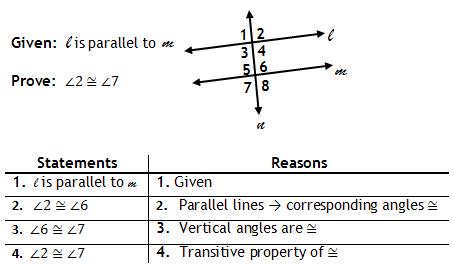
The problem here isn’t just the coffin-like two-column stricture. The proof doesn’t arise from “a question that requires proof” but from a statement that has been assigned. That statement makes no attempt to nail the gray, truthy area Danielson describes. It informs you in advance of its truth. It’s obviously true! You just have to say why. Tell me anything more lifeless than that.

BTW: Ben Orlin is great here also.

Great Classroom Action

131017_1

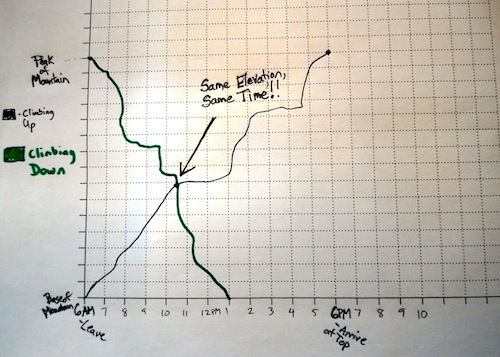
Nathaniel Highstein engineers a counterintuitive moment about graphing, one that subverts his students’ expectations and creates intellectual need for new knowledge:

I love this problem because the answer becomes totally clear when you make a time vs. elevation graph — and the answer violates nearly everyone’s expectations and leads to a surprise! Many students got stuck in their initial guess, and even when we went over together what the intersection of the two lines implied, they tried desperately to draw a version of the graph where the two lines didn’t intersect. When they figured out that even skydiving down wouldn’t work, some resorted to teleportation.

Option 1. Explain how to use place value.
Option 2. Explain how to use place value while first asserting its usefulness to humanity.
Option 3. Explain how to use place value while first putting students in a position to experience life without any kind of place value.

Anna Weltman took option three:

Three fingers is Na Na Na. But four fingers — now, that’s a lot of fingers. Na Na Na Na is quite a mouthful and it’s getting hard to tell the numbers apart. Here is where the cavemen bring in a new word. Na Na Na Na is Ba.

We continue counting. Ba Na, Ba Na Na (giggles), Ba Na Na Na — now what? The kids think until — Ba Ba, of course!

I remember Hung-Hsi Wu’s frustration with incomplete pattern problems. Paraphrasing him: “You can’t find the next term in the sequence ‘4, 10, 16, … ,’ because it could be anything.” He’s right, of course, but you can find a first term and Chris Hunter turns that fact into an icebreaker and a robust exercise in justification. He asks students to “Extend the pattern ‘Ann, Brad, Carol, … ,’ in as many ways as you can.”

Not mathy enough for you? Remember, not all teachers will have a positive attitude towards mathematics. This is a safe icebreaker. You can always follow it up with the mathier “Extend the pattern 5, 10, 15, … , in as many ways as you can.”

The first week of Exploring the Math Twitter Blogosphere asked teachers for their favorite tasks. Lots of people mentioned Four Fours. Megan Schmidt offers us an interesting cousin to that task and a useful description of what makes it effective for students.

The students also developed some interesting strategies, like grouping pairs that totaled 16 and 25. By the end of the 30 minutes, every single student had arrived at the correct solution. I’m not sure if it was the physical manipulative or the puzzle-like feel of the task, but I was so proud of this group of kids.

My guess: it’s the puzzle-like feel. (Extra credit: What makes a math task feel puzzling?)