Year: 2013

Total 117 Posts

The Digital Networked Textbook: Is It Any Different?

Let’s speculate that before this year’s cohort of first-year teachers retires from math education more than 50% of American classrooms will feature 1:1 technology. That’s a conservative prediction — both in the timeline and the percentage — and it’s more than enough to make me wonder what makes for good curricula in a 1:1 classroom. What are useful questions to ask?

Here’s the question I ask myself whenever I see new curricula crop up for digital networked devices like computer, laptops, tablets, and phones.

Is it any different?

That isn’t a rhetorical or abstract question. I mean it in two separate and specific ways.

Digital

If you print out each page of the digital networked curriculum, is it any different?
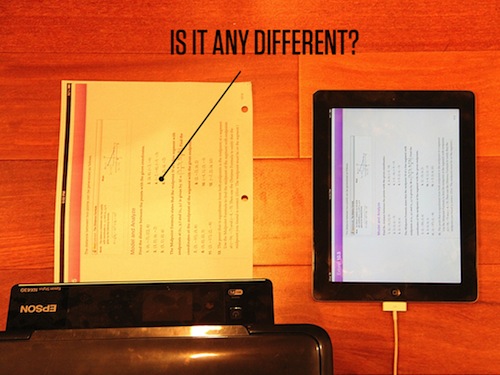
130921_2

The answer here is “sort of.”

When I look at iBooks in the iBookstore from Pearson and McGraw-Hill or when I see HMH publish their Algebra Fuse curriculum in the App Store, I see lots of features and, yes, they require a digital medium. They have a) interactive slider-type demonstrations, b) slideshows that walk students through worked examples, c) stock video in the margins instead of stock photography, d) graded multiple-choice quizzes, e) videos of Edward Burger explaining math concepts and f) probably other items I’m forgetting. None of those features would survive the downgrade to paper.

So the question becomes, “Is it different enough?”

Are these offerings different enough to justify the enormous expense in hardware, software, and bandwidth? Do they take full advantage of their digital birthright?

I don’t think so.

Networked

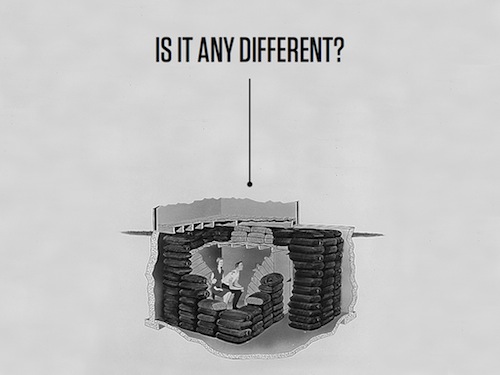
“Is it any different?” here means “if you were hundreds of feet below the surface of the Earth, in a concrete bunker without any kind of Internet access, is the curriculum any different?”
130921_3

Here, in September 2013, the answer is “no,” which is a shocking waste of very expensive, very powerful device.

Look at the apps you have on the home screen of your smartphone and ask yourself “how many of these are better because they have a large network of people using them?” Me, I have 12 apps on my homescreen and eight of them — Tweetbot, Messages, Instapaper, Instagram, Phone, Mail, Safari, Spotify — are so much better because of the crowd of people that use them with me. When I switch off my phone’s network connection, they get so much worse. Those are the apps I care most about also, the ones that enrich my life, the ones that justify the expense of a smartphone.

When you switch off the network connection, most curriculum stays exactly the same. It doesn’t suffer at all, which means it isn’t taking advantage of the network connection when it’s on.

More Different

Digital devices should allow you to:

  • Pose more interesting problems using more diverse media types and fewer words. (eg. three-act-style tasks).
  • Replace your textbooks’ corny illustrations of mathematical contexts with illustrations from their own lives. Students: find a trapezoid from your own life. Take a photo. Tap upload. Now it’s in your textbook.
  • Progressively disclose tasks over multiple screens so students don’t have to look at pages full of questions and information like this [pdf] and can instead start with a brief video and single sentence.

Networked devices should allow you to:

  • See all your friends’ illustrations from their own lives. The teacher should be able to see that gallery of trapezoids, promote certain illustrations, and offer comments on others that are visible to everybody.
  • Start lessons with integrated, formative polling. I’m talking about Riley Lark’s ActivePrompt software built right into the textbook.
  • Create student conversations. Use student data to find students who disagree with each other, pair them up, and have them work out their differences. All of that should happen without the teacher having to facilitate it because the device is smart.
  • Combine student data for better, more accurate modeling. (eg. Pennies, where each student collects a few data points which are then instantly collected into a much larger class data set.)

There are other possibilities, of course, some of which we’ll only start to realize as these tools are developed. But don’t just sit around and wait for an industry as reactive as textbook publishing to start making those tools for you. Publishers and their shareholders react to their market and that’s you. As long as they can still profit by repurposing existing print curriculum they will. It’s on you to tell your publishing reps that the curriculum they’re selling doesn’t do enough justice to the powerful, digital networked devices they’re putting them on. It isn’t different enough.

2013 Sep 27. And here’s LA Unified buying a billion dollars worth of iPads and then wasting the network that might make that investment worthwhile:

By Tuesday afternoon, L.A. Unified officials were weighing potential solutions. One would limit the tablets, when taken home, to curricular materials from the Pearson corporation, which are already installed. All other applications and Internet access would be turned off, according to a district “action plan.”

Featured Comment

Elizabeth Statmore:

This is always a problem in the early stages of a new technology. The “Technology Adoption Life Cycle” has proven itself over and over for the last 20 years to be the gold standard in analyzing tech markets.

The “innovators” adopt a technology because they need to be the first kids on their block to have whatever it is. The “early adopters” see strategic advantages and uses for it – and they are willing to put up with what they perceive as minor inconveniences like limited optimized uses in order to gain the advantages they seek.

That moment of “crossing the chasm” into the mainstream is that moment when a technology catches fire because vendors have figured out a way to reach beyond the techno-enthusiastic “early adopters” who have sustained their businesses to the techno-unimpressed “early majority” customers who are the major “show-me” skeptics. These skeptics form the first mass market for a technology, followed only later – and reluctantly – by a “late majority.”

Seems to me that we are still very much in an “early adopter” market in the race for digital textbooks. No one knows the “killer app” for digital curriculum is going to look like, but we do know it might bear some slight resemblance to the analog textbook. But this will not

As Steve Jobs always used to say, the “killer app” for the iPhone was making a phone call. But it was all the supporting infrastructure tht was built in (seamlessly integrated contacts, e-mail, texting, reminders, calendar, notes, & management of the technology) that transformed the act of making a phone call.
Pennies, Pearson, And The Mistakes You Never See Coming

I took machine-graded learning to task earlier this week for obscuring interesting student misconceptions. Kristen DiCerbo at Pearson’s Research and Innovation Network picked up my post and argued I was too pessimistic about machine-graded systems, posing this scenario:

Students in the class are sitting at individual computers working through a game that introduces basic algebra courses. Ms. Reynolds looks at the alert on her tablet and sees four students with the “letters misconception” sign. She taps “work sample” and the tablet brings up their work on a problem. She notes that all four seem to be thinking that there are rules for determining which number a letter stands for in an algebraic expression. She taps the four of them on the shoulder and brings them over to a small table while bringing up a discussion prompt. She proceeds to walk them through discussion of examples that lead them to conclude the value of the letters change across problems and are not determined by rules like “c = 3 because c is the third letter of the alphabet.”

My guess is we’re decades, not years, away from this kind of classroom. If it’s possible at all. Three items in this scenario seem implausible:

  • That four students in a classroom might assume “c = 3 because c is the third letter of the alphabet.” I taught Algebra for six years and never saw this conception of variables. (Okay, this isn’t a big deal.)
  • That a teacher has the mental bandwidth to manage a classroom of thirty students and keep an eye on her iPad’s Misconception Monitor. Not long ago I begged people on Twitter to tell me how they were using learning dashboards in the classroom. Everyone said they were too demanding. They used them at home for planning purposes. This isn’t because teachers are incapable but because the job demands too much attention.
  • That the machine grading is that good. The system DiCerbo proposes is scanning and analyzing handwritten student work in real-time, weighing them against a database of misconceptions, and pairing those up with a scripted discussion. Like I said: decades, if ever.

This also means you have to anticipate all the misconceptions in advance, which is tough under the best of circumstances. Take Pennies. Even though I’ve taught it several times, I still couldn’t anticipate all the interesting misconceptions.

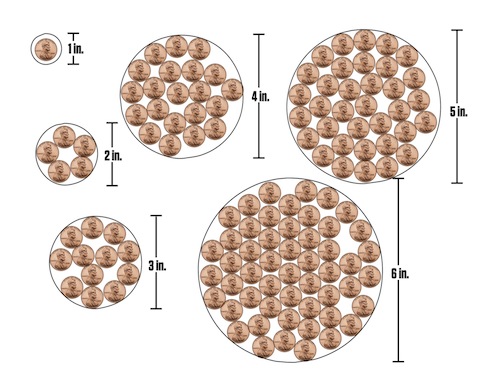
The Desmos crew and I had students using smaller circles full of pennies to predict how many pennies fit in a 22-inch circle.

131003_1

But I can see now we messed that up. We sent students straight from filling circles with pennies to plotting them and fitting a graph. We closed off some very interesting right and wrong ways to think about those circles of pennies.

Some examples from reader Karlene Steelman via e-mail:

They tried finding a pattern with the smaller circles that were given, they added up the 1 inch circle 22 times, they combine the 6, 5, 4, 3, 2, 1, and 1 circles to equal 22 inches, they figured out the area of several circles and set up proportions between the area and the number of pennies, etc. It was wonderful for them to discuss the merits and drawbacks of the different methods.

Adding the 1-inch circle 22 times! I never saw that coming. Our system closed off that path before students had the chance even to express their preference for it.

So everyone has a different, difficult job to do here, with different criteria for success. The measure of the machine-graded system is whether it makes those student ideas invisible or visible. The measure of the teacher is whether she knows what to do with them or not. Only the teacher’s job is possible now.

Featured Comments

Sue Hellman:

This doesn’t even touch the students who get questions RIGHT for the wrong reasons.

Dave Major:

Dashboards of the traditional ‘spawn of Satan & Clippy the Excel assistant’ sort throw way too much extremely specific information straight to the surface for my liking (and brain). That information is almost always things that are easy for machines (read. programmers) to work out, and likely hard or time consuming yet dubiously useful for humans to do. I wonder how many teachers, when frozen in time mid-lesson and placed in the brain deli slicer would be thinking “Jimmy has 89% of this task correct and Sally has only highlighted four sentences on this page.”

[Future Text] Math Cache

a/k/a Great Moments in Digital Networked Math Curricula

You Should Check Out

Math Caching and Immediately Useful Teaching Data from Evan Weinberg.

What It Is

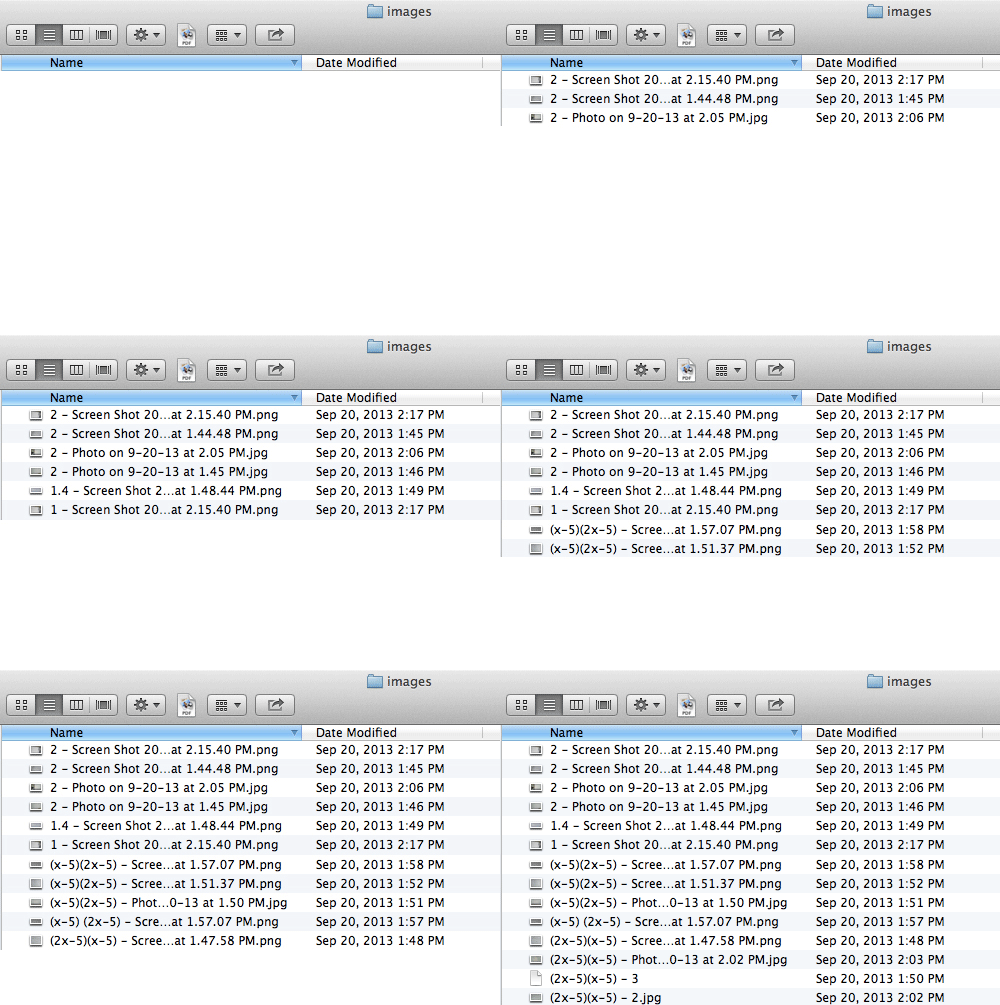
Evan has his students working on some practice exercises. As they complete their exercises, they use their Macbooks to submit a) an answer (which is nothing new in a world driven by quantitative machine-graded data) but also b) a photo of their work.

The images are titled with their answers and then start populating a folder on Evan’s computer.

130928_1

Why It’s Important

Mistakes are valuable. Student work is valuable. This collects both quickly.

Mistakes are valuable for starting conversations, for prompting to students to construct and justify arguments, for asking students, “What different question does this work correctly answer?”

Most machine-graded systems hold back students with wrong answers and let them advance once they’ve corrected their errors. But this essentially sweeps clear the brambly trail that led to that correct answer when there’s so much value in the brambles. Those systems don’t tell you why the student had those incorrect answers. They don’t allow the teacher to sequence and select incorrect student work for productive discussions later. Math Cache does.

Here’s Evan:

I didn’t need to throw out the tragically predictable ‘who wants to share their work’ to a class of students that don’t tend to want to share for all sorts of valid reasons. I didn’t have to cold call a student to reluctantly show what he or she did for the problem. I had their work and could hand pick what I wanted to share with the class while maintaining their anonymity. We could quickly look at multiple students’ work and talk about the positive aspects of each one, while highlighting ways to make it even better.

Somewhat Related:

Nicora Placa:

A main assumption that I work with when doing these [student] interviews is that children do what makes sense to them even if it seems like nonsense to me. My job is to figure out what makes sense to them and why.

2013 Oct 2. Pearson’s research blog picks up this post and argues that I’m too pessimistic about machine-graded data.

[Future Text] Des-man

a/k/a Great Moments in Digital Networked Math Curricula

You Should Check Out

Des-man: a Desmos Labs Project.

What It Is

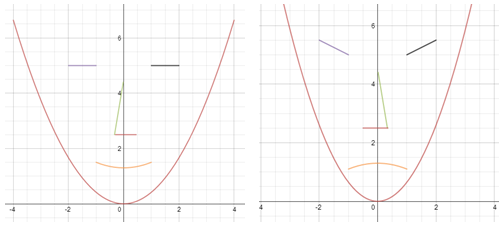
First, you had Fawn Nguyen’s assignment where students created a face using the Desmos graphing calculator.

130925_1

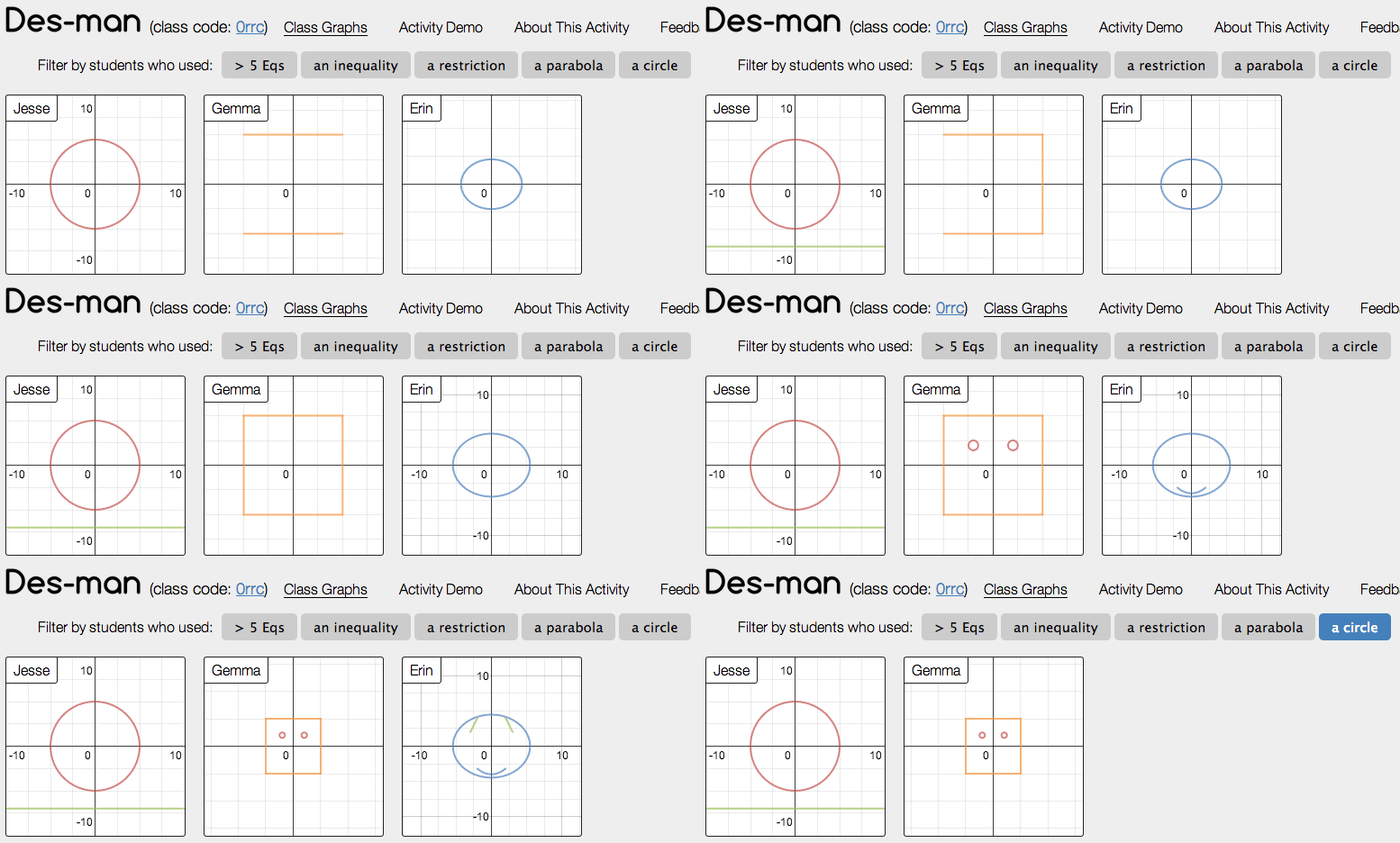
Students reviewed conics and domain and range. That was a blast for a lot of reasons. Now Desmos has created a system where the teacher can quickly see the creation of the faces in real-time and use filters to sort quickly through student work in productive ways.

130928_2lo

Why It’s Important

Des-man explores the potential of networked devices in math class.

You could download the Desmos iOS app, flip off your iPad’s Internet connection, and still have a good time creating your Des-man. If the experience of using a digital math curriculum doesn’t get any better when you turn on the Internet, it is wasting the Internet.

With Des-man, an Internet connection lets you see all your friends’ Des-men instantly, as they’re being drawn. It lets the teacher see the Des-men quickly too and then select and sequence them in productive ways.

We have here a math activity for networked devices that doesn’t waste the network. That shouldn’t be noteworthy, but it is.

Great Classroom Action

130927_1

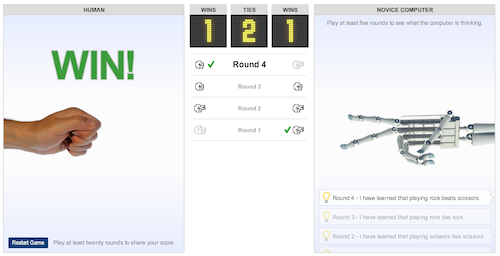
Bob Lochel has his statistics students take a “Rock, Paper, Scissors” prediction robot down:

Anyway, the NY Times online Science section has shared an online game of “Rock, Paper, Scissors”, where you can play against a choice of computer opponents. The “Novice” opponent has no understanding of your previous moves or stratgey. But, the “Veteran” option has gathered data on over 200,00 moves, and will try to use its database to crush your spirit Here’s what we did.

Sarah Hagan links up the definition of a function to dating advice:

After this short conversation, I think I saw some light-bulbs come on. There was laughter, and I heard several girls discussing how they were going to ask the next guy they were interested in if he was a function or non-function. They decided this was problematic, though, because he wouldn’t know what they were talking about if he hadn’t taken Algebra 2.

Campaigns for “Literacy / Numeracy Across The Curriculum” always seem to wind up a joyless exercise in box-checking for teachers outside those disciplines, but Bruce Ferrington’s school approached schoolwide numeracy with some whimsy:

The boss has decided that teachers are going to wear a number around their necks. No, we are not all convicts doing time. It’s a cunning plan to get the kids to look at numbers in new ways. The whole idea is that the students are not allowed to use the names of the teachers. They need to call them by a number combination or calculation that equals their number.

Bryan Meyer takes a rote numerical calculation (multiplying numbers in scientific notation) and adds several mathematical practices with an extremely canny, extremely simple makeover:

We decided that if we wanted kids to talk, they needed to have something rich and complex to talk about and make sense of. After brainstorming some different options, we turned the computational question into a conceptual one.