a/k/a [Makeover] Painted Cubes (See preview.)
That’s a very helpful comment from, Alyssa Boike, a recent workshop participant. Textbooks don’t have that same luxury.
Here’s an example. Watch how Connected Mathematics treats the classic Painted Cube problem:

Here are elements the textbook has already added:
- A central question. (“How many faces of the little cubes have been painted?”)
- A strategy. (“Look at smaller versions of the cube.” It also tells you by omission that it’s impossible to find more than three faces painted.)
- A table. (For organizing your data.)
- Table column headings. (Edge length, total cubes, total cubes of each kind.)
If you subtract those elements and add them in later, you get to ask interesting questions and host interesting conversations with your students. Like this:
-
A central question. (“What questions do you have about Leon and his cube?” And later: “Guess how many cubes don’t have any paint on them at all?”) -
A strategy. (“What are all the possibilities for the number of faces that could have paint on them? Could five faces have paint on them? Can I tell you how mathematicians work on big problems? They look at smaller versions of the big problem. What would that look like here?”) -
A table. (“All of the numbers from our smaller versions are getting out of control. How can we organize all these loose numbers?”) -
Table column headings. (“What kind of data should we look at? What about these cubes seems important enough to keep track of?”)
You can always add those elements into the problem — the questions, the information, the mathematical structures, the strategy — as your students struggle and need help. But you can’t subtract them.
Once your students see the table, you can’t ask, “What tool could we use to organize ourselves?” The answer has been given. Once they see the table headings, you can’t ask, “What quantities seem important to keep track of in the table?” They know now. Once you add the strategy (“Look at smaller versions.”) their answers to the question “What strategies could we use?” won’t be as interesting.
In sum, much of the problem has been pre-formulated, which is a pity, seeing as how mathematicians and cognitive psychologists and education researchers agree that formulating the problem leads to success and interest in solving the problem.
So again I have to remind myself to be less helpful and be more thoughtful instead.
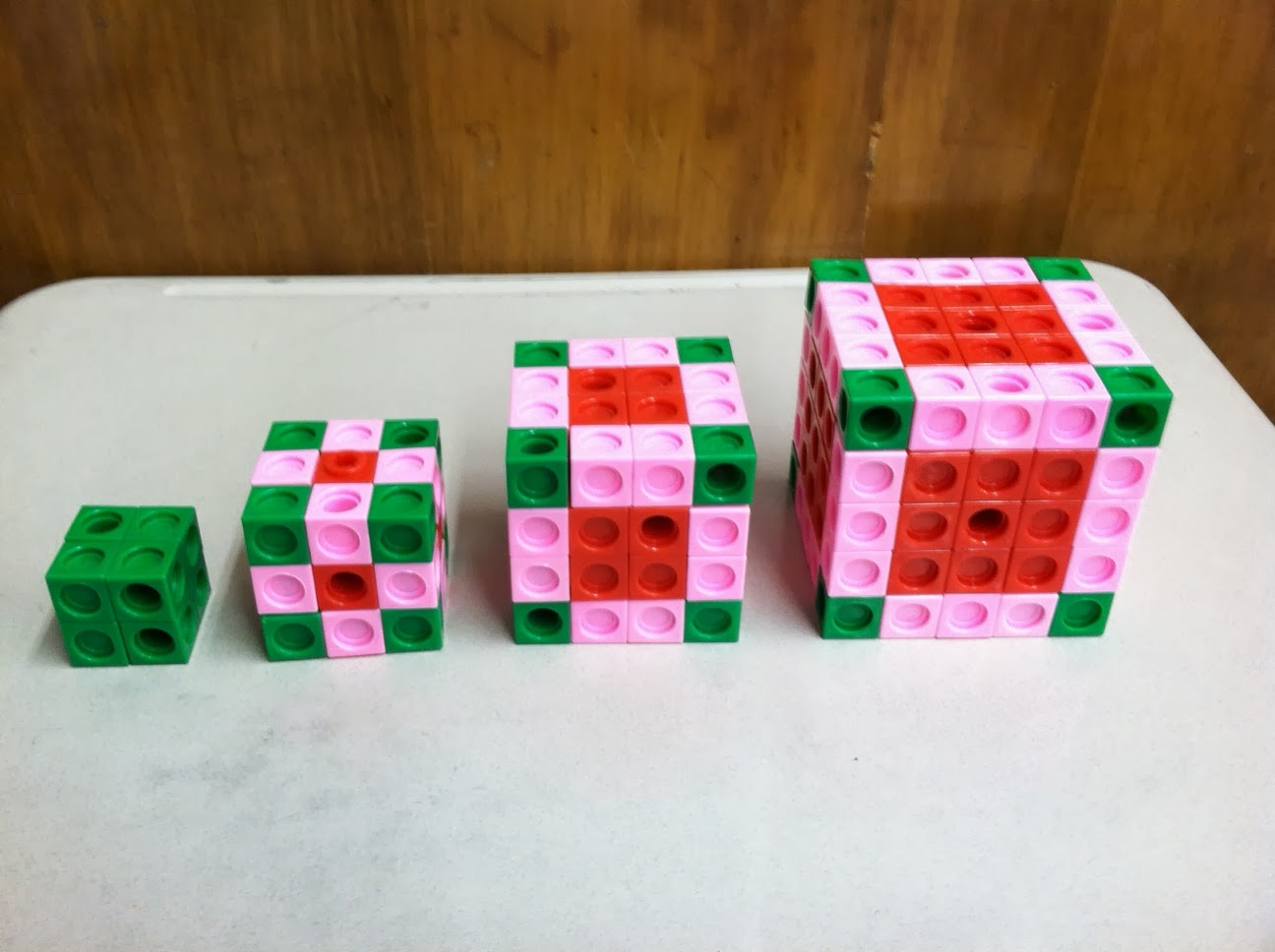
BTW. Of course I’m partial to Nicole Paris’ setup of the task:
Great Help From The Comments
I’m reprinting Bryan Meyer’s entire comment:
I don’t know that I have anything terribly insightful to add, but this seems like a fun conversation.
I don’t really see too much that is wrong with the problem/puzzle itself, which (to me) is something like:
I have this cube (show picture/tangible) made up of smaller cubes. If I dipped the whole thing in paint, how many of the smaller cubes would have paint on them? Is there a rule or shortcut we can create that would allow us to answer that question for ANY sized cube?
To me, the issue seems to be that the version we see in your blog post attempts to steer the direction of student thinking and leaves little room for play and divergent thinking/approaches. It “scaffolds” away all of the rich mathematical thinking and play in an attempt to cover standards. In particular, the unspoken assumption in the way it has been printed is that writing and graphing linear, quadratic, and exponential functions is the real “Math” in the task (things we can easily point to as belonging to the discipline/standards).
But, at it’s core and without all the mechanical scaffolding (as re-posed here), the question allows room for many mathematical strengths and habits of mind to be valued and sends different messages about what the real “math” might be: taking things apart and putting them back together, creating systems of organization, assigning variables, making generalizations, posing extension questions, etc. In addition, because it doesn’t dictate how to proceed, it encourages students to trust their own thinking and allows them to “see themselves” in the work that develops. The work of the teacher becomes to follow the student, looking for mathematically ripe opportunities in their work and thinking.
2014 Jun 2. Christopher Danielson brings his perspective to the task as writer of CMP.
2015 Nov 2. Great example from Jennifer Michaelis.