Year: 2015

Total 50 Posts

Announcing The Winner Of Our Fall Contest

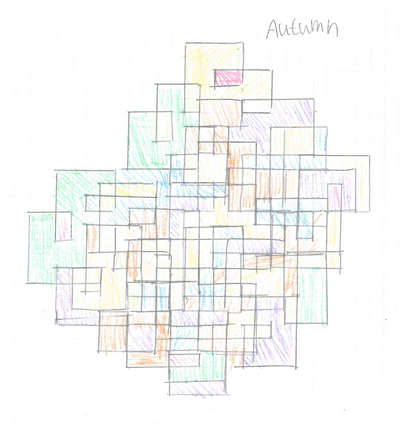
I received about one hundred loop-de-loops from teachers, parents, and students from several different countries. It took me an hour to take in all the awesome eye candy, which included dioramas, videos, 3D loop-de-loops made from snap cubes, and more. I pulled out my five favorites and sent them to three judges who I think embody the best of creativity in mathematics.

The Judges

  • Malke Rosenfeld, who uses dance and choreography to explore mathematical thinking.
  • George Hart, a research mathematician who also sculpts using geometry as his medium.
  • Michael Serra, author of Discovering Geometry, a geometry textbook infused from the front cover to the back with Michael’s love for math and art.

Five Finalists

Autumn, from Angela Ensminger’s class:
151012_4

Theo, from Alice Hsiao’s class:

151012_3

Trish Kreb’s seventh grade student:

151012_2

John Grade & his daughter:

151012_1

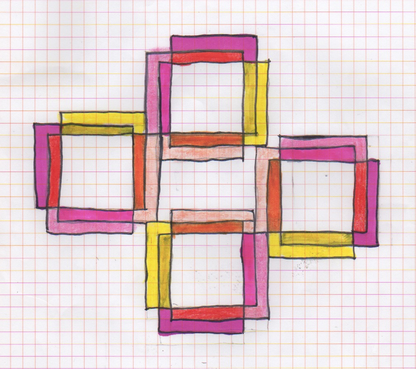
Maddie Bordelon and her math art team, “Right Up Left Down”:
151012_5

[BTW. In an early draft of this post, I reversed the second and third prize winners. Mistakes were made. Apologies have been issued.]

Third Prize

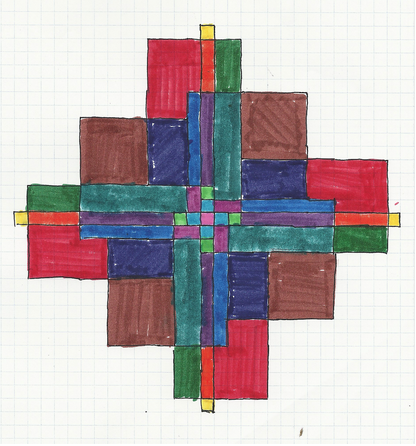
Third prize, which is a medium-intensity high five delivered if we ever meet, and one copy of Weltman’s book, goes to Maddie Bordelon and her math art team, “Right Up Left Down.”

151012_5

Second Prize

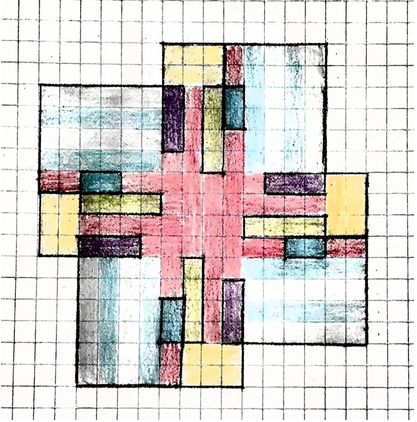
Second prize, which is sustained applause in a crowded, quiet room, and five copies of Weltman’s book, goes to Theo from Alice Hsiao’s class:

151012_3

One judge wrote:

[E] completely holds my attention. The coloring choices pull me in and highlight the patterns and structure in a way that fascinates me. The long bands of white, blue and grey make a fantastic contrast to the brighter colors closer to the middle, which are also the shorter segments in the design. And, the bold outlines pull out the structure even more. I don’t know if it was intentional, but the overall effect of hand-coloring plus scanning the image made for a lovely final effect.

First Prize

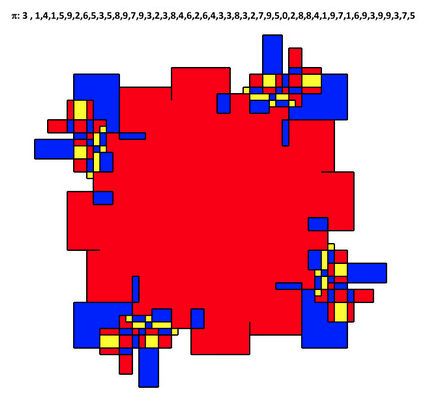
First prize, which is 40 copies of Anna Weltman’s awesome book, goes to John Grade & his daughter.

[2015 Oct 12. John Grade is graciously passing his first prize down to the second prize winner.]

151012_1

Our judges wrote about John Grade’s loop-de-loop:

It is very well constructed, brilliant use of color, and the number pattern chosen is pretty special.

A nice experiment to try Pi and see if a visible pattern emerges.

Congratulations, everybody.

Honorable Mention

I loved seeing students conjecturing mathematically about loop-de-loops, asking each other which ones converge and diverge, trying to predict the patterns they’d find in different strings of numbers. (See: Denise Gaskin’s comment for one example.)

Also, The Nerdery really sank its teeth into this assignment. This blog’s collection of programmer-types produced some great loop-de-loop visualizations:

Four Animated GIFs Of The Same Awesome Problem

Here is the original Malcolm Swan task, which I love:

Draw a shape on squared paper and plot a point to show its perimeter and area. Which points on the grid represent squares, rectangles, etc? Draw a shape that may be represented by the point (4, 12) or (12, 4). Find all the โ€œimpossibleโ€ points.

We could talk about adding a context here, but a change of that magnitude would prevent a precise conversation about pedagogy. It’d be like comparing tigers to penguins. We’d learn some high-level differences between quadripeds and bipeds, but comparing tigers to lions, jaguars, and cheetahs gets us down into the details. That’s where I’d like to be with this discussion.

So look at these four representations of the task. What features of the math do they reveal and conceal? What are their advantages and disadvantages?

Paper & Pencil

You’ve met.

paper-pencil

Dan Anderson’s Processing Animation

Hit run on this sketch and watch random rectangles graph themselves.

processing

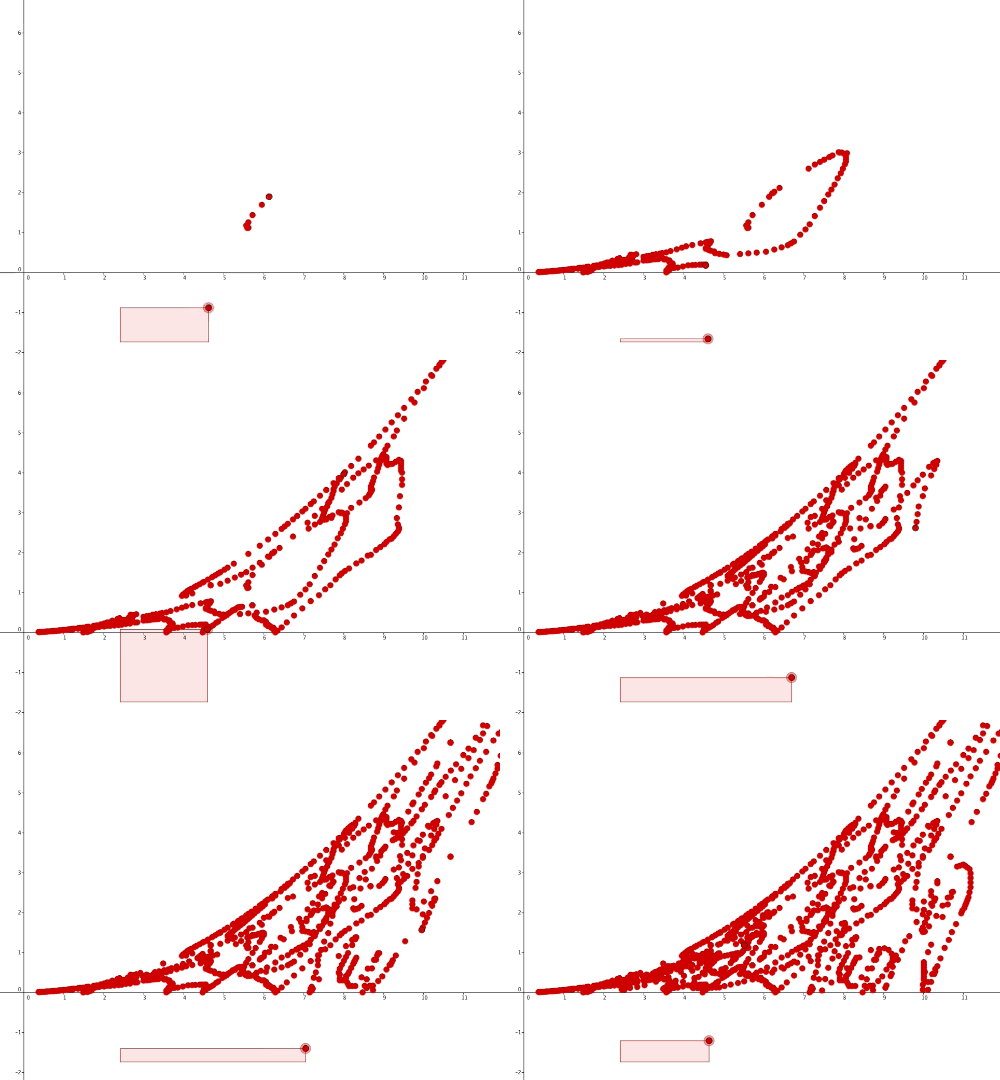
Scott Farrar’s Geogebra Applet

Students click and drag the corner of a rectangle in this applet and the corresponding point traces on the screen.

geogebra

Desmos’ Activity

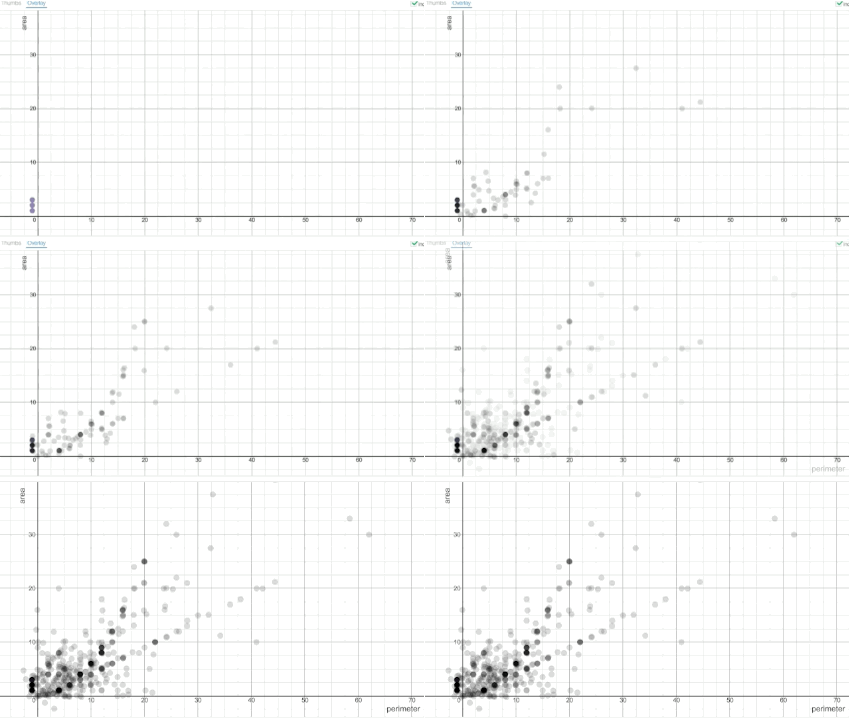
277 people on Twitter responded to my prompt:

Draw three rectangles on paper or imagine them. Choose at least one that you think that no one else will think of. Drag one point onto the graph for each rectangle so that the x-coordinate represents its perimeter and the y-coordinate represents its area.

Resulting in this activity on the overlay:

desmos

Again: what features of the math do they reveal and conceal? What are their advantages and disadvantages?

September Remainders

Quick programming note: our Loop-de-Loop contest ends 10/6 at 11:59 PM Pacific Time.

New Blog Subscriptions

New Twitter Follows

Commenters I Wish Had A Blog / Twitter Account / Zine / Etc.

Our Fall Contest & This Is Not A Math Book

2015 Oct 14. Announcing the winners.

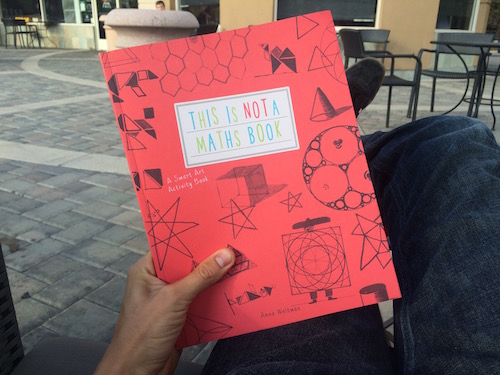
150928_1

You should buy Anna Weltman’s new math book, This is not a Math Book.

You should buy several, probably, for all the little people in your life who are deciding right now what they think about math and what math thinks about them. If they’re taking their cues on that decision from someone who dislikes math or who dislikes little people, consider using This is not a Math Book for counterweight.

You’ll find dozens of pages of math art, math sketches, math reasoning, and math whimsy. I read it in one sitting outside a coffee shop one afternoon, big dumb smile on my face the whole time. Actually finishing the book, fully participating in Weltman’s assignments of creativity and invention, will take many more afternoons.

I’d like to send one of you a class set of Weltman’s book. Here is how you get it:

  • I love Weltman’s Loop-de-Loop assignment. It lends itself to some of my favorite mental mathematical acts around prediction, sequencing, transformation, and questions like “what if?” So you or your students or all of the above should make an awesome Loop-de-Loop. (Here is Weltman’s instruction page and her student work page, but any piece of graph paper will work.)
  • Scan and send it to ddmeyer+loop@gmail.com.
  • I’ll pick my five favorites and ask some of my favorite math artist friends to pick the winner from those five. Winner takes all, which is to say 40 copies of This is not a Math Book, from me to you.
  • Contest ends 10/6 at 11:59 PM Pacific Time.

Drawings, color, character work, mixed media, it’s all fair game. I can’t wait.

BTW. Over the next several days, Weltman is blogging interesting questions to ask your students about Loop-de-Loops.

Featured Tweets

Yes, do that!

Yes, do that!

Got your back.

The Math Problem That 1,000 Math Teachers Couldn’t Solve

I spent a year working on Dandy Candies with around 1,000 educators.

In my workshops, once I stop learning through a particular problem, either learning about mathematics or mathematics education, I move on to a new problem. In my year with Dandy Candies, there was one question that none of us solved, even in a crowd that included mathematics professors and Presidential teaching awardees. So now I’ll put that question to you.

Here is the setup.

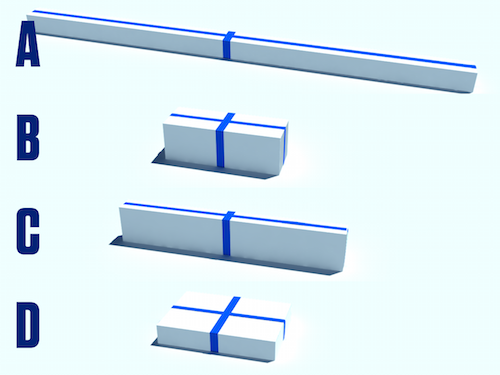
At the start of the task, I ask teachers to eyeball the following four packages. I ask them to decide which package uses the least packaging.

150924_1

With the problem in this state, without dimensions or other information, lots of questions are available to us that numbers and dimensions will eventually foreclose. Teachers estimate and predict. They wonder how many unit cubes are contained in the packages. They wonder about descriptors like “least” and “packaging.”

After those questions have their moment, I tell the teachers there are 24 unit cubes inside each package. Eventually, teachers calculate that package B has the least surface area, with dimensions 6 x 2 x 2.

We then extend the problem. Is there an even better way to package 24 unit cubes in a rectangular solid than the four I have selected? It turns out there is: 4 x 3 x 2. When pressed to justify why this package is best and none better will be found, many math teachers claim that this package is the “closest to a cube” we can form given integer factors of 24.

150924_2

The Problem We Never Solved

We then generalize the problem further to any number of candies. I tell them that as the CEO of Dandy Candies (DANdy Candies … get it?!) I want to take any number of candies โ€” 15, 19, 100, 120, 1,000,000, whatever โ€”ร‚ย and use an easy, efficient algorithm to determine the package that uses the least materials.

Two solutions we reject fairly quickly:

  1. Take your number.
  2. Write down all the sets of dimensions that multiply to that number.
  3. Calculate the packaging for that set of dimensions.
  4. Write down the set that uses the least packaging.

And:

  1. Take your number.
  2. Have a computer do the previous work.

I need a rule of thumb. A series of steps that are intuitive and quick and that reveal the best package. And we never found one.

Here was an early suggestion.

  1. Take your number.
  2. Write down all of its prime factors from least to greatest.
  3. If there are three or fewer prime factors, your dimensions are pretty easy to figure out.
  4. If there are four or more factors, replace the two smallest factors with their product.
  5. Repeat step four until you have just three factors.

This returned 4 x 3 x 2 for 24 unit candies, which is correct. It returned 4 x 5 x 5 for 100 unit candies, which is also correct. For 1,000 unit candies, though, 10 x 10 x 10 is clearly the most cube-like, but this algorithm returned 5 x 8 x 25.

One might think this was pretty dispiriting for workshop attendees. In point of fact it connected all of these attendees to each other across time and location and it connected them to the mathematical practice of “constructing viable arguments” (as the CCSS calls it) and “hypothesis wrecking” (as David Cox calls it).

These teachers would test their algorithms using known information (like 24, 100, and 1,000 above) and once they felt confident, they’d submit their algorithm to the group for critique. The group would critique the algorithm, as would I, and invariably, one algorithm would resist all of our criticism.

That group would name their algorithm (eg. “The Snowball Method” above, soon replaced by “The Rainbow Method”) and I’d take down the email address of one of the group’s members. Then I’d ask the attendees in every other workshop to critique that algorithm.

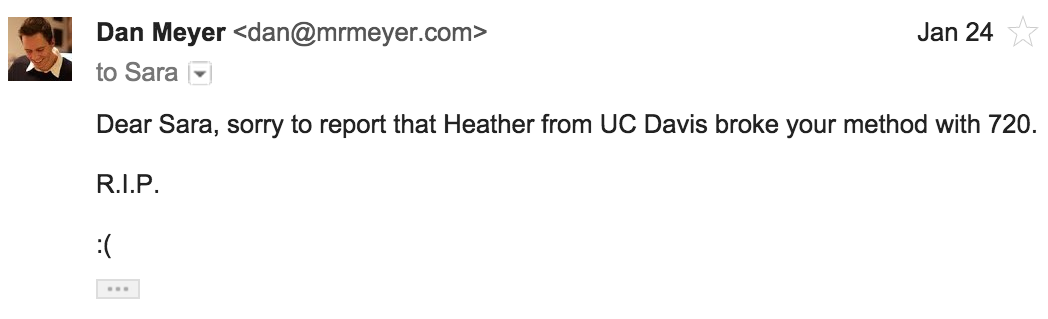
Once someone successfully critiqued the algorithm โ€” and every single algorithm has been successfully critiqued โ€” we emailed the author and alerted her. Subject line: RIP Your Algorithm.

150924_3lo

So now I invite the readers of this blog to do what I and all the teachers I met last year couldn’t do. Write an algorithm and show us how it would work on 24 or another number. Then check out other people’s algorithms and try to wreck them.

Featured Comment

Big ups to Addison for proposing an algorithm and then, several comments later, wrecking it.

2015 Sep 25

We’re all witnessing incredible invention in this thread. To help you test the algorithm you’re about to propose, let me summarize the different counterexamples to different rules found so far.

20 should return 5 x 2 x 2
26 should return 13 x 2 x 1
28 should return 2 x 2 x 7
68 should return 2 x 2 x 17
222 should return 37 x 3 x 2
544 should return 4 x 8 x 17
720 should return 8 x 9 x 10
747 should return 3 x 3 x 83
16,807 should give 49 x 49 x 7
54,432 should return 36 x 36 x 42
74,634 should give 6 x 7 x 1777