In the comments, Marilyn Burns distinguishes knowledge students should be told from knowledge they can reason through:
Explicit instruction (teaching by telling?) is appropriate, even necessary, when the knowledge is based in a social convention. Then I feel that I need to “cover” the curriculum. We celebrate Thanksgiving on a Thursday, and that knowledge isn’t something a person would have access to through reasoning without external input”•from another person or a media source. There’s no logic in the knowledge. But when we want students to develop understanding of mathematical relationships, then I feel I need to “uncover” the curriculum.
Chester Draws responds and asks a question which I’ll extend to anyone who takes a similar view of direct instruction:
You expect student to “uncover” calculus?
Do constructivist teachers quietly just directly instruct such topics? Do they teach them, but pretend the students found them out for themselves? I can’t even begin to imagine how I could teach the derivative through constructivist techniques.
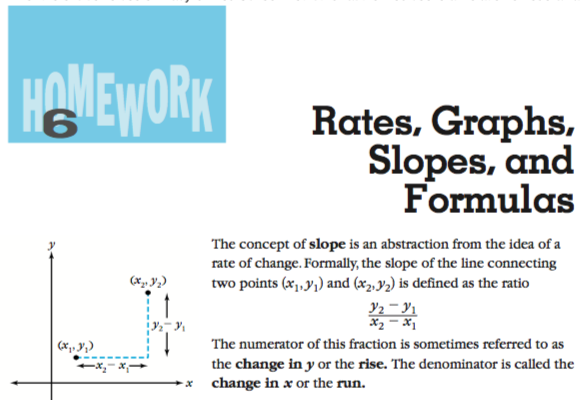
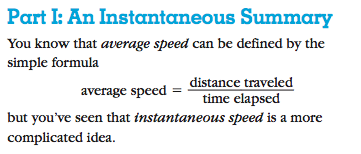
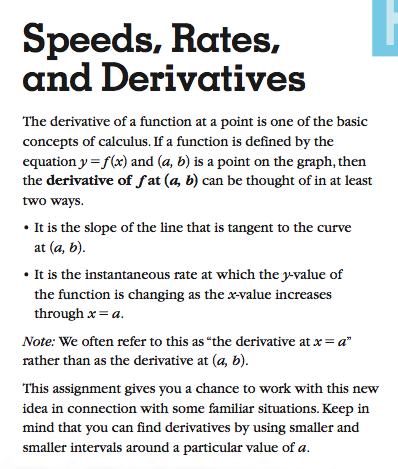
Brian Lawler responds that, yes, it’s possible to teach calculus without direct instruction, and offers up his Interactive Mathematics Program Year 3 unit “Small World” as evidence. Pulling out my copy of IMP, though, I find pages in the Small World unit that directly instruct students in the calculation of slope, the calculation of average rate of change, and the definition of the derivative. This appears to answer Chester’s question, “Do constructivist teachers quietly just directly instruct for such topics?”
So I hope Marilyn and anybody else with similar ideas about direct instruction will take up Chester’s question with force. It’s an important one, and mandates like “uncover the curriculum” seem more descriptive of philosophy than practice.
It’s worth pointing out in closing that this direct instruction in IMP is preceded in each case by activities through which students develop informal and intuitive understandings of the formal ideas. This is in the neighborhood of pedagogy endorsed by How People Learn, which, again, you should all read. It just isn’t the example of direct instruction-less calculus Lawler seems to think it is.
BTW. Clarifying, because I’m frequently misinterpreted: I don’t think learning calculus without direct instruction is logistically possible over anything close to a school year, or that it’s philosophically desirable even if it were possible.
BTW. Elizabeth Statmore offers an excellent summary of the pedagogical recommendations in How People Learn.
BTW. Chester references “constructivist teachers.” Anybody who sniffs back at him that “constructivism is actually a theory of learning, not teaching” gets week-old sushi in their mailbox from me. I think his meaning is clear.
Featured Comment
I consider CPM pretty strongly constructivist, and I am currently LOVING that calculus program. My kids are generating much better insights and dialogues around calculus than I have seen with other programs and what I am seeing suggests much better expected results on the AP exam. Don’t know if it is sufficiently pure to pass the “no instruction evar!” test that you seem to be using.
Also, it is probably worth noting that the VAST majority of AP workshops are centered around making instruction more constructivist, because the typical textbook presentation is so MASSIVELY DI. That makes this whole conversation feel like it is taking place in some bizarro universe. The question I tend to find myself asking is this:
“You expect students to understand calculus when taught using only DI?
Do traditionalist instructors just quietly slip in investigations, but pretend the students figured things out from their amazing lectures? I can’t even imagine how I would teach derivatives without heavy exploration of finite differences, secant and tangent lines, and distance/time vs velocity/time graphs.”
No matter what anyone says, “uncovering curriculum” is just discovery learning & concept formation in a different cloak. I started teaching back in the 1970’s when this method was in full bloom. Once we’d set the stage for ‘aha moments’ of understanding to occur, we let the struggle ensue. We were limited to asking a learner nudging questions, redirecting his/her efforts in a more fruitful direction when the chosen path was a dead end, and simplifying the problem so he/she’d trip over the gem. As one after another student ‘got it’, we imagined we could hear a series of little light bulbs popping on over their heads until the light of understanding in the room was blinding!
The problem was that it’s impossible to be at every student’s side to ask just the right question at just the right moment all at the same time in a class of 25 or 30. First discoverers would end up telling their more baffled peers the secrets (hidden direct instruction). Some of the really lost got direct instruction from older siblings or parents.
The awful thing was that students who didn’t get it couldn’t turn to the teacher for help, because they’d only get more questions & more ‘lead up’ to the place where the leap of understanding had to be made. Direct questions were not to be met with direct answers. The teacher didn’t believe in telling.
And that’s the sort of dishonest thing about this method. The teacher has all the secrets. Everyone knows this is the case. The students’s job becomes finding and digging up treasure. For a some this is an act of learning. For many it’s like being in an elaborate guessing game with the prize of enlightenment denied those who are not capable players. The teacher had all the secrets but never tells.
But what many teachers don’t get is that taking students through a process of discovering Uncovering those secrets is not the same as constructing personal understanding. And they also don’t factor into the learning experience the fact that direct instruction is everywhere. If you won’t share the secrets & homework has to be done, kids will ‘uncover’ up what they need online. Kids can circumvent your process with the tap of a finger if it will get them what they (or their parents) believe they need.
Although deepening understanding is the goal, getting a toehold on being able to do some stuff can be a great place to start. How many of us who drive have a deep understanding of the physics, chemistry, and engineering that makes up our vehicles? Yet we can use them skillfully to solve problems. The same goes for cooking. If you can follow a recipe you can feed your family – which is a pretty fantastic result achieved without understanding how & why the recipe works. There’s nothing wrong with passing on knowledge and then getting on with helping kids learn how to apply it confidently and in a broad range of circumstances.
As teachers, it’s our job to pack our tool boxes with as broad a range of strategies as possible so we can help each kid forge the connection of skill development & growth of understanding. I urge colleagues not to become so enamored with one approach that they become ‘one trick ponies’. I fear it will not serve you or your kids well in the long run.