Mark Chubb, today on Twitter:
If a teacher sees students as disengaged and not liking math, what would be one good thing to watch, one good thing to read, one good thing to try?
Watch: Beyond Relevance & Real World.
Read: Why Don’t Students Like School?
Try: Estimation180.
Andrea Davis, later today in the comments:
Will you please give me the top three pieces of advice you have for the teachers of our youngest learners? We are K-6 and want to start now.
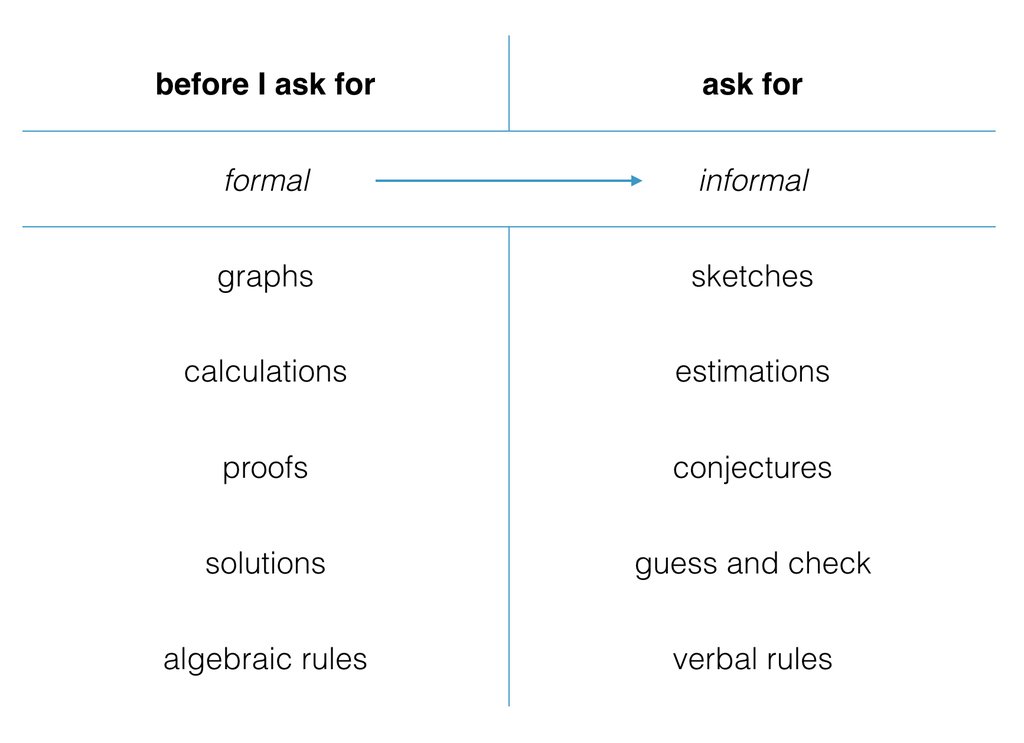
One, ask informal, relational questions (questioning, estimating, arguing, defining, etc.) as often as formal, operational questions (solving, calculating, simplifying).
Two, pose problems that have gaps in them — look up headless problems, tailless problems, and numberless problems, for three examples —Â and ask students to help you fill in those gaps. The most interesting problems are co-developed by teachers and students, not merely assigned in completed form by the teacher.
Three, before any explanation, create conditions that prepare students to learn from that explanation. These for example.
What are your suggestions for Andrea and Mark?
Featured Comments
Play.
Let’s try to describe a big number using a small amount of syllables (Berry’s Paradox). For example, 777777 takes 20 syllables, but saying “777 times 1001” takes 15. For a number like “741” which is seven syllables, “Nine cubed plus twelve” is much better. More complicated expressions test our perception of order of operations. Have students come up with a scoring system to rank abbreviations.
Read: Mathematical Mindsets
Watch: Five Principles of Extraordinary Math Teaching.
Try: Number Talk Images