The biggest inhibitor to my development as a math teacher is that I don’t teach or do math enough. That should make plenty of sense.
I’ve ramped up my teaching since fall with regular (okay, monthly) sessions at a local San Francisco high school. Opportunities to do math are bit easier to find and a bit easier to wedge into empty corners of my day than classroom teaching.
I was grateful, for example, that Jennifer Wilson built plenty of time for doing math into her workshop today at North Carolina’s state math education conference. She posed this problem (source unknown) and I experienced two insights into how I experience mathematical insights.
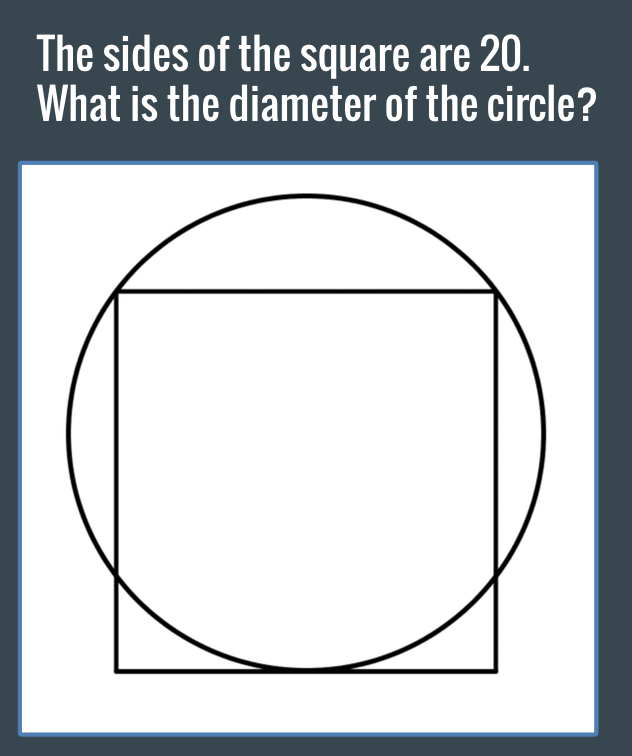
First, I approximate an answer. I recognize that the diameter of the circle will be larger than the side of the square. That’s because I can draw the diameter in my imagination and compare the lengths, and also because I know that chords in a circle are never longer than the diameter. I’m guessing the diameter is around 25 units, not more than 30, and not less than 21.
Second, I try to figure out what makes the thing this thing rather than some other thing. I don’t have any details about how the square was constructed. The circle could be any circle, but what makes that square that square? I need to construct it myself. I start changing the square’s location and scale in my head, asking myself, “Is this square legal? What about this square?”
Here is what I see in my head:
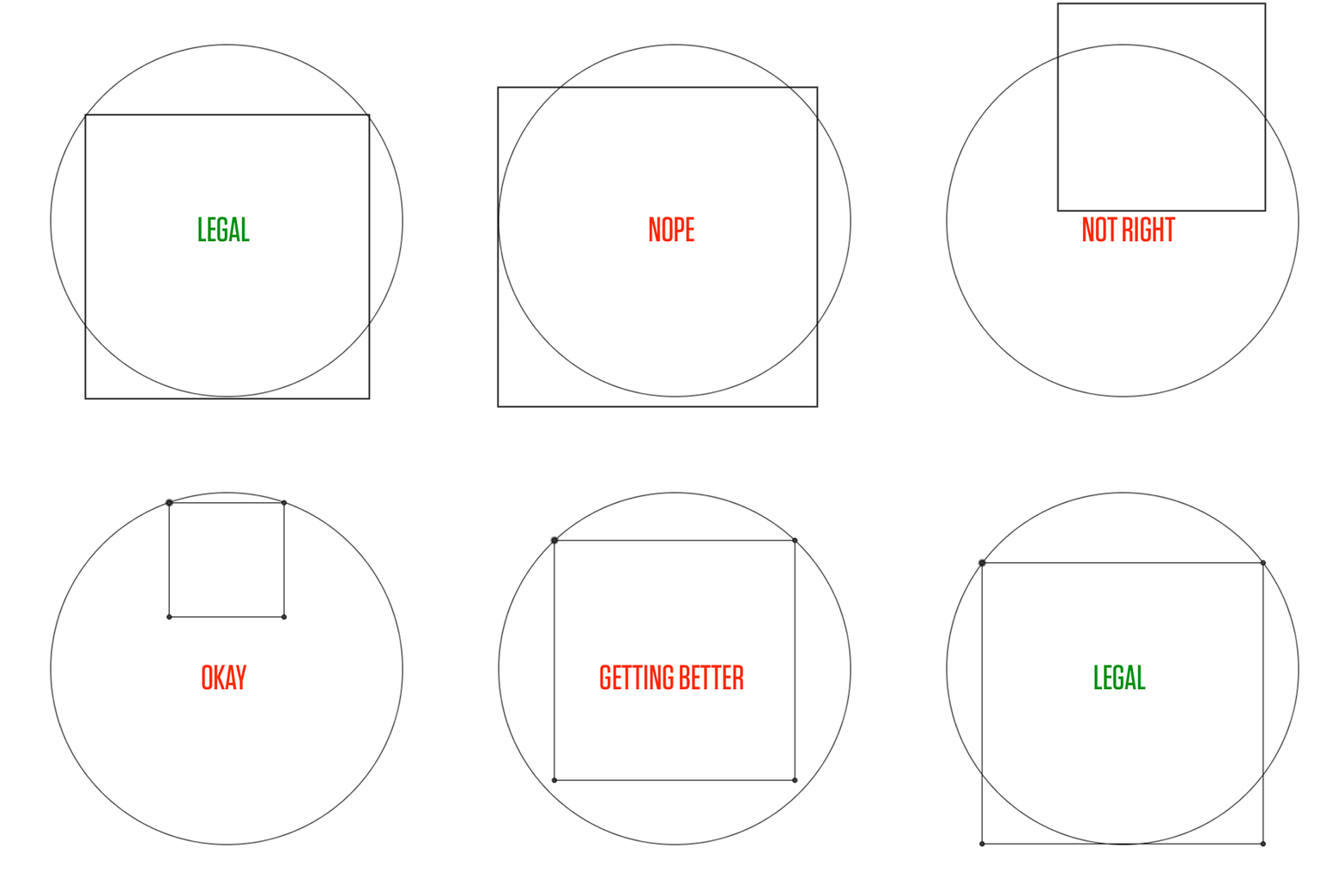
When the square becomes legal at the end, I hear an actual “ding” inside my brain. That’s when all the constraints make sense to me and I can start writing down variables and relationships.
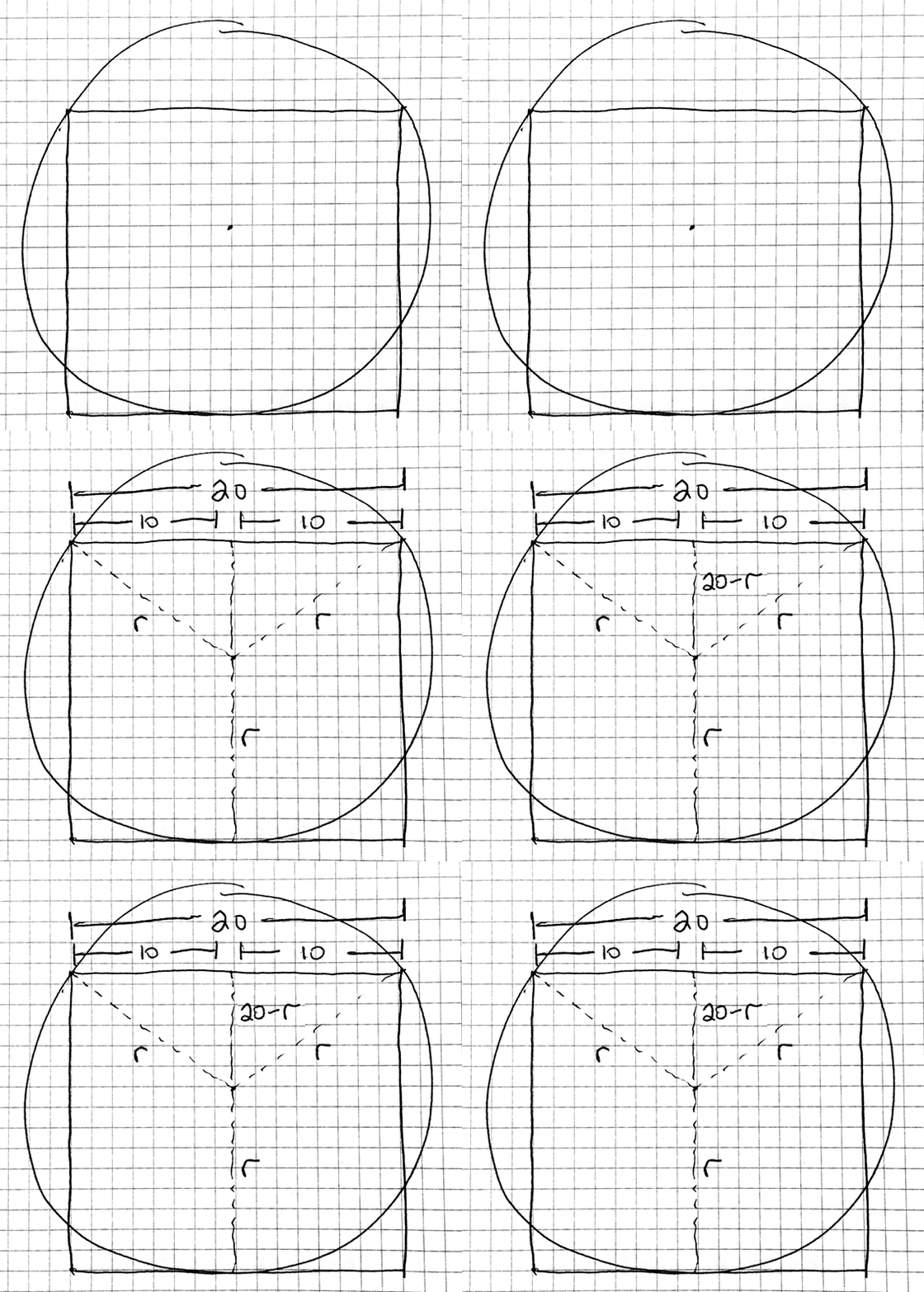
That last “20 – r” was only possible because of the exercise of mentally making different illegal and legal squares.
From there, I trotted over to Desmos with a Pythagorean relationship in my hand.
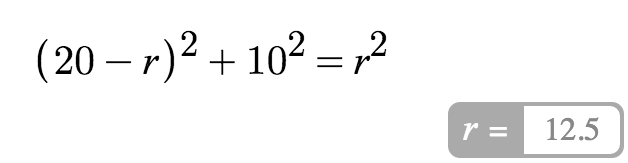
Because I had approximated right and wrong answers earlier, I knew that 12.5 was too low. I realized that was the radius so I doubled it for the diameter.
I think these techniques are what Piggott and Woodham call “stepping into the problem.”
Here visualisations are used to help with understanding what the problem is about. The visualisation gives pupils the space to go deep into the situation to clarify and support their understanding before any generalisation can happen.
At least that’s the best term I can coax from the Internet. I don’t know if Polya’s work on problem solving speaks to that practice directly.
- If you have another name for that process, let us know it.
- If you’ve made mathematical problem solving a part of your development as a teacher, let us know how.
- And if you have an interesting problem to share, let us know about that too.
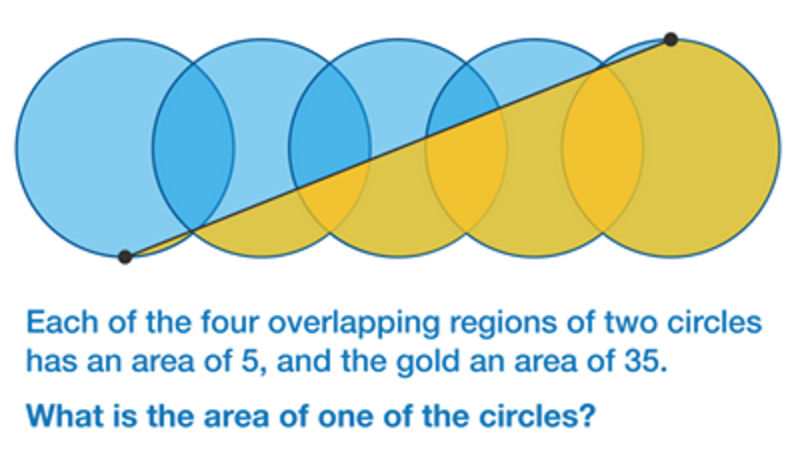
I’ll leave you with this awesome little number from Brilliant. I promise you can solve it.
Featured Comments
William Carey:
If you ask a literature teacher what book they read most recently for pleasure and they don’t have an answer that’d be really worrying. But I bet it’s pretty rare. If you ask a math teacher what math problem they most recently worked through for pleasure, I bet the results are much scarier.
Lori M:
For decades, there has been a focus in ELA classes around a push that teachers who read, know how to teach (and reach) readers. Let’s start a similar movement among math educators.
Dick Fuller:
With some over simplification, real problems are not about mathematics, certainly not about arithmetic. The problem is the formulation of the problem. To suggest a problem is particular to values of parameters points toward evaluation as the critical component of its solution. It is not. Evaluation is particularization of a general formulation. A bald assertion: this is at the root of the difficulty students have with “real” problems.
Simon Gregg offers his own solution and then links to a fascinating question about perimeter.