Dan Meyer

Total 1628 Posts
I'm Dan and this is my blog. I'm a former high school math teacher and current head of teaching at Desmos. He / him. More here.

How Teaching Movies Fail Me

Teaching movies suffer just like all movies do from weak actors, murky cinematography, and didactic, lazy writing. I’d argue that teaching movies hold a lower batting average than most, but you’d call me fussy, so I’ll note, instead, two extremely specific, substantive ways teaching movies fail me:

  1. Wrongheaded pedagogy. In The Wire we’re meant to smile when Prez cancels literature review (boring!) for another lesson loosely connecting gambling to math (fun!).

    Or in another episode, when Bunny Colvin creates a separate class for a group of unruly kids, the sole purpose of which is socialization, because, paraphrased, “they can’t learn.”

    Or Chalk, which propagates the philosophy that students oughtta do the teacher’s job.

    Or Freedom Writers, whose failings are notorious around here.

    When these films and programs speak truth to the reality of teaching in America, it’s often accidental. More often than not, they do us some terrible PR, depicting this job for bystanders and prospective teachers as something it isn’t.

  2. Noxious pandering. Call it the “Oh Captain, My Captain” moment, endemic to the genre, which pits an unctuous, narrowminded dean …
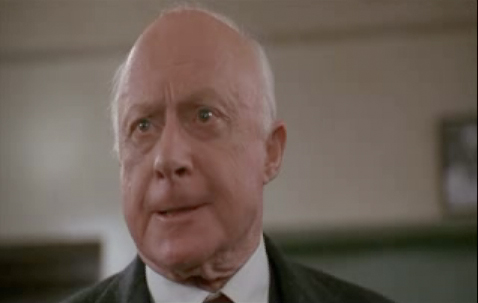
    … against a beneficent but unconventional teacher …

    … with a bunch of disadvantaged doe-eyed students between them. And it’s like, how do you think a situation that contrived is gonna turn out?

    Every time this sequence shows up (usually within the last reel) I feel like a stranger has started massaging my back. I don’t need that.

Mr. K

My question, then, is whether there are any depictions of teaching you find worthwhile, or whether youโ€™d relegate everything to the same trashheap as Kindergarden Cop?

I have found the most interesting depictions of teaching in movies and tv wholly unconcerned with teaching.

As in The Wire, which depicts Carver’s transformation from an overbearing, self-important cop to a community police who knows where the kids hang out, who motivates, talks to, and looks after young offenders instead of writing up their every humble misdemeanorIf TMAO doesn’t watch The Wire, he oughtta., who believes, paraphrased, that “until the bracelets fit, there’s still room for talking.”

Or in The Office, which on a weekly basis speaks more truth to the exigencies of befriending, interacting with, and motivating your subordinates than any teaching movie I’ve ever watched.

None of this is to say I hated Chalk. I don’t know if its wisdom was entirely intentional but one short scene involving a stolen box of chalk warrants an entire graduate seminar of its ownEducation deans & conference organizers: you know where to find me..

I’m certain, though, that teaching lends itself poorly to dramatization. Our triumphs are often ephemeral โ€“ here and gone again โ€“ and sometimes exist only in the hindsight of an appreciative former student. The work isn’t cinematic โ€“ we aren’t piloting X-Wings into the Death Star here โ€“ and it’s often an interior, intellectual pursuit.

Why, then, do we insist on dramatizing a profession which defies dramatization?

Unfit For The Grind

This whole year I’ve been focusing on these kids who have these discipline issues and these kids who don’t care and I realize now it’s the kids who do care that really matter to me … and that I really miss a lot.

confessed to the camera without irony by teacher-cum-assistant-principal, Mrs. Redell, in Chalk, a movie which is to teaching what Major League is to baseball.

The Feltron Project

[BTW: the post-mortem.]

At the start of winter semester, maybe a month ago, I told them they’d have homework every night, even weekends.

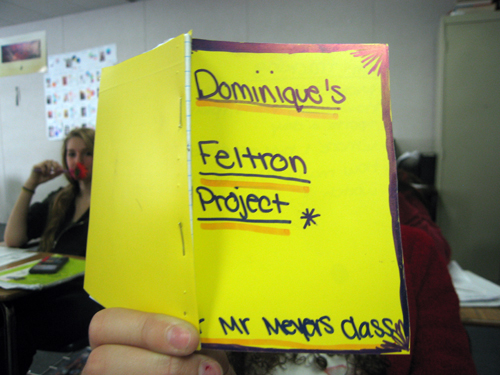
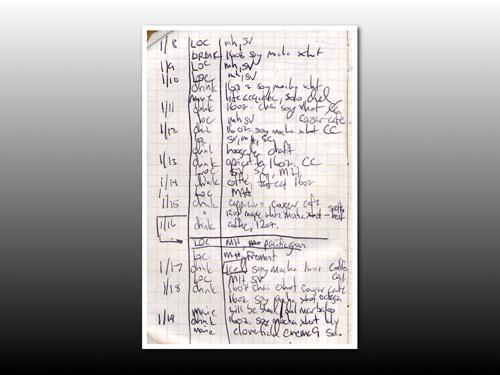
I called it The Feltron Project. I showed ’em mine and asked them to identify the mathematical forms. I told them we were going to take their lives and make math out of them.

Track Your Life In Four Ways

I told them they had to track four variables this semester. I shared with them my ownAnyone crazy enough to try this with me: it’s essential you play along with your students.:

  • where I’ve been [cities per day]
  • text messages sent / received [quantity per person per day]
  • movies I’ve watched [title per medium (dvd, theater, ipod) per day]
  • coffee drinks i’ve purchased [accessory per drink per location per day]

The Feltron Notebook

While they thought on it, we made Feltron notebooks: graph paper, folded, cut into quarters, and bound with repurposed file folders the last teacher left behind.

I showed them how I designed my own Feltron notebook (Coudal’s Field Notes, natch) to maximize page use.

How Do We Grade Your Life?

We discussed grading. What would an A look like? An F? A C? I steered the conversation towards three criteria:

  • the interesting-ness of the variables chosen
  • their consistent tracking
  • their clear & pretty design

We discussed interesting and un-interesting variables. Some students are rocking this thing all semester long, counting calories, tracking everyone they text over a semester, tallying every ounce of everything they drink.

Other students are skating, tracking the number of days they’re late to school, tracking the number of times they sneeze, etc.

We conferenced, each student and I, and I suggested changes, both to add value to their final project and to make the assignment easier for themFor instance, 100 kids decided to track “TV Watched.” “What does that mean?” I’d ask. “Uh.” they’d reply. “So make it min/channel/day or min/show/day, whichever you prefer.”.

Checkpoints

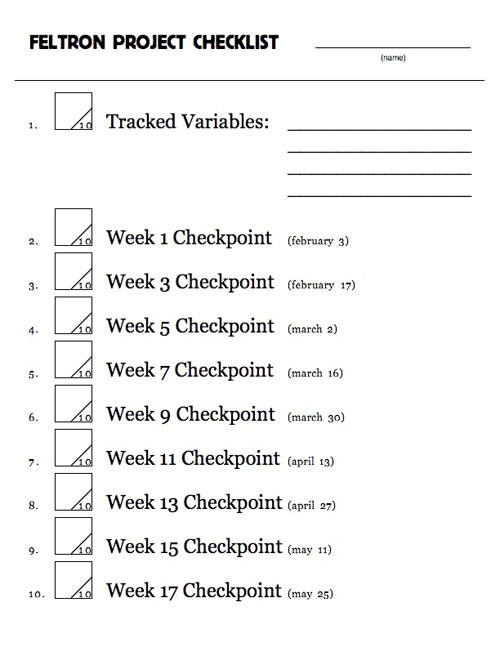
This thing runs on bi-weekly checkpoints [pdf] where I move around the class and verify that everyone’s keeping up.

One Indication This Assignment Wasn’t Stupidly-Conceived

Not one student has taken exception to the workload. Several students, without my prompting, have integrated a notebook update into their daily classroom routine.

The Moment I Fell In Love With The Thing

One freshman decided to track the cigarettes she smoked each day. Not because she wanted to scandalize me or her classmates. She just “always kinda wondered.”

One Month Later

I surveyed 99 students last week: “how much time do you spend updating your Feltron notebook each day?”

The average response was 5.5 minutes with a maximum of 31 minutes and a minimum of 0 minutesNo idea what the minimum’s about..

Next Steps

  • I ordered a hard copy of Nicholas Felton’s annual report (to which my assignment pays seeerious homage). We’ll pass pages around and develop a written narrative of his year.
  • Then I’ll fabricate entire data sets. eg. some girl’s caffeine intake over the course of a semester. We’ll run through several infodesigns and discuss which ones tell the most effective, truthfulAll better? story. We’ll use other data sets (eg. hours spent studying) to introduce some superficial correlation.
  • Uh. That’s all I have.

The Big Questions

  • Do we make the graphs in Excel or work out the math by hand? One option gets ’em dirty with the math. One is more useful to their post-grad experience.
  • What do I do when a student comes to class a month into the project and claims her dog ate her Feltron notebook? The question, as of first period today, ain’t hypothetical.

The Regret

I should’ve collaborated with someone here. I don’t know another teacher, period, who’s out there sweating the connection between language and math like I am here which makes The Feltron Project something of a blind jump off the high dive when it ain’t altogether obvious that the pool is filled with water, thumbtacks, or nothing.

Why Twitter?

Jeff Wasserman:

if you figure out exactly what the heezy youโ€™re supposed to, like, DO with Twitter, please to let me know, sir.

I don’t know what you’re supposed to do with Twitter, but Twitter, for now, satisfies my need to publish tiny short-form pillbombs, small-caliber blasts of insight and sarcasm, but mostly sarcasm, the sorta stuff which โ€“ for reasons of length and content โ€“ I can’t get away with on my blog but which I have to get away with somewhere.

I do this for me, not you, not because I think I have anything you need, but because authoring content of all shapes and sizes is what I need.

Which is why I don’t follow anyoneExcept Zac Chase, who is my entire world for reasons too stupid and petty to recount. As much as I’m interested in the farty minutiae of everyone’s day-to-day, I don’t know that I have time for another timesucking feedreader right now. I have Twitter set to deliver any and all “@ddmeyer” replies, but I don’t have much interest in the TwittersphereOr whatever you people call it. Haven’t been around long enough to absorb the vernacular. beyond my front stoop.

What’s interesting about my specific purposing of Twitter (and what makes it worth even a passing mention on this blog) is that some folks find it inexplicable, even offensive. Perhaps my explanation above will render the conspiracy theories, hyperventilations, and picket lines moot, and I don’t want to generalize too much here, but this all seems a bit too weird, too rich in irony, to ignore.

I realize I’m already positioning myself as the obnoxious party guest at the Twitter Mansion, but here it is on the real: as with a hammer, a fax machine, or any other tool, I’m unobliged to a) Twitter, b) the community y’all have constructed around it, or especially c) the social norms and artifice you’ve invested in that community.

I’m just over here, in my own shed, banging away at some nails because I find the experience satisfying. Watch or don’t, but resenting my satisfaction because it isn’t yours, because this tool doesn’t apply identically to my life as it does yours, speaks precisely to my historic irritation with the School 2.0 sectarians.