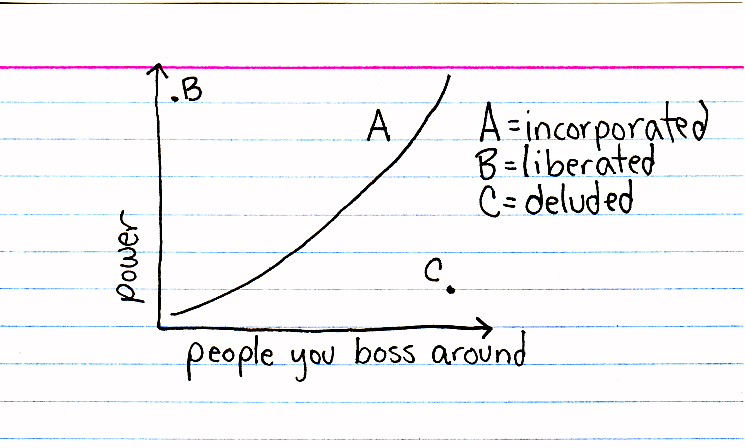
Her graph does what several hundred words in my draft pile, thus far, have not.

Her graph does what several hundred words in my draft pile, thus far, have not.
In the same Classroom 2.0 thread entitled “Top 3 Blogs to Read?” in which a member asks for the network’s three favorite edublogs:
I mean, c’mon, fellas. I spend several hours a day reading my own archives just like anyone else, but calling myself my own favorite edublogger? Not with a straight face. Not in a Ning forum. I mean, if this sorta thing slides by in our social networks, how much longer ’til our classrooms fall?
Plus, as if that weren’t enough fun:
Does the edublogosphere need a Gawker? I just registered a few domains, in any case.
Awhile back, a new teacher e-mailed me:
I’m tired of watching math taught the way math is taught at my school – review last night’s homework, give notes, start that night’s homework. I want to do things differently but I don’t know how.
I’m not gonna pretend my kids wouldn’t rather be at Seabright than taking my class, but year-for-year my attendance has never been higher. For the first time since getting into this, I get kids mad at me for calling in a sub. Like they prefer the class with me in it than without.
Here, reformatted a bit for blog output, is my reply:
Such a huge question, [redacted]. Let’s see where ten minutes of typing takes us.
Kids today, I think, find the typical classroom pace too slow. Teacher writes something on the board. Kid writes it down. They talk about it. Two years ago I chopped that time in half using a digital projector and Keynote to type my notes in advance of the class. I gesture. I talk about whatever they see on the board but they don’t have to wait for me.
Transitions take too long. Teachers burn a few minutes here and there passing out worksheets or getting kids started into an opener or allowing them to line up at the door early.
Basically I think the first step to creating a classroom that kids look forward to is to reclaim any minutes you possibly can through good planning and good classroom management.
After that you pave the way for a lot of miscellaneous fun. For example, if you run a warmup, toss an interesting question onto the end that’s unrelated to math. They’ll look forward to it. It’ll show ’em that their teacher cares about stuff they’re interested in or at least that she doesn’t just care exclusively about stuff they aren’t interested in (ie. math). I’ve attached a list of questions I use in class, most of which were lifted from a book called Vital Statistics which I wholeheartedly recommend
Don’t ask. .After you salt those throughout your class routine, you start making the math more engaging. Ask yourself: if I have a good idea for a mathematical connection or application, can I make a learning experience out of it? If you don’t have a projector, you’re pretty well limited to worksheets and outside artifacts. But from there, walking around with the knowledge that if you had a good idea, you could do something with it, you’ll start getting good ideas from all corners.
I get ’em watching TV a lot. I extract a video clip and make a thirty-minute worksheet out of it. Not ’cause I have any amazing insight or skills but because I’m constantly in teacher mode, looking for interesting things.
So you’ve started tossing small engaging bits along the margins of your classroom and you’ve started making your activities more interesting. Then I really recommend you reconsider how you assign homework and how you assess. In my opinion, the default procedures for homework (1-30 odd) and assessment (large, comprehensive tests every two weeks) are extremely damaging to kids. I have two posts in my most-read sidebar (Why I Don’t Assign Homework & How Math Must Assess) which explain a lot of this.
Brain dump there, [redacted]. Please don’t consider any of this prescriptive or gospel. There are plenty of ways to make a math class that kids hate to miss. These are a few of mine.
Regards,
Dan
Dina Strasser, responding to skepticism of her earlier skepticism, addresses those who would suggest that classroom tech is a sufficient motivator for students:
While I have witnessed this and agree, I also think that it’s a red herring. A sparkling, glitzy herring in high heels dancing backwards, but a herring all the same. If I scan a page of a vocabulary workbook into the computer, convert it to PDF, and add digital fill in the blanks, my kids may be “motivated” to work on it— but it’s still the same damn workbook that has no basis in effective teaching practice, flexible problem solving, or language acquisition research.
Engaging a classroom on a daily basis requires more than just some superficial adjustment to classroom form. You’ve gotta bring great, diverse content daily and, unfortunately, there exists no tool, no shortcut, nothing else to do the job but the blunt application of profound creativity in the direction of challenging content standards.
Michael Lopp with a great article on presentation, though he goes off the deep end, imo, in the final paragraph:
This presentation is only partially about you and what you think. Yes, you are the guiding force, but the goal is to present an idea with space around it. In this space, your audience is going to pour their own experience and their opinions; they’re going to make your idea their own.
Related: How to Not Throw Up
Updated: The quoted paragraph is not the lunatic passage. The quoted passage is right on. The lunatic passage is this one:
Could you give your entire presentation from a single slide. 50 minutes, a room full of people, and you with your single slide with six bullet points?
That’s your goal, and you can have a wildly successful presentation without achieving it, but a one-slide presentation represents the ultimate commitment to your audience. It says, “This isn’t about slides. This about me telling you a great story… out loud.”