Dan Meyer

Total 1628 Posts
I'm Dan and this is my blog. I'm a former high school math teacher and current head of teaching at Desmos. He / him. More here.

This girl is dangerous.

As much as you’d like to believe there are only two crowds here – one crowd of competent ed-technophiles and another of ignorant ed-technophobes – there is a crowd of teachers milling about the faculty lounge that gets this stuff, that enjoys this stuff even, but that needs a sales pitch less emotional and more practical when it comes to classroom integration.

Enter Dina Strasser’s seven skeptical questions, which lays our inner monologues out for everybody else. I swear, if y’all would just read and link and del.icio.us this up, I’d never have to write about my classroom tech reservations again. Hers are that comprehensive.

  1. Does this value-added, teacher-independent learning relate DIRECTLY to my content objectives and standards?

    Sorry. “Universally related” or “indirectly related” just doesn’t cut it–this is the open door for uncritical idolatry. For example, I have never understood the lumbering Godzilla-like argument that because our kids are “digital natives,” we should de facto use tech in school. Why? If using tech is as natural to them as breathing, isn’t this like asking us to teach kids to breathe?

If you’re a tech coordinator, -evangelist or -salesperson, you’d do well to read the rest and realize that, if you can’t sell your particular product [Twitter, Skype, Ustream, whatever] to a tech-savvy teacher who has outlined her every objection in advance, then you will find deaf ears everywhere else as well.
So Happy Together #4

Make the marriage of your digital projector and laptop a happy one.

One Idea:

Use visual callbacks to refresh their memory.

Like this:

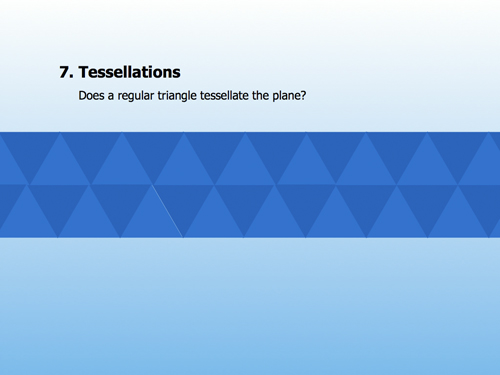
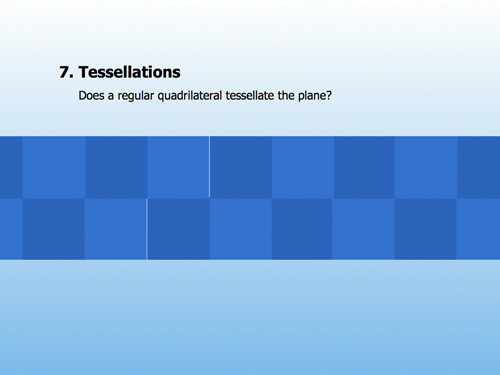
We’re talking about tessellations, how squares and equilateral triangles tile your bathroom floor without gaps.

I put up a square / equilateral triangle in Keynote and after they draw the tessellation on their paper, I hit a button and the same thing animates on the screen.

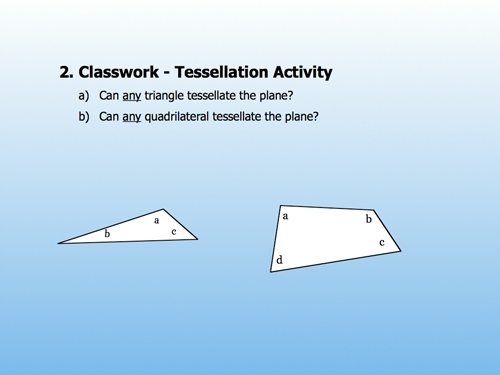
The next day I want to talk about the general case.

Without my digital projector, I’d say, “Okay, so you guys remember yesterday how we saw that an equilateral triangle tessellated the plane? Will your garden-variety, no-account scalene triangle do the same thing?”

No one would contradict my first assumption but only, like, 50% would really remember.

With a digital projector, though, I just copy & paste a slide from the previous day, strip off its animations, and there I have an effective visual callback to the last lesson.

Just like the “Previously on Lost ” introductions, this technique functions even when pushed weeks into the past.

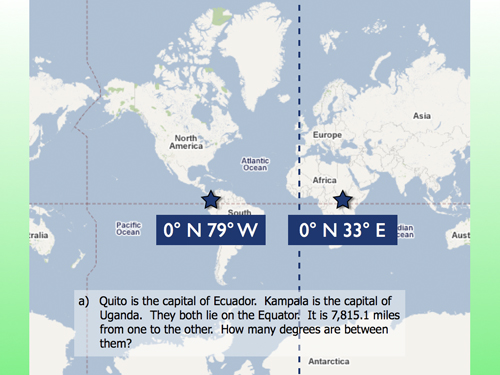
“Remember when we were looking at distance around the Earth last month?”

And they do.

Previous Editions:

Linked Lists:

Two found lists, both old, both worthwhile in parts.

Stefan Sagmeister on Things I Have Learned In My Life So Far:

  1. Drugs feel great in the beginning and become a drag later on.
  2. Over time I get used to everything and start taking for granted.
  3. Money does not make me happy.
  4. My dreams have no meaning.

And, more recently, Immaculate Heart College’s Art Department Rules:

  1. Nothing is a mistake. There is no win and no fail. There is only make.
  2. The only rule is work. If you work it will lead to something. It’s the people who do all of the work all the time who eventually catch on to things.
  3. Don’t try to create and analyse at the same time. They’re different processes.

There is only make.

How Animoto Gets Animoto Wrong

Jason, one of the Animoto guys, responds to my criticism, admitting his utility’s limitations as a storytelling mediumwhich, of course, is the box most K-12 educators are forcing Animoto into, even though it makes VoiceThread look awesome. but then noting its “great pedagogical usages,” the most interesting of which is:

… the Animoto presentation is in a style that many students are familiar with (MTV-style videos), I think it adds a great juxtaposition of using an aesthetic with which kids are already familiar, along with learning material than [sic] they are being exposed to for the first time.

Animoto is a staggeringly cool tool which almost everyone – even its creators, off Jason’s comment – appreciates for the wrong reason.

Specifically, Animoto creates photo montages better and faster than any other Internet utility but, over the long run, the fact that the montages jitter and bob with the music – its most celebrated and distinctive feature – does nothing for me as a media consumer and less than nothing for me as a educatorwatch a dozen in a row and let me know how quickly your returns diminish..

This isn’t because I like taking shots at the high-flying School 2.0 balloon or even because this is a matter of opinion. It isn’t. Nor do I take some old-fashioned exception to the MTV aesthetic.

But the MTV aesthetic, even at its most arresting, spasmodic, and hypnotizingly awful, gives content some considerationeg. the lyrics of a dark, dreary song inform the visuals at least a little.. Animoto has no such capability. It will adjust the speed of your video to match your song but it does not care even a little about your photographic content.

Its z-axis transitions look great but they are selected wholly apart from your content and, several times per slideshow, they obscure it – cropping out your Auntie’s face and strobing several shots over the rest of your family – simply because Animoto doesn’t know any bettercf. the Ken Burns effect, which, stale and tired as it is, zooms, pans, and crops photos all to enhance content..

“No two videos are the same,” claims Animoto’s main page but each slideshow shares in common a complete, 100%, de facto disregard for the relationship between form and content. Maybe it’s unfair of me to suggest that educators oughtta know better but I’m astonished that this same crowd which dumped all over MTV in the ’90s has missed this, that it has endorsed a tool good only for spackling enthusiasm across a crowd as meaningful learning, as meaningful assessment, as meaningful self-expression.

If you’re going to teach this at all, you owe your kids to teach it right. Yet my colleagues’ enthusiasm for visual expression has outpaced their understanding of it by several orders of magnitude.

What efforts are you making to get this right?