Dan Meyer

Total 1628 Posts
I'm Dan and this is my blog. I'm a former high school math teacher and current head of teaching at Desmos. He / him. More here.

Blue Point Rule

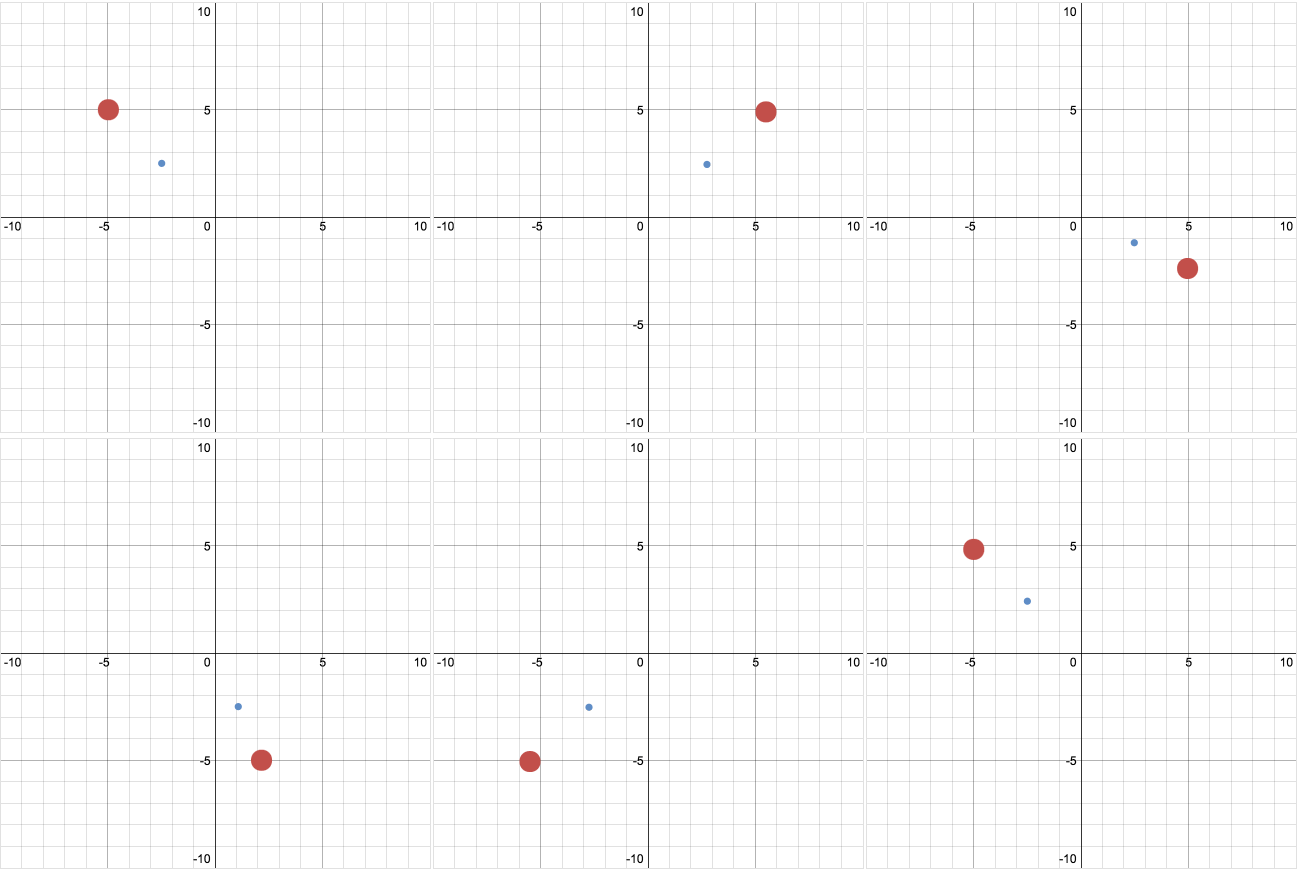
What is the rule that turns the red point into the blue point?

160512_1hi

My biggest professional breakthrough this last year was to understand that every idea in mathematics can be appreciated, understood, and practiced both formally and also informally.

In this activity, students first use their informal home language to describe how the red point turns into the blue point. Then, more formally, I ask them to predict where I’ll find the blue point given an arbitrary red point. Finally, and most formally, I ask them to describe the rule in algebraic notation. Answer: (a, b) -> (a/2, b/2).

It’s always harder for me to locate the informal expression of a idea than the formal. That’s for a number of reasons. It’s because I learned the formal most recently. It’s because the formal is often easier to assess, and easier for machines to assess especially. It’s because the formal is often more powerful than the informal. Write the algebraic rule and a computer can instantly locate the blue point for any red point. Your home language can’t do that.

But the informal expressions of an idea are often more interesting to students, if for no other reason than because they diversify the work students do in math and, consequently, diversify the ways students can be good at math.

The informal expressions aren’t just interesting work but they also make the formal expressions easier to learn. I suspect the evidence will be domain specific, but I look to Moschkovich’s work on the effect of home language on the development of mathematical language and Kasmer’s work on the effect of estimation on the development of mathematical models.

Therefore:

  • Before I ask for a formal algebraic rule, I ask for an informal verbal rule.
  • Before I ask for a graph, I ask for a sketch.
  • Before I ask for a proof, I ask for a conjecture.
  • David Wees: Before I ask for conjectures, I ask for noticings.
  • Before I ask for a calculation, I ask for an estimate.
  • Before I ask for a solution, I ask students to guess and check.
  • Bridget Dunbar: Before I ask for algebra, I ask for arithmetic.
  • Jamie Duncan: Before I ask for formal definitions, I ask for informal descriptions.
  • Abe Hughes: Before I ask for explanations, I ask for observations.
  • Maria Reverso: Before I ask for standard algorithms, I ask for student-generated algorithms.
  • Maria Reverso: Before I ask for standard units, I ask for non-standard units.
  • Kent Haines: Before I ask for definitions, I ask for characteristics.
  • Andrew Knauft: Before I ask for answers in print, I ask for answers in gesture.
  • Avery Pickford: Before I ask for complete mathematical propositions, I ask for incomplete propositions.
  • Dan Finkel: Before I ask for the general rule, I ask for a specific instance of the rule.
  • Dan Finkel: Before I ask for the literal, I ask for an analogy.
  • Kristin Gray: Before I ask for quadrants, I ask for directional language.
  • Jim Murray: Before I ask for algorithms, I ask for patterns.
  • Nicola Vitale: Before I ask for proofs, I ask for conjectures, questions, wonderings, and noticings.
  • Natalie Cogan: Before I ask for an estimation, I ask for a really big and really small estimation.
  • Julie Conrad: Before I ask for reasoning, I ask them to play/tinker.
  • Eileen Quinn Knight: Before I ask for algorithms, I ask for shorthand.
  • Bill Thill: Before I ask for definitions, I ask for examples and non-examples.
  • Larry Peterson: Before I ask for symbols, I ask for words.
  • Andrew Gael: Before I ask for “regrouping” and “borrowing,” I ask for grouping by tens and place value.

At this point, I could use your help in three ways:

  • Offer more shades between informal and formal for the blue dot task. (I offered three.)
  • Offer more SAT-style analogies. sketch : graph :: estimate : calculation :: [your turn]. That work has begun on Twitter.
  • Or just do your usual thing where you talk amongst yourselves and let me eavesdrop on the best conversation on the Internet.

BTW. I’m grateful to Jennifer Wilson and her post which lodged the idea of a secret algebraic rule in my head.

Featured Comment

Allison Krasnow points us to Steve Phelp’s Guess My Rule activities.

David Wees reminds us that the van Hiele’s covered some of this ground already.

Creating a Need for Coordinate Parentheses & Combining Like Terms

Our first approach in preparing a new lesson is often to ask, “Where does this skill apply in the world of work or in the world outside the classroom?” There may well be a great answer for some skills, but this strategy generalizes very poorly to lots of mathematics. So instead, I try first to ask myself, “Why did we invent this skill? How does this skill resolve the limits of older skills? If this skill is aspirin, then what is the headache and how do I create it?”

Two examples from my recent past.

Combining Like Terms

Why did we invent the skill of combining like terms in an expression? Why not leave the terms uncombined? Maybe the terms are fine! Why disturb the terms?

One reason to combine like terms is that it’s easier to perform operations on the terms when they’re combined. So let’s put students in a place to experience that use:

Evaluate for x = -5:

3x + 5 + 2x2 – 7 + 8x – 5x2 – 11x + 4 – 5x + 3x2 + 4 + 3x – 6 + 2x + x2

Put it on an opener. The expression simplifies to x2, giving students an enormous incentive to learn to combine like terms before evaluating.

[I’m grateful to Annie Forest for bringing the example to mind. She also adds a context, if that’s what you’re into.]

Parentheses

When students first learn to graph points, the parentheses are the first convention they throw out the window. And it’s hard to blame them. If I told you to graph the point 2, 5, would you need the parentheses to know the point I’m talking about? No.

So why did mathematicians invent parentheses? What purpose do they serve, assuming that purpose isn’t “tormenting middle school students thousands of years in the future.”

It turns out that, while it’s very easy to graph a single point with or without parentheses, graphing lots of points becomes very difficult without the parentheses. So let’s put students in a place to experience that need:

Graph the coordinates:

-2, 3, 5, -2, 8, 1, -4, 0, -10, 4, -7, -3, -2, 7, 2, -5, -3

You can’t even easily tell if there are an even number of numbers!

[My thanks to various workshop participants for helping me understand this.]

Closer

The need for combining like terms is Harel’s need for computation and the need for parentheses is Harel’s need for communication. I can’t recommend his paper enough in which he outlines five needs for all of mathematics.

My point isn’t that we should avoid real-world or job-world applications of mathematics. My point is that for some mathematics that is actually impossible. But that doesn’t mean the mathematics was invented arbitrarily or for no reason or for malicious reasons. There was a need.

Math sometimes feels purposeless to students, a bunch of rules invented by people who wanted to make children miserable thousands of years in the future. We can put students in a place to experience those purposes instead.

Previously

We explored these ideas in a summer series.

The Difference Between Pure And Applied Math

Henry Pollak, in his essay, “What Is Mathematical Modeling?

Probably 40 years ago, I was an invited guest at a national summer conference whose purpose was to grade the AP Examinations in Calculus. When I arrived, I found myself in the middle of a debate occasioned by the need to evaluate a particular student’s solution of a problem. The problem was to find the volume of a particular solid which was inside a unit three-dimensional cube. The student had set up the relevant integrals correctly, but had made a computational error at the end and came up with an answer in the millions. (He multiplied instead of dividing by some power of 10.) The two sides of the debate had very different ideas about how to allocate the ten possible points. Side 1 argued, “He set everything up correctly, he knew what he was doing, he made a silly numerical error, let’s take off a point.” Side 2 argued, “He must have been sound asleep! How can a solid inside a unit cube have a volume in the millions?! It shows no judgment at all. Let’s give him a point.”

What a fantastic dilemma.

Pollak argues that the student’s error would merit a larger deduction in an applied context than in a pure context. In a real-world context, being wrong by a factor of one million means cities drown, atoms obliterate each other, and species go extinct. In a pure math context, that same error is a more trivial matter of miscomputation.

The trouble is that, to the math teachers in the room, a unit cube is a real-world object. They can hold a one-centimeter unit cube in their hands and, more importantly, they can hold it in their minds.

The AP graders aren’t arguing about grading. They’re trying to decide what is real.

What a fantastic dilemma.

Featured Comment

Shannon Alvarez:

Whenever I wanted to give students the most amount of partial credit, my coop teacher would ask me the poignant question, “What exactly are you assessing?” I found this was a great question to continue asking myself. So, in the example you gave, are you assessing students’ ability to perform mathematical functions correctly or are you assessing their ability to connect those math functions to the real world?

Benjamin Dickman alerts us that Pollak’s piece is online, free, along with a number of his modeling tasks.

Great Classroom Action

160506_1lo

Annie Forest gives you ten ideas for your last week of class:

Here is my criteria for what makes a good mathy activities for the end of the school year: no/low tech; still incorporate math or problem solving in some way; fun and engaging.

Hey I’ll pitch one in! Here’s an eight-year-old blog post of mine. Every student starts with a 2D paper circle and by the end they’ve collaborated to construct a 3D icosahedron!

Marissa Walczak started carrying around a whiteboard as she helps students with their classwork:

If I wanted to show something to students I would always have to ask if I could write on their paper (which I really don’t ever want to do), or I’d have to say “wait for one sec” and then I’d go grab a piece of scratch paper, or I’d draw something on the board and then it’s far away from the group and then everyone sees it even though I don’t want everyone to see it.

Christine Redemske’s class takes Popcorn Picker to the literal limit, making cylinders that are shorter and shorter and wider and wider.

Tina Cardone gets a lot of mileage out of a very simply-stated arithmetic problem:

In the next question students needed to decide what half of 2^50 would look like. All around the room students wrote 2^25. But children! We just talked about that! And then I realized that 1) it’s far from intuitive, that’s why they included more questions in the book to solidify this idea and 2) the language changed.

Let’s Talk About The Future of NCTM

Disclaimer

I doubt I’m NCTM’s median or ideal member. Accommodating all my wishes below might be a great way to doom the organization. That said, my wishes are the only ones I have. So make yours known too.

The Promise

NCTM membership promises lots of benefits, but chief among them in my mind are advocacy, professional development, and community. Here are some thoughts about NCTM’s present work in each of those three categories and some hopes for its future.

Advocacy

In the era of the Common Core State Standards, math education is a matter of national and local interest. Nationally, witness Andrew Hacker’s op eds in the New York Times. Locally, witness your Facebook timeline and all the parents complaining about lousy “Common Core” worksheets. (“What do you mean the Common Core didn’t make this worksheet? It says it’s theirs right in the link!“)

At a time when everybody seems to have an opinion or a comment, it’s really hard for me to locate NCTM’s opinion or comment.

There were three years between the release of the final Common Core State Standards and NCTM’s statement announcing its support. Borrowing from Twain, lies about the array model can travel halfway around the world when NCTM takes three years to put on its shoes.

Or try to find NCTM’s advocacy more recently. By my count, The Atlantic has published six articles about math education since December. NCTM is quoted in none of them. Am I expecting too much? Do these reporters even have NCTM’s number in Reston, VA? I throw my dues into the collection plate so that, collectively, math teachers can have a louder megaphone than any one of us would have individually.

Professional Development

I experience NCTM’s professional development efforts through its journals and its conferences. Let’s talk about each.

I’ve had the latest issue of Mathematics Teacher in my backpack for the last three weeks. I’m trying to figure out why it doesn’t seem like urgent reading to me whereas there are about twenty math education bloggers in my feed whose posts will not wait and must be read immediately. I’m also wondering why I give JRME, NCTM’s academic journal, a lot more scrutiny relative to the teaching journals.

Here’s my idea. The teaching journals lack the kinetic energy of JRME and they lack the potential energy of blogs.

By “energy” I mean that the energy of a piece of writing is partly kinetic — what the author actually wrote — but also potential. Given the right forum, readers will come alongside those words, offer their own, and co-construct incredible kinetic energy out of that potential.

JRME articles have low potential energy but incredible kinetic energy. Responses to articles are only published after months or years but the articles themselves and their ideas are often very well-researched and very well-written. Articles in the teaching journals have lower kinetic energy than JRME articles (because it’s much harder to publish in JRME) and their potential energy is … also pretty low. For example, Albert Goetz’s response to my modeling article appeared 11 months after the original publication. That latency won’t allow us to convert the potential energy of my article into anything kinetic.

So the teaching journals are stuck somewhere in the middle. I don’t know if this is cause or effect, but no one has tweeted out a link to any article from any of the teaching journals. None of them. Ever. [2016 Apr 27. This is too strong. Here’s a tweet. I’m not clear why it isn’t returned in Twitter’s search results. I think my general point about the low potential energy of the teaching journals holds.]

Short of taking down the paywalls, I don’t have a great idea for increasing the potential energy of the teaching journals. My colleagues Zak Champagne, Mike Flynn, and I have put in a great deal of thought trying to increase the potential energy of the conferences, though. For two years now, NCTM’s leadership has given us some room to play around with the very simple idea of giving every speaker a webpage for their conference session and then getting out of their way. Relative to dropping the paywall on the teaching journals, this is a very cheap idea.

And it seems successful also. They gave a small handful of speakers webpages this year. A week after NCTM’s annual meeting, there are 135 comments, all turning potential energy into kinetic energy without any marginal effort from NCTM. (Check out the energy at Kaneka Turner’s page for example. We haven’t even released video of her talk yet!) That system will scale. NCTM needs to make that system available to every speaker and they need to add the question to their speaker application form, “How will you help your attendees convert your ideas from potential energy to kinetic energy?” (Or something more appropriate for people who haven’t read this post. “How will you support your participants’ work after the conference?” maybe.)

Community

Here is an area where my intuition totally failed me. My assumption was that math teachers who have found community online for free are less interested in paying money to find community in some distant city at an annual or regional meeting.

I was way wrong.
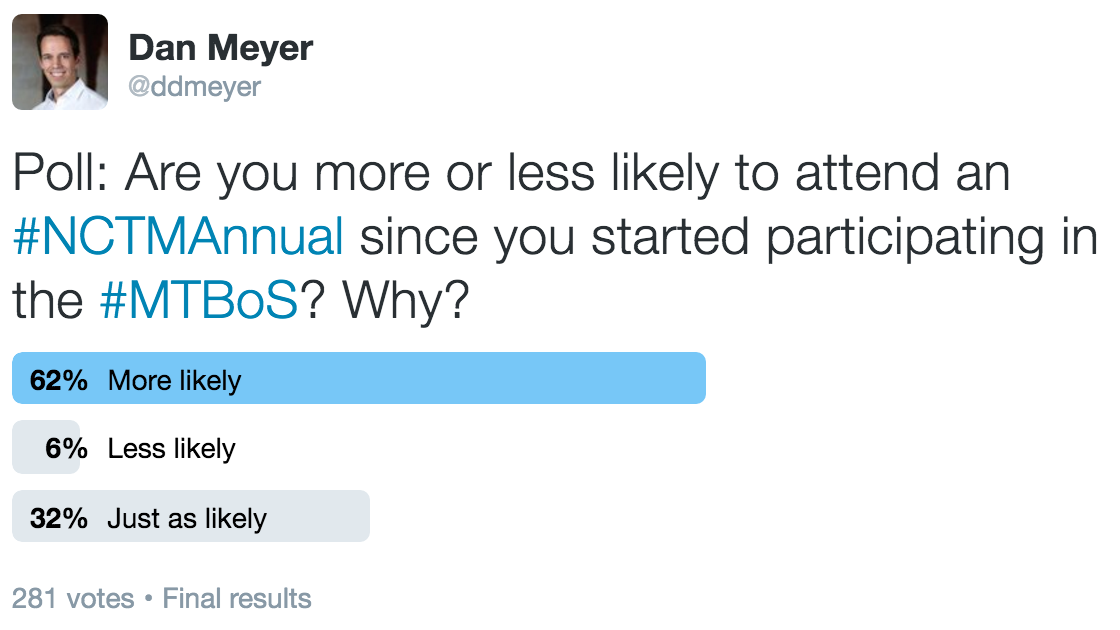
160427_1lo

Feel free to scroll through the comments and read person after person describing how much more interested they are in attending a national conference knowing their online community will be there also.

NCTM needs to do everything they can to import and export that community.

They can import that community by making sure we’re all aware who the first time presenters are so veterans can attend their talks, support them, and also benefit from their perspectives. They can import that community by helping these unwashed bloggers and tweeps find their way to longstanding NCTM functions and events. And vice versa, by exporting themselves to blogging and tweeting events like ShadowCon, the Desmos Happy Hour, and Math Game Night. (Matt Larson checked me for not passing him an invite to the Desmos Happy Hour. That’s fair. This obligation goes both ways.)

NCTM can support these blogging and tweeting attendees after the conferences by giving them lots to blog and tweet about. Feed the community. It seems no one is tweeting about the teaching journals. But lots of people are tweeting about the release of the videos from the Ignite and ShadowCon talks. Jo Boaler’s talk was at capacity with a thousand people locked outside. You wouldn’t know from her conference listing that someone captured video of that talk. No one knows where to find it so no one is talking about it.

Fix that! Give every speaker a webpage. Help them understand how to turn its potential energy into kinetic energy, how to turn isolation into community.

Spoiled

Again, I imagine my needs are pretty idiosyncratic. I’ve been spoiled by blogging and tweeting and by the teaching community that lives on my phone and travels with me in my pocket wherever I go. So what are your professional needs? How well has NCTM been servicing them? What hopes do you have for its future?

Featured Comments

Please read NCTM President Matt Larson’s response to my post. His description of NCTM’s advocacy efforts was particularly useful.

Also read NCTM Past President Linda Gojak’s comment.

Kim Morrow-Leong:

Is the role of NCTM to be the leader of the frenetic #MTBoS blogosphere? Or is it to be the slow, more “craft beer” or “fine wine” place for ideas to ferment? What is the in between? Make your suggestions known because it is hard to be both.

Zak Champagne:

The editorial board of TCM (full disclosure — which includes me) is working hard to create some kinetic energy around the journal. We are hold a #TCMChat each month on twitter around the free preview manuscript (Which coincidentally means we tweet the heck out of link to the free preview every month).

Megan Schmidt:

Early Friday morning of NCTM, I attended a focus group to discuss the future of NCTM and more specifically, their partnership with the Math Forum. Many issues were discussed including the ones you bring up here. But one that seemed to resonate with everyone in attendance was the people who work for the Math Forum. Joining the Math Forum and NCTM has given NCTM a face and a personality exemplified through the wonderful people that make up the Math Forum. They have helped bridge the divide, physically and metaphorically, between NCTM and the greater Math Twitter Blogosphere and have been a catalyst for the continuing conversation between these groups.

Sam Otten:

I have (what I think is) a really great linear systems lesson that I developed with my brother. It’s been accepted for publication in MT but it’s going to be about a two year gap between submission and publication.

Sam Shah posts his internal monolog every time he imagines inviting a teacher to submit an article to the teaching journals versus posting it on a blog. He closes with:

But for me as a part of a community which already shares ideas freely, comments on them, improves them… I don’t see how an NCTM journal can compare. Immediacy, feedback, and encouragement make blogging the choice for me.

Mary calls out her interest in extending the conversation in several sessions she attended. NCTM can support this.

There were several K-2 talks I attended at NTCM that I would love “to continue the conversation.” I tried Twitter, but the sessions had low turnout so there was no interaction. One was ELD and math, giving students position and power. They used Go Pros to observe from a child’s perspective and introduce change to their teaching. It was awesome; every k-2 teacher should have been there and needs to think about how we are giving voice and power to our students.

Norma:

In regard to Advocacy, it isn’t all invisible. Check out http://www.nctm.org/news/ for NCTM press releases as well links to press coverage (with quotes from NCTM Presidents).

Julie Wright adds an appeal for participation in your local affiliate.