Category: 3acts

Total 60 Posts

[3ACTS] Ditch Diggers & Bubble Wrap

Here are two new tasks – Ditch Diggers and Bubble Wrap. They’re united by one common feature:

I saw something interesting and tried to turn it into something challenging.

This process is always harder than I think it wil be.

With Ditch Diggers, I was bobbing up and down on an inner tube in Kauai as a tour guide told us that two groups dug these irrigation tunnels by blasting and digging their way towards each other from opposite ends.

With Bubble Wrap, I was reading about an Italian performance artist who passed out sheets of bubble wrap of different sizes so people waiting for a train could calm themselves down.

Both of these things interested me, but the line from there to a classroom modeling task forces me to ask myself:

  1. What question would lead to that interesting knowledge?”
  2. Is there some way I can provoke that question visually?
  3. Could a student guess at that question?
  4. What information would a student need to answer that question?
  5. What mathematical tools would a student need to answer that question?
  6. Is there some way to confirm the answer visually?

So the next time you see something that’s simultaneously a) interesting to you and b) mathematical, try running through those questions above and see how they’d play out. In the meantime, you can check out my specific answers above.

BTW. Many thanks to Chris Hunter for helping me brainstorm Bubble Wrap.

Let’s Do Some Math: Scrambler

Here’s the scrambler, a carnival ride out of my childhood:

I’m curious where my red cart will be when the ride finishes. To begin with, you might tell me a location where my red cart definitely won’t end up. Ordinarily I’d ask you what information would be helpful for you to help me answer my question, but in the interest of time, I think this may help you here:

My sense is there are a number of different ways to answer my question but I’m not sure how many. Please post your thoughts in the comments and as precise a location of the red cart as possible. I’ll update this in two days with the answer.

BTW. A follow-up question (or “sequel” in the three-act parlance): if you trace a path behind the red cart as it moves, what will the path eventually look like? (This is called a “locus” but I suppose it’s best if we postpone formal vocabulary development until our debrief.)

2013 Feb 01. Here’s the video as it runs down to the end of the ride:

And here’s a killer Desmos calculator that lets you adjust all kinds of parameters on the scrambler.

Great work in the comments. Several people analyzed the periodic nature of the scrambler. Others

[3ACTS] Toothpicks

I enjoy tasks that exhaust a finite supply of things in order to make some kind of interesting structure. Here, a finite supply of toothpicks (250 of them) are exhausted to make a pyramid. (Or consider the finite fencing around Pixel Pattern.)

At some point I’d like to test out the hypothesis that removing the finiteness would make the video a lot less perplexing on the whole. In other words, we wouldn’t be as perplexed by a guy plugging away at a pyramid with an inexhaustible supply of toothpicks. We’re perplexed because we know, at the end of the video, that he’s done and we want to know what the pyramid looks like.

Here’s the task page.

Here are several interesting questions that popped up at 101questions:

  • Alison: How many rows in the end?
  • Hope Gerson: How many toothpicks does it take to make the next sized equilateral triangle?
  • Douglas Moore: How many triangles?
  • Matthew Clark: What’s the perimeter of the final triangle?
  • Scott Westwell: How many small (3 toothpick) triangles can be made?
  • Jeff de Verona: How many “total” triangles will be created (any size)?
  • Gregory Taylor: How long did it actually take to go through the entire stack?

[3ACTS] Best Squares

I’ve been working on this series for the last two months. I asked four of the most active contributors on 101questions (Andrew Stadel, Chris Robinson, Timon Piccini, and Nathan Kraft – all dudes, sorry about that) to:

I love these problems, but they scare the hell out of me.

You have the #3act hallmarks: a short visual setup, minimal language demand, and a question that can be approached intuitively at first. Have your students write down a gut-level ranking of each contestant. Who drew the best square?

Now we ask the students what information matters and doesn’t matter and how they’ll use that information to make a rule.

We’ll eventually give them all the information they could want – area, perimeter, angles, side lengths, and coordinates (so they can get whatever we missed). The point is, we could very easily hint our way towards an answer by providing the area and the perimeter in advance, but now the student’s task is much harder and much more interesting.

Also, your task is much harder and much more interesting. You have to take whatever rule your groups of students come up with and parry back with cases – large, small, degenerate, etc. – that heat that rule to the melting point.

If the student says, “Let’s subtract each side from the mean side length. All the sides should be congruent,” you offer her a tilted rhombus, which scores perfectly against that rule but shouldn’t.

If the student says, “Let’s subtract each angle from the mean angle measure. All of them should be 90°,” you offer her a short, wide rectangle, which scores perfectly against that rule but shouldn’t.

These problems terrify me because even as I put an answer in the teacher’s guide [pdf], I’m not convinced it’s the best answer. (Should we give the bigger squares more credit because they’re tougher, for instance?) I only know the process is worth the terror.

BTW. This activity owes a debt to The Eyeballing Game and to Patrick Honner’s question, “Which triangle is more equilateral?” where you can find him parrying superbly in the comments.

Featured Comment

Bowen Kerins:

Why should it be “our task” (teachers?) to take the students’ rule and parry back bad cases? This is one of the most interesting roles a student can take in this process. I’d much rather have the students coming up with edge cases against their own, or ideally others’, rules. I’d keep a few in my back pocket just in case, but students can drive that conversation in great ways.

James Key:

“Draw two points and then the point exactly between them.”

Sorry to be nit-picky, but while the above task certainly meets the requirement for “minimal language demand,” I think ONE MORE WORD is required for the sake of precision: “halfway.” There is not a unique point that is “exactly between” two given points; there are many. But there is one point that is “exactly halfway between them.”

I know that “conciseness” and “precision” sometimes compete with one another, and I confess that I often strike the balance poorly.

2012 Dec 15. Fawn Nguyen gave this a go in her classroom.
[3ACTS] Pixel Pattern

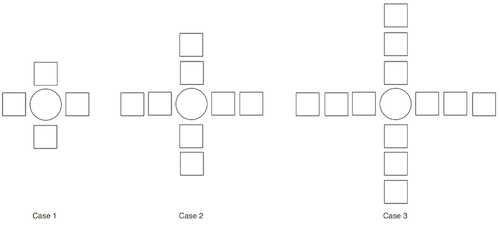
You’ve heard of pile patterns? There are variations but generally you have three snapshots of a growing shape like this:

Questions follow regarding future piles, past piles, and a general form for any pile.

I wanted to know what this old classic would sound like with newer equipment. Would video add anything here, for instance? Here is the result of my tinkering:

Video adds the passage of time. I added a red bounding box to the video, which was an attempt to make the question, “Where will the pattern break through the box, and when?” perplexing to students.

I also added different colors, which allows students to track different things or ask themselves, “What color will be the first color to break through the box?” Different questions require different abstractions. If you care about total tiles, you’ll model the total. If you care about the breakout, you’ll model the width and height. Each one will require linear equations, which is nice.

Other notes:

  • The sequel asks about the “aspect ratio” of the growing shape which is a useful way to dig a little at limits.
  • Real-world math. Here again I’m thumbing my nose at our conviction that math should be real. This isn’t real in the sense we usually mean. If it interests your students, it will interest them because it asks questions that rarely get asked in a math classroom, questions from the bottom of the ladder of abstraction:
    • What questions do you have?
    • What’s your guess?
    • What would a wrong answer look like?
    • What information do you need to know?