Category: 3acts

Total 60 Posts

[3ACTS] Split Time

Here I am tinkering with Google Maps again.

This is the kind of application of proportional reasoning you can find in abundance on 101questions. What’s remarkable about it is the e-mail I received that kicked it off:

My workouts during the indoor season are based on 200 meter split times (since most indoor tracks are 200 meters around), but our local track is only 160 meters around. So if I wanted to be running a 35 second 200, what would I have to run 160 in?

You have here a math teacher who applied proportional reasoning to his own life, who recognized what he was doing, and who then took steps to reconfigure that experience into a task so that his students could experience and resolve the same dilemma.

Math teachers use math. Our challenge is to preserve those experiences for our students.

Building A Better Taco Cart

And by “taco cart” I mean “digital math curriculum.”

I made Taco Cart out of videos and photos. I’m comfortable making math curricula out of videos and photos but I’d rather build them out of code.

Here’s the Taco Cart I wish I had made. Implicitly, here, I’m admitting I’m in over my head. I need a new set of skills or a new set of collaborators.

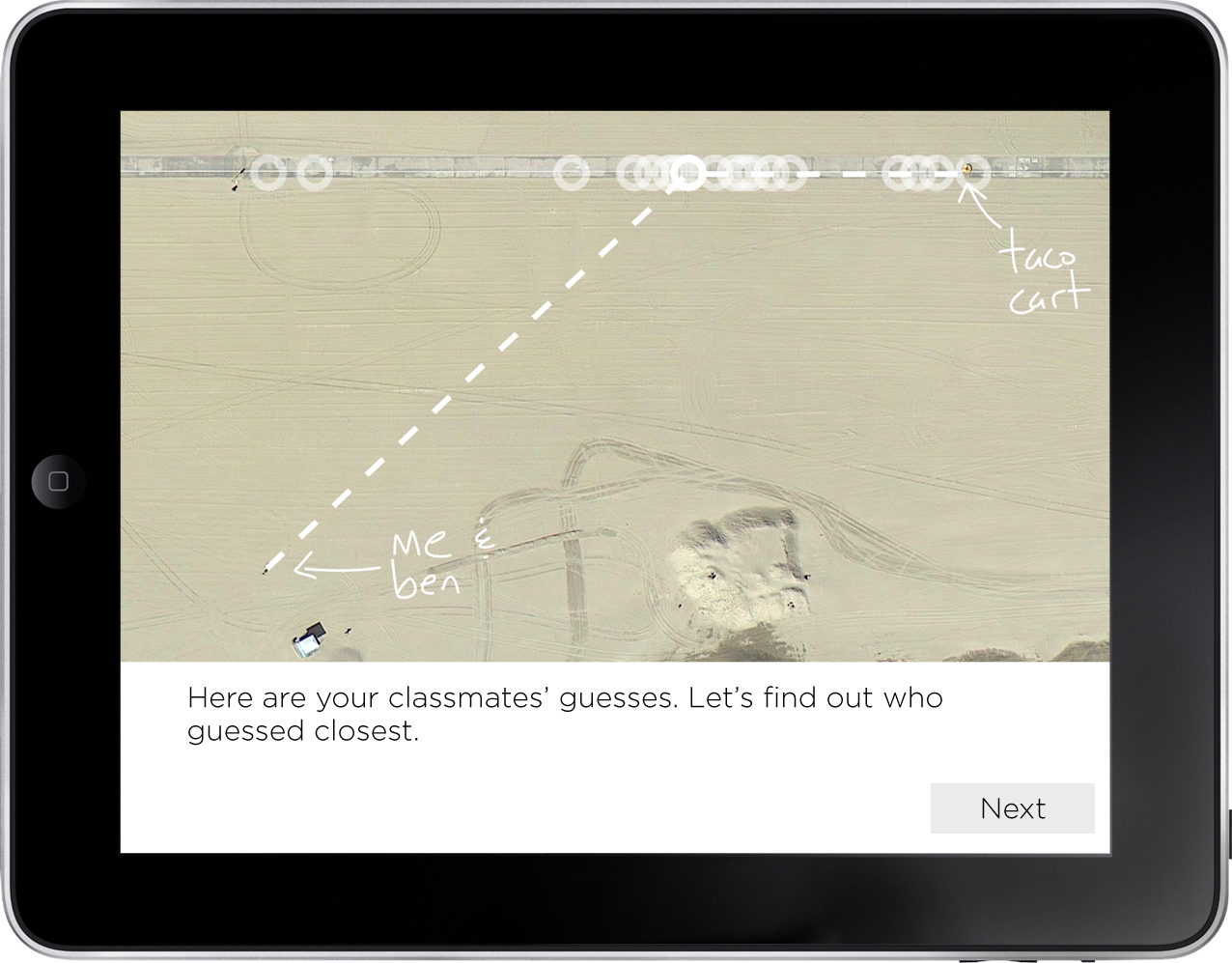
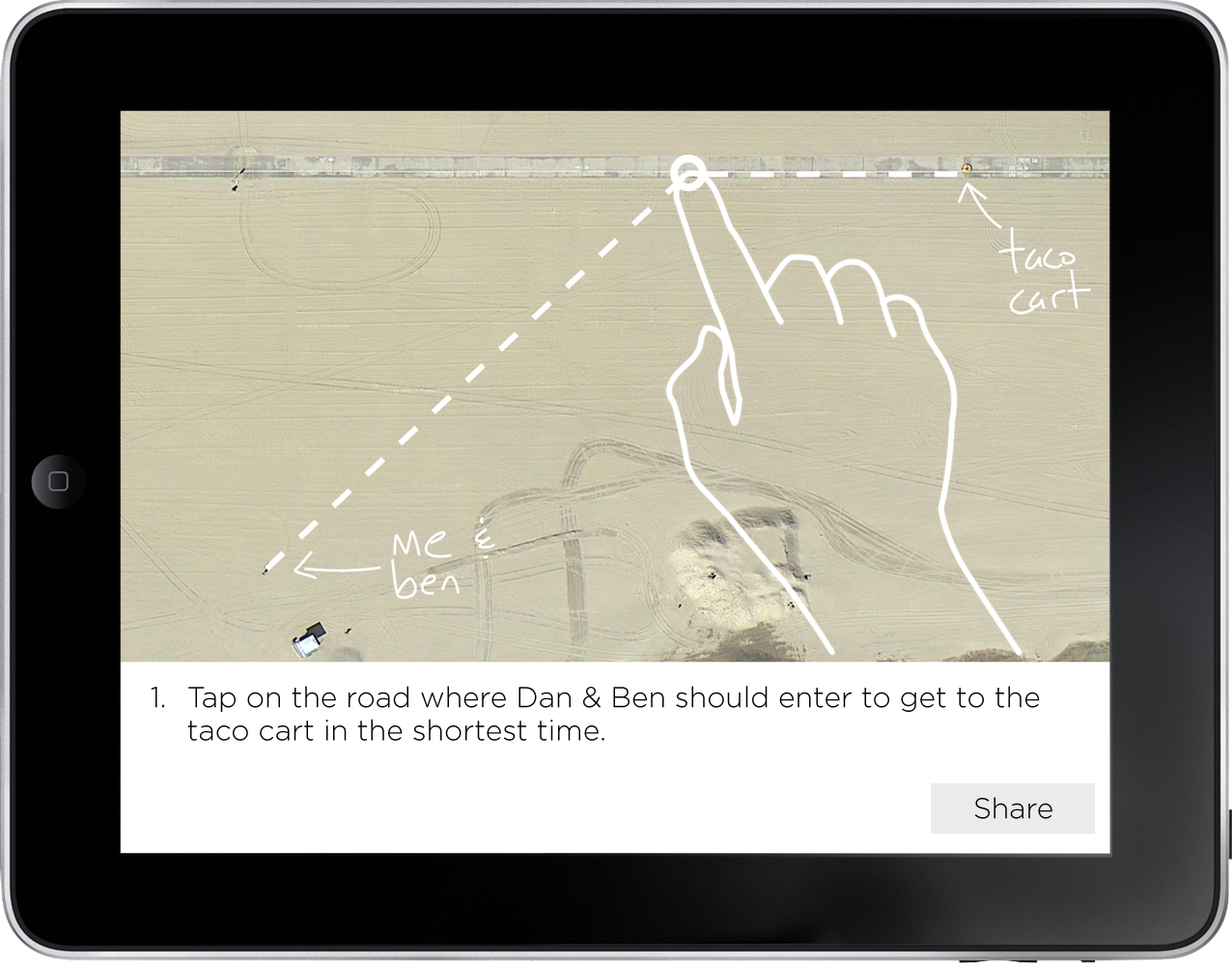
Currently, I’m asking students to guess where Ben and I should enter the roadway to get to the taco cart as fast as possible. But how do they register that guess? Do they point to it? Do they make a mark on a printout of the scene?

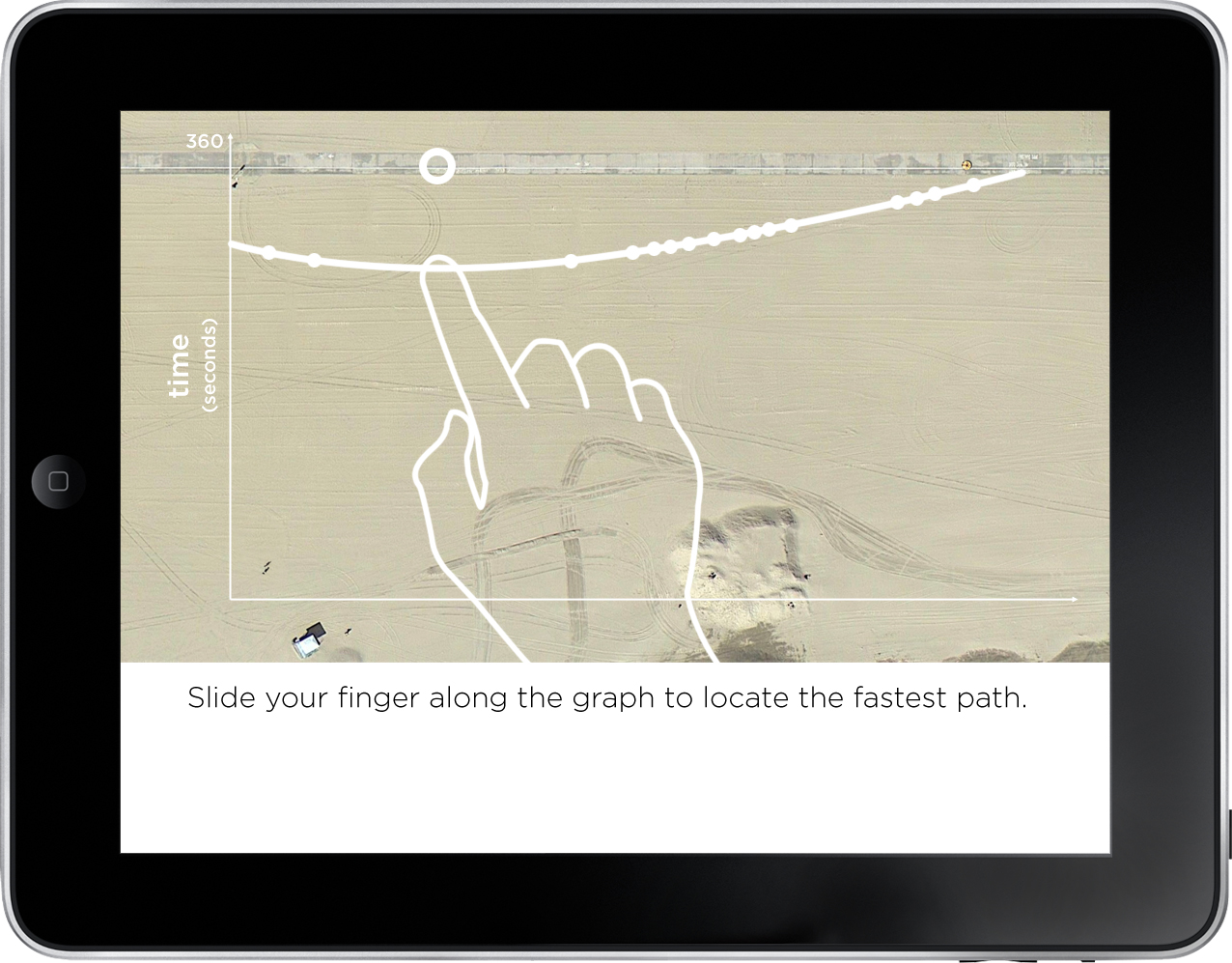
Let’s give them tablet computers, instead, and let them slide their fingers down the road until they’re happy with their guess.

Then they see all their classmates’ guesses. Ideally those guesses are all attached to faces or names somewhere so you can see how your best friend or the girl you have a crush on guessed. This ratchets up their perplexity. Who guessed closest?

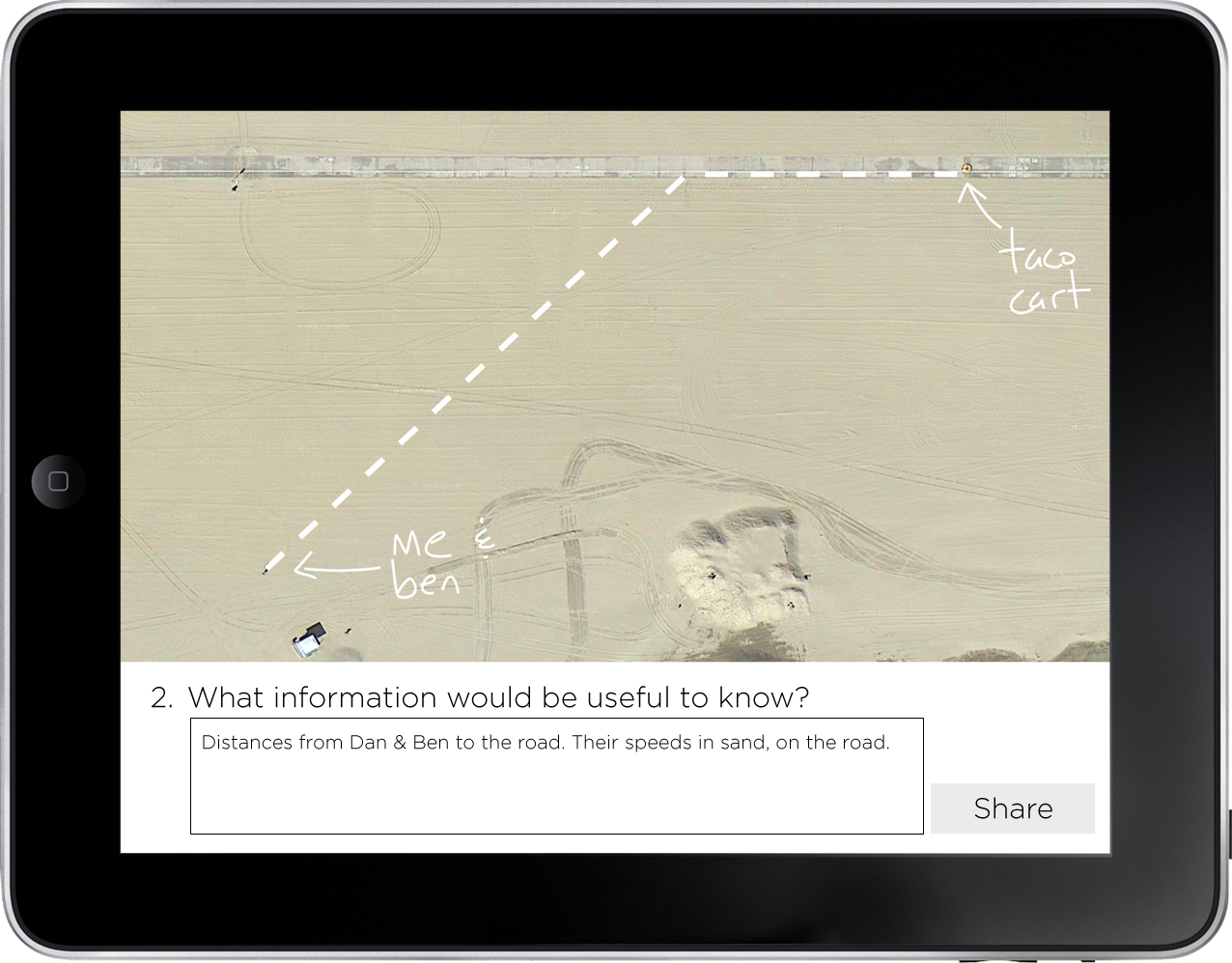
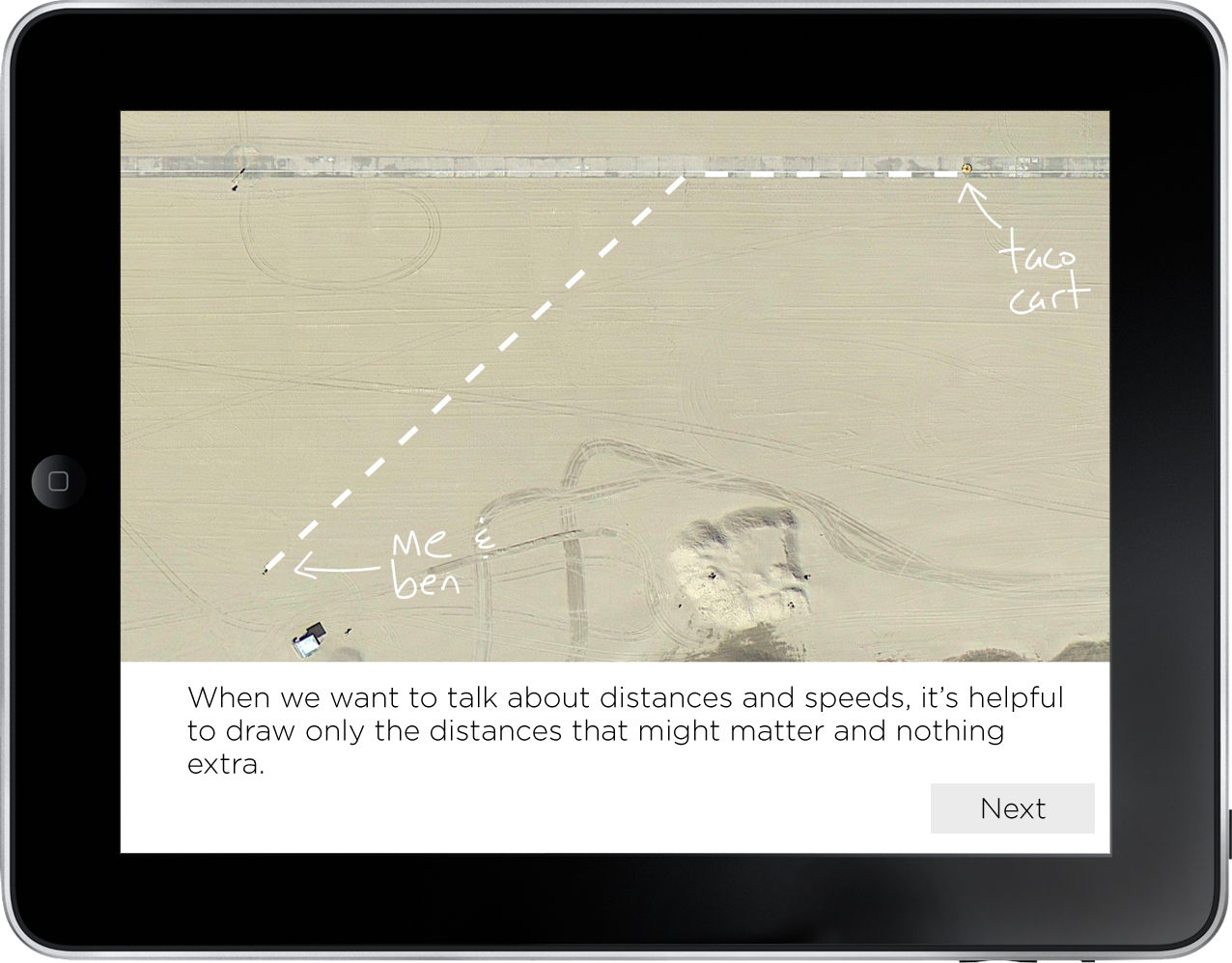
Then we ask them what information would be useful. This is abstraction. We’re giving the students a chance to extract the essential features of the context.

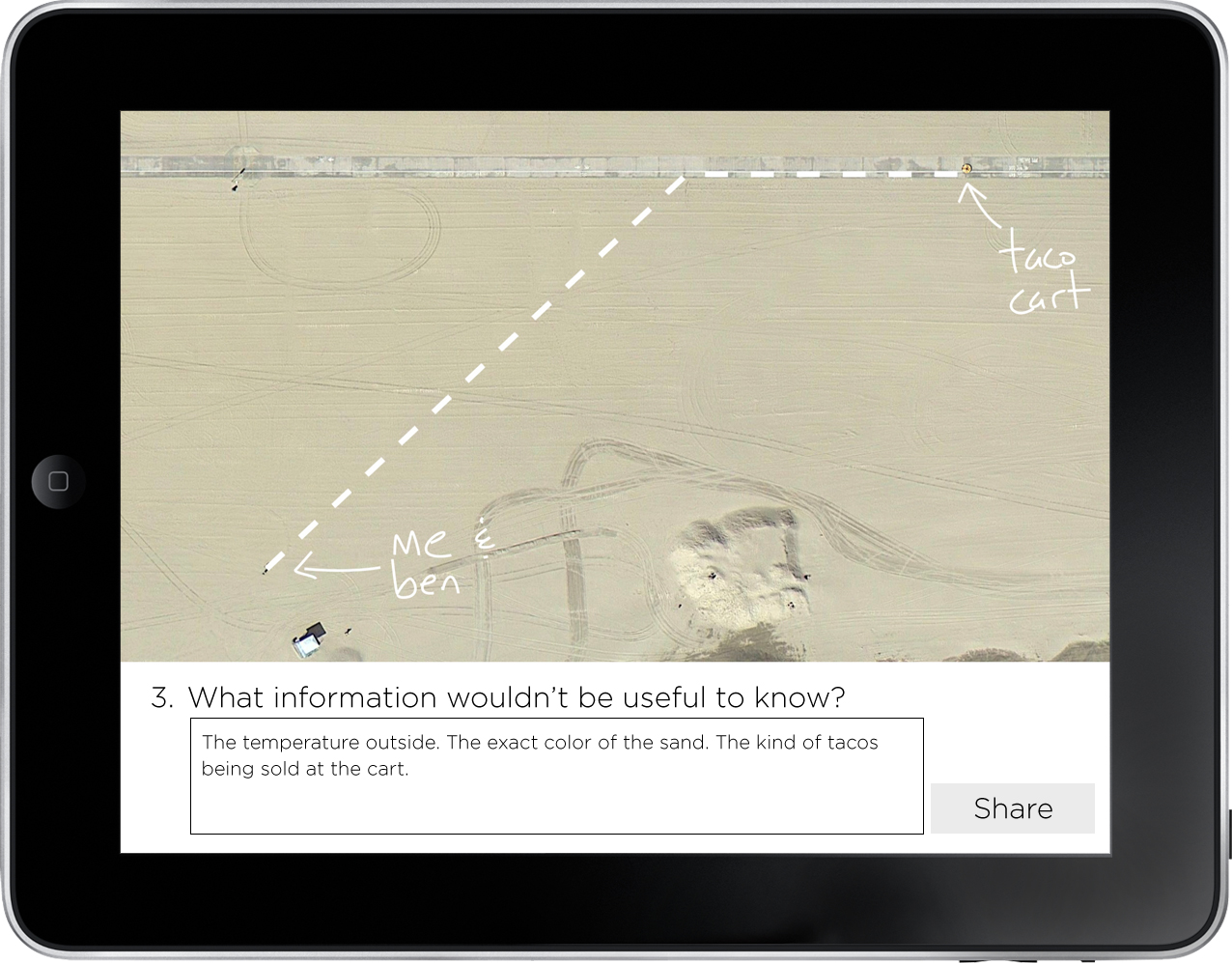
We ask them to discard the inessential features of the context.

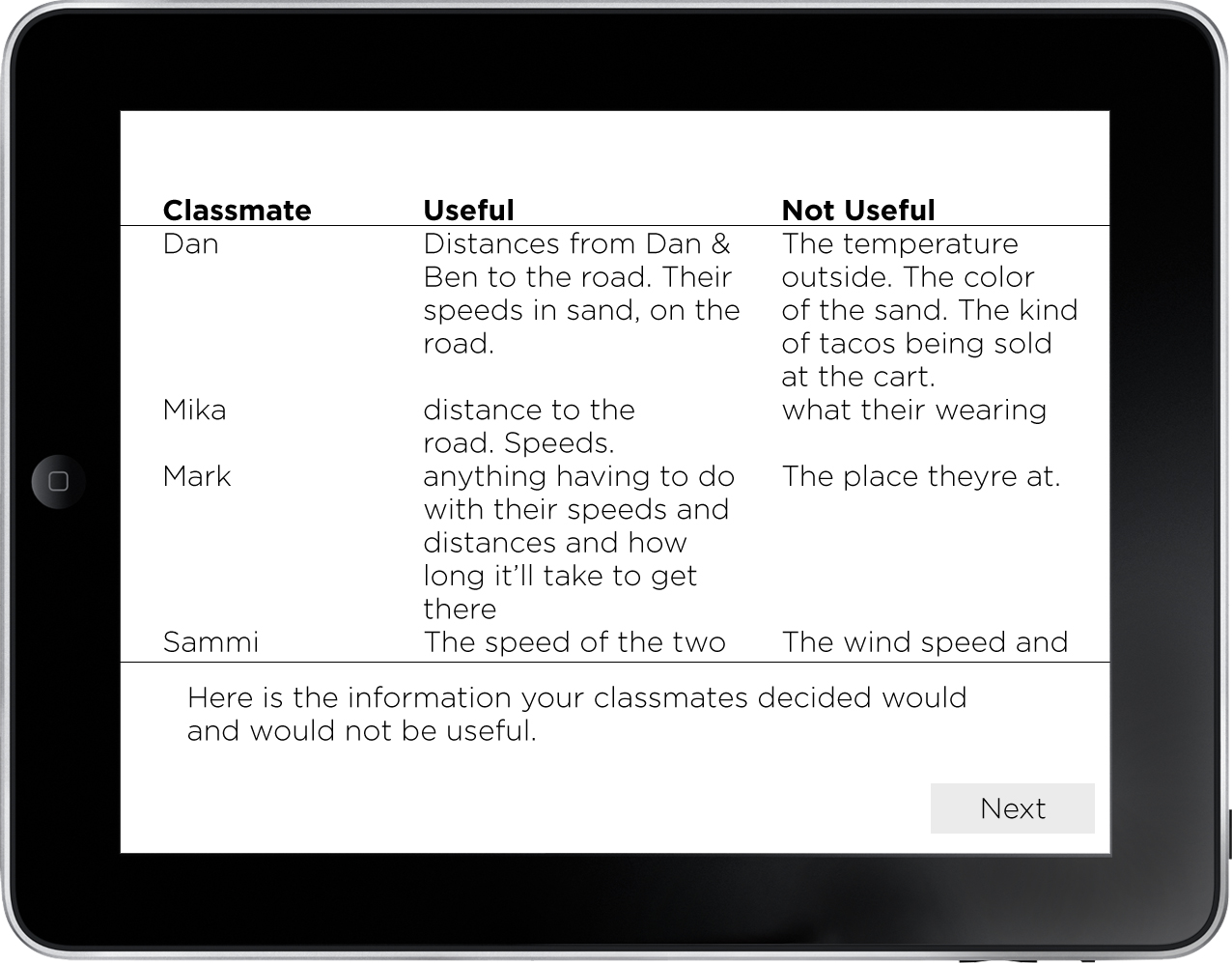
The tablet summarizes the class’ responses. The teacher can use this information to seed a brief discussion.

What happens next is violent. We’re going to vaporize the world. We’re going to strip away the sand. We’re going to destroy the buildings. We’re going to wipe Dan and Ben and the taco cart off the map and replace them with points and lines. If you’ve studied math at the university level, it’s possible you’ve lost touch with the violence inherent in mathematical abstraction.

So we scaffold that process briefly. We prepare the student. We say, “We’re going to get rid of a bunch of stuff you said was inessential and represent the rest as neatly as possible.”

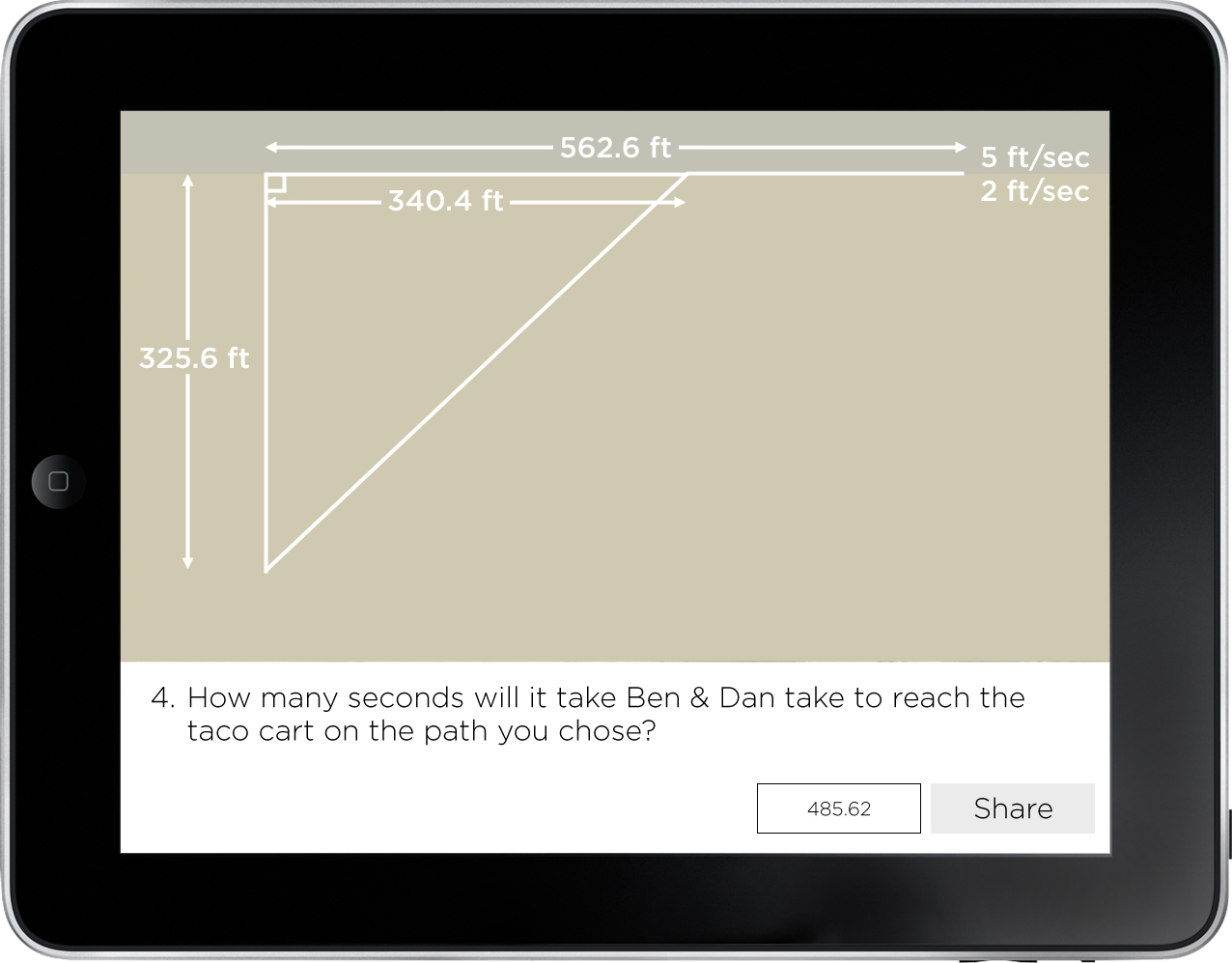
Now this is interesting. Each student is given her own task, a task that she, herself, picked. “You guessed that this would be the fastest path,” we say. “Go ahead and figure out how long your path would take.”

This is more fun than evaluating the duration of a generic path and it’s easier than differentiating the generic path and solving for its minimum. It isn’t all that much more difficult for the teacher to check either because everyone is performing the same calculation, just on a different value.

Everybody enters their results. The tablet checks them for correctness and then displays them.

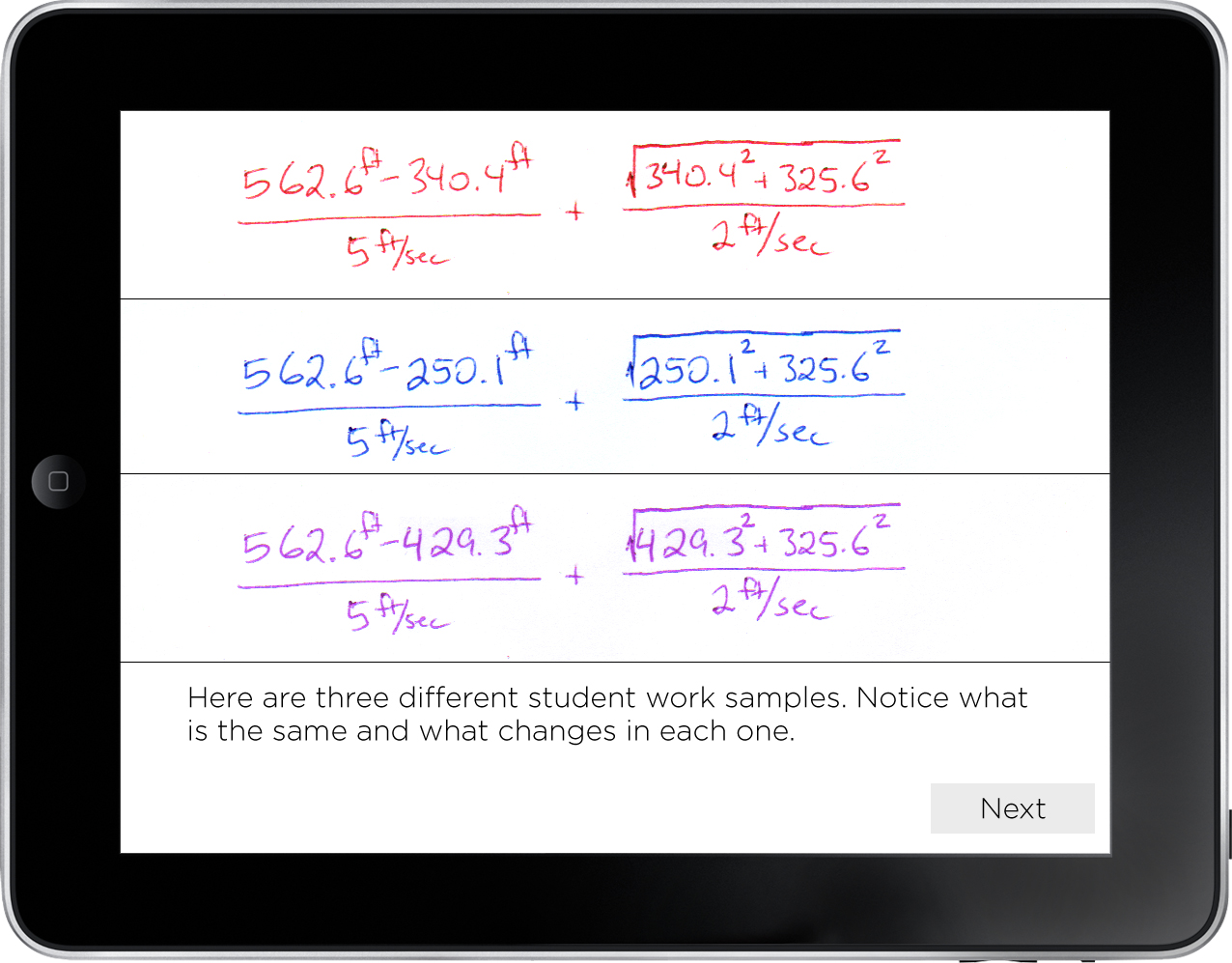
Remember that everybody is doing the same calculation on a different value? [BTW: Christopher Danielson is right that I overstepped myself here.] That means it’s abstraction time again.

We pull out three student pages (never mind that these are all from the same person) and we ask the students to notice what changes and what doesn’t.

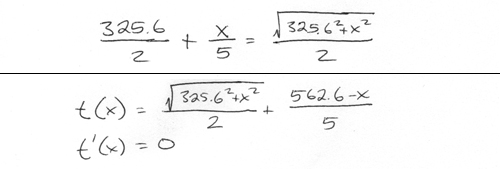
We turn the thing that changes into a variable. But why? Because math teachers need the work? Because math teachers amuse themselves with this notation? No. Because it lets us try any value we want really quickly. What are the highest and lowest values we should try?

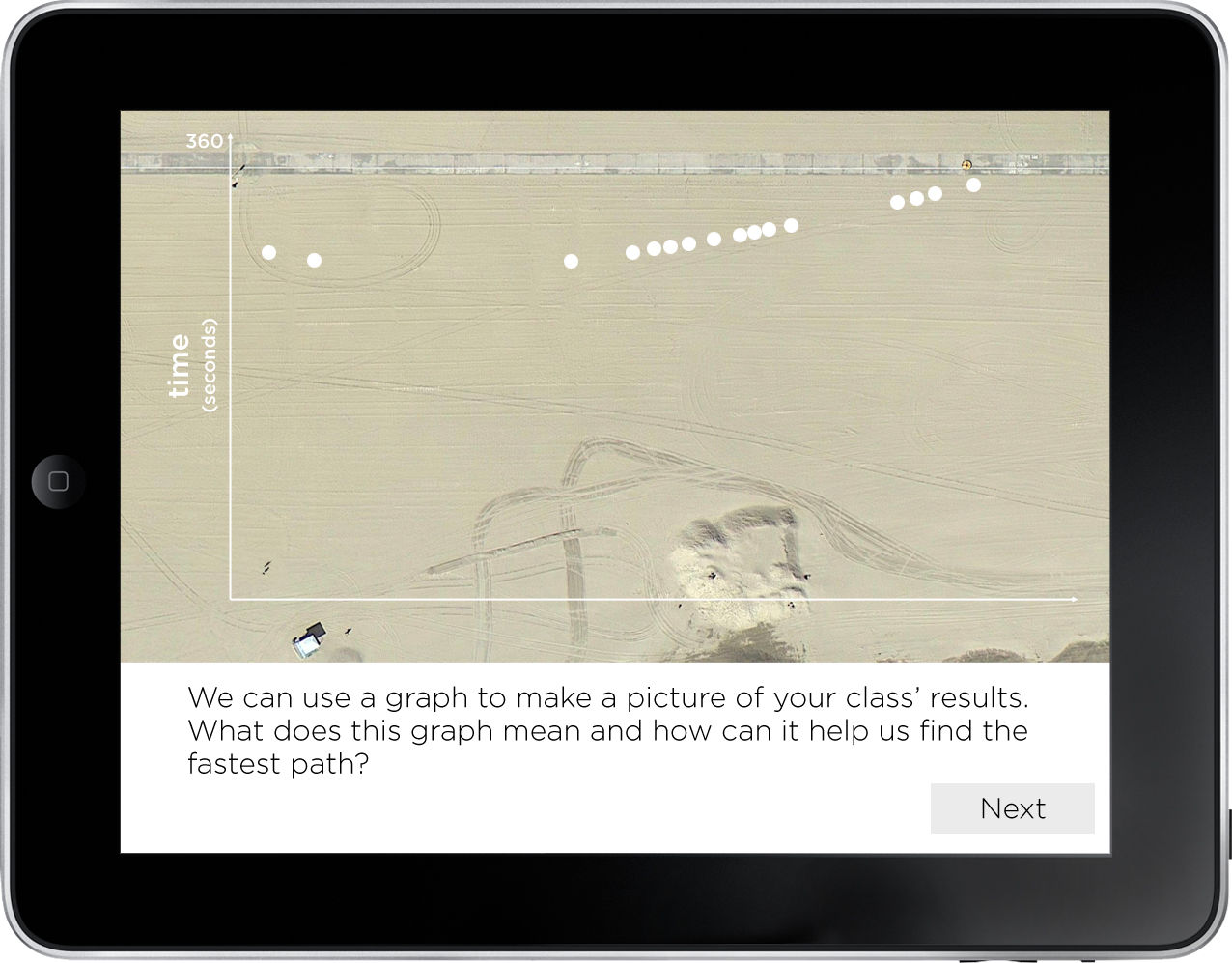
The student slides her finger along the graph and the path adjusts with it. The tablet snaps to points of interest like minima and maxima and displays the value of the graph at those points.

From here we’d play the video that shows that answer. The tablet would find out which student guessed the closest initially and throw some love on her.

A Few Closing Notes Before I Ask Your Opinion About This Kind Of Curriculum

  • On the upside, this task attempts to clarify abstraction for students and make that process participatory. It involves the entire ladder. Students pick their own math problem. Students are guessing. They’re deciding what information is useful and useless. ¶ Look at the original task and imagine how many more students are included in this re-imagining. ¶ The task is also social in a way that’s difficult to achieve without 1:1 technology. The tablet collects and represents the entire class’ guesses in real-time. A teacher can’t do that.
  • On the downside, I’m not sure what the teacher does in this sketch. At different times, I wobble between having the textbook function as the teacher and having the textbook simply maintain a steady course through the problem. If I taught this problem, I know I’d handle a lot of the exposition (ie. “Here’s why we use variables.”) myself, in conversation with students. But what should the textbook do? ¶ Also, we didn’t differentiate the function and solve for the minimum. We formulated the model and solved it graphically. Does that still count as math?

Now you go.

2012 Oct 11. Dave Major went out on spec and put a lot of this into code. It’s exciting.
Two PD Opportunities

One, I’ll be chatting with three-act mavens Chris Robinson and Andrew Stadel in the Global Math Department Wednesday 10/10 8:00PM Central Time. Here’s the agenda.

Two, I’ll be offering two sessions in San Francisco on Monday 10/14 for Integrate|Ed along with a pile of other really great educators. Details here. Tickets are ordinarily $275 but if you type “vendor sponsorship” in the coupon code blank you get it for $75, which is kind of an insane discount.

2012 Oct 11. Here’s the recorded version of the Global Math Department discussion.

[3ACTS] Taco Cart

This task is one possible response to this week’s check for understanding. It was a pile of fun to produce.

Release Notes

Real to me. My wife and I were on a beach recently and found ourselves in this math problem. This happens to every math teacher, I’m sure. We use our own product. We employ mathematical reasoning in our own lives in obvious and subtle ways. I’ve tried to discipline myself not to miss those moments, to instead write them down, photograph them, and turn them into a task where students experience the same dilemma my wife and I did.

Google Maps. The game here is to screenshot a bunch of tiles from Google Maps, align and stitch them together in Photoshop, and then fly around that large image in AfterEffects.

Use appropriate tools strategically. The sequels aren’t optional here. One sequel suggests that the cart will start moving towards you and asks “at what location will both paths take the same time?” The other asks for an even faster path than either of the two originally posed.

In both cases, I enjoyed setting up and solving the algebraic models.

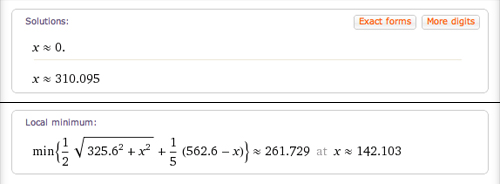
But as I contemplated solving one equation and finding the minimum of another, symbolic manipulation never occurred to me. Without any teacherly presence hovering over me, nagging me to rationalize my roots, the most obvious, practical solution was Wolfram Alpha โ€“ no contest.

A teacher at a workshop pulled off a similar move this week and felt embarrassed. He said he had “cheated.” Tools like WolframAlpha require us to come up with a more modern definition of “cheating.” (And of “math” for that matter.)

The ladder of abstraction.

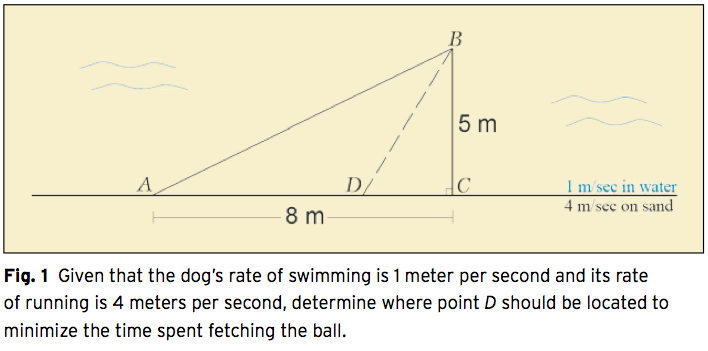
Referring back to the check for understanding, here are ways the original task had already been abstracted:

  • the dog and the ball are represented by points; their dogness and ballness have been abstracted away,
  • very little of the illustration looks like the scene it describes, for that matter; the water and sand are the same color; the image of a dog swimming after a ball has been turned into the remark “1 m/s in water,”
  • points have already been named and labeled,
  • important information has already been identified and given,
  • auxiliary line segments have already been drawn; the segments AB and BC and DC don’t actually exist when the dog is running to fetch the ball; they have been abstracted from the context later.

My version of the task starts lower on the ladder. You see the sand and the sidewalk. You see what it looks like to walk in each. They aren’t abstracted into numerical speeds until the second act of the problem, after your class has discussed the matter. I do draw a triangle on the video, which is a kind of abstraction. I didn’t see any way around it, though.

BTW. Andrew Stadel also has a nice task involving the Pythagorean Theorem and rates.

People’s Choice Voting Now Open For The #MTT2K Contest

There were twenty-eight responses to the call to critique Khan Academy’s house style. My co-judge, Justin Reich, and I are debating their merits in a smoke-filled room, particularly along the “enlightening” and “entertaining” axes. We’re inviting you to weigh in on the results also and issue a People’s Choice Award. Visit this survey and give your opinion. We’ll announce the winners in a week.