Category: anyqs

Total 24 Posts

Asking Interesting, Natural-Seeming Questions

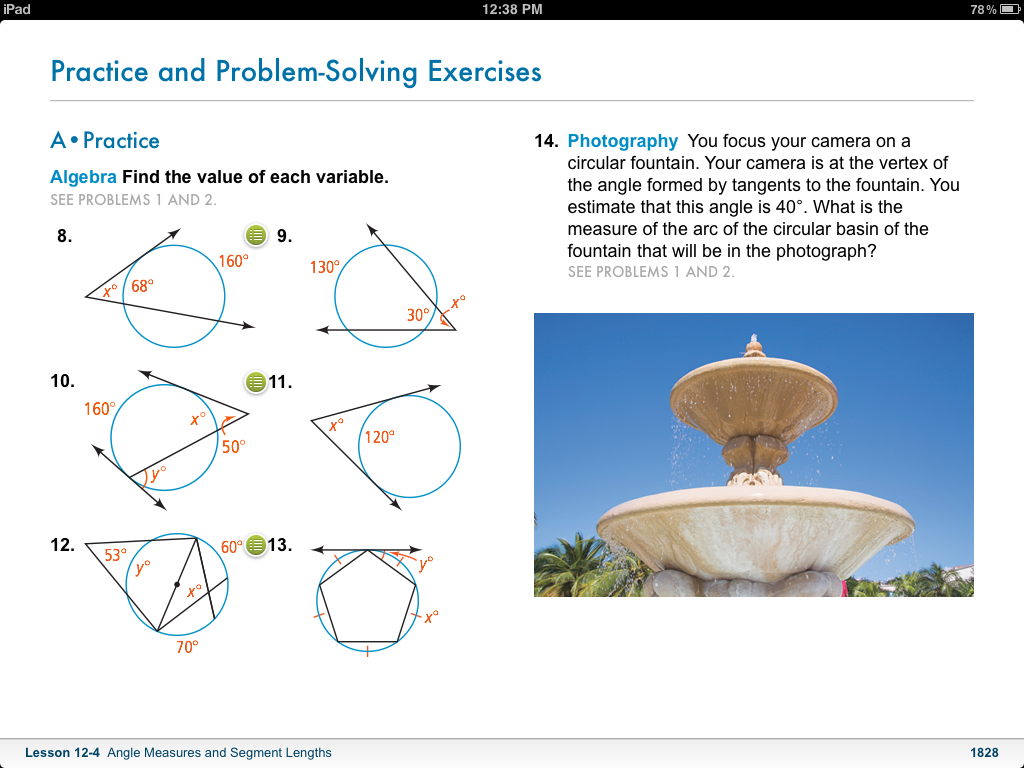
Here is a picture of a fountain from Pearson’s Common Core Geometry iBook. (Full disclosure: I consult with Pearson.)

Given ten tries, you’d never guess the question connected to that image: “What is the measure of the arc of the circular basin of the fountain that will be in the photograph?”

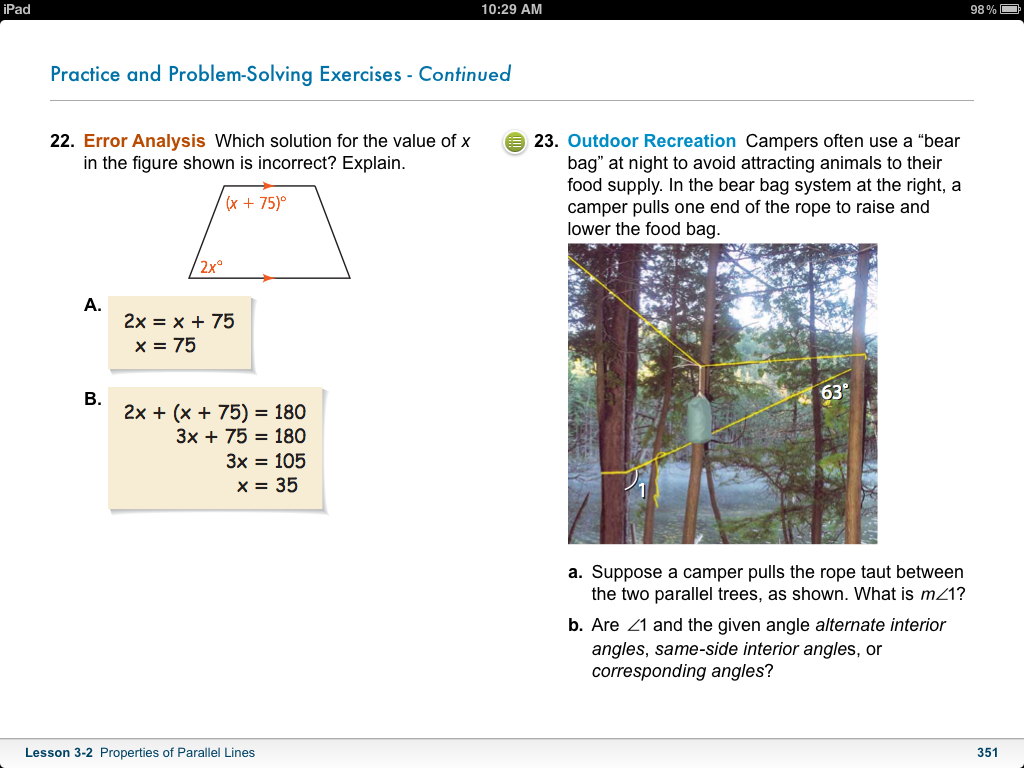
Same with this line from problem 23 on page 351:

Campers often use a “bear bag” at night to avoid attracting animals to their food supply.

It is followed by:

Are angle one and the given angle alternate interior angles, same-side interior angles or corresponding angles?

Not only will those questions fail to interest many of my students but they’re also unnatural and disconnected from the context to which they are attached. The fountain doesn’t want that question. The bear bag has no use for its question. Students notice that disconnect. Some have fully internalized that disconnect and concluded that math is some alien, otherworldly thing they’ll survive and then forget as quickly as possible.

What Do We Do?

Not this:

Over at Danโ€™s site people have been discussing these last set of questions and we find, naturally, Dan promoting his brand of โ€œMake the prompt scream the question you are looking forโ€ …

I hear it too often in emails, tweets, and conversations after conference sessions:

“I asked them what questions they had and they asked the one I was looking for!”

Just ask it.

“It took some time but I prompted them a little and they asked the question I wanted them to focus on!”

Just ask it.

“They guessed the question I wanted them to ask!”

Just ask it.

Just ask the question. My point has never been that you should never ask questions rather that you should ask questions with some certainty they will be interesting and seem natural to your students.

How can you tell in advance that a question will be interesting or seem natural to your students? Ideally, I’d have a room full of students I could run ideas past โ€“ an on-call focus group. I’d punch a button and they’d snap to attention. Then I’d introduce a context and a question and they’d give me a thumbs up or down. (Standard disclaimer: math is a context.) Maybe they’d suggest other, more interesting questions. That would be great โ€“ all of it โ€“ but I don’t have those students on call. I have you guys instead, and that’s way, way better than nothing.

But just because the football player runs through tires on the scrimmage field doesn’t mean he runs through tires on game day. See? 101questions is our scrimmage field. It isn’t the game itself.

BTW: Avery Pickford has some smart writing along these same lines.

Previously: Unnatural Currents

Featured Comment

Mylene:

Inquiry-based science teaching sometimes gets bogged down in similar games of “guess what the teacher wants you to say.” ร‚ย Almost as frustrating as known-answer questions are these, which I shall start calling “known-question answers.”
Five Favorites โ€” 101Questions [5/5/12]

People have asked why they can’t add questions to these links. The only place you can ask questions (or skip them, if you’re bored) is on the homepage where they’re stripped of the author’s name, the author’s questions, and everyone else’s questions, all of which have the potential to bias your response. You might disagree with that call but it was intentional, not an oversight.

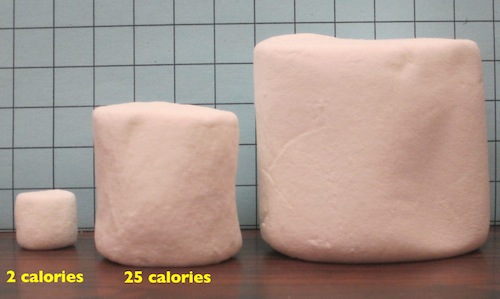
  • Big Marshmallow, Christopher Danielson. Five out of six questions (as of this writing) concern calories. Coincidence? What could have been? (PS. 100% perplexity as of this writing also. Strong work, Mister Vice President.)
  • Bart Acceleration, Tim Erickson. The placement of the beam adds an interesting frame of reference to the video. I’d like to see the timer saved for later, of course.
  • Big and Small Cookies, John Golden. The photo’s blurry and already cluttered up with abstraction but I do like the question a great deal, “Is it a better deal to buy the three smaller cookies or the larger one?” Because the area of a circle is a strange thing.
  • Danish Clog, Fawn Nguyen. I wouldn’t find this nearly as perplexing without the sandal in the clog. A little bit of whimsy goes a long way with me.
  • Wheat and Chessboard, Carl Malartre. This is a task I’ve only ever seen posed verbally. The visual, for me, illustrates the fact that, my word, square 64 is going to have a ton of wheat on it.

Plus my own listings this week, which include some older material:

Let me run an idea by you: once we get these things tagged up by standard or objective or keyword or whatever, then you have ready-made gallery problem sets. ie. Rather than inflicting my own fascination with absurd gummi bears on a kid who doesn’t care about them, I can send her over to 101questions and she can pick out a problem that interests her and use it to demonstrate competence. Student-centered paradise? Logistical nightmare? Both?

Five Favorites โ€” 101Questions [4/28/12]

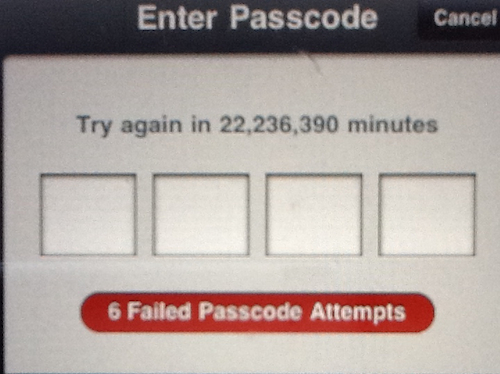
  • Locked iPad, Jeff. I love that math makes large, incomprehensible numbers a little more comprehensible. How many days, weeks, or years will I have to wait to try another passcode?
  • Bake House Piano Drop 2012, Jeffrey Kirby. They really only had one shot at this. No do-overs. So how did they calculate the position of the ground piano for impact with the flying piano?
  • When you wish upon a star …, Statler Hilton. I want to see what this looked like from the air. This had to be carefully laid-out and diagrammed.
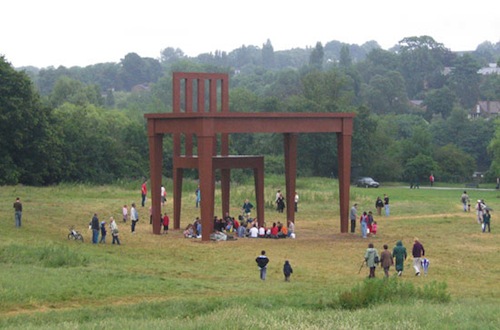
  • Giant Domino, Ian Frame. A gaggle of these popped up after my NCTM talk yesterday (during which I plugged 101questions). These enormous objects litter a small acreage surrounding the Philadelphia convention center, inspiring a pile of interesting questions related to scale. “How tall is the person who is playing with this domino?” will get you first-order similarity. “How heavy is he?” gets you the third order.
  • File Cabinet โ€“ Act 1, Andrew Stadel. Crazy bananas. Thankfully, only one of us has to do this for all of us to use it and, lucky for him, he only has to do it once.

Also interesting:

  • Floor 13 please, Luke Walsh. I had a back-and-forth with Karim Ani over this first act. As of this writing, all four of Luke Walsh’s “students” want to know how heavy the average person is. Meanwhile, Walsh asks his students, “What is the area in square feet of this elevator?” That difference interests me. It seems, perhaps, typical of the student-teacher relationship where I can always override my students’ preference by the power vested in me as a teacher, a grown-up, and a person who is several feet taller than they are. All other characteristics of a task being equal, though, I’d rather its question be something that occurs naturally to them or that seems natural when I pose it. 101questions helps me locate those natural-seeming questions.

Plus my own listing:

  • Portal Laser. I uh got kinda heavy into Portal this last week. Both of them.

Best Of 101Questions [4/21/12]

My five favorite listings on 101questions this week:

  • Soccer Ball Inflation, Nathan Kraft. My students are promiscuous with proportions, applying them to any situation where they have one known relationship and one unknown. That’s my fault. A proportions unit ought to feature unproportional relationships right alongside the proportional and in similar quantities. So here’s a good one from Nathan Kraft. If the small ball takes nine pumps to fill and it’s half the size of the large ball, the large ball will take 18 pumps. Right?
  • Swimming the River, Scott Farrar. Resultant vectors aren’t always easy to visualize, which makes this invaluable. If I used this in a class, I’d probably cut it halfway so students could calculate the girl’s odds of making it to the rock. Pairs well with Crosswind Landing.
  • Tuba Echo, Nathan Kraft. So you have a guy honking away on a tuba, facing a wall that honks back. Gold
  • Google Calc Error, Carl Malartre. For whatever reason these are pretty risky. Why is Carl at 80% with this while James McKee is stuck in Skipsville with Temperature Conversion?
  • Please take a seat, Gulliver, Statler Hilton. My question: “How tall is the person who would sit there? How much would she weigh?”

Plus my own listings:

Best Of 101questions [4/14/12]

A few of my favorite listings on 101questions this week:

  1. A Fistful of Quarters (and Dimes), Nathan Kraft. Provokes the comparison of the value of a coin against its weight, which seems at first like a useless ratio. But remember the nickel thieves? If someone let you carry as much change away as you could lift, which kind of coin would be the smartest pick?
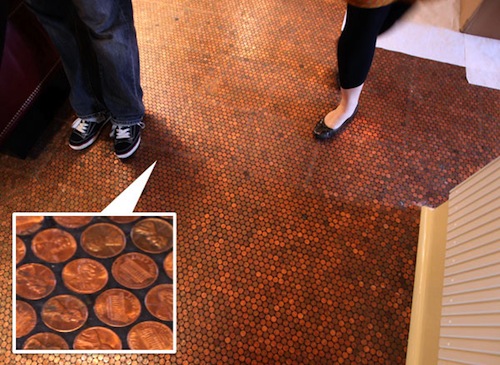
  2. Pennies, Friedrich Knauss. Provokes the comparison of the value of a coin against its surface area which, again, seems like a totally useless ratio until you see a photo like this. If you were going to carpet your floor with a particular kind of currency, which would be the smartest pick?
  3. Handshakes, Craig. Love the clip. I find the question, “How long would it take to infect the whole office?” irresistible.
  4. Coins, Steve Phelps. I’ve noticed these kinds of first acts are difficult to pull off. (Check, please, also uploaded last week, is struggling, for instance.) They’re often too cluttered or they place students too high up the ladder of abstraction too quickly. Steve Phelps strikes a nice balance here. Moreover the task is open to several correct answers, which is unusual for material you’ll find on 101questions.
  5. 1982 Osborne Executive vs. 2007 iPhone, Carl Malartre. I tried a similar approach with Evolution. I like Carl’s more.