Category: anyqs

Total 24 Posts

BREAKING: BLOGGER DESIGNS WEBSITE FOR SHARING NICHE CURRICULUM INTEREST

Let me invite you to check out 101questions, a website I’ve been building since last fall.

Other websites will let you “like” something or call it a “favorite” or “interesting” or give it a thumbs up or a +1. As a teacher, I don’t aspire to any of those things as much I aspire to be perplexing. I want to perplex my students, to put them in a position to wonder a question so intensely they’ll commit to the hard work of getting an answer, whether that’s through modeling, experimenting, reading, taking notes, or listening to an explanation.

A lot of my most perplexing classroom moments have had two elements in common:

  1. A visual. A picture or a (short) video.
  2. A concise question. One that feels natural. One that people can approach first on a gut level, using their intuition.

Let’s call that a first act. There are still two more acts and a lot of work yet to do, but the first act is above and before everything else.

It’s been difficult for me to know in advance whether or not my first acts will perplex my students. Sometimes they confuse my students. Sometimes the warped lens I have on the world indicates something perplexing but it bores my students. For awhile I inoculated myself against that possibility by tossing the photo out to my Twitter followers and asking them “Any questions?

Their responses have been extremely helpful, but limited in some ways that 101questions will fix. I’ll describe those in more detail in another post.

For now, check it out. Ask some questions. Upload a first act. Wait for the questions (or skips) to roll in. Then figure out how you’ll help your students get answers.

Pretending Closed Questions Are Open

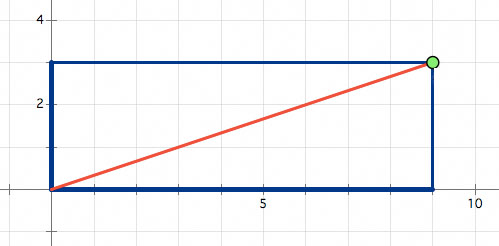
I was in Avery Pickford’s session at CMC-South when he put up this image and polled his participants for questions that interested them.

They asked about the slope of the diagonal. They asked about its length. Avery then constrained their questions. “What things could we count?” he asked.

His participants responded with “the perimeter” and “the number of squares.” At that point, Avery just asked the question that interested him:

How many squares does the diagonal pass through?

His session ended on that problem but I’m extremely curious what would have happened had he presented a new image and asked his participants for new questions. I can’t be sure but I suspect they would have held out. They’d know from their last experience that Avery had a question in mind and everyone but the apple-polishers would have waited him out.

Open And Closed Questions

If you have a question you’d like your students to answer, ask it. But before you ask it, consider creating a visual โ€“ something short and sweet, one photo or one minute of video โ€“ that orients your students to the context of your question and makes that question seem like a natural one to ask. Like:

If you’d like your students to pose some questions of their own, ask them what questions they have. But questions about what? Give them something to ask questions about. Consider creating a visual โ€“ something short and sweet, one photo or one minute of video โ€“ that lends itself to different perplexing questions. Like:

What Happens On Twitter Stays On Twitter

How can you tell in advance if students will be perplexed by your closed question or if they’ll have open questions about your photo or video? You pilot it. There’s no right way to pilot curricula, only optimizations for different variables that are often in competition with one another. Like:

  1. Are you piloting with students or with some proxy for students?
  2. How easy is it for your participants to give you feedback?
  3. How many participants are giving you feedback?
  4. How helpful is that feedback to your development process?
  5. How far into the development process are you waiting to get feedback?

Here’s one optimization: show teachers your photo or video on Twitter and ask them what questions they have about it.

This means (1) you aren’t piloting with students, which is unfortunate, though no students are harmed if your idea is a dud, (2) it’s easy for your participants to give you feedback, (3) the number of people giving you feedback is proportional to your followers on Twitter, (4) that feedback is often useful โ€“ if you plan to ask a closed question, the feedback will let you know if that question is interesting; if you plan to ask for open questions, the feedback will let you know what questions to expect.

Or you might pilot your curriculum on the same day you’re teaching it, making modifications for your afternoon class based on feedback from your morning class. You can evaluate the variables for yourself on that one.

Make it work for you. Twitter, #anyqs, your classroom, your faculty lounge, whatever. Make it make you a better teacher. Just understand that when you’re using curriculum in the classroom, you’re optimizing for an entirely different set of variables than when you pilot that curriculum somewhere else.
[anyqs] Speed Of Light

Here’s another. Again, these are push-ups to me. If I don’t make an exercise out of turning interesting things into challenging things, the result is that I become less interested in things altogether. Here’s the original thing that interested me.

  • h/t Max Goldstein who brought the original animation to my attention. I’m fascinated with his fascination with the dimensions of the Earth’s atmosphere in pixels. If I were to rank the things about that animation that fascinate me, I’m not sure that datum would crack the top fifty. There’s a lesson for me in there somewhere.
  • Here’s something that kinda sorta looks like I’m trying to make a lesson plan out of this video.
  • While we’re on the subject of #anyqs, I love this effort from Mylรจne at Shifting Phases. She dips her toes in the #anyqs waters and makes a huge splash.

2011 Sep 06: I posted this #anyqs for response to Twitter and got a long, resounding “Huh?”

@thescamdog: @ddmeyer I've got nothing. Mostly I wonder what the shady looking guy with the flashlight is up to.

@park_star: @ddmeyer had to watch it twice and i'm still sort of wondering what the heck is going on.

It should go without saying that this kind of feedback is just as valuable as the kind where everyone aligns around the same question. Far better to get this feedback now, on Twitter, from a group of math educators, than when it’s too late, in the classroom, from thirty bored math students.

[anyqs] Hurricane Irene Edition

So I made this short video:

… because a week earlier I read this awesome hurricane preparation tip:

If an evacuation is required, one should freeze a nice, clear, full, pint-sized glass of water into solid ice and put a penny on the top of the ice in the freezer. Given that power outages can vary from block to block for varying lengths of time, and that power can be restored before one can return home, it is very possible to arrive after an evacuation to a fridge and freezer working normally. However, if you find the penny at the bottom of an almost-full glass of solid ice, you can toss your bags of food in the trash without even opening them. The penny at the bottom of the glass of ice means that power was out long enough for the ice to melt all the way through. Long enough so that the stuff in the bags is surely re-frozen and re-chilled spoiled food.

That’s the #anyqs game, everybody. Take what you find interesting and turn it into something challenging, something provocative for someone else. We’re great at assigning questions, at writing them down in textbooks or on the whiteboard and using the power of the state to force students to answer them. (“Do you want a bad grade?!”) We have much less practice at provoking questions, at putting students in situations that make them wonder, “Whoa. What just happened back there?”

This has been an attempt at that.

BTW: The big behind-the-scenes dilemma, for whatever it’s worth, was whether or not to include a final shot showing me dump a bunch of food from the freezer into the trash.

Featured Comment:

Frank:

There is a better way, however. Take a used water-bottle, put a little water in it, and freeze it *upside down*. Then store it in the freezer *right side up*. If you ever find the ice at the bottom of the bottle, there has been a thaw. This eliminates the uncertainty introduced by the “ice skate effect”.

Redesigned: John Scammell

So John Scammell uploaded this #anyqs, which captured an interesting moment. In his tweet, he wrote, “When I was a kid, I’d grind other kid’s pencils down to nothing.”

John Scammell โ€“ Original from Dan Meyer on Vimeo.

Some things I’d like to accomplish in the redesign:

  1. Get the camera lens parallel to the pencil, an angle that makes it easier to see the length changing.
  2. Convey to the student visually what John wrote in his tweet: that this pencil is about to get ground down to nothing.
  3. Postpone the pencil measurements until the second act. The moment where John measures the pencil is useful and necessary but the first act (the #anyqs) should focus exclusively on curiosity and context. The math introduces itself later in act two to help resolve that curiosity.

Act One

Pencil Sharpener – Act One from Dan Meyer on Vimeo.

Act Two

Pencil Sharpener – Act Two from Dan Meyer on Vimeo.

Act Three

Pencil Sharpener – Act Three from Dan Meyer on Vimeo.

The Goods

Download the full archive. [10.8 MB]