I wrote some commentary recently to the effect that I have never been prouder of any school’s administration or of any department than I am of mine. We are collaborating efficiently on the macro- and microscopic levels. Our six math teachers have made great use of our weekly department meetings while, on the school level, 30% of our staff volunteered an unpaid Saturday to attend professional learning community training out of town.
Weird stuff, and a credit to our principal, who wisely spent his first year mending fences and generating goodwill before encouraging this scary collaboration stuff.
Personally, through this blog-as-self-study thing I’m running here, I’m proud that I was able to nail down some of my largest failings as an educator last year in time to remediate them for this year. In large part because I’m so uncertain how long I’ll be a classroom teacher, I have taken a sledgehammer to these failings. No innovation left on the table once this is finishedOf course, it’s really impossible to measure how much this pace of innovation has contributed to my flagging job satisfaction. Out on a limb, though, I’m guessing not much. and all that.
Here are the big efforts:
Launching Laser-Guided Remediation Missiles
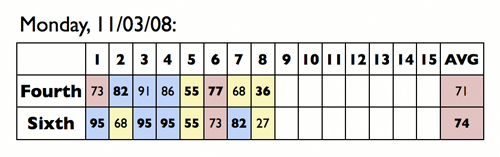
We assess three of our skills every week. I keep detailed records of our progress along those skills (nothing new) but whereas I used those data reactively last year, waiting for students to come see me before I’d use my records to target their remediation, nowadays:
- I take notes as I grade, marking everything from class-wide trends to individual errors.
- I put those same three skill questions on the next day’s opener.
- I pick my jaw up off the floor after I realize that no one notices these are the exact same questions from two days ago.
- I pass back tests to the students I’ve flagged for individual remediation. (“Hey check this out: you came so close here but to undo that positive 4x you don’t divide by 4, you subtract 4x.”)
- The students who made small errors generally start smacking their foreheads repeatedly at which point I say something, like, “Hey, come in today at lunch and show me you know what you’re doing and we’ll fix your gradeI could write a book of poetry describing the satisfaction I get out of this process. My kids are motivated to remediate their own skills! Their grades have meaning! I can recommend meaningful solutions for improving their grades! (None of this “write me an essay on Euclid for extra credit” nonsense.) My job is so much easier when kids have mastered our early skills! I mean, it’d be really lame poetry, but poetry nonetheless..”
I also assess mid-week rather than at week’s end. The grading of those assessments (undesirably) boosts my mid-week workload (obviously) but (desirably) frees my weekend up for luxuries like blogging and puts only two days between assessment and remediation instead of four.
Harassing My Students Into Success
I poked at this idea half-heartedly two years ago, giving kids an “Incomplete” grade at semester’s end instead of “Failing” and contracting with them to remediate all their unmastered skills. This was stupid. Math is too much a progression of skills and student motivation is too much an exponential variable to decide after half a school year that we’re going to turn the whole aircraft carrier around.
So the day a kid’s grade drops below 70%, I assign her an appointment to see me during her free time at which point we remediate her skills (from weakest to strongest) until her grade is passing. This has been awesome because it makes the appeal of my assessment strategy obvious to the kids I want my assessment strategy to appeal to most. (Which is to say that these kids keep coming in even after I stop making them come inThe concept of “making” my students give up their free time is, admittedly, tricky. Usually, they’re so pumped that their teacher isn’t dogging them for their low grades, that instead he believes they can get their grades up and he’ll help them get their grades up, they come in on their own accord. Several times, however, they’ve blown off their appointments, at which point I have called home and hoped for good, coercive parenting. These interventions have caught every student on my roster but two. (Which isn’t to say that every student but two is now passing, just that every student is either passing or making a concerted effort at passing.) For those two students, I’m going to hold my nose and issue an official after-school detention, citing “defiance” (ugh … I know … I know) and force them to accept my help..)
Fixing A Common Objection To My Assessments
“But don’t the kids just keep hacking away at a concept until, finally, they nail it once, forget it, and move on.”
I vary the structure of the problems to the extent that this is really, really rare. (Students who pass concepts tend to pass them again on subsequent assessments.) But now, if a student misses a problem in our one-on-one remediation, I send home two problems for practice. (Putting their nightly total at three!)
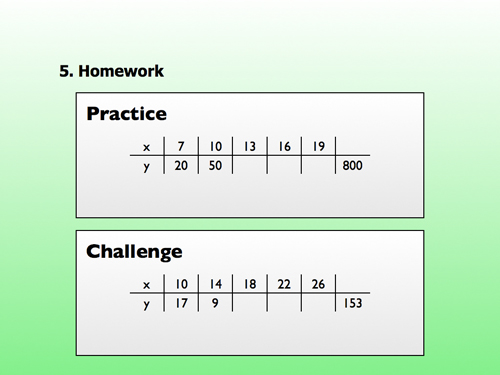
Assigning One Homework Problem Per Night
I already wrote up my motivations for this one. Just an update, then, that it’s really, really easy for me check for understanding, to have a quick conversation about a problem that a student gave 100% of her attention, when there’s only one problem. I like this.
Celebrating
As I pass back assessments, I make a big deal about students who pulled down one or more perfect scores. (“Jessica, three out of three! Bringing the hammer down on Algebra!”) It’s a challenge slipping tests to kids who didn’t get anything right without embarrassing them (though really, really possible) but you should see those kids light up like Christmas trees when they start pulling down perfect scores.
Competing
I track the percent of my students proficient or advanced on a given concept in each class and publicize it weekly.
Competition isn’t exactly the bedrock of great instruction, I realize, but it ain’t bad landscaping. Students talk each other up, encourage each other to do better, to come in on their own time, all without incriminating anybody. It’s pretty awesome.
I also heaved a sigh last week and told them that, yes, what your older classmates have told you is true: I have a secret past as a rapper and, yes, there is a music video and, yes, I will show it to you but only if we rise to 80% proficiency on each concept by semester’s end.
Commence ambivalence, enthusiasm, depending.
Building The Data Wall
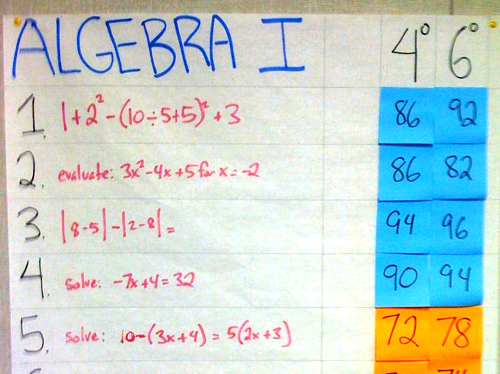
I update those data weekly on a wall chart, which looks kinda cute and colorful. Kids crowd around it after each update, comparing classes and scores.
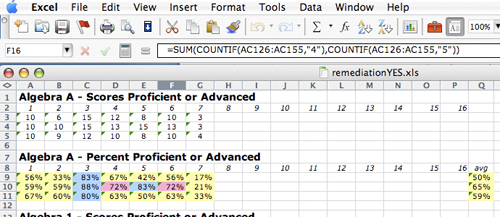
This process was originally time-consuming and annoying, counting up the perfect scores for each concept for each class, calculating the averages, then making colored Post-Its, but I invested an extra hour last week into some conditional formatting and Boolean logic in Excel. Now I just paste the assessment scores in from my grading program and hand a color print-out to my TA, who makes the Post-Its.
Outsourced! Just 54 hours away from a 4-hour work week!
Students also track their own progress on a separate poster (template right cheer: Excel and PDF) marking half a box for proficiency and a full box for mastery.
Observing Other Classes
I wrote about this briefly last week and I’ll only add that if (heaven forbid) I ran my own school I would do everything I could to fund a regular release day (every two months, lets say) for individual departments to migrate between classrooms, learning and leaving feedback. This has been some of the best professional development of my career.
Sitting On The Site Council
My staff elected me to our site council. It helped, somewhat, that I ran unopposed. (“What? No takers? Hey, why’s everybody grinning?”) I’m looking for a challenge, for a different, broader view of how education works in this system we’ve set up. Jury’s still out on this one.
Writing Grants
I signaled interest in participating in a grant-writing team, of which I am now the leader and sole member. (Kind of a trend here.) This has been a good opportunity for me to reach out to my faculty, across party lines content areas.
Attending Conferences
I resolved at the end of last year to attend more conferences. This has been a mixed-to-negative experience so far but I’m looking to bring my average up with the dependable CMC-North conference in December and I’m trying to formulate a pitch for district funds to attend EduCon 2.1 next January. Not sure, exactly, how I’ll sell that one.