Category: assessment

Total 34 Posts

You See The Problem, Right?

This is true:

It is May. Aaron has attended 20% of my classes this year. His grade is a C+.

This scenario is uncomplicated but it illustrates precisely the philosophical chasm between me and my colleagues (local, national, maybe international, too – who knows) and how we teach math.

[Update: I’m a little less coy in the comments.]

Yesterday’s Other Moment Of Clarity:

The Law of Cosines is a beastly formula, which, yesterday, for the first time in five years, I didn’t ask my students to memorize.

I gave them my reasoning: basically, that ten years down the road, ten months, maybe ten days, they’d forget this formula. It’s inevitable. I’d rather them pour their guts into creatively operating the formula than memorizing it, since, in the Google era, that’s an appropriation of resources I could no longer defend.

At the end of my monologue, I wrote the formula on the board and started passing out tests. One student in the front held up her hand, smiling, the Law of Cosines written brazenly across it.

On Nailing/Blowing Assessment

Blowing It

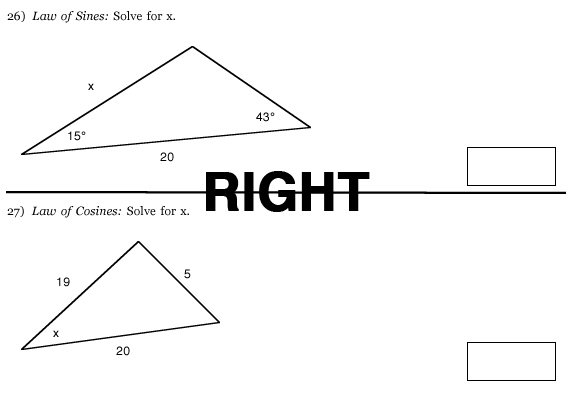
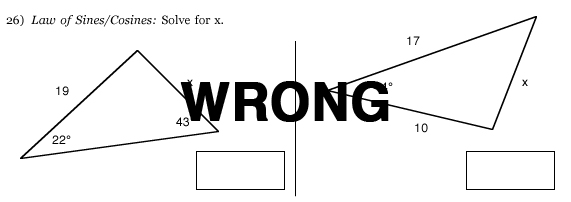
Me, on our last concept quiz, balling both Law of Sines and Law of Cosines into the same heading:

I watched kids tear Law of Sines apart and then get torn apart by Law of Cosines. I was about to toss 2 points out of a possible 4 into the gradebook for, like, seventy students.

But then they come in for help a week, maybe two weeks down the line and what? How does that 2/4 direct my remediation? Which don’t they understand? Law of Sines or Cosines?

And here I try so hard to imagine: how in the world did I ever lump a dozen skills under the same “Chapter [x] Test” heading, the preferred grading strategy of the world’s math teachers?

Disaggregation is the name of the game. It empowers students and teachers. So, on the next test, I did:

Nailing It

Frank N., from the comments, co-opting this assessment strategy for physics.

Now, has all this craziness made a difference? I can tell you this: the kids don’t feel defeated by physics as they did in years past. They can get a 2/10, realize that they didn’t know what they thought they knew, and come back to get a 9/10 and feel great. Plus, when it comes down to grades, there isn’t anything stopping them from getting a 100 each quarter. The ball in in THEIR court. How can a parent argue with a system like that?

In addition, I can immediately tell which topics need re-teaching by me and which the kids get right away.

Exactly.
Knocking Them Down At ASCD

Dina Strasser and Patrick Higgins both rock recaps of sessions at the ASCD… which stands for “Association for Supervision and Curriculum Development,” a title which hits just about every one of my sweet spots. annual conference.

Dina took requests and reviewed a session called Decriminalizing Homework, during which Dr. Cathy Vatterott launched cherry bombs into the crowd (quoted from Dina):

  1. Eliminate grading homework.
  2. Homework that cannot be done without help is not good homework.
  3. A building which has a range of homework weights from 10 percent to 89 percent of a subject grade is “just stupid,” Vatterott stated flatly.

Meanwhile, Patrick, whose unease in his position as technical overlord at his school has inspired some precious reflection recentlyDay 72: No eats lunch with me anymore., attended Brain-Friendly Presentation Skills. I’m prepping my first speaking engagement since August, on entirely new material, and Patrick’s notes were useful:

One of the most powerful things she did was move us. Not the kind where we were emotionally moved, but rather we physically moved around the room. In the 90+ minutes we were there, we moved over 15 times. We conversed, we shared information and discussed the topics in the handout on our own terms, but in ways that she dictated.

The presenter swerves across a fine line and then back again, though, when she implores her audience to “simply walk around the room and touch something blue,” strategies for “engagement” only one degree removed from dosing out amphetamines to dozing attendees.

Pay close attention to the suggestions involving collaborative reflection. Ignore anything that looks like the presenter’s buying her audience’s engagement on the cheap. That’s what engaging content is for.

How Assessment Oughtta Be

Off his students’ distraction, TMAO pulls his unit assessments back in, tells his students not to worry, they’ll do it some other day when they’re better prepared for the challenge, except, one by one, they ask him for another shot.

Now nearly every hand is in the air, delivering the line with increasing rigor and strength, taking their tests and working now for real. One kid chokes on the words; another giggles. They do not receive a test. These are serious words spoken by serious people, people who want to do serious work, I say. Another student tries to wait me out. I ignore her and her short-lived rebellion, and eventually the hand hits the air: “I am ready to step up.”

Ascendéte, Jaguar.

I swear if I saw the same scene in a movie I’d double over laughing. This guy is the real deal, though.