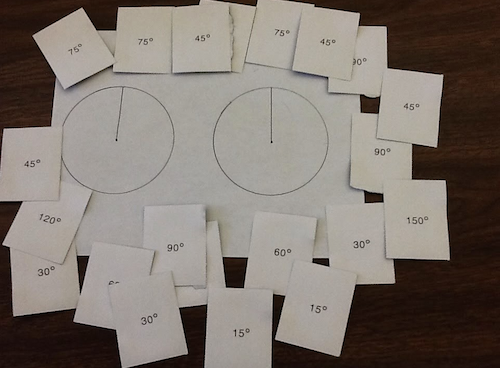
Joe Schwartz hosts a pie-eating contest:
The game consists of two circles (the pies) and a set of Angle Race cards. Partners take turns drawing a card and then using a protractor to measure off the right sized piece. Keep going until you’ve eaten your entire pie. Whoever finishes the pie first is the winner!
Joe improvises his lesson plan in two very interesting ways and he explains his thinking. That’s great blogging.
Matthew Jones gives us a nice picture of modeling in the elementary grades when he asks his students to help him put a new roof on the school gym:
Will any of them have to do this in the “real-world?” Who knows? Maybe, maybe not. But the pictures and slides set into motion a new enthusiasm about solving it because it was their school, it was their gym. It was something they know like the back of their hand. Maybe next time they’ll look up at the ceiling and remember how they figured out the area.
Kaleb Allinson and Sarah Hagan offer different but useful approaches to probability.
Here’s Sarah:
My students instantly wanted to play again. I had anticipated this, hence the double-sided bingo cards. Based on our first round of bingo, my students set out to create a better bingo card. One of my students decided to calculate the probability like I had. She accidentally left the BB combination off of her card. She was not happy about this!
And Kaleb:
I will have students make their own boards using geometric shapes that will convince someone to think they can win but that odds are still in the game owners favor. As an extension students can include winning different amounts of money depending on where you land so a player is more enticed to play.