Category: classroomaction

Total 43 Posts

Great Classroom Action

130927_1

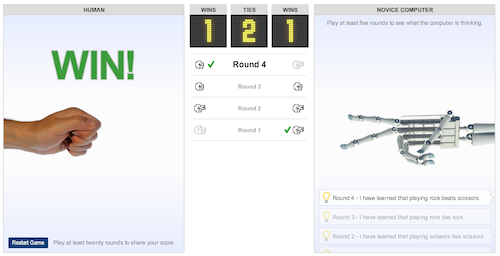
Bob Lochel has his statistics students take a “Rock, Paper, Scissors” prediction robot down:

Anyway, the NY Times online Science section has shared an online game of “Rock, Paper, Scissors”, where you can play against a choice of computer opponents. The “Novice” opponent has no understanding of your previous moves or stratgey. But, the “Veteran” option has gathered data on over 200,00 moves, and will try to use its database to crush your spirit Here’s what we did.

Sarah Hagan links up the definition of a function to dating advice:

After this short conversation, I think I saw some light-bulbs come on. There was laughter, and I heard several girls discussing how they were going to ask the next guy they were interested in if he was a function or non-function. They decided this was problematic, though, because he wouldn’t know what they were talking about if he hadn’t taken Algebra 2.

Campaigns for “Literacy / Numeracy Across The Curriculum” always seem to wind up a joyless exercise in box-checking for teachers outside those disciplines, but Bruce Ferrington’s school approached schoolwide numeracy with some whimsy:

The boss has decided that teachers are going to wear a number around their necks. No, we are not all convicts doing time. It’s a cunning plan to get the kids to look at numbers in new ways. The whole idea is that the students are not allowed to use the names of the teachers. They need to call them by a number combination or calculation that equals their number.

Bryan Meyer takes a rote numerical calculation (multiplying numbers in scientific notation) and adds several mathematical practices with an extremely canny, extremely simple makeover:

We decided that if we wanted kids to talk, they needed to have something rich and complex to talk about and make sense of. After brainstorming some different options, we turned the computational question into a conceptual one.
Great Classroom Action

130921_1

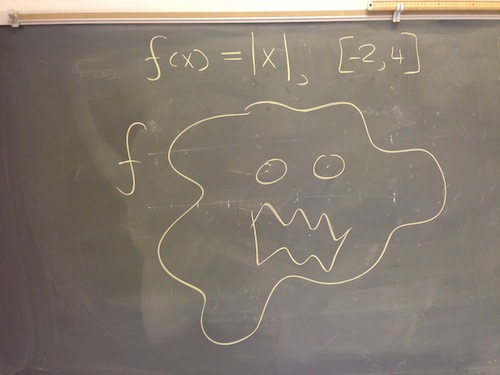
James Key uses a function monster to illustrate transformations:

f(x) is a function monster, and it can only *eat* numbers between -2 and 4. Now we define g(x) = f(x-3). We know that f eats numbers from -2 to 4. What numbers can g eat?

Cathy Yenca uses a number talk to draw out the distributive property:

I love how this scenario never fails me. Inevitably when I ask — not for the final answer — but the process and thinking that students used to find the answer, someone shares that they thought of “outfits” … 3(20 + 25) … and someone else shares that they thought of shirts and jeans separately … 3 – 20 + 3 – 25.

In the middle of a lengthy and fun post describing his first day of school, Andrew Knauft asks his students which number in the set {9, 16, 25, 43} doesn’t belong and why:

Here was a student, on the first real day of class, evaluating an argument independently of her own person bias, without forgetting that bias! (She believed her reason, for a different number, was more convincing, so the argument she read, although good, wasn’t good enough to sway her off her choice.)

Also in the vein of constructing and critiquing arguments, Andrew Shauver asks which image-preimage reflection is “best” out of a set of imperfect reflections rather than which one is “right”:

That question opens up a lot of potential thought-trails to wander down. As I did this activity with students today, the class settled on three criteria for rating these reflection attempts. The first is that the image and pre-image should be congruent. The next thought was that the image and pre-image should be the same distance away from the line of reflection. Finally, the students thought that the segment connecting the image/pre-image pairs would should be just about perpendicular to the line of reflection.

Great Classroom Action

130829_1

David Cox comes up with a sharp way to simulate the locker problem.

Geoff Krall turns a snow day (still cleaning out the backlog here!) into an estimation task for students and Facebook friends alike:

Want an easy way to build buy in? Have kids make predictions on something and make sure it takes a long time for them to see if they’re right. Like I said, our delay was a couple hours and this pretty much took up the entire time.

Nat Highstein cross-pollinates disease with probability and shares the lesson plan:

And one has … the dreaded Disease Z.

Students must identify who has The Dreaded Disease Z, as it is highly contagious — and fatal! If the infected person boards the ship with everyone else, they are all doomed.

The only way to identify each person’s health is through blood testing; a bag for each person has representative chips for their blood levels (per chart included below). I used color tiles in brown paper bags for this, and let students take 40 “blood samples.” With 40 chances, students had to be strategic about which bags to sample from.

Marshall Thompson uses math to corral his toddler.

What if I cut it into two 2 ft x 8 ft pieces and zip-tied them together? I’ll bend them into a circle with a 16 foot circumference. How much bigger or smaller than the play yard would it be? Would I need another sheet to make it big enough?

Comments closed.

Great Classroom Action

130804_1

I’m still clearing some links out of the filter, trying to get fresh for the new school year. Some great classroom action from the last school year.

Amy Zimmer shows us how to take a repetitive exercise worksheet and wring some more cognitive demand out of it:

My students were looking for and making use of structure, my students were constructing viable arguments and critiquing the reasoning of others, my students were looking for and expression regularity in repeated reasoning! I know just how geeky this sounds, but man, it was beautiful!

More adventures from Prof. Triangle Man in measurement in the elementary grades:

Groups of three are each given a dowel (or, in this year’s case, a paper strip). The dowels vary in length. The lengths are chosen to provide a useful combination of compatibility and incompatibility. One may be 9 inches long, while another is 15 inches long. But-and this is important-these lengths are never spoken of! You will never refer to these dowels using standardized lengths.

Bowman Dickson helps me see the benefit of starting at a low rung on the ladder of abstraction, even in highly abstract contexts like calculus:

So general pedagogical moral of the story? Letting students conceptualize something on their own before bringing in mathematical language and notation makes it more likely that the notation will aid in their understanding rather than provide another hurdle in learning.

Evan Weinberg used cell phones and TVs to drive calculations of similar figures.

Great Classroom Action

130726_1

It’s summer break here in North America so there’s very little classroom action, much less great classroom action. Let me take advantage of the lull and empty out the links that collected in my link trap last winter.

Bryan Meyer asks what you do when your students get into a math fight:

There was a big controversy about whether or not we should count 1+2 and 2+1 as two different options or if we should just count them together as one option. [..] Neither side was willing to budge, so I suggested we conduct a huge experiment with lots of trials across all three of my classes so that we could put the results together and see what conclusions we could draw.

Tom Ward asks a question that’s strangely compelling, “Should you drive or fly?

So now, instead of simply plotting flight cost vs. distance, we’ll also plot driving cost vs. distance, helping us find the answer to the question above. A couple plots, a couple lines of best fit, an intersection representing a break even point and yes, you can use this in real life.

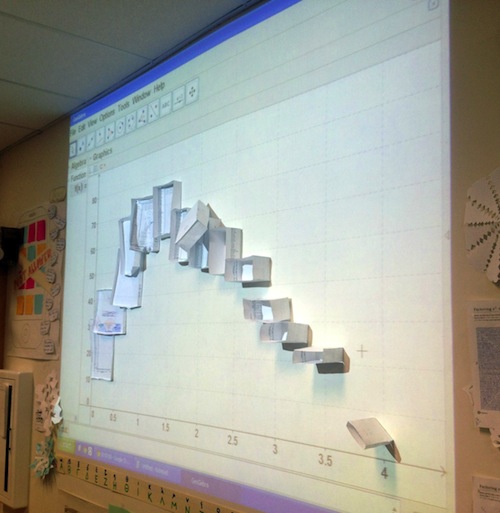
Scott Farrar wins the Emmy for best graph.

Heather Kohn creates a ruckus in homeroom with the jelly bean guessing contest:

All eyes were on the board as I highlighted the data, clicked the insert tab, and chose the first scatterplot option. There were many “What?! How?!” comments as students digested the graph before them. They immediately wanted to know if the graph would always be in that shape, and this led us into our discussion of graphing absolute value functions and describing their characteristics (over the next two class periods).