Category: conferences

Total 78 Posts

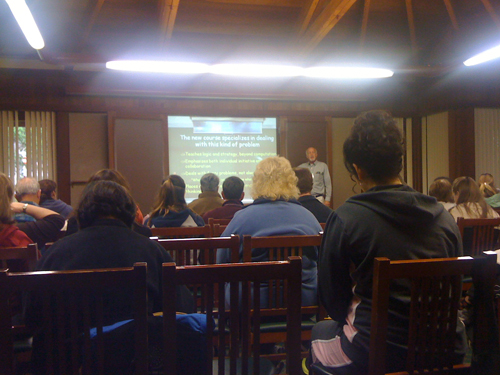
Asilomar #2: What Do We Do With The Seniors?

Session Title

What Do We Do With The Seniors?

Presenter

Robert Loew, High School Math Teacher

Narrative

Loew and his colleagues wanted more options for students who finished Precalculus during their third year of high school (or earlier) but who weren’t going on to a STEM major and didn’t want to take Calculus. They came up with two.

1. Math Analysis

College prep. Approved by the University of California for a-g credit.

One semester of “Calculus Lite,” heavy on application, light on theory, including:

  • continuity and limits,
  • average/instantaneous rates of change,
  • the derivative as the rate of change at a point,
  • basic rules for differentiation, including the chain rule,
  • the meaning of extreme values,
  • the meaning and use of the first and second derivatives,
  • the integral as the cumulative effect of change / area under the curve.

One semester of “other math topics,” including:

  • management science,
  • Eulerian and Hamiltonian circuits,
  • critical path scheduling,
  • game theory and negotiation,
  • the prisoner’s dilemma (as it applies to arms negotiation),
  • fair division (as it applies to settling an estate between three heirs),
  • the time value of money,
  • models for saving and investment (as they apply to calculating the value of a stock, the greater fool theory),
  • decision analysis.

Key texts:

2. Problem Solving

Approved for elective credit. These are techniques for solving problems that aren’t neatly defined, for answering the question “what do you do when you don’t know what to do?” The course emphasizes both individual initiative and group collaboration, rewarding creativity and divergent thinking.

Chapter headings:

  • Draw a Diagram
  • Systematic Lists
  • Eliminate Possibilities
  • Matrix Logic
  • Look for Patterns

Class norms/values:

  • open ended inquiry / divergent thinking,
  • tolerance for ambiguity,
  • collaboration,
  • sustained effort,
  • many students will be uncomfortable and “may need to be filtered out.”

Key text:

I applaud this kind of curriculum design but it seems a shame to me that students who aren’t already tolerant of ambiguity or already patient in their problem solving “may need to be filtered out” of a class designed to teach tolerance of ambiguity and patience in problem solving especially since those seniors have likely been indoctrinated with those bad habits by eleven years in the very same school system.

Visuals

PowerPoint. Texty. Comic Sans.

Handouts

PowerPoint printouts. An interesting tactic here: he withheld the handouts until the very end and passed them out only in exchange for a completed session review slip. Seems to me to miss the point of handouts as another space to interact with ideas, but whatev.

Homeless

  • A family of deer skipped across the path as I walked to this session. The grounds here are incredible.
Asilomar #1: What Do We Do With Algebra II

Session Title

Thoughts On Rationalizing Algebra In Ways That Serve Kids, Not Universities

Presenter

Steven Leinwand, Principal Research Analyst, American Institutes for Research

Narrative

The day before CMC-North I was trading notes with our lead counselor, just swapping stories about kids, when she mentioned a student who was at the end of her turn at the local community college. She’d be transferring to a state college to complete a liberal arts degree if it weren’t for a failing grade in Algebra II. Because she can’t yet perform long division on polynomials, she’ll have to postpone her degree in (just guessing here) linguistics a full year.

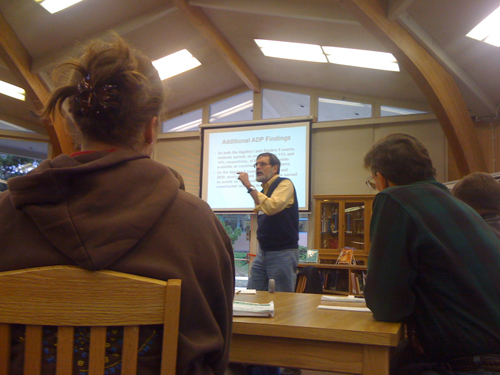
Leinwand opened his talk: “The great divider of our time is the Algebra II final exam. Algebra II squeezes off options for so many kids. Algebra II is anathema to all but the top 20% of the population. My premise: as currently implemented, high school algebra I and II are not working and not meeting either societal or student needs.”

He described the courses as “focused on increasingly obsolete and useless symbol manipulation at the expense of functions, models, applications, big ideas and statistics.”

He works with schools across North America and when he’s trying to get a feel for the tenor and rigor of their math programs, he asks for:

  • the courses they teach,
  • their course descriptions,
  • the books they use,
  • the balance of course enrollment,
  • last year’s final exams for every class.

He said they give him unrestricted access to the first four but balk at the fifth. He said, “if you want to engage people in discussion, go and get those finals.”

Leinwand asked, why are most Algebra II final exams balanced towards the verbs:

  • Simplify,
  • Solve,
  • Factor,
  • Graph.

… when math is ever so much more about being able to:

  • Find,
  • Display,
  • Represent,
  • Predict,
  • Express,
  • Model,
  • Solve,
  • Demonstrate.

Lynn Steen: As mathematics colonizes diverse fields, it develops dialects that diverge from the “King’s English” of functions, equations, definitions and theorems. These newly important dialects employ the language of search strategies, data structures, confidence intervals and decision trees.

Leinwand: “No one is saying throw out the old dialect, but what about the new dialect.”

This all came across depressingly but he ended on a hopeful note, citing several promising projects. Among them, The Opportunity Equation, which aims to:

… explore the feasibility of offering a mathematics pathway to college for secondary students that is equally rigorous to the calculus pathway and that features deeper study of statistics, data analysis, and related discrete mathematics applications, beginning with a redesigned Algebra II course.

He called the forthcoming Common Core math standards “the last, best hope” for meaningful math reform. He ended with a proposal for Algebra I and Algebra II curricula, paced at one chapter per month.

Algebra I

  1. Patterns.
  2. Equations.
  3. Linear Functional Situations.
  4. Representing Functional Situations.
  5. Direct and Indirect Variation.
  6. Data.
  7. Systems of Equations.
  8. Exponential Functions.
  9. Linear Programming.

Algebra II

  1. Review and Reinforce Big Ideas and Key Skills of Algebra I.
  2. Quadratic Functions.
  3. Polynomials and Polynomial Functions.
  4. Patterns, Series, and Recursion.
  5. Exponential and Logarithmic Functions.
  6. Rational and Radical Functions.
  7. Probability and Statistics.
  8. Optimization, Graph Theory, and Topics in Discrete Mathematics.

Visuals

PowerPoint. Black text on a white field. He introduced his slides with this, “These are terrible slides coming up. You want to read PowerPoint slides that break every rule of PowerPoint these are them.”

I felt sick. Leinwand had attended my PowerPoint: Do No Harm talk last year and I could only hope he hadn’t added that disclaimer on my account. He was wrong anyway. He used his slides as conversation pieces. Doesn’t matter to me that they were monochrome.

Handouts

None.

Homeless

  • There is a gentleman at the table across from me murmuring and nodding agreement at Leinwand’s every line. It would not be inappropriate to describe the atmosphere in this session as something like religious conversion.
  • New rule: “Legislators can’t require a test that they themselves don’t take and publish the results of on their websites.”
  • If you’re looking for an example from Leinwand of the “old dialect,” here’s one: rationalizing roots in the denominator of fractions. Here’s another: the conjugate in the same context. Can anyone make a case for that?
  • One of “the most honest and important documents in our business in the last five years”: the $3.1 billion budget State Superintendent Jack O’Connell submitted in response to Governor Schwarzenegger’s pressure to make Algebra I an eighth-grade standard.

BTW: Fantastic follow-up from Josh G.

All of this just highlights the real problem: universities and colleges want a gatekeeper. They want that extra way to filter admissions, because they have to do it somehow. Worse, they don’t want to be seen as the “easy” school to get into, because this lowers their respectability. (This also drives me crazy.) So they demand gatekeepers, whether or not those gateways are actually a more useful math education for their students.

BTW: I have attached Leinwand’s slidedeck here.

CMC – North 2009: My Playlist

a/k/a Asilomar 2009

I’m at CMC – North this weekend. CMC has cut itself back quite a bit in light of these Tough Economic Times. Nevertheless, past experience has set my expectations pretty high for this conference. My slate is particularly strong this year, also, with two sessions from Steven Leinwand (engaging presenter with an interesting approach to problem-based learning), one from Michael Serra (author of the least helpful Geometry curriculum I have ever used), and one from Allan Bellman (my teaching mentor at UC Davis). In the middle of all that I’ll be presenting my own material.

If you’ll be there, tweet at me (#cmcn09), drop a comment here, say hi. I’ll be blogging most sessions and I’ll update this post with links later.

  1. Thoughts On Rationalizing Algebra In Ways That Serve Kids, Not Universities, Steven Leinwand.
  2. What Do We Do With The Seniors?, Robert Loew.
  3. Don’t Just Cover Geometry, Discover Geometry, Michael Serra.
  4. Be Less Helpful, Dan Meyer.
  5. Lights, Camera, Action! Fun And Success For All In Algebra, Allan Bellman.
  6. Intriguing Lessons About How Math Is Taught And Assessed In High Performing Asian Countries, Steven Leinwand. Sick. Left the conference early.

My O’Reilly Webcast: 2009 October 1

Title: How To Save Math Education
Subtitle: (And A Tiny Piece Of The World Along With It)
Time: 10h00 PST
Duration: 60 minutes
Price: Free

It’s an overwrought title, sure, but it’s hard for me to overestimate the damage I did in my first five years teaching. I thought I was building up intellectually adventurous learners who would be patient with problems that didn’t resolve neatly or conform quickly to any of the example problems I’d already coached them through when, point of fact, I was doing the opposite. I don’t have any illusion that five hours of sturdy, problem-based math education each week will counteract the intellectual Novocaine our students consume throughout the other 163, but we can at least do no harm.

The timing of this session is unfortunate as it’s squarely in the middle of the North American school day. It would be nice to see some familiar names on the participant list, though, so if you’re able to attend, please register.

Update: I have embedded the presentation below.

Notes From Foo

Also: Why WCYDWT?

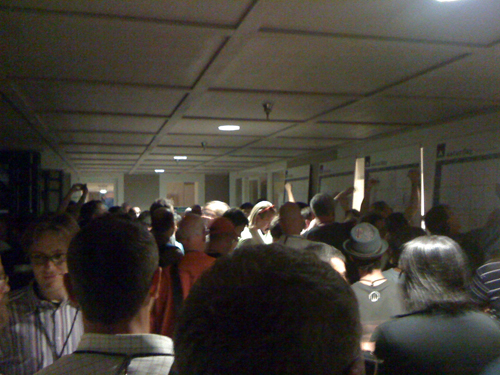
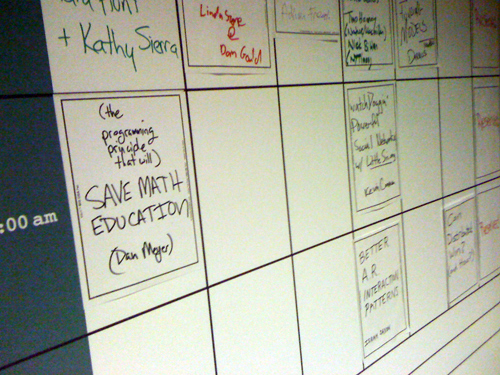
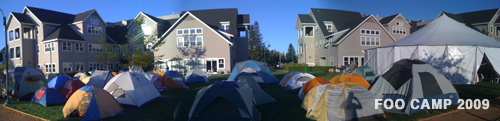
On the first night of Foo Camp, 250 attendees introduced themselves by name, affiliation, and three hashtags, and then descended on a gridded wall-tall conference schedule, scribbling down session titles, selecting venues, folding similar sessions into one another, scheduling roundtable discussions with people they had only met thirty minutes earlier over food.

The crowd was thick so I commandeered a Segway and steered it full-bore into the scrum, scattering people long enough to slide a session onto the closing day’s schedule: The Programming Principle That Will Save Math Education.

That’s three opportunities in three months (counting the webinar I’m conducting in October) that my patrons at O’Reilly have given me to throw a half-baked idea casserole at a bunch of really, really smart people and walk away with something quite a bit tastier.

The debate at an earlier session on the future of education was idealistic and high-minded with participants from all sectors trying to reach consensus (in sixty minutes) on merit pay, standardized testing, class size, unschooling, home schooling, charter schooling, public schooling, and probably several other intractable issues I’m now forgetting. I tried to approach my session, then, from two more assailable angles:

  1. math curriculum, which, for whatever it does right, doesn’t a) put students in any kind of place to apply mathematical reasoning to the world around them, or b) do anything to encourage patience with problems with complicated inputs and messy outputs, which is to say, most problems worth solving. Math curriculum, speaking generally, does the opposite of those two things.
  2. after we develop a model for good math curriculum, we don’t know how to share it.

The outcomes of merit pay and standardized testing will be decided in protracted, gruesome battles between various unions, legislators, and chancellors. The challenge of sharing good math curriculum, however, is one that the people attending my session – an intimidating array of talent, knowledge, and funding – could solve over lunch.

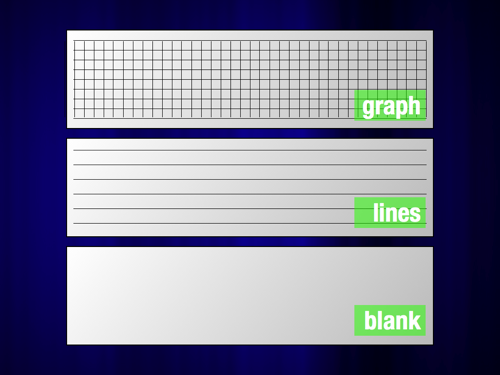
O’Reilly gave a blank notebook to the weekend’s participants. Not lined. Not quad-ruled. Blank. We talked about how you’d only give out lined or quad-ruled paper if you were sure the average attendee wouldn’t want to doodle.

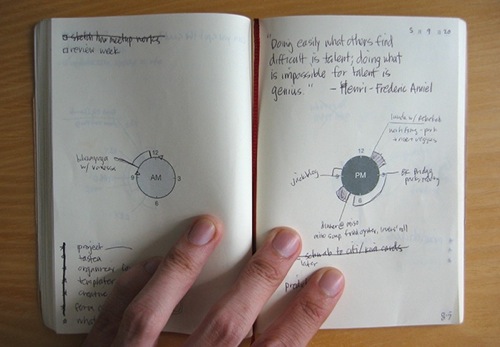
I showed the participants how the Muji chronotebook shuns calendars and hour-blocks, opting instead for the least constrained approach to scheduling possible, a small clock in the middle of the page. This is the rule of least power, the programming principle that can save math education.

I won’t waste space here recapping my session notes. I drew heavily from these six posts:

  1. The Rule of Least Power: An Initial Approach
  2. Why I Don’t Use Your Textbook
  3. WCYDWT: Glassware
  4. WCYDWT: 2008 World Series of Poker
  5. Flight Control / Lesson Plan
  6. BetterLesson Reviewed

But I realized this: I flog WCYDWT media from whatever forum I’m offered not because I think WCYDWT media is the evolutionary pinnacle of math instruction. I do think WCYDWT is leagues better than the curricular norm, particularly compared to the kind of curriculum offered by the largest textbook publishers. More crucially, though, WCYDWT is the best model I know for classroom math instruction that can also leverage Internet distribution. I can use global publishing tools to infect other math teachers with these videos and photos. I can’t do the same thing with netbooks. I can’t do the same thing with physical manipulatives. I don’t know a better model of math instruction that I can also aerosolize so easily.

[Muji notebook photo credit]