My thanks to Arvind, his minions, and the SLA gang for the quality video work. I was half this coherent before they re-edited my talk in post-production.
Check out the rest here.
[Update: My TEDxNYED session.]
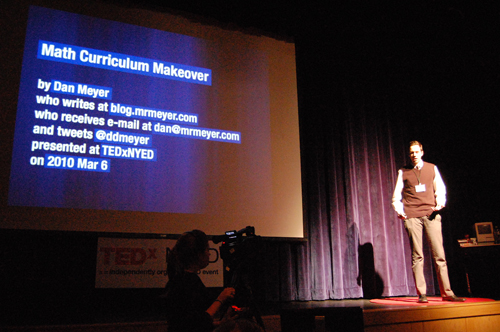
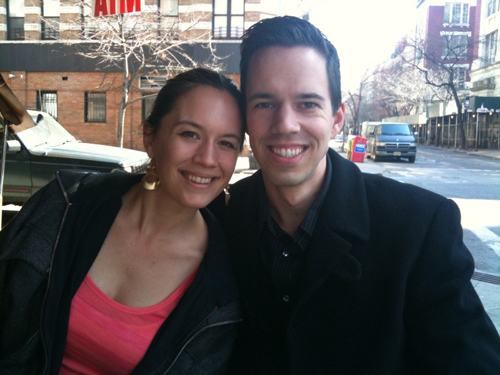
I’m obliged to David Bill, et al., for their meticulous planning and execution, for sponsoring my first trip to New York (where I also got to meet up with my twin sister in her East Village environs), and for the opportunity to meet a bunch of cool educators I had only previously known online.
Three Remarks On Meeting Internet People
Co-Presenters
A lot of my co-presenters seemed previously acquainted or at least familiar with each other through similar conference and/or higher-ed circles. As the proprietor of a mid-shelf edublog, I found this intimidating and was grateful for the explicit welcome (especially) from George Siemens and David Wiley, who both treated me like I was anybody else in that bunch of pedigrees.
Some of these people presented without slides. Some said that they hadn’t yet finalized the content of their talks. This was the day before the event, which seemed awesome to me. At this point, I can’t give a ten-minute talk without spending two weeks on slides and two weeks rehearsing in front of a bathroom mirror. Someday. Maybe.
My Slides
These slides won’t be comprehensible without the audio, which is as it should be, in my opinion, if you’re playing to the strengths of both mediums. I’ll be sure to post the video of my bit once the TEDxNYED A/V club finishes its work.
Conference Notes, Incl. My General Frustration With Education Conferences
You’ll hear a lot of people describe their TEDxNYED experience as some kind of overwhelming epileptic fit, an inspiring but exhausting experience.
I relate. This isn’t particular, by any means, to TEDxNYED, but at any forward-looking education conference, I tend to follow a predictable (and fast) trajectory from inspired to exhausted to irritated.
Speaker by speaker, it was true that the farther removed you were from the daily grind of public K12 classroom teaching, the less restrained you felt to critique and condemn it.
This saw its apex in Jeff Jarvis’ eighteen self-gratifying minutes, which began with his remark that “This is bullshit.” (referring to the TEDxNYED format in particular and public education in general) and climaxed with “Fuck the SATs.”
I was grateful to presenters who recognized, contra Jarvis, that they were addressing an idealistic crowd already in an agitated state. Those speakers modulated their remarks to a lower frequency both to avoid pandering to their audience but also, in some exceptional cases, to challenge assumptions the majority of the audience clearly held. George Siemens, in particular, devoted four of his eighteen minutes to an off-the-cuff rebuttal of Jarvis’ remarks, specifically cautioning the crowd that “the solutions to the problems of education are starting to concern me more than the problems themselves.” Basically, I’m unimpressed by presenters who throw chum in the water when fish are already leaping into the boat.
I was grateful also to presenters who balanced their idealism for the classrooms of tomorrow with pragmatism about the classrooms we have today.
Among others, I’m talking about:
I’m not saying that the only people capable of describing or critiquing classroom teaching are classroom teachers. There are people who don’t work in a classroom who know a lot more about my business than I do. I’m saying it’s difficult, as one of public education’s foot soldiers, to do much with inspiration. I don’t have many places to put inspiration, certainly not as many as the edtechnologists walking away from TEDxNYED minds buzzing, faces aglow, and so it tends to settle and coagulate around my bile duct. It’s too hard to forget that tomorrow I and three million others will have to teach too many standards of too little quality to too many students with too few resources. What can you do with this?
[BTW: These photos are courtesy of Kevin Jarrett.]
Session Title
Lights, Camera, Action! Fun And Success For All In Algebra
Presenter
Allan Bellman, Supervisor of Teacher Education, UC Davis
Narrative
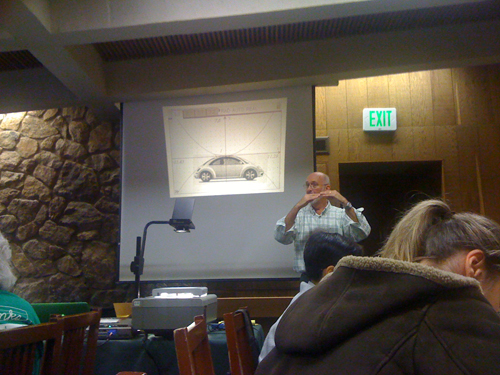
“Why would we want to teach with digital images?” he asked and then answered, “Because it’s better to watch it than read about it.” where “it” referred to any generic textbook problem.
I had no disagreement insofar as we keep text on the table as an option for those who do find it better to read about it than watch it. Math education, however, is not suffering from a surplus of visual representations.
I’m naturally inclined to this kind of discussion. He pointed at an image on the screen and asked, “What can we do with this?” which is obv. one of my favorite questions to pose, discuss, or answer. Bellman and I answer that question differently, however.
The image was of a Volkswagen Bug and he wanted us to point out all the mathematical shapes we could see on its frame. We eventually settled on the parabola that formed its canopy. He passed out a printout of a Volkswagen Bug and a transparency of graph paper. He asked us to find the equation of that parabola.
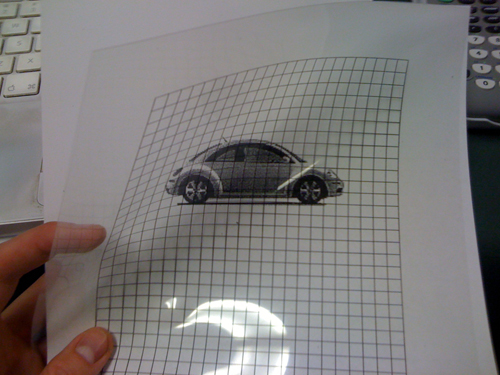
We could position the car wherever we wanted. Some positioned it upright. Others upside-down. Some defined the origin of their coordinate system at the top of the car. Others at the bottom. We all derived our equations.
Then he put a transparent Bug on top of a TI ViewScreen panel connected to a TI-84 Plus. He put the Bug in different positions and we had to modify our parabolic equation each time to match it, which was an interesting exercise in transformations.
Then we reworked the same exercise with an advertisement ripped from a magazine that featured lines, parabolas, and sinusoids. There were TI-Navigators on every table connected to hubs which were connected to some Windows software that would graph the equations we submitted after we logged in.
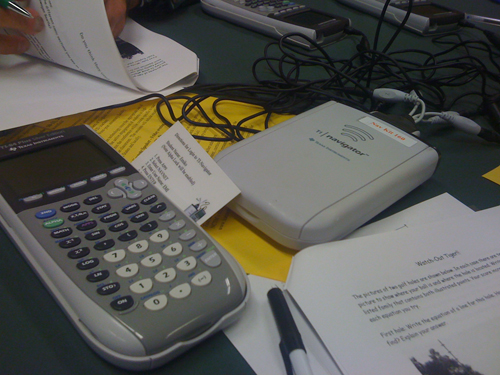
I graphed y = 4, which traced a horizontal line across a rooftop, and looked smugly at my tablemates.
Bellman then put up a picture of a golf course. He draw a ball next to the ninth hole and asked us to determine the equation of the line that went through those two points. He challenged us to find a quadratic model that fit to those two points. He mentioned that we could even ask our students for an exponential model.
And this is where my purpose splits from his on using digital media in the classroom:
Neither that line, that quadratic model, nor that exponential model have anything whatsoever to do with golf. If we’re going to use an image of a golf course we need to ask a question that clarifies or has even a glancing connection to golf itself.
By setting the background of a coordinate plane to an image of a golf course, we may engage a few more students than if we used a plain plane but I think we’ll also lose a few students on the other end who recognize the arbitrary, artificial nature of the setup. (ie. “Why not a picture of a baseball diamond?”) I worry that if we use digital media in our classrooms like this, we’ll define mathematics even more as an abstract thing rather than as a tool for explaining our own lives.
Bellman then brought up a video of a basketball player shooting a jump shot. We used Logger Pro to pull down some coordinates from the first half of the ball’s arc. Then we answered the question, “will he make the basket?” which is exactly the approach I’d like to see to digital media in the math classroom.
Visuals
Some PowerPoint. A lot of modeling.
Handouts
Transparencies and paper to push around and play with.
Homeless
Be Less Helpful – CMC North 2009 – Dan Meyer from Dan Meyer on Vimeo.
Session Title
Be Less Helpful
Presenter
Dan Meyer, High School Math Teacher / Google Curriculum Fellow
Narrative
30% of my talk targeted how we teach – the subtle ways we encourage students to stop thinking. 70% targeted what we teach – the not-so-subtle ways our adopted curriculum makes our students intellectually timid and incurious.
Very little of the content will be a surprise to regular readers. However, after my O’Reilly webcast, I resolved to always add some new content or some new analysis every new time I present the material, both out of appreciation for those attending who, in their loyal readership and commenting, have done a great deal to shape these ideas, but especially because ideas, if they’re worth anything, should keep growing and changing.
Visuals
Big pictures designed for conversation.
Handouts
A place for people to interact with ideas using notes and drawings. Very similar to the handouts I designed for last year’s presentation, which I model in this video.
Homeless
Session Title
Don’t Just Cover Geometry, Discover Geometry
Presenter
Michael Serra, Teacher / Author
Narrative
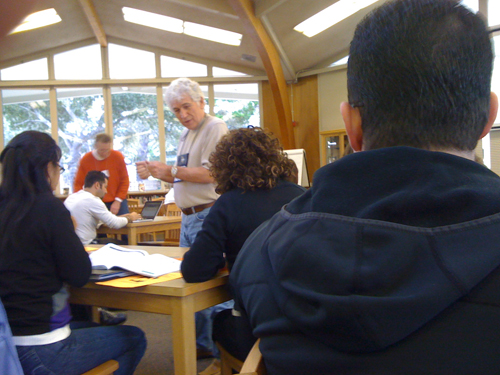
Serra took the participants through his well-worn strategies for teaching Geometry, emphasizing manipulatives and induction. His students develop definitions and terms together. At whatever point they see a pattern in their experimentation (ie. “okay … all the angles in a triangle seem to add to 180°”) the students write the conjecture.
This approach requires of a teacher a rare mix of knowledge, confidence, and humility and it’s no surprise to me that operationalizing his approach into a textbook has yielded unpredictable returns. Whereas other books will cite and define the parallel line postulate, his book cites it and starts the definition but leaves the critical parts blank. They aren’t defined farther down the page. They aren’t defined in the back of the book. They’re just blank. Some teachers will simply fill in those blanks for their students who then dutifully record the conjectures in their notes. Others will have the students develop those conjectures through observation and experimentation, as intended.
Serra demonstrated the latter approach over the course of ninety minutes, developing 75% of Cartesian Geometry with nothing more than induction and patty paper.
Visuals
Document camera for modeling the experiments.
Handouts
Pre-printed shapes and forms. We operated on them in groups with scissors and rulers.
Homeless