Category: conferences

Total 78 Posts

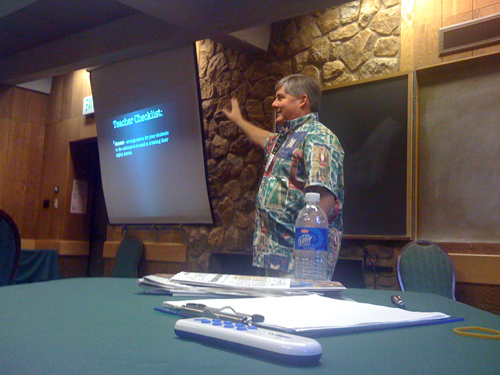
Asilomar #8: Making Math Movies

Session Title

Digital Story Telling With Mathematics

Better Title

I Just Came From The CUE Conference And It Was AWESOME

Presenter

Brian Van Dyck, math coach, Santa Clara, Google Certified Educator

Narrative

His thesis went: kids spend a million hours per day gaming, texting, blogging, e-mailing, chatting, so you should give them the opportunity to express themselves digitally in your math classes. Brian demonstrated equipment and software and played examples and gave a lot of respect to typical concerns of access (many of the utilities are free as in beer) and time (assign the projects after class for extra credit), which was all good.

Concerns:

How do we assess this stuff? If we believe that a video explanation of fractions is sufficient demonstration of fraction mastery, then that needs a more meaningful place in our grading schema than “token extra credit.” This is easy if you break your grades out by standard. Otherwise, how?

At what point do we care if these digital stories are any good? I really hope more teachers make this an option for their students, if only so our focus might then shift from “let’s get kids doing this” to “let’s get kids doing this well.”

Put another way: If you’re going to accept all manner of digital expression in your classroom, what is your obligation to know good expression from bad expression? I mean, I dunno, do you subscribe to any design feeds? Have you taken a class on photography? Do you know what separates good videography from lousy videography? How much should you care about issues of quality? Does your emphasis on multiple disciplines demand multidisciplinary expertise?

Eventually we need to stop framing this as a technical challenge. The challenge is creative.

Visuals

The only person, to my eyes, who used Keynote. Plus QuickTime movies and a lot of screenshots. Student response systems for surveys.

Handouts

Tri-fold paper with biographical info, web pages, some brief notes.

Homeless

  • He told a truly fantastic story about the time his business calculus professor took him out for pizza and in two hours taught him all the math he needed from pre-K to college. Alas, he didn’t elaborate and the window for a question closed.
  • Animoto goes unmentioned and I owe my Twitter followers $10 apiece.
Asilomar #7: A Complete, Balanced Curriculum

Session Title

What Does A Complete, Balanced Curriculum Really Mean?

Better Title

Declaring The Math Wars A Draw

Presenter

Dr. Tom Sallee, Professor, UC Davis, orator first-class

Narrative

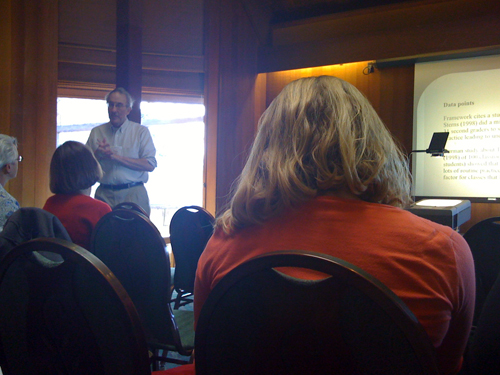
I have to admit right away to a total blind spot for this guy. Tom Sallee could read passages from a microwave repair manual and I’d enthuse wildly. He’s dry, sarcastic, though self-effacingly so, and extremely personable, interested in every mundane detail of your life. If I manage to shed some of my more ornery twitches, I imagine I’ll arrive somewhere near his personality. This matters only to me.

“This is a truly gorgeous day,” he said, and gave us all explicit permission to leave if the talk began to not meet our expectations. “If it were blowing a gale out there I might be hurt, but not on a day like today.” I have to believe this kind of confidence is essential to certain really great teachers. He knew no one was leaving.

He discussed California’s math framework for students and teachers. He noted the semantic significance of the teacher goals appearing above the student goals, and along similar lines, he said he thought California prioritized them inadequately.

Currently the student goals read:

  1. Conceptual and procedural fluency;
  2. Precise communication;
  3. Logical thinking.

He thought logical thinking was seeded at least one ranking too low.

He defined the warring math factions as a) those who believe math is about knowing a set of principles from which you should be able to solve something new, and b) those who believe math is about knowing what you have been taught. He said they represent fundamentally opposing world views. At one point he believed that with enough research and enough dialogue those factions would dissolve but “I have given up on that,” he said.

He put these up:

  1. Basic Skills
  2. Conceptual Understanding
  3. Problem Solving
  4. Logical Thinking

And asked, how do we test each of these? which of these are cheap and easy to test? which are expensive and hard? which will be tested?

“Let me tell you my answers:”

  1. Focus needs to be on long-term learning.
  2. There isn’t much point in teaching a topic if students don’t understand it well enough to use it later.
  3. A lot of math needs sinking-in time โ€“ especially concept development.
  4. Practice and thinking needs to be spread out for effective learning.

“Algebra is about four or five concepts. However, if you separate coin, rate, and mixture problems, then there is a lot more there.”

Someone from the crowd asked him to define them.

“You need to understand what a variable is and how you can use it to represent a situation. You need to have a general strategy for solving a series of equations when you have several variables. There is a relationship between equations and graphs. Proportional reasoning. Multiple representations.”

That fifth one was difficult for him.

Special Guest Star

H!, who is half as tall and twice as Norwegian in person.

Visuals

Overhead transparencies. Like last time.

Handouts

A printed Word document.

Homeless

  • The Two Lies of Teaching, According to Dr. Tom Sallee: (1) If I say it then they will learn it. (2) If I don’t say it then they won’t learn it.
  • “If there was a right way to teach math, we would have found it by now.”
  • On precise communication: “I cannot get excited about the distinction between ‘fraction’ and ‘rational number.'”
  • On teaching algorithms: “Untrammeled by evidence, unless you understand what an algorithm is going to do, it isn’t going to make sense to you.” “Untrammeled by evidence” is just a fantastic throwaway line.
  • On good problems: “A good problem seems natural.” I take this to mean “a good problem reveals its constraints quickly and clearly”. By contrast: “The Schmedley’s speak truth on Tuesday, Wednesday, and Friday,” etc.
  • On developing good problems: “Developing problems is not at all an easy task. I have a lot of experience with it and I have failed many times.” He is the President of CPM, incidentally.
  • “If there was a right way to teach math, we would have found it by now.”

Asilomar #6: Infrastructure Investments

Session Title

Students Take Charge Of Their Learning And Raise Test Scores

Better Title

Ensure That Homework Is Placed Just-So On The Front-Right Corner Of Every Student’s Desk Exactly Four Minutes Into The Period Every Day

Presenter

Kate Reed, Professor, CSU East Bay

Narrative

My companion was unhappy with this one. I was apathetic and caught up on my RSS reader, but I recognized, anyway, that two very different schools of thought competed for space in that small room that day.

Essentially, if your journey has a teacher has led you, as it has led me, to the idea that content and management are functionally the same (ie. engaging activities prevent most discipline problems) you are called to develop engaging activities.

If, on the other hand, you separate management and content, you may be led, as Kate Reed has been led, to develop them separately. Over an hour and a half, Reed never discussed content. She described, instead, her classroom’s opening procedures, every detail from how students would pass up papers, to how they would resolve homework questions, to the multiple-choice bubbles she copied onto student warm-ups, to how she grades those warm-ups.

I have no doubt this is an effective strategy for certain populations, especially those that experience meaningful routine only at school, but I would have to alter the course of my career at least 170ยฐ to even consider her approach.

Visuals

Overhead transparencies.

Handouts

A copy of her opener sheet, multiple-choice bubbles and all, for the teachers who couldn’t make one on their own.

Homeless

  • None. Let’s move on. Consider the benefits and liabilities of both approaches, why don’t you?

Asilomar #5: Michael Serra

Session Title

Games And Puzzles That Develop Sequential Reasoning

Better Title

OMG MICHAEL SERRA!!1!

Presenter

MICHAEL SERRA!!1!

Narrative

A structure not dissimilar to Megan Taylor’s yesterday, where Serra debuted games and puzzles and gave us time to tease them out.

I sat with two former colleagues in the back โ€“ all of us now at different schools. One teacher enthused over Sudoku puzzles. They challenge kids. Kids like them. It gets them comfortable with numbers. The other enjoys Serra’s games and puzzles, like Lunar Lockout. Both cite improved student disposition toward math and improved deductive reasoning.

I disagreed with them. In general, I find it dangerous to put too much distance between “fun time” and “math time” preferring, instead, to have that cake and eat it too, creating as many challenges as I can that are both fun and mathematically rigorous. (Which Sudoko, to put it plainly, isn’t.) My task is harder, I think, and I know I fail at it more, but I’m more satisfied on balance.

It was a good conversation. Feel free to interrupt us.

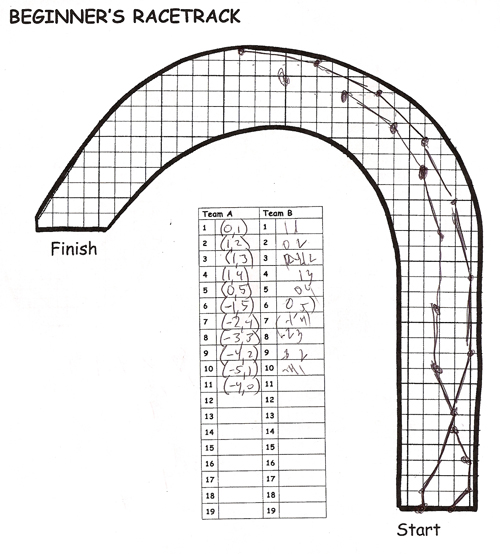
Serra’s best offering for my money was Racetrack Math:

It’s like this:

  1. Draw a racetrack on graph paper, however crude.
  2. You and your opponent start anywhere on the starting line.
  3. You travel along vectors. You may increase or decrease either the x-value, the y-value, or both, but only by one unit per turn.
  4. First person to the finish line wins.
  5. (P.S. No crashing.)

This gets very interesting very quickly. You start out with tiny vectors which lengthen by one unit every turn. If you fail to notice the side of the track off in the distance, though, and fail to slow down in time, you crash. (Which I did in the example above.)

I hereby toss all of my battleship exercises in the recycling bin. This is a much more straightforward introduction to positive/negative coordinates since each new turn is relative to the last turn rather than relative to this strange coordinate axis thing.

Plus, your students can create racetracks of their own, of infinite complexity, within seconds. Serra cited some kids who created a pit lane, which you had to enter on your second lap, and oil slicks, on which you could not adjust your vector at all. I’m impressed.

Visuals

PowerPoint. Which is tough when you’re asking people to solve a puzzle. If someone suggests an alternative route to the one you have programmed into your slide, you have to dodge their answer a bit.

Handouts

Blank puzzles and games to draw on. Again, paper is not dead. How do you do this digitally? Load each picture one at a time into Skitch and pass a stylus back and forth? Moderation, please.

Homeless

  • “There is no research that demonstrates these games improve outcomes in other mathematical procedures like two-column proofs,” Serra admitted reluctantly. “It has to be there. I know it is.

Asilomar #4: PowerPoint โ€” Do No Harm

Session Title

PowerPoint: Do No Harm

Better Title

Something Provocative To Compensate For My Total Anonymity At This Conference

Presenter

Dan Meyer

Narrative

Nothing I haven’t already inflicted on my regular readers, though the structure here fell along the following lines:

  1. general benefits of storing curriculum digitally (easy, cheap access; portability; better classroom management)
  2. very easy ways to kill your kids with PowerPoint (lousy graphic design, cheap solutions for visual engagement)
  3. very easy ways to counteract the very easy ways to kill your kids with PowerPoint (simple, sound graphic design)
  4. lesson plans built from a single compelling image and a single compelling question (if you have paid even a little attention to our What Can You Do With This? segment, you know where this went)

The room was set for 30. I printed 54 handouts, which sounds optimistic under any circumstance and downright delusional if you’ll recall the turnout to my last presentation. Still, I passed them all out and people sat on the floor.

It was exhilarating, really. I would say something I thought was pretty insightful or smart or whatever and someone from the audience would offer something which made my thing smarter and more insightful.

I was shocked that 100% of the times I asked the audience to journal their thoughts or share them with a neighbor they obliged. This is because I teach freshmen.

I would like to deliver this presentation to other audiences, particularly to new and preservice teachers. My e-mail address, if you’re interested, is dan@mrmeyer.com.

Special Guest Star

  1. OMG Michael Serra!

Visuals

Handouts

I tossed the handouts from my last conference and built them from scratch, guiding my design by The Rule of Least Power. I’m happy with the result and they functioned, more or less, exactly as I intended


PowerPoint: Do No Harm โ€“ Handouts from Dan Meyer on Vimeo.

Homeless

  • This may be impossible to determine but I wonder about the difference between a) how one of my session attendees experienced this content (ie. in one ninety-minute burst) and b) how one of my readers has experienced this content (ie. distributed over many posts and many months with many revisions along the way). If you have experienced the content both ways, please weigh in. Otherwise, you’re welcome to speculate.
  • One laptop in the crowd. No wireless. So much for that wiki.