
Category: conferences

Total 78 Posts

Asilomar #3: 30 Excellent Math Problems

Session Title

From Tsuruda To Sicherman: 30 Of The Best Math Problems Ever

Better Title

Math Problems That Will Make You Feel Inadequate, With Your Host, Megan Taylor!

Presenter

Megan Taylor, Ph.D. student, Stanford [site]

Narrative

This one played out pretty schematically. We bounced from one problem to the next like some 90-minute National Geographic special on countries in Africa. If you came with a buddy, which I did, this kind of schema was perfect. Taylor was an engaging tour guide. She put one interesting problem up after another โ€“ some modern, others ancient; some canonical, others something her 7th-grade math teacher conjured up. She explained just enough of the set-up to establish constraints and pique our interest, and then got out of the way.

She gave very few answers to her own problems, which was confounding but effective. I closed my eyes last night and saw a broomstick broken in two places.

Visuals

PowerPoint. Probably the canniest use of the software I saw all conference. Few transitions or animations, if any. Large visuals, which, from slide-to-slide changed only by degrees. An arrow drawn here. A square filled in there, changes which were so subtle I’m positive that 90% of the crowd forgot she was using PowerPoint, which, for my money, oughtta be the goal of anyone using PowerPoint.

Handouts

Slide printouts, offering us ample room to work on problems. I have no idea how Will Richardson expects this kind of engagement using digital media. LaTeX? Maybe if we re-titled the session “One Of The Best Math Problems Of All Time [And One More If We Have Time].”

Homeless

  • Thanks, Rich! She pulled out the truncated tetrahedron activity at one point, which was really easy if, uh, you knew the solution in advanceWhat do you do in that situation, where you know the answer to a difficult problem, and don’t want to look like that know-it-all kid who knows that the only country in the world that starts with an “o” is “Oman.” I have no idea..
  • Forgot to snap a photo at this session so instead you get Asilomar’s State Beach. Gorgeous. Where did you say you do professional development, again?
Asilomar #2: Geogebra

Session Title

Visualize Algebra & Geometry Concepts With The Greatest Of Ease

Better Title

Geogebra Geogebra & Geogebra Geogebra With The Geogebra Of Geogebra

Presenter

Bill Lombard, Teacher [site & PowerPoint presentation]

Narrative

I downloaded Geogebra a million years ago and recognized immediately its value as a free alternative to Geometer’s Sketchpad but I shelved it in my Applications folder and didn’t touch it after that. Like I tweeted during the session, I’m probably the last person in the fifty states to get with this killer program, which lets you create geometric figures, intersect them, drag them, and watch the system change on the fly. This session served one invaluable purpose:

Bill Lombard sat me down for 90 minutes and forced me to play. He demoed the program and I just followed along.

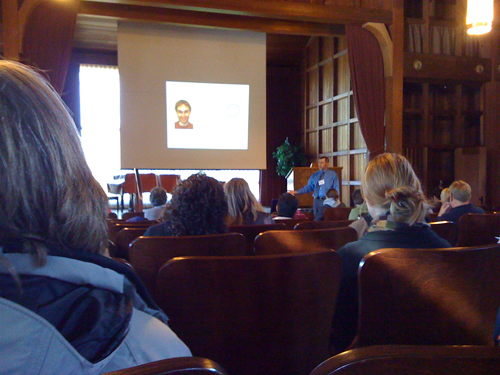
This was a presentation, not a workshop, though, which put Bill Lombard in a difficult position. How do you convey the power of dynamic software when you’re just one guy using it at the front of the Asilomar chapel.

His solution was to ask for audience input and query at every turn.

“What color do you want this line?”

“What shape should we draw next?”

“What would be a good variable for this slope slider?”

Etc.

It was great. People gasped at various intervals, and I’m 99% sure I heard someone muffle a sob somewhere behind me, the software is just that beautiful.

Visuals

Combination PowerPoint & software demonstration.

Handouts

A tri-fold paper (not the only time I saw this format) useful mostly as a link to his personal site.

Homeless

  • A tall gangly guy walked in late and Lombard called him out in front of the entire crowd, “Hey, Guy! Hey, everybody, this is Guy Foresman.” Lombard continued with an oddly passive-aggressive introduction and the awkwardness of the moment was so overwhelming I seem to have repressed the memory. I vaguely recall Lombard telling everyone that Foresman is trying to turn this awesome, free, open source software into a lame, proprietary, end-user product. Foresman sat down, chagrined. It was like I was six and my parents were fighting.

Asilomar #1: YouTube Math

Session Title

YouTube Math: Politics, Advocacy, And The Internet

Better Title

Math: Politics And Advocacy

Presenter

Marianne Smith, consultant.

Narrative

I enjoyed this session a great deal considering I only realized I had little interest in it after it was too late. Smith wrote the only description in the program featuring the word “blog,” so I thought I’d get my token 21-century session out of the way as soon as possible.

She started with two YouTube videos, both out of Washington State, each taking an opposing side in their math war:

  1. Math Education: An Inconvenient Truth, featuring a Washington TV meteorologist, polished to a shine, representing procedural fluency.
  2. A Parents’ Guide to Math Education in Today’s Classroom [sic], representing conceptual fluency.

We spent fully one third of the presentation on a) those two videos and b) a think-pair-share discussion with our neighbors. Marianne Smith did a fabulous job facilitating discussion between attendees but now, only a day later, I recall little of what Marianne Smith thought about any of this.

She did report that a grassroots site in Washington succeeded in dethroning the Superintendent of Public Instruction (a proponent of conceptual fluency) and installing one of their own (big procedural fluency fan). Most of the attendees in our session advocated not one or the other but โ€“ get this โ€“ a blend of procedural and conceptual fluency. (I love these people.) Smith urged us to become more active on committees at the state level, to write our legislators, and to make YouTube videos advocating our point of viewSmith falls under the same category of tech user as my mom: really eager, really curious novices who use “a YouTube video” and “a YouTube” interchangeably. I can’t help finding these people really, really endearing..

The crowd was satisfied. I’m curious if anyone has written the how-to guide for educational activism using YouTube videos and blogs I thought this presentation would be. Does anyone who matters (on a policy-making level) even read these things?

Visuals

PowerPoint. Traditional. All-white background.

Handouts

A comprehensive bibliography of Internet links, which is weird, right? I’m pretty sure this was the first time I ever transcribed a YouTube link from paper to web browser. Facing the same dilemma in my own session I tagged all my online resources in Delicious, but there is probably a better solution.

Homeless

  • One particularly earnest and agitated audience member: “Maybe we should start a blog … get the word out.” This is how it all begins, isn’t it?

Asilomar Dispatch #1: Schedule

BTW: added links to session recaps.

I’m tweeting and blogging CMC-North in Monterey this weekend so get juiced. This is the tentative line-up:

Friday

  1. YouTube Math: Politics, Advocacy, And The Internet, Marianne Smith. [link]
  2. Visualize Algebra And Geometry Concepts With Greatest Of Ease, Bill Lombard. [link]
  3. From Tsuruda to Sicherman: 30 Of The Best Math Problems Ever, Megan Taylor. [link]
  4. PowerPoint: Do No Harm, Dan Meyer. [link]

Saturday

  1. Games And Puzzles That Develop Sequential Reasoning, Michael Serra. [link]
  2. Making High Content Math Movies And Music Videos, Robert MacCarthy. Students Take Charge Of Their Learning And Raise Test Scores, Kate Reed. [link]
  3. What Does A Complete, Balanced Curriculum Really Mean?, Tom Sallee. [link]
  4. Digital Story Telling With Mathematics, Brian Van Dyck. [link]

Sunday

  1. In Fact, It’s All About Data, Tim Erickson.

My closing remarks.

ILC 2008

or: My First Ed-Tech Conference
also: My Last Ed-Tech Conference

I’m back now from the Innovative Learning Conference in San Jose, CA. When I first bumped into Alice Mercer, she said, “This doesn’t seem like your kind of thing.” She’s either right, and I’m just the wrong person for ILC, or else ILC should have stepped its game up in a lot of ways. Obviously, I’m biased toward the latter. Either way, I shouldn’t have missed class time for this.

Therefore, a brief preface of ILC’s good stuff and then my best advice for the presenters there. If you’re reading this and you presented at ILC, obviously I’m not talking about you, or your session, etc., and hopefully you all realize by now that I reserve my harshest criticism for myself.

Preface

It was nice meeting Collette, Rushton, Alice, Gail, and some other folks; CUE organized the conference well, with the right number of sessions per day (five) at the right length (an hour, though some presenters didn’t earn ten minutes); the catered lunch was fine, just fine.

That Said

In order to earn one seat-hour from a few dozen people, your presentation needs either:

  • a compelling personality behind it;
  • expertise, the sort of expertise DFW wrote about, the kind that has such a tight conceptual grasp, it can explain itself from any side, from any angle, from a macro- or microscopic lens;
  • a compelling narrative, something with an antagonist, with obstacles to overcome, even if they’re just stubborn network administrators; this is why I pinned my talk on math methods (back in the day) to a fictional student and gave her a photo;
  • illustrative, complementary visuals; video, PowerPoint, handouts, makes no difference to me so long as they’re pretty and useful;
  • empathy for audience expectations, the sort of clairvoyance where you know what your audience is wondering, what it’s waiting to see.

Fourteen of eighteen presentations I attended couldn’t manage one of those.

There was the usual PowerPoint plague, presenters standing for thirteen minutes stock-still in front of a bulleted slide, that flat text often describing a highly visual conceptThere is no excuse for describing student video production with text bullets. Show video!, those bullet points often disregarding basic mechanical Englishie. If you’re going to shame yourself with bullet points, they should read (eg.) “Noun; Noun; Noun; Noun” not (eg.) “Noun; Noun; Noun; Past-Tense Verb.”.

As a guy who teaches compulsory Algebra to kids who have hated Algebra, I don’t see how fourteen presenters managed to blow a scenario where an audience volunteered to attend their sessions. Where the audience is interested in the session (provided the presenter didn’t falsely bill it). Where the audience is pulling for the presenter. Where the audience is eager to be dazzled, fed, or inspired.

ILC was like walking into eighteen car dealerships, pockets bulging with cash, declaring to every salesperson, “I’m here to buy,” and discovering that fourteen of them couldn’t close the sale.

Equivocations

I don’t mean to be overly particular but what I saw this weekend was visual- and verbal illiteracy at a high level. I saw fourteen educated professionals put styrofoam on a plate, convinced it was steak. I want no part in that sorry transaction. I want to produce and consume the best I can while I still can.

I’m speaking at CMC-North in Monterey this December on how not to ruin entire classes with visual illiteracy. I realize it’ll serve me right to have some punk kid out there in the audience, snarking about me on his blog and on Twitter.

All I can do is hold myself to this same standard.

Promoting Quality

If you’re cool with some profanity and if you’re even a little invested in the state of online gaming, check out this presentation from NY Tech Meet-Up. It did more to inspire, educate, and illustrate in five minutes and change than did the median presentation at ILC 2008.


NY Tech Meetup Presentation from Charles Forman on Vimeo.