Category: conferences

Total 78 Posts

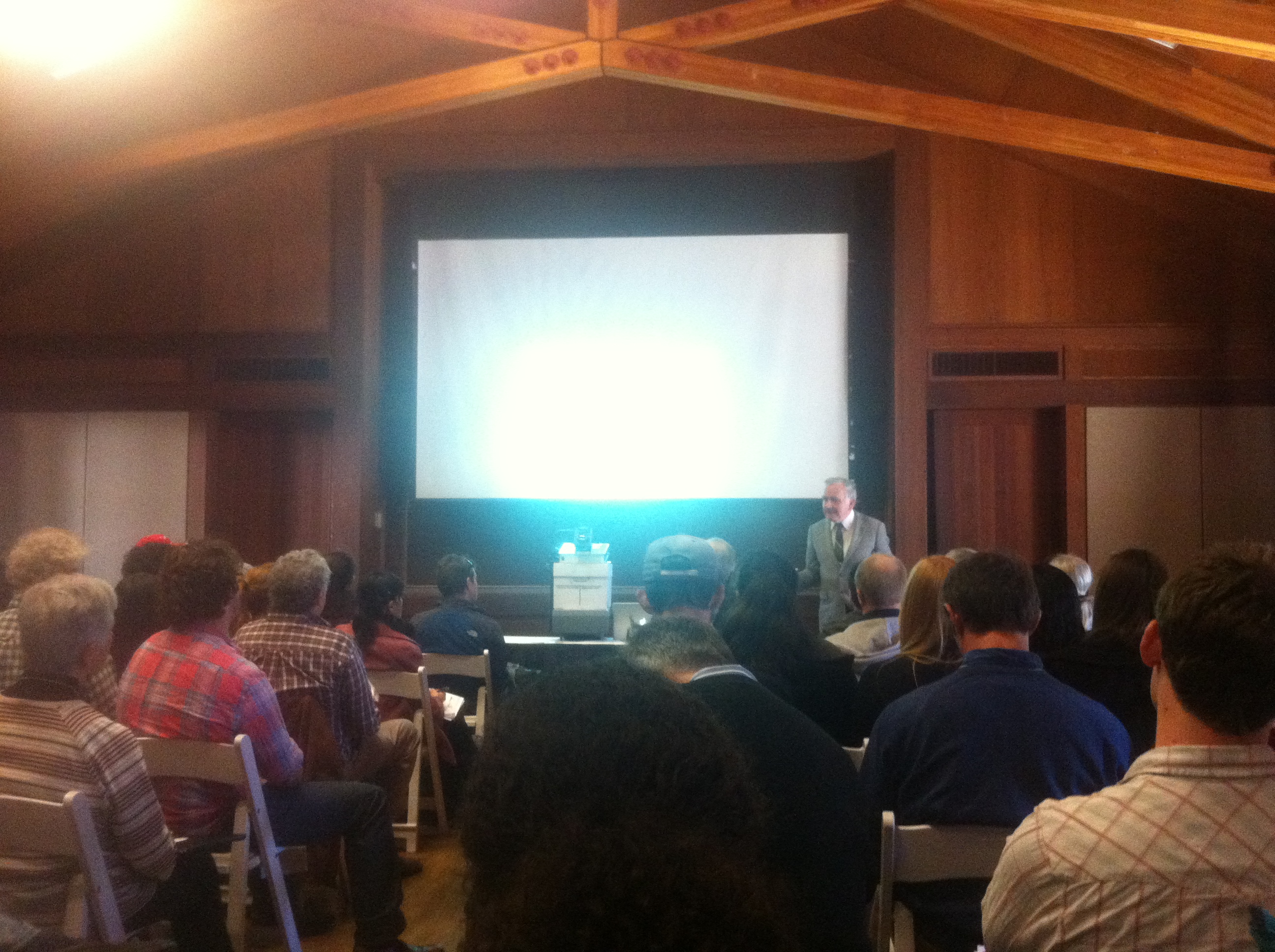
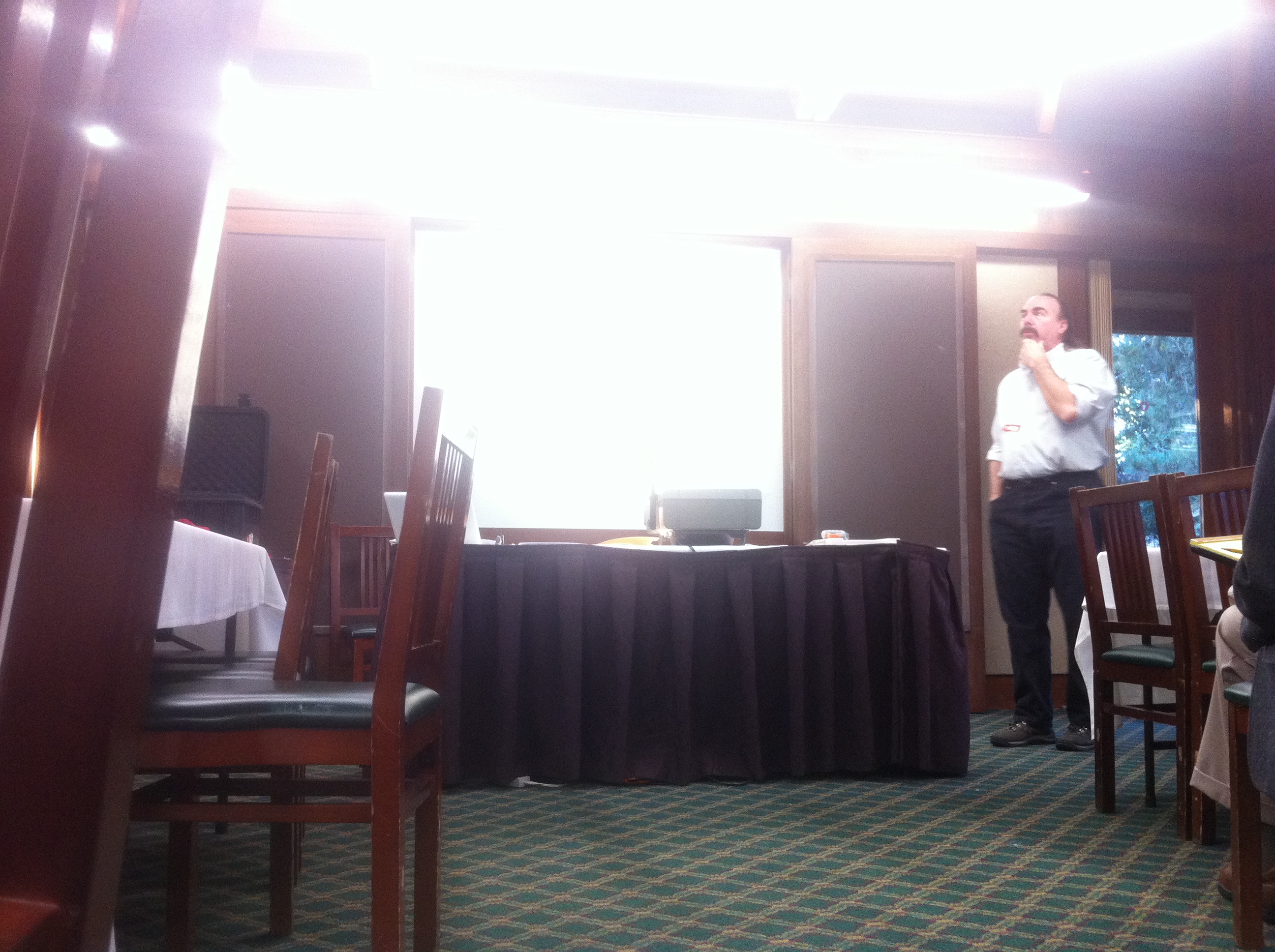
Panel Discussion On Social Media In Teaching At Stanford โ€” Keith Devlin, Karim Ani, Dan Meyer

Keith Devlin (@profkeithdevlin) invited Karim Ani (@mathalicious) and me to co-host a panel at his summit with Finland and American academics on our experience with social media in teaching. I captured it on my Flip camera and posted the video below.

I’ve also transcribed two passages I wanted on the record. One is my introductory remarks (starting at 9:30) which cover how I’ve used blogging to grow as an educator โ€“ from 2006 to present day. The other is some real talk about grad school (starting at 45:36) prefaced by, “I’ve never shared this with anybody here, least of all my adviser, who’s in attendance.”

Introductory Remarks

Keith came upon me kind of halfway through my story of social media and teaching. The start of that story was when I didn’t have professional development options. Like I started in a big district with lots of them, big professional development days every month, huge festivals of teacher learning, and then I went to this school in the foothills of Santa Cruz where there was a total of six or eight math teachers in the entire district. There weren’t a lot of options. The people I worked with โ€“ they were much more senior than me. They had already pushed past or resolved or were not interested in the issues that I was interested in and needed to learn about. So for the cost of a few cups of coffee, I went online, made a website, got a blog software running and just started writing a journal and what happened for me as a young teacher was โ€“ I’m just grateful for it. That’s my primary stance here is one of gratitude because this could have gone any number of ways.

I wrote about everything I did. I’m not a bad writer so it wasn’t boring to read but people started coming around, people who were much more veteran than me, who had the same interests that I did, and essentially I found myself creating my own faculty lounge. And these people would just pepper me with criticism and flatter me with some compliments now and then if they liked it and I learned to โ€“ I figured out who was good to pay attention to, who the cranks were, that’s a key skill I had to develop. And, honestly, I have no empirical basis for this but I think I developed two years as a teacher for every one year I was in the classroom on account of all this criticism sanding off my rough edges and pivoting me away from some dead ends. You know I had my worksheet phase where I would obsess over font choices on worksheets or whatever and I had enough feedback that like “There is a limited shelf life for this.” And that was great.

So pursuing this thread of return on investment โ€“ 200% return on one year of teaching is how I saw it โ€“ and there’s plenty of other ways I saw that too where I would post curricula that I had spent a lot of time on. The first big one for me was a video series called Graphing Stories where kids would watch videos and then graph elements of it to introduce two-dimensional graphing. Took me like eighteen hours over a weekend to create the thing. And it was good and productive for my class. But I posted it online afterwards and just offered up the whole thing in an easy download and 6,000 people downloaded it in two weeks. And the process gave me lots of feedback which made it better for my students. Social media for me creates this very virtuous cycle where I become more productive, get better feedback, my kids win, other peoples’ kids win. And this narrative plays out in reverse with other people who blog and me. I am that person to them that they are to me. It’s something that I’m still trying to figure out. I posted all of my Algebra 1 curricula I developed. All my Geometry curricula is just there for easy download. This is kind of the lifestyle now.

I applied to give a talk for my regional math conference. You know, we have this small North California thing. Not like an NCTM plenary. It was like a twenty person thing in a classroom at a middle school but you know I put a small camera on a shelf and filmed it and put it online and just sent a note out and, you know, there’s twenty people in that room and I just checked it before I got here and 3,000 people have watched it in total. That’s passive. I didn’t do anything to pursue any of them. I just put it somewhere where it’s easily found and my message, the things I’m enthusiastic about, that I want to advocate, those get out there. And people find it. And they learn from me. And they critique me. And it’s all very, very positive.

People from news organizations will contact me and ask for my opinion on this or that. I’ve seen this happen to other bloggers who have their hobby horses and they pursue them relentlessly and I see them in every single article or TV press piece on, say, Khan Academy that there is. They’re always there. And you think about some teacher in some rural area who has no impact outside of 150 kids and six teachers in their department. They can have that worldwide, national impact with social media. So see it as an advocacy thing. See it as a professional development thing. Those are my two largest frames I have on it.

Real Talk About Grad School

Can I please follow up on that [Devlin’s comment about webcasts] and ask a question out here, of the academy? I’m a grad student in my second year and I’ve never shared this with anybody here, least of all my adviser, who’s in attendance, but I don’t understand the incentive structure for what you do and what I may do someday. You write amazing things and you study amazing things and you write them compellingly in journals that are not read by practitioners very often. They affect a lot of policy, which I think is a really good, top-down approach. But then I’m over here and I can post something that’s seen by 10,000 people overnight. That’s the number of subscribers I have to my blog right now. Or any number of these things. So the incentive seems strange to me. Like I don’t understand this brass ring I’m chasing. It seems like a strange prize at the end of a finish line of grad school. So there’s the question and then there’s also the encouragement. You have so many soapboxes available to you. Find a kid like me and ask him how to do a webcast or something. You have so many โ€“ and to restrict yourself to peer review, I don’t know. There’s very little upside to me, it seems.

[to my adviser] We should talk.

2012 Jan 22. I’m recalling Prof. Loeb:

By the time you see a paper in a journal, the field has moved on. (Loeb, 2010, lecture).

2012 Jan 22. Scott Elias started a series exploring the value and process of an education doctorate.

2012 Jan 25. Had that meeting with my adviser. I wasn’t sure how it’d play out since I kind of took an incredulous stance towards the academy in that panel. The upshot of the conversation is that she wants some help setting up a blog and she thinks I should look at some of this online teacher professional development we run here as a possibility for dissertation research. So … positive, I’d say.

Featured Comment:

Dan Goldner:

For me the PhD wasnโ€™t the brass ring. The brass ring was discovering something about (in my case) the physics of the ocean from a point of view that no one else ever had taken, and convincing a bunch of people who had studied that system really closely that what I was seeing made sense and wasnโ€™t missing anything important (as far as we could all tell at the time). Or, as Ben puts it, โ€œHaving learning as a full-time job is really, really delicious.

Alex:

From my vantage point, the brass ring of academia is not getting the message one already has to the most people but the search for the right message. Can they be done simultaneously? I donโ€™t know. But, the fact that someone may have 10,000 followers does not mean that person possesses the truth. Many people read USA Today, but itโ€™s still a crappy paper.

Andy:

If we could really put much stock in this research, people would look at the results and agree that XYZ works and everybody would do it, and just leave the fiddling alone, but nobody has figured out what XYZ is, other than to make sure that kids come from higher income households and that their parents care about their education.
CMC-N 2011 Reax

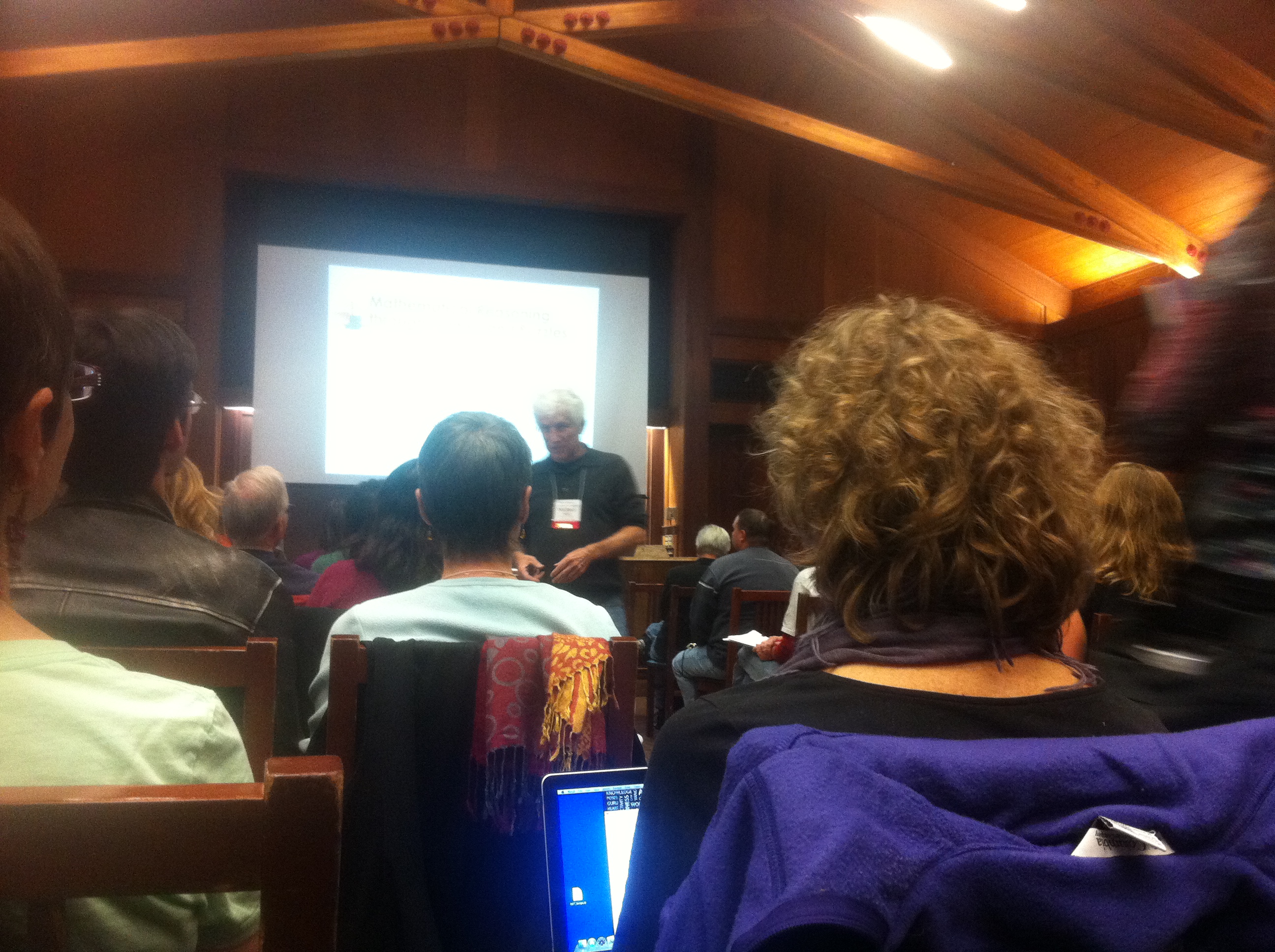
I didn’t have sound at my morning presentation at CMC-North last weekend. That was on me, and it wasn’t an enormous deal anyway. I told the people there I was sure we’d get through it together. I was right, but I had no how right I was until we were starting into my explanation of mathematical storytelling. I was showing shots from the first acts of Star Wars, Jaws, and Raiders of the Lost Ark and the absence of music in each of those scenes was pretty conspicuous. But then we heard the music. It started in the back with a few people humming out The Imperial March from Star Wars and then it rolled over the rest of the group. I added the “pew pew pew!” of the ships volleying shots back and forth.

I love this conference and I love these people. They’re smart, optimistic, and funny. The lineup is unusually strong. The venue is world class. You should stop by sometime. Here are a few things I saw and did and the digital goodies I grabbed for you while I was there.

Bix Beeman on the Math of Surveying

[pdf handout]

The official word on the Asilomar grounds is that it’s 107 acres. But how do they know? It’s a weird shape. How do you capture the area of weird shapes and, in this case, the area of weird shapes that are larger than the paper on your desk? Beeman took us up through different solution strategies, all the way from counting squares on grid paper to the matrices and determinants of the Surveyor’s Area Formula [pdf]. It would have been great if he had given us much time to play with the different methods and discuss the tradeoff between complexity and accuracy. As it was, we rushed through (eg.) Pick’s Theorem so that in the last ten minutes we could use TI calculators to calculate the area formula across all the coordinates bounding the Asilomar grounds.

All snark aside, I do not get TI technology. I’ve used an iPhone for the last four years and the C++ programming language for the last ten weeks and, suddenly, I cannot find the appeal of a device that displays a total of 128 characters at a time in black and white. I mean, try to read a single line of the spec sheet without pitying the poor copy editor who had to write it. “2.5 times the processor speed of the TI-83 Plus.” Well! “Lists store up to 999 elements.” That many! “24KB of available RAM memory.” It just feels mean, at a point.

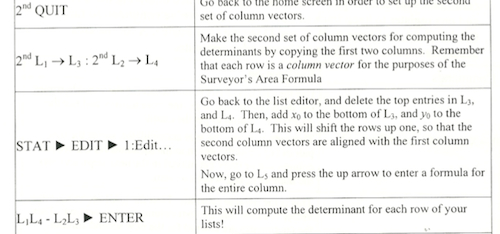
Beeman hinted at various times that your students will become docile and engaged as they’re copying coordinates and instructions into their calculators.

I don’t actually doubt this is true. Given the choice between a demanding task and grinding, students regularly choose grinding. There’s a lot less risk. But if you give a student this page of instructions [pdf], what work is left for her to do? What are the odds she’ll be able to conceptualize and solve her own problem later?

BTW. Here’s a fundamental difference in approach. Beeman told us early on that the official survey of Asilomar was 107 acres. Then he said, “Let’s see how close we can get to that.” Me, I would have asked the class to guess how many acres comprised Asilomar. Then, after we applied our best mathematical analysis to the task, we would have checked our work against the official survey.

Dan Meyer Doing His Dan Meyer Thing

[session website]

I’m finding the contours of this talk a little too familiar lately. I’ll be giving it in February at GSDMC, then in April at NCTM, at which point (fingers crossed) I’ll film it, post it to the archive, and move on.

Harold Jacobs’ Mathematical Snapshots of 2011

[resources]

Someone said this was the fortieth edition of Harold Jacobs’ annual “Mathematical Snapshots” talk at Asilomar. It was my first. Basically, Jacobs has a sharp eye for mathematical moments in the news or in life. He summarizes them annually in his session and then passes them out at the end on a CD-ROM, which I have uploaded for you here. Jacobs said this was his first snapshots talk using a digital projector (rather than projecting transparencies) and, I have to say, he was a total natural with the medium.

Jacobs’ snapshots fell into one of two categories. In one case, he’d read off tidbits from the news that hinted at something mathematically interesting. Like this cornball who insists he’s proven that pi is rational and is, in fact, 3.125. These were interesting but nowhere near as impressive as the snapshots which he attempted to turn into some kind of challenge for students, giving them some part to play in the interesting mathematics. Like the Italian woman who received a $44,500 parking ticket because the police officer set the date at 208 instead of 2008. Jacobs asked students to calculate the correct fine.

Excellent curation, really. I’m not sure I needed the presentation, though. Let’s work out some kind of rotation for next year and share the CD, okay?

Michael Serra’s Math Games

[pdf handout]

I had lunch with Jodie T, whom I hadn’t seen since our days learning to teach in the same cohort at UC Davis, and we worked off the lunch coma in Michael Serra’s session on math games. There were a lot of classics (Knight’s Tour, Battleship / Treasure Hunt) but Serra applied some kind of twist to each, ratcheting up the demand (and fun) of the task just past the point where I would have quit. Definitely check out the handout.

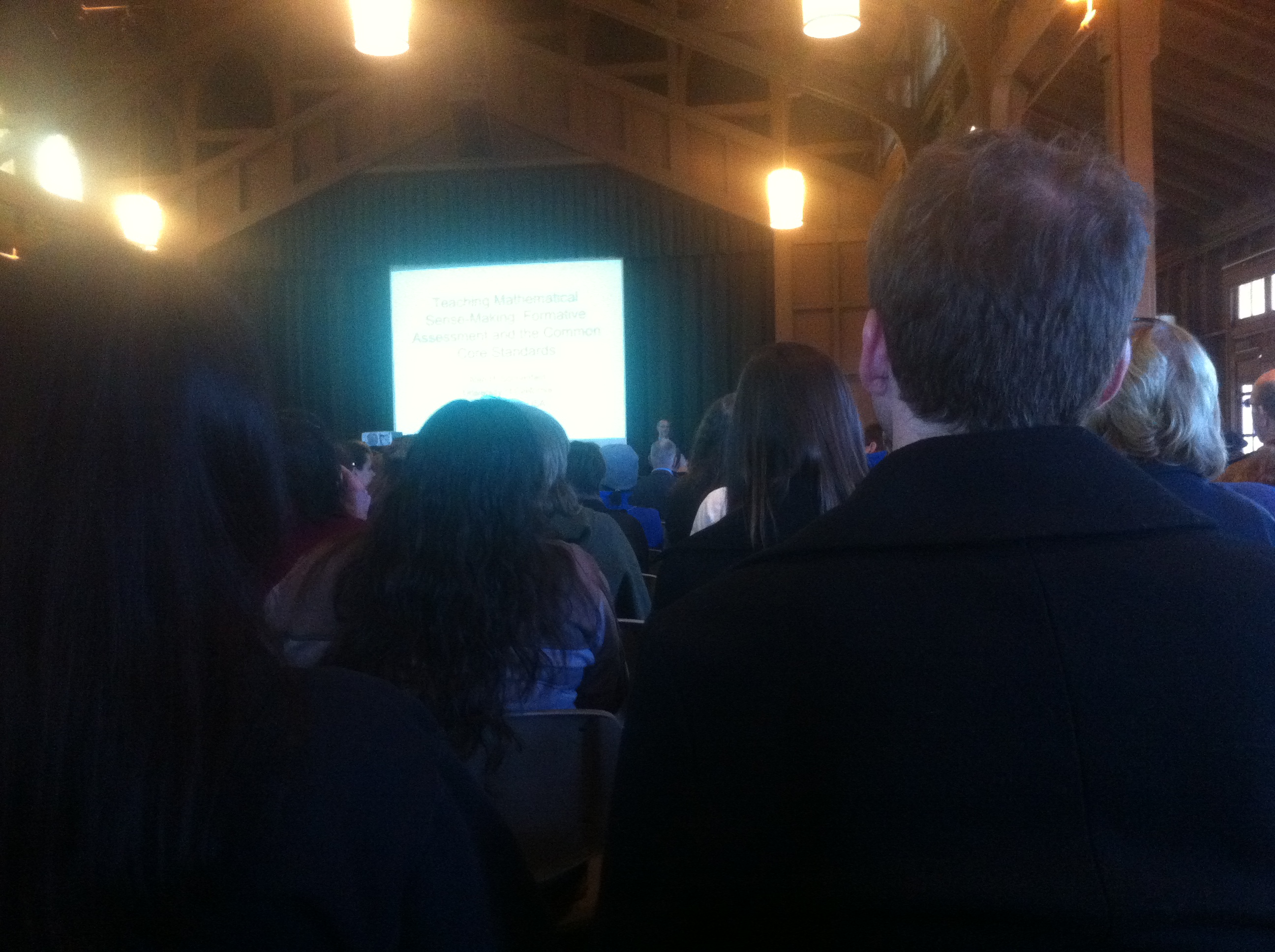
Alan Schoenfeld on Common Core Assessments

Schoenfeld advises the SMARTER Balanced Assessment consortium. He made a case for the quality of the consortium’s work and he laid down high odds for the success of its Common Core assessments. I can’t speak to his second point. The politics of math education (particularly in California) go back to when the Hatfields accused the McCoys of de-emphasizing procedural fluency. I felt he made a strong case for the quality of the assessments, though, particularly if your alternative is the California Standards Test, as it was for everyone in the room.

Here’s the case for quality. SBAC draws heavily from the talent pool at the Shell Centre in England, which includes Malcolm Swan, whose exemplary work I’ve covered here and here. These are exceptional educators and task designers, but you don’t have to take my word for it. The Shell Centre has released a pile of sample assessment tasks. Here’s one:

Compare that to the released questions from California’s Geometry CST [pdf]:

More? Here’s CST Algebra [pdf]:

Compared to a Shell Centre algebra assessment:

The new assessments are more challenging and they reveal more about a student’s thinking. (They’re critiquing arguments. On a math test.) Check out the rest and let me know your reservations.

CMC-North on Technology

Here’s a terrifying thought. It’s 2032. I’m fifty years old, still a CMC member, still attending Asilomar, but Merrill Hall is only half-full for the closing keynote and everyone attending has white hair. Nobody came up the ranks in the last twenty years, in large part because the CMC-N conference-going experience would still be totally at home in the 1990s, right down to the TI calculator sessions. (Sorry. No more jokes.)

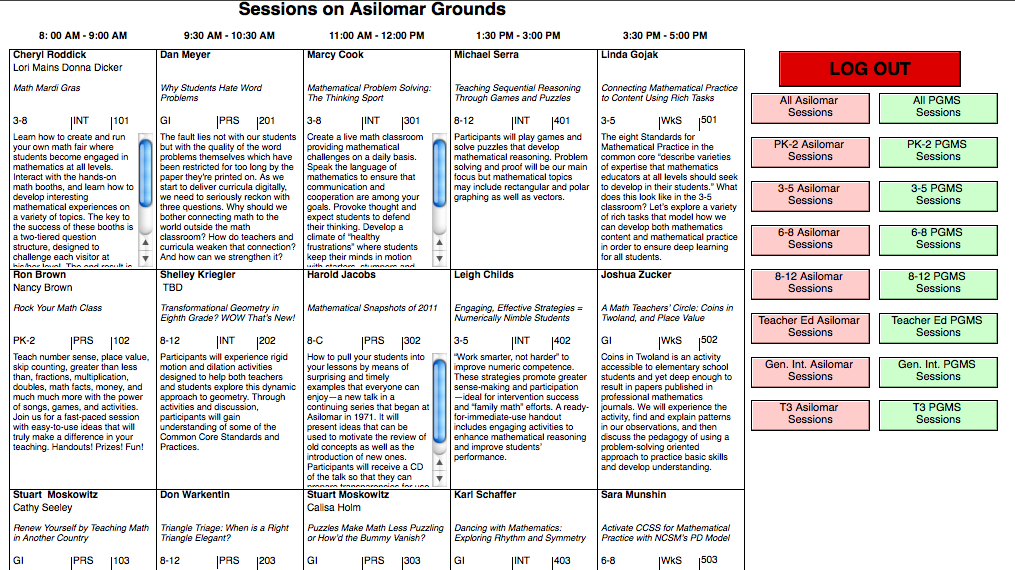
There were nineteen tweets on the #cmcn11 hashtag this year, a third mine. Someone at CMC-S e-mailed me a long-ish note to ask permission to livetweet my session, which to the best of my knowledge never happened. They passed out CD-ROMs of session materials in the conference bag. There are better options for conference scheduling than PDFs but a PDF of the program would beat whatever this is:

I’d like to start an off-the-books sub-committee, a place to brainstorm some ideas to present to the conference planning committee, many of which we’ll implement ourselves at CMC-N 2012. If you’re a CMC member (either South or North) and want a piece of the action, email a good idea for upgrading the CMC conference-going experience (so I know you’re serious) to ddmeyer+cmcupgrade@gmail.com.

Hypothetical NCTM Roster

I can’t make NCTM work this year but I checked the speaker listing (really, really quickly) and these are the people I’d check out if I were going. (Limited warranty, your mileage may vary, etc.)

  • Jerry Becker. Developing Computational Skills While Solving Problems and Avoiding Drill.
  • Akihiko Takakashi. Ideas for Supporting Students in Becoming Independent Problem Solvers.
  • Allan Bellman. Classroom-Level Assessment That Determines and Meets Individual Students’ Needs.
  • Michael Serra. Non-typical Investigations in Geometry for 2011.
  • Keith Devlin. Video Games for Mathematics: They Will Soon Get Better.
  • Bowen Kerins. Bringing Algebra and Geometry Together through Linear Algebra.
  • Bowen Kerins. Mathematics of Game Shows.
  • Glenda Lappan. Using Geometry as a Springboard to Mathematics.
  • Karim Logue. Real-World Lessons the Mathalicious Way.

ASCD 2011

I was sitting in the first of four sessions I attended at ASCD’s annual conference when the presenter asked all of us to introduce ourselves to our neighbors and discuss a particular prompt. I turned to my seatmate and said,”Hi, I’m Dan.”

“I was noticing your press badge,” she said, without introducing herself. “I have an implicit distrust of the press. Do you mind if I make up a fake persona?”

“You know what, don’t worry about it,” I thought, and discontinued the conversation as politely and quickly as I could.

Right. So I’m the press. The fourth estate. ASCD reached out to several local bloggers, offering to comp our registration in exchange for coverage. Let’s get into it. Here are the four sessions I attended in my first and only day at #ASCD11:

  1. Curriculum 21. Heidi Hayes Jacobs.
  2. Made to Stick. Chip Heath.
  3. Moving toward Mobile. Cheryl Davis & John Nickerson.
  4. They Snooze, You Lose: 10 Shots to Recaffeinate Your Presentation. Lynell Burmark.

You can ask any one of 9,000 educators for their impression of Chip Heath’s keynote. (Here is David Cohen with a nice take, for instance.) Lynell Burmark has been on this blog’s radar for a good three years. As someone who occasionally exchanges speaking services for checks made out to “Cash,” I figured I’d attend and see what tips I could pick up and perhaps inquire also about the design decisions that went into the cover of her last book. I took off when it became apparent that I probably wasn’t her target audience.

So I’m only recapping the sessions from Heidi Hayes Jacobs and Davis & Nickerson.

Curriculum 21

Jacobs was an ASCD featured speaker and she gave a confident talk at TEDxNYED a few weeks ago so I settled in. Her recommendation was for both short-term and long-term upgrades to our schools: a) teachers need to make one-to-one replacements of curricula while b) administrators need to replace old systems with new ones, all supporting 21st-century learning. She had both the microscopic and macroscopic lenses. It was a talk that let no one off the hook. No matter what your role in a child’s education, she had a job for you.

My seatmate and I never really recovered from our contentious introduction but even setting that aside, I was irritated throughout most of Jacobs’ talk. I found it difficult to pin down the specific, gnawing source of the irritation but here are some possibilities:

Jacobs pitched her products nine times over ninety minutes — six references to her book, three references to the website of her consultancy.

She recurred frequently to catchphrases (ie. “Paper. Is. Over,” “I have met the enemy: the #2 pencil.”) They were bombastic and guaranteed to pop up a few times on the #ASCD11 hashtag but they were only meaningful to the extent that you brought to them your own meaning.

Her style was passive-aggressive and frequently sarcastic. After dazzling the crowd with a Gapminder demo, she said, “Don’t use it. Use your laminated charts instead.” After demonstrating Wordle and Visual Thesaurus, she said, “Or don’t use them. They’re free.”

Her implementation designs were sketchy. I very much appreciated that she came with a particular rubric to guide our replacements. They should either a) give students more ownership, b) engage them more, c) or create a more quality product. (I’m not saying those are the exact elements I’d choose. I’m just glad she had something more than “new = better.”) Also, she emphasized several times that it wasn’t enough that students are creating new media like (eg.) podcasts โ€“ they need to create good podcasts.

Still, she spent a lot of stage-time demoing web apps, dazzling her audience into submission to her message (the times, you see, they are a-changing) with much less clarity on what educators are supposed to do with those apps. For instance, with Wordle and Visual Thesaurus, she recommended students run their essays through Wordle to identify the most frequently-used words and then run those words through Visual Thesaurus to swap them out with synonyms โ€“ a find-and-replace strategy that sounds just about right for churning out flimsy essays overburdened with fifty-cent vocabulary. We moved quickly along to the next tool.

Her embrace of new media was quick and uncritical. TED talks? “Students should be giving TED talks.” iOS apps? “By the end of eighth grade every student should create an app.” Screenplays? “I rarely find a school that requires every student to write a screenplay.”

She checked herself there and clarified that screenplays are a 20th-century medium โ€“ Curriculum 20 not Curriculum 21. The implication was, I guess, that if the medium has a born-on date older than eleven years, it deserves our skepticism.

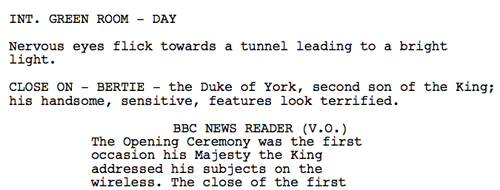
Nevertheless, she was enthusiastic about screenplays and I couldn’t really figure it. See, I’ve written short ones and it is a weird medium. Have a look at 2010’s Academy Award-winning best original screenplay:

The camera direction. The blocking. The capitalization. The margins. None of that has anything to do with narrative. None of it is comprehensible to the average reader. None of it serves any purpose unless the screenplay eventually interacts with actors, directors, cinematographers, and so on, en route to the screen. So why, again, are we supposed to assign this idiosyncratic medium to students? Jacobs took the question for granted.

Ditto iOS apps, for a different reason. A student can write an excellent persuasive essay about any area of her expertise without any instruction in how to use a word processor. An excellent app, on the other hand, requires much more extraneous knowledge โ€“ Objective-C, for instance, or the Javascript/HTML5/CSS stack. If Jacobs is serious about requiring apps from eighth graders, does she plan on every school offering coursework in those programming languages? And, if so, what is her plan for recruiting those CS teachers from the middle school ranks? Where does she intend to find room for those required classes in the master schedule? Or are we just assuming the students will figure out how to program iOS apps? (“Haven’t you heard, Dan? These kids don’t read instruction manuals.”) Or maybe Jacobs isn’t serious. If she isn’t serious โ€“ if she hasn’t considered even the most basic logistical implications of what she’s recommending to thousands of educators โ€“ why would she say these things?

“I really mean this.” She said this several times throughout her talk, usually before some grand pronouncement like, “I don’t think any of you can improve Johnny’s performance. The only person who can improve Johnny’s performance is Johnny.” The effect was to make the audience wonder if she really meant what she said when it wasn’t preceded by this explicit assurance that she really meant it.

This was, I suppose, the nut of my irritation with Heidi Hayes Jacobs’ talk. While she heaped responsibility onto the attending teachers and principals, she failed to acknowledge any for herself. What responsibility should you, a consultant, acknowledge for a ninety-minute presentation? For starters, you should acknowledge that you are a consultant giving a ninety-minute presentation. You should acknowledge, if only to yourself, that unless you’re especially vigilant you’ll always favor simple solutions, grand pronouncements, and bombasticism over the details of implementation. You should acknowledge the vast gap in responsibility between you, the consultant, and the audience members, all of whom work with children in classrooms where the constraints on the imagination are much, much tighter than they were for you when you were at your desk reading TechCrunch or Seth Godin. Just like love means never having to say you’re sorry, being a responsible presenter means never having to say you really mean what you’re about to say.

Moving Toward Mobile

Is it a coincidence that the most effective session of the four I attended was the only one whose title wasn’t the same as a book the presenters were hawking? It has to be a coincidence.

Speaking in a much smaller room to a standing-room-only crowd, Davis and Nickerson described their district’s transition from traditional print-based curricula to iPads, iPod Touches, and predominantly digital resources. I can’t recall a single catchphrase from their talk. Instead, they described the content of the bond measures they passed, their outreach to the community, their constant attention to stakeholders within and without their school, their constant evaluation of new technology. (Here is their evaluation form.) They spoke of infrastructure โ€“ the wireless vendors that came out of the woodwork at first sign of an RFP and how the school tested each vendor by attempting to stream thirty HD movies from the same router at once. They spoke of professional development โ€“ร‚ย how they sent new devices home with the teachers for the summer, how they involved teachers in micro-level discussions about implementation and macro-level discussions about philosophies of learning.

Their presentation wasn’t bombastic. (Bond measures!) But it was tightly organized and incredibly helpful. (Here are their slides.) They wrangled a large audience using a TodaysMeet backchannel and PollEverywhere. Their talk was extremely practical but it was impossible not to be inspired also.

Escape From The Textbook Conference Will Be Livestreamed Tomorrow

I’m not sure while I’m only just now hearing about Escape from the Textbook, but it sounds like it’s broadcasting right on my frequency. The conference runs from 9:15AM to 3:15PM (Pacific), tomorrow, February 12. It’s sold out but they’re livestreaming the event so let’s you and me get a conversation going on the backchannel. See you there, buds. [via Avery]