Category: conferences

Total 78 Posts

CMC-North: Session Line-Up!

[BTW: Owing to a death in my family, I had to cancel my participation in CMC-North this year.]

CMC-North a/k/a Asilomar is on us and my expectations are impossibly high. I’m not heavy into conference-going so take this for what it’s worth but CMC-North is my favorite meet-up of educators all year.

Here’s where I’ll be Friday through Sunday. If you’re going, drop a line in the comments. If you spot an omission in my schedule, drop a line in the comments. The indented bullets reflect a back-up session in case my primary turns into a snooze or a pitch for Scientology or something.

Friday

Lucy West, Academic Discourse It Ain’t Just for Kids โ€“ Keynote

Saturday

Ed Zaccaro, 5 Real-Life Math Investigations That Will Astound Students
Michael Fenton, Imagine: Wikipedia for Mathematics Assessment Questions

Dan Meyer, Math Curriculum Makeover
Steven Leinwand, Glimpses of Instructional Excellence

Phil Daro, Common Core Standards: What is the Difference?
Marty Bonsangue, Surprising Problems for Those Not Easily Surprised

Sheldon Erickson, Conceptual Algebra: Teach More, Better, Faster
Harold Jacobs, Mathematical Snapshots of 2010

Michael Serra, Investigations in Geometry for 2010

Various, incl. yrs trly, Ignite

Sunday

Jo Boaler, The Psychological Prisons From Which They Never Escape? How School Mathematics Shapes Children’s Lives. (Keynote)

And, yeah, I can’t freaking believe they counter-programmed me against Steve Leinwand, who has never disappointed whenever he’s turned up on my conference schedule. If you’re flipping a coin between the two of us, watch this and pick Steve. On the off chance I start boring myself, I’ll see you there.

The Ukiah Sessions

UUSD Technology Showcase Keynote from Dan Meyer on Vimeo.

I gave a keynote last week in the district where I grew up, to teachers who taught me when I was fourteen, which was all kinds of nervewracking. The coordinators asked me to speak on technology, which isn’t my usual speaking assignment, and I was grateful for the opportunity to arrange my thoughts.

The talk is thirty minutes and includes:

  • the two best lessons I learned from the two best math teachers I had in high school.
  • my best guess at the value added by a math teacher to this post-Khan Academy world of ours.
  • the three criteria I use to decide whether or not to invest time or money in a given tool.
  • a fairly comprehensive list of all the tools I use in my curriculum development.

I also gave a workshop targeting math specifically. You can find the sessions page for both here: http://ukiah10.mrmeyer.com/

NCTM / NCSM: Where Are The Kids?

I’m grateful, again, to Key Curriculum, for luring me down to NCSM; to Ihor Charischak, for extending my stay through NCTM; and to Nana, for letting me stay in the guest room. Both conferences were worth my time, particularly NCSM, where my ratio of session hits to session misses was unbelievably high.

I had a variation on the same conversation with six or seven people at both conferences, people who were all closer to the end of their careers than the start, people with elevated angles of sight on math education in the U.S. (elevated enough that several specifically told me not to quote them on my blog), and they all wondered the same thing:

Where are the new teacher-leaders?

One individual clocked the average age of an NCSM attendee at 57. Another, an edtech vendor, said that the biggest liability to his business was his own age. I received a lot of kind notes on my Ignite session but some of the praise was really hyperbolic, predictions about my place in math education that, based on five minutes in front of a projector screen, were flatly unreasonable, and indicative of a certain desperation to point to someone — anyone — on the other side of a yawning leadership gap.

NCTM and NCSM need to convince younger math teachers and younger teacher-leaders of their value. We can do that and bridge the leadership gap with the same solution:

Make it really, really easy for new teachers to connect with mentors over the Internet and vice versa.

Many opportunities exist for older, talented educators to mentor younger educators. Crucially, though, few of them demand any less than an eight-hour-a-day commitment. Teacher mentorship is currently a full-time job in the U.S. Or, if you’re working in an induction program, two hours per week with two or three new teachers. I don’t know how to sell that investment to any of the six or seven people I spoke with in San Diego, all of whom have day jobs.

There are very few high-yield investments for twenty minutes per day of an amazing educator’s time, but that can change.

We need to give Stack Exchange a long look. Stack Overflow is the first stop for anyone looking to crowdsource a programming question and the people behind it have decided to extend their platform to other disciplines. Their stated goal is to “make the Internet a better place to get expert answers to your questions.” You can connect those dots.

I won’t summarize all the factors that have made Stack Overflow a valuable resource for developers though my opinion is that many of them would translate into value for teachers. I encourage you, instead, to read their FAQ. Read some sample questions. Then come back here and let us know how you could see yourself working on this bridge between expert and novice educators, if at all.

NCTM 2010 โ€” Day Three

NCTM is the forward-thinking younger sibling of NCSM and was, therefore, much more progressive about wireless Internet access.

Session Attended:

How to Develop Computational Skills without Drill, During Problem Solving. Jerry Becker.

So Here Are A Few Interesting Problems That Permit Constructive Solutions While Still Assessing Basic Skills

Becker brought out two problems that a) assessed both computation and reasoning and b) scaled all the way from basic counting through limits, which isn’t a small trick.

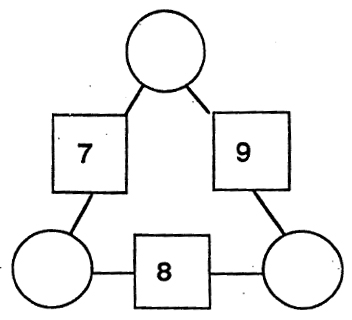
First, arithmogons. Add adjacent circles to get the middle rectangles. Then do it in reverse. Develop a rule for solving them quickly. They scale from easy to algebra at whatever speed your students want.

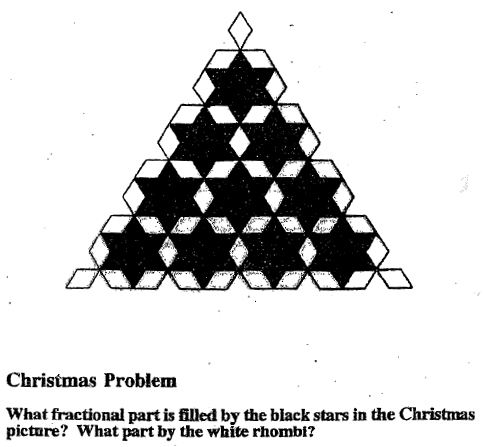
Second, the Christmas problem, which goes from counting all the way up to limits as you add more and more rows to the pyramid.

The Really Curious Part

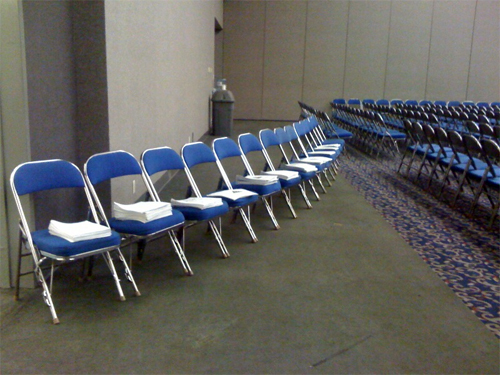
The session was remarkable mostly for the one hundred copies Becker made of a 55-page handout he spread across ten chairs. “Take one from each pile,” he said as I walked in.

He only used (conservative estimate here) seven of those pages. When he ran out of packets, he promised the remaining attendees he would mail them a copy (as in postal mail) if they left him their addresses. I swear I am not making this up.

Here’s an excerpt of an e-mail Becker sent out to the group several days after the conference:

I apologize for running short of the handouts at our session. But I will have the handouts duplicated in the next couple days and then put them in the U.S. Postal Services mail to you – snail mail, so it might take a few days. But I am working on it already. The address labels will be typed up tomorrow.

So I don’t know.

It struck me several times throughout both conferences that we need to counter-program a session across from the “Newcomer’s Orientation.” I’m not talking about “Rolling Your Own Backchannel with Twitter.” Scale that back. Way back. Something more like, “How to Make National Presentations a Lot Less of a Chore for Presenters,” featuring URL shorteners, Delicious, PDFs, basic FTP. maybe drop.io. You name it.

(BTW: here’s a PDF of Becker’s handouts.)

NCTM 2010 โ€” Day Two

Sessions Reviewed:

  • Linking Best Mentoring Practice and Online Support for Beginning Teachers. Nina Girard.
  • Using Mathematics Homework with an Eye on Equity and on Mathematical Integrity. Deborah Loewenberg Ball.

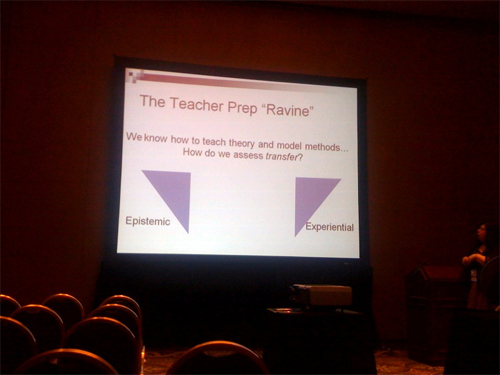
The Teacher Prep Ravine

Girard described a ravine between epistemic and experiential ledges. How do you bridge it, getting new teachers from learning about teaching to actually teaching?

Girard and her team used the free Moodle course management system in four ways:

  1. A wiki for sharing ideas and resources.
  2. A journal for student reflection.
  3. Blog posts, prompts written by Girard for new-teacher comment. Girard spoke of certain blog threads that caught fire in a way that was gratifying like when you hear students talk in the hallway later in the day about what you were teaching that morning. (I’m not sure how well I relate to that analogy, but I think I get it.)
  4. A forum for conversations initiated by new teachers.

None of this will shock guys like Couros or Shareski who have been doing this with new teachers for awhile now, or Kuropatwa who does this with his math students. Girard presented all of this with the matter-of-factness it deserves. It’s just a sensible way to extend classroom conversations outside of the time you’re alloted by your bell schedule or your course’s credit-hours.

New teachers who are hesitant to join a conversation full of type-A teachers may bloom online, said Girard. It was also useful for teachers who struggled with content knowledge. Many of the forum posts were requests for lesson help.

Girard and her faculty are encouraging graduates to hold onto their login credentials, to continue contributing to and benefiting from the resource wiki, and to share their knowledge with the next class of new teachers. The potential there is kind of inspiring.

Homework That Doesn’t Hurt

Deborah Loewenberg Ball began with a concise summary of inequity in education in America. She singled out students whose schedules were overflowing; students who had work after school, either earning money for the family or babysitting so others could; students who had limited access to resources, either knowledgeable family members or materials like scissors and tape.

She then asked the session’s motivating question:

How do you create homework that is mathematically valuable but still accessible to all students?

She introduced us to her Elementary Mathematics Laboratory, a two-week program for incoming fifth-graders to learn math in interesting, novel ways for a few hours a day.

She never said so explicitly but I assume EML is where she conducts the majority of her research. And why not? Check out the banner image on the EML website.

You have two video cameras around the room, table mikes spaced all around the students, and a lav mike on the teacher. The research page says they photograph all the public spaces like whiteboards, overheads, and student posters. The room is positively rigged for research.

At the EML, they decided that homework is best used for …

  1. between-class work to bridge the gap between today and tomorrow.
  2. structured, independent work to free up in-class time for social or extended learning. (cf. these guys.)
  3. study-skill development, for learning how to learn and study math and develop a productive disposition.

Her demonstration assignments required no more paper than what they were printed on and they were further scaffolded by …

  • … a student contract to the effect that this is a serious class and you will need to complete this work to be successful.
  • … a teacher contract designed by the students to the effect that the teacher will bring the heat every single day. The practical result of both contracts was largely symbolic but DLB said it set a powerful tone for the course.
  • … homework kits containing scissors, tape, and other necessary supplies.
  • … explicitly labeled problems. Three varieties.
    1. Independent practice. Skill development, reinforcement, and reflection, designed to be completed without help. In fact, students were told not to get help.
    2. Preparation for new work. “Go as far as you can.” This was work they hadn’t been fully taught, designed to teach tolerance for difficult work and a productive disposition toward math. Students didn’t finish the majority of these assignments.
    3. Work to be shared. This was to improve home/school communication, to develop a student’s ability to narrate her own work. “Share what you’re learning with someone in your home.”

The EML (which, it must be said, hardly resembles a student’s experience in a traditional classroom during a traditional school year) posted a 100% homework submission rate. I’d soften my stance toward homework even further if I could a) get someone to teach me how to create these assignments and b) get several members of my department on board to distribute that creative work.