Category: digital instruction

Total 80 Posts

Between Simple And Easy

My favorite problems are simple but not easy. The difference hasn’t always been apparent. I’m talking about clear, minimal constraints which require complicated, comprehensive thought. These problems are rare, but some lucky days they arise from a single image, like the one up there, like the one today.

The Question

If that table tennis ball is the Earth:

  1. how big is the Sun?
  2. how far away is the Sun?

Follow Through

You take bets. Is the sun a tennis ball? A beach ball? (A: something closer to a weather balloon.) If you miniaturized the solar system, what solar body would focus the Earth’s orbit? (A: the taqueria down the road.) You pick their pockets with these bets, getting them to buy into the problem unwittingly.

Maybe you put them into groups and wait until they requisition data. (eg. the radius of the Earth, the tennis ball, and the Sun; the mean distance from the Earth to the Sun.) Maybe you give them all laptops and let them scour the ‘tubes for the same data.

And I Wonder Constantly:

  1. do these simple-but-not-easy questions exist for every math standard on the books?
  2. who has them?
  3. are these people easily extorted?

Weak Become Heroes

I put this opener on the board three times today and each time the weakest student in each class figured it out first. In two classes, the weakest student was the only student to land it.

In one class it was the soft-spoken student whose father committed suicide earlier this year, who’s been in and out of class all year, whose eyes were bright like a torch after I told him, “Nice! Now hide that, hide that.”

So Happy Together #6

The Oakland presentation is behind me but the value of this digital projector becomes more apparent every day. This digital projector is decreasingly an affectation and is increasingly essential to my math practice.

Here is a Vimeo clip [1:14] I edited to illustrate what is no doubt some well-known cognitive theory which I’ve been too lazy to study, but which I arrived at through two years of error and trial and error just the same.


So Happy Together #6 from Dan Meyer on Vimeo.

In summary: as you’re scaffolding a complicated task, it’s essential to highlight the small differences, the subtle ways an easy problem โ€“ one which we’ve mastered โ€“ now becomes difficult. The brain senses differences and a digital projector makes those differences more apparent than does a) a pencil and paper, b) your voice, or c) a whiteboard and dry-erase marker.

So Happy Together #5

I’m one day out of a presentation to the Oakland Teaching Fellows on digital projectors (working title: PowerPoint โ€“ Do No Harm) and really excited about it. A lot of these folks are right around my age, some older, which’ll make for different dialogue than what I’m used to in my high school classesWhich usually hovers around who can fart loudest into the speakerphone..

This last note-to-myself circles around classroom management and how much easier it is to keep a large group of students focused with a digital projector, presentation software, and wireless remote than without.

One Idea:

Classroom Management: The Triangle Offense

Like This:

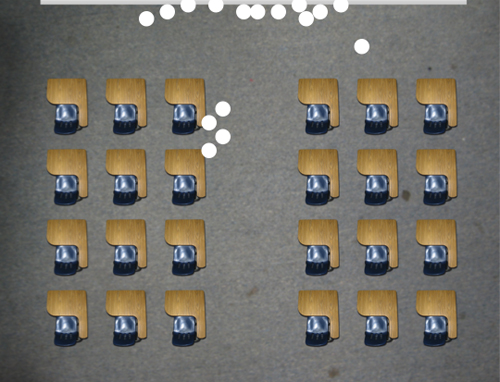
Let’s say you’re in a short lecture block. If your only tools are a chalkboard/whiteboard and chalk/marker, you’re tethered to the board.

You can draw a bit, write a bit, ask questions a bit, but always at the board. If Llewelyn loses focus, you can wander to his desk, maybe ask a softball question to pull him back in, but then you’ve gotta return to the board, all while the kids farthest from you drift off.

Your classroom dot plot looks like this:

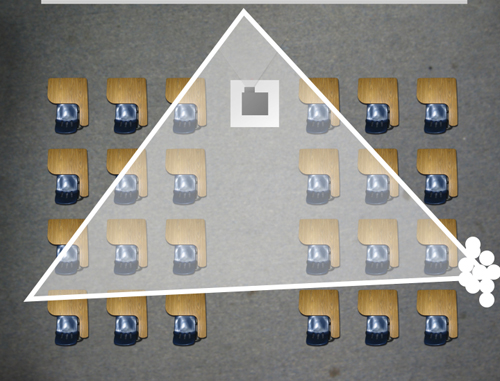
Let’s say now you have a digital projector and a wireless remote and you’ve already loaded some discussion-worthy diagrams into your presentation software. You’re mobile.

You walk to the far side of the classroom and address the board. Your focus directs theirs. You toss a question at the opposite side of the room pulling them into your locus.

Your question, the projected image, and the kid answering the question, are three vertices of a triangle inside of which classroom management is a relative non-issue, inside of which you all have really, really good focus.

It’s the triangle offense, and it’s very effective.

Previous Editions: