Category: digital instruction

Total 80 Posts

Digital Storytelling Carnival Entry

Mathew Needleman hosts a new blog carnival to limited fanfare and an inexplicably shortened deadline. But I’m a sucker for carnivals.

A two-part submission, then. One part to take issue with Mathew himself, and another to offer a slick assignment for a class that isn’t mine.

A Story Is A Story

My original sleep-drunk post basically declared (without justification) storytelling the most common discipline between every 21st-century career, consequently declaring it the most common discipline between every classroom on your campus, as well as the most collaborative and the most important to teach.

Mathew took exception to my democratic optimism:

I still think that there is a particular language to film making that only a few will pick up just by osmosis. If you want to make good videos you have to be aware of certain film language in the same way that print design requires adherence to certain principles.

It’s true that editing a montage involves a different instrument than composing a paragraph but they descend from the same skill.

For reasons of time, I can only offer one other example but they are littered everywhere if you feel like looking:

In storytelling, it’s essential that you set the scene and lend your reader / viewer / listener (henceforth “audience”) some bearingLet’s ignore, for a long moment, how great and appropriate it is to break these essential rules on occasion..

  • Language. In writing, it’s an introductory/topic sentence, like the first from chapter three of Moby Dick:

    Entering that gable-ended Spouter-Inn, you found yourself in a wide, low, straggling entry with old- fashioned wainscots, reminding one of the bulwarks of some condemned old craft.

  • Math. In a proof, you first declare the given constraints:
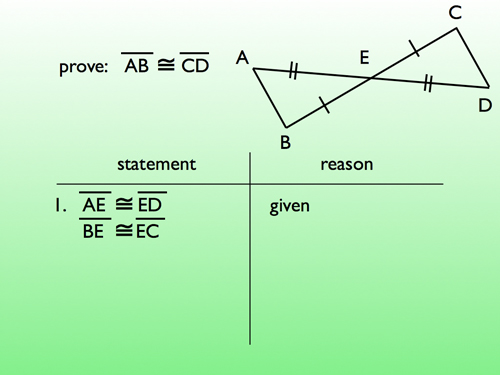
  • Music. In music, you often set the scene by layering your instruments, staggering their introductions. Like in Gimme Shelter, first the guitar, then the drums, then the piano, then the vocals, and then, after the audience has become comfortable, they rock.
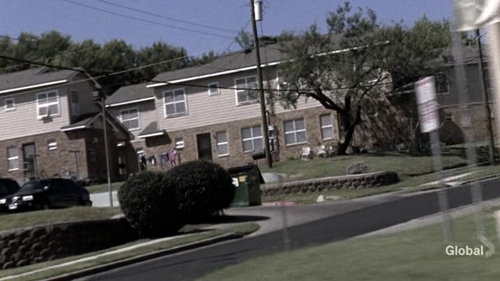
  • Film. In film/tv, you open a new sequence with a wide, establishing shot, letting the audience orient itself before you dig deeper with medium shots and close ups.

    Like with last Friday’s Friday Night Lights, within the first few seconds of the episode, you’ve got this wide, exterior shot of Smash’s neighborhood:
Writing and film offer the most useful parallels and, honestly, they. just. don’t. stop. Everything โ€“ from transitional sentences to the rhythm of individual words to alliteration to concluding paragraphs โ€“ has an analog in film and vice versa. True to Mathew’s point, their executions vary, but execution is always secondary to conception.

I want to build students who can recognize common storytelling elements in these mediums and then move effortlessly between them.

Kant Attack Ad

To that end, it’s impossible to watch this mudslinging campaign ad without dreaming up a classroom assignment.

So you have your kids pick two opposing people, ideas, or concepts. Yeah, you could go with opposing philosophers as in the video, but my mind is elsewhere:

  1. metric v. imperial,
  2. hamlet v. laertes,
  3. basketball v. soccer,
  4. wii v. xbox 360,
  5. or, since in the states it’s a freakin’ election year, pick two candidates and go at it.

And by “go at it,” I mean:

  1. research the issues;
  2. pick a side;
  3. choose a limit on duration;
  4. research current campaign ads on youtube;
  5. gather images, video clips, sound bites from the opposition;
  6. distort and decontextualize them;
  7. get your menace on for the narration;
  8. use the ken burns effect a lot;
  9. host a classroom film festival;
  10. have the class vote on the issues based on the persuasiveness of the campaign ads.

Raise your hand if you wish you were teaching an elective right now.

*raises hand*
So Happy Together #2

Make the marriage of your digital projector and laptop a happy one.

One Idea:

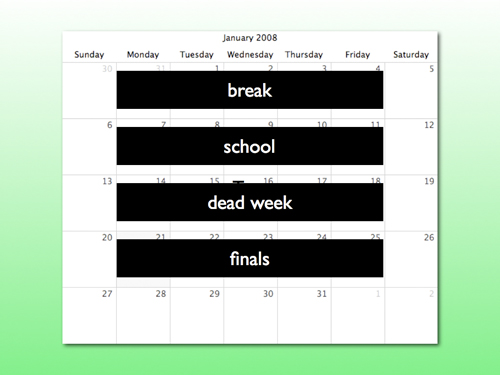
Make perfunctory classroom maintenance a little more engaging by adding visuals.

Discussing the complicated, end-of-semester schedule? Screenshot a calendar and illustrate it.

Previous Editions:

Call to Action: Make it Fun

Okay so I’m gonna cherrypick a set of your comments and decontextualize ’em to serve my point. God bless the remix culture.

fgk, on why people don’t take lessons from those who offer them:

i think a big part of why we donโ€™t adopt [lesson plans] from others is because we donโ€™t see it happening. when you watch a class, you can tell when something succeeds, and figure out how to incorporate that into your own teaching.

druin, on the frustrations of sharing lesson plans with others:

I think for many people the idea of sharing is lop-sided. I donโ€™t mind sharing ideas with others, but it frustrates me when Iโ€™m the only one sharing.

sarah, assessing my lesson offerings:

The power of your narratives is the piece that keeps me hoping that something turns up in your [lessons] tab. Itโ€™s that reality check of what works. Itโ€™s hearing your voice, getting hints of your personality, helping me mentally test what I can pull off, and what, like rap music, would be obvious that Iโ€™m faking. That voice is what every lesson plan needs. [emphasis added]

So my advice is this: you have to make stories out of your lesson plans, collapsing resources into anecdotes. It’s easy to blog stories. They’re cathartic and satisfying where resource posts feel expensive. Plus people are more inclined to read stories than rubrics.

Talk about the questions you asked, the responses they gave. Share pictures or screenshots when possible. Post stories, not plans, and then attach handouts or link sources at the end. I can’t help you with the time cost but if you’re convinced you should share your resources, I promise that this is the way to make it fun for you.

Moreover, I promise that as you start receiving feedback on your stories โ€“ positive & negative โ€“ you’ll start looking for more stories to tell. Constantly. The pipe that carries interesting things from your eyes to your students’ and then to your readers’ will grow wider. It’ll move faster. If you start this in earnest, I pomise you won’t be able to turn it off.

Call to Action

I gave myself too much credit for innovation with that DVD sub plan. Some of y’all have been pulling that rabbit out of your hat going on years now. Respect for that but here’s my question:

Why aren’t we sharing?

Why didn’t I read about it? I’ve been issuing lousy sub plans for three years, three years which could’ve been cooler if someone I readAnd, admittedly, someone I don’t read might’ve posted it and I wouldn’t know. had made that part of his or her practice public.

One of the most shocking blog entries I read this week was Miss Profe’s Tic Tac Toe: Foreign Language Style. There was nothing obviously earthshaking about it but still I sat there with spoon frozen halfway between bowl and mouth, realizing how rarely people Around Here share lessons and activities.

Time is always a good scapegoat. These things take too much time sometimes. I wonder also, though, if we don’t post more resources because those posts are some of the least sensational. They generate the fewest commentsZero so far on Miss Profe’s.. They don’t fit into the standard post templates of a) anecdote (“my day sucked today, here’s why”) or b) manifesto (“my school district disabled the right-click today, here’s why that sucks for education”).

Lesson plan posts lack any call to action, which seems like a waste in a blogosphere where every third blog post is a call to action.

But that sucks because new teachers want your answers. That sucks because I want your answers.

  • I want to know how to do group work right.
  • I want to know how to do a good equipment check-out system so that my compasses and calculators don’t walk out the door but which doesn’t sap away instructional time.
  • I want to know how to incorporate some math on the sly into the day before Christmas break.

I know you’re holding. Give it up.

If you’re a blogger …

  • post something cool from your bag of tricks.

If you’re a reader …

  • put a request in the comments. Something that’s getting you down (solving equations, seating arrangements, whatever). Something you’d like to see. Or just an affirmation that you’d like to see more resources floating around the ‘sphere. You’ve gotta let ’em know it’s worth their while.

One of these days, as a blogosphere, we’ll get resource sharing rightSomehow I suspect that somewhere someone’s working on it. and this job is gonna get a lot easier and a lot more satisfying for a lot of people. Until then, as connected as this place seems, we’ll struggle alone.

So Happy Together #1

I’m compiling notes for a presentation entitled Getting The Most Out Of Your Digital Projector (I know. Really catchy.) the main thrust of which is that my instruction has never been happier than when I made friends with:

  • A digital projector, and
  • A laptop.

One reason why:

The story goes that during World War II, Allied pilots were taking a beating. There was a very limited supply of retrofitting armor at the time so the Allies hired a statistician to determine where and how they might best allocate it.

The statistician took a top- and right-view diagram of the planes out to a runaway and watched the planes land. He marked a dot wherever he saw bullet holes and came back with something like the slide below. [cf. Abraham Wald’s original study.]

So after you tell your class that story and after you show that slide, you ask the question, “Where would you put the armor?”

You insert the question real quick and you turn your inflection up at the end like it’s just a quick set-up for the real question when in fact, nah, this is the only question.

They walk right into it and tell you they’d attach the armor where all those dots are clustered.

Then you tell ’em, “Nah, see, mister statistician put the armor where you don’t see dots.”

And I tell you: there isn’t any correlation between the age of the student and how long it takes her to figure out why.

See, I first told that story last year. I happened upon it ’cause some friend linked to some other blogger who linked to it out of someone’s del.icio.us feed.

Basically there was no way I’d ever find it again this year. I mean, maybe I’d remember the story but odds are slim I’d relocate that image again if not for the fact that my lightweight presentation files (a few megabytes per week) let me save every fun thing I’ve ever shared with my class. Forever.

And now this year, the same friend links to kottke who links to waxy via boing boing who gives up some other cool thing to share with my class. And suddenly I’ve got two awesome thought-provocations to spread over two days.

How long until I have 180 provocations for every day of the school year? No way to tell but given how happily my laptop and digital projector play together, I can only surmise: not very.

[Updated: to add a citation link to the source (courtesy Tim) and to clarify for anyone who thought I was claiming authorship for this anecdote or the illustration, I wasn’t. This post was explicitly about effective storage of found online resources.]

[Updated again: to add a link to Abraham Wald’s original study.]


For Your Consideration:

Are you better off than you were four years ago? Vote dy/dan best new edublog and best individual edublog.