Category: digital instruction

Total 80 Posts

No-Drop Zones

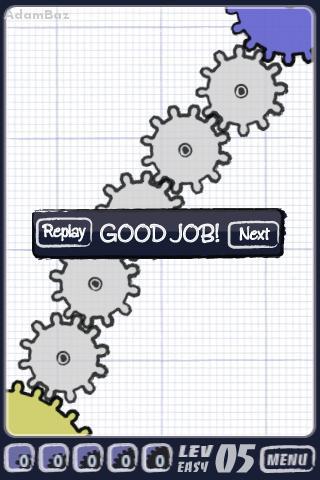
From the #iPhone-game-as-metaphor-for-curriculum-design hashtag, we have Geared, which I purchased because I’m almost completely obsessed with little spinny things, a purchase which I almost immediately regretted.
Two reasons:

  1. The early levels are ridiculously easy. Not a serious problem in and of itself. The same is true of Flight Plan, which you’ll recall I rather liked.
  2. But game play gets harder only over a series of completely nonsensical contrivances. You’re dropping gears into a system, blitzing your way through easy. Then on level 21, as the game flips to medium, you’re confronted with “no-drop zones.” That’s really it. Everything else is the same. You’re arbitrarily excluded from routes you know would otherwise work for reasons that have nothing to do with the function of gears.
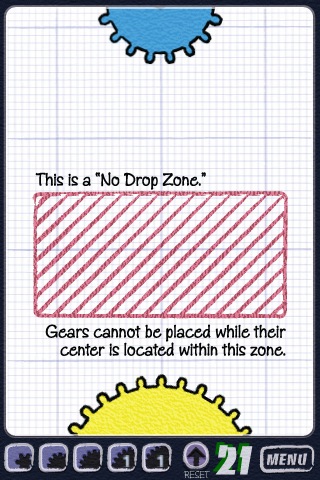
There’s no good reason to criticize an iPhone game from this forum except for the robust metaphor it offers for conceptual growth in math. Few textbooks get this right โ€“ and I include here the ones that do a pretty good job of being less helpful:

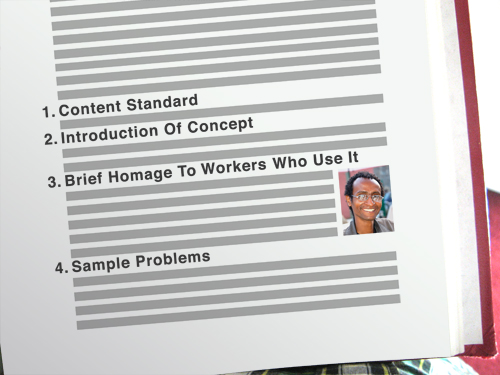
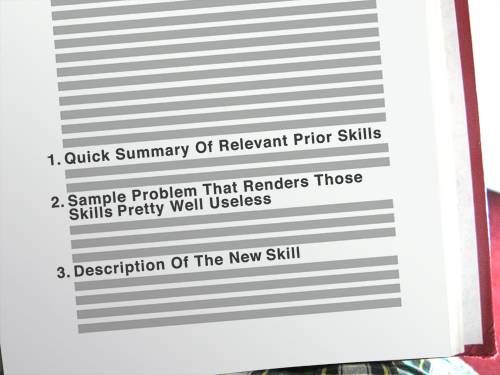
whenever possible, introduce new skills and new knowledge as the solution to the limitations of old skills and old knowledge.

Typical:
Better:
Please argue with me here but I don’t think my freshmen really care if career professionals use math in their jobs. This “career” concept is supremely abstract to most and therefore mostly useless to me as a motivator. I’ve found a much stronger motivator in a palpable sense of forward momentum, in a coherent skill set, in real, uncontrived challenges.

I’m teaching remedial Algebra for a fourth year now and the change I make to my curriculum far more than any other is to add this connective tissue.

You’re comfortable with a dot plot? Fine. Let’s put you in a place where a dot plot is tough to execute โ€“ say, a large data set with no mode and a huge range. That’s annoying. Then bring in the box-and-whiskers, the histogram, or whatever. I try not to introduce the next concept simply because it’s the next chapter in the book or the next bullet point on a list of standards or because it’s “what we’re learning today.” In other words, I try to stay away from the no-drop zones.
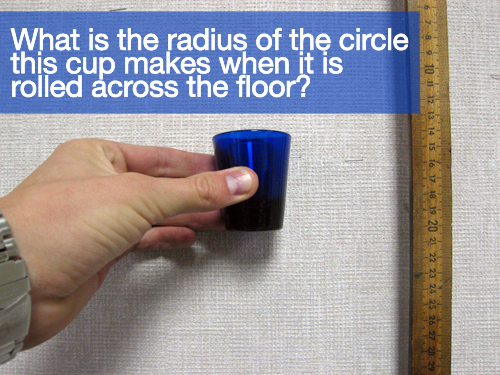
What I Would Do With This: Glassware

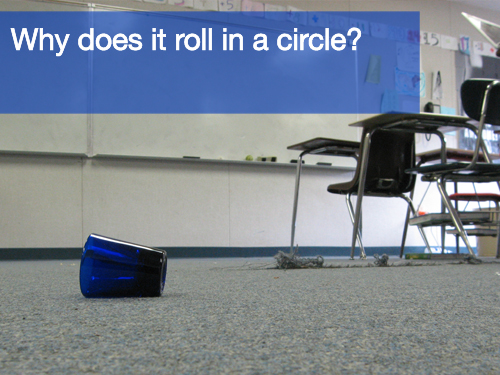
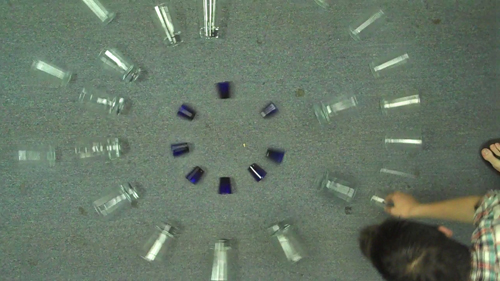
If you have never rolled a cup across a flat surface and marveled at how precisely it returns to the same place you rolled it from, it’s possible you’re the wrong audience for this post.

There is math here, certainly, but I have made it a goal this year to stall the math for as long as possible, focusing on a student’s intuition before her calculation, applying her internal framework for processing the world before applying the textbook’s framework for processing mathematics.

Bad First Question

This one sucks the air right out of the room. We’re into the math immediately, having bypassed several easy opportunities to pull in our students who hate math… and, when those students comprise your entire class, good luck with that..

Jason’s First Question

Jason Dyer suggests handing out plastic cups, letting students roll them around, then asking “why do they do that?” I have no problem with this approach. I would like to start from a position of stronger student investment, though.

My First Question

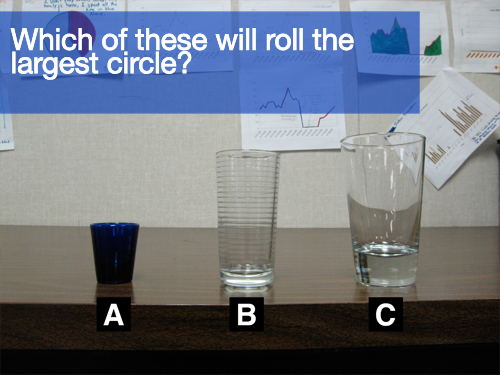
Have them roll some plastic cups around. Then toss up this slide and ask them a question that has a correct answer, yes, but which attaches little stigma to the wrong answers. It’s an educated guess and different students will make persuasive cases for all three of these. Ask them to write their guesses down, to put them on the recordIt’s extremely helpful here that the tallest glass doesn’t make the largest circle..

A Lesson Sketch

The conversation can then proceed along some interesting lines where you ask the student to:

  1. justify her guess.
  2. draw the kind of cup that will roll the largest circle using a fixed amount of plastic. This is fun. Many will draw a really tall cup, which isn’t the best use of limited material. A two-inch-tall cup can roll a circle that’s a mile wide.
  3. make their ideal cup from a page of card stock. The fixed size of the card stock will normalize the results.
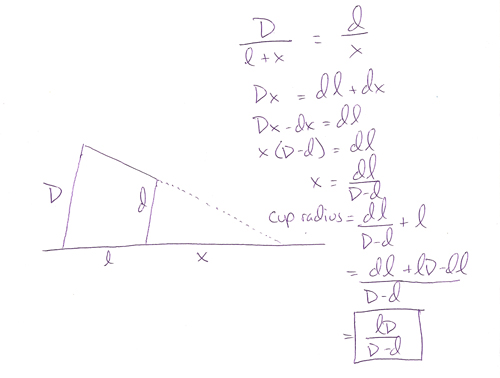
  4. draw a complete picture of their cup including the auxiliary lines. Can they find the invisible center of the circle it will roll? What’s the method?

We do all of this before we start separating triangles, before we write up a proof, before we generalize a formula. We ask for all this risk-free student investment before we lower the mathematical framework down onto the problem.

Degenerate Cases

A cool feature of this formula is how well it handles degenerate cases. For example these two:

  1. A cone’s roll-radius is the same as its slant height so letting d = 0 should (and does) eliminate D from the formula.
  2. A cylinder will roll forever so letting D = d should (and does) return an undefined answer.

Iterate

From there you can pull out of your cupboard (digital or otherwise) any random set of cups and the students should be able to predict the roll-radius within a small margin of error.

And the framework grows stronger.

A Parting Swipe At Textbooks

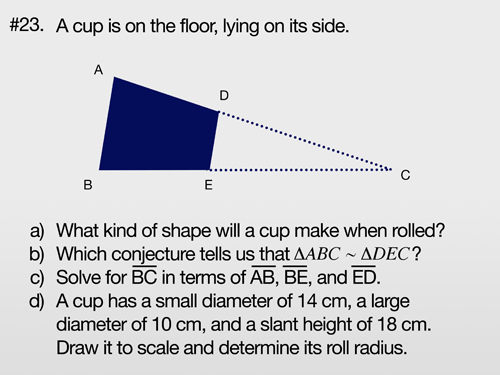
I didn’t dig this out of a textbookh/t Mr. Bishop, Summer School Geometry, Ukiah High School, 1997. but this (hypothetical) scan highlights the difference between my math pedagogy and my textbook’s.

The Most Dangerous Man In Edublogging

Rhett Allain picks apart the dubious physics of Up, Pixar’s latest kiddie joint:

If you can model the hairs on the head of a man in an animation, donโ€™t you think you could use Newtonian mechanics to plot the position of the GPS? I donโ€™t know, maybe it would have fallen too fast or something. Oh well.

He has graphs and everything.

Slides Then / Slides Now

a/k/a Redesigned: Dan Meyer

Then

Now

Something I have been completely wrong about is the best way to use slide software in a math class. A few years ago I wrote a design series explaining how I use color theory, grid systems, etc., to clarify complex procedures, but the whole thing turns out to be simultaneously a) a lot more fun and b) a lot less time-consuming than that.

My reversal in slide design reflects a shift in my math pedagogy also. Far more important to me now than “developing fluency with complex procedures” is “developing a strong framework for interpreting unfamiliar mathematics and the world.”

I’m not trying to set up a false dichotomy here. We do both. Both are important. But all too often slides like that first one, with the classroom dialogue and solution method predetermined, cordon off classroom dialogue and student reflection onto very narrow paths. That kind of pedagogy does nothing to unify mathematics, tending, instead, to position complex procedures in isolation from each other, which is a very confusing way to learn math and a very laborious way to teach it.

Instead, I want my students to focus without distraction on a) how new questions are similar to old questions, b) how tougher questions demand tougher procedural skills, asking themselves c) which of their older tools can they adapt to these tougher questions?

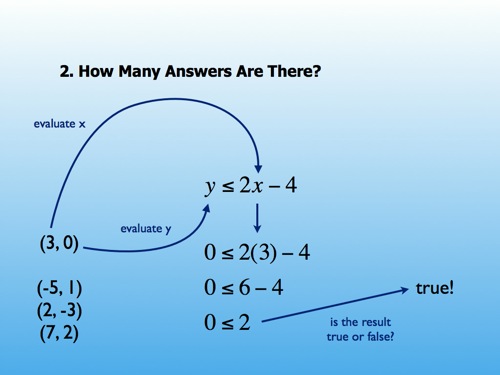
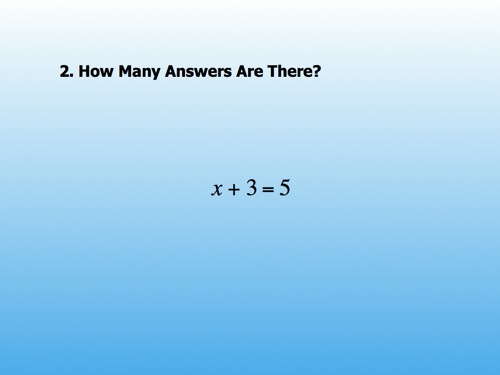
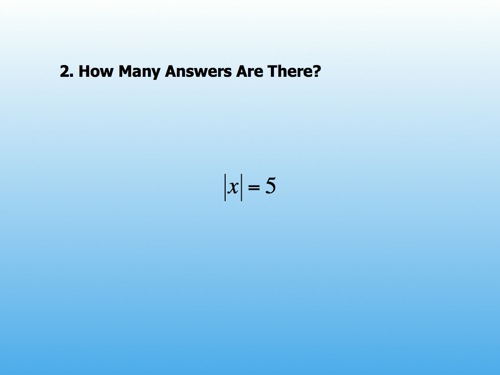
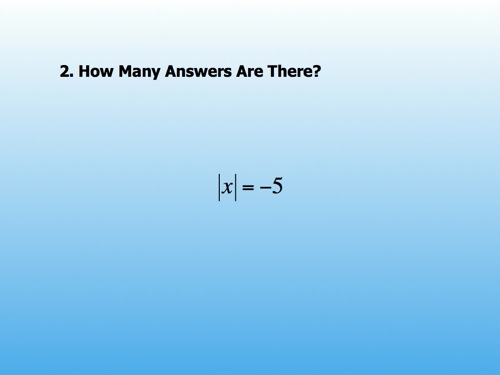
For example, I put six equations on separate slides, equations we have seen. I asked, “how many answers are there?” One. Two. Zero. Etc.

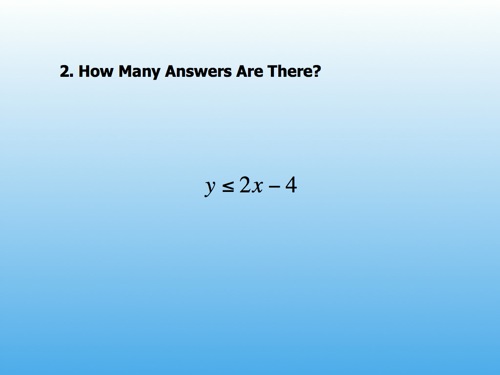
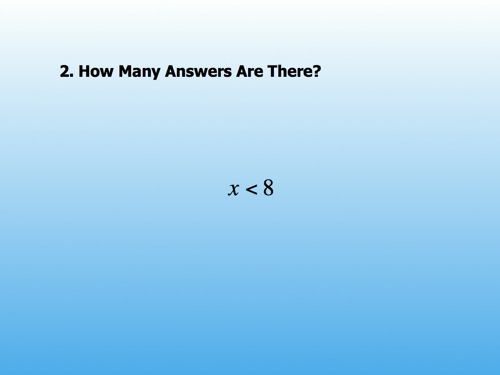
Then I put up an inequality, tweaking the problem slightly, and quickly.

They told me there were lots of answers. I asked my students to start listing them. “7, 6, 5, 4.2, 4.1, 4,” etc.This became tiresome quickly and made the introduction of a graph โ€“ a picture of all those answers โ€“ clear and necessary.

Slide software makes it easy to sequence these mathematical objects, ordering and re-ordering them to promote contrasts and complements. Slide software lets me sequence these mathematical objects quickly, from anywhere on the globe, from photos and videos I take, from movies my students watch, from textbooks too. Graphic design is useful to mathematics, but I am happy to have discovered certain constraints on that usefulness and, simultaneously, higher fruit hanging elsewhere.

It is the curation of this mathematical media that interests me now, though I reserve the right to return to this space shortly and reverse myself again.

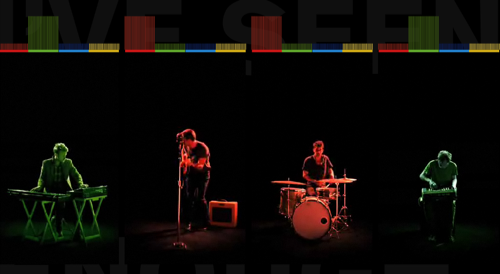
“I’ve Seen Enough,” Cold War Kids

Killer concept and execution on this Cold War Kids video. You can activate/deactivate any instrument at any point in the song and change any musician to any one of four tracks.

I have no objection to loading this thing up after the opener exercises and simply playing with it. If the moment offered itself, though, I wouldn’t mind asking:

  1. If we set all the tracks before the video starts, how many different videos could we watch?Further: the song is 3:10 long. If we started watching all of those videos right now, on what day and at what time would our marathon end?
  2. How many times did each musician have to record the song?

The difference between those two numbers is staggering, worth classroom discussion, a sign of the times, etc.

[BTW: Thanks to Karl Fisch for spotchecking my hyperlink.]