Category: digital instruction

Total 80 Posts

Are You A Sucker For Product Placement?

Watch this YouTube video, which is sweet and wistful all the way up until you realize it’s selling flavored sugar water:

The question I asked my students was, “when did you realize it was selling you Coke?” and “how many times did you see Coke throughout?”

The kids who are unfortunate sponges for product placement didn’t notice it was a Coke ad until the end. Savvier shoppers spotted the Coke billboard halfway through.

These classroom conversations are fun and useful and I’m glad we make room for them in math. I have given up posting my show and tell media here but if you’d like a feed of photos and video I show in my classes every day, I have tagged them here.

What Won’t Work: Harvard’s Movie Math

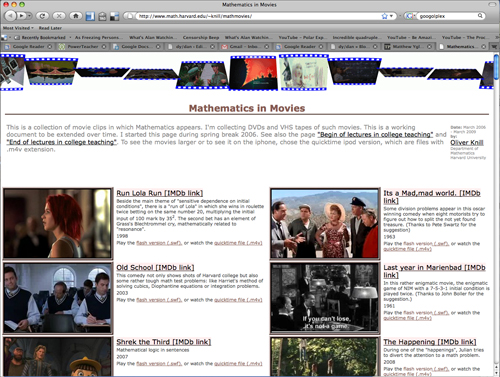
Harvard’s Oliver Knill extracts clips from movies that evoke math. To whomever first tipped me to this site last year and for the dozen recommendations I have received since, thanks, but I have no idea what to do with it. There is value here, certainly, but rarely is it of the WCYDWT? variety, which has kids actually getting dirty with math.

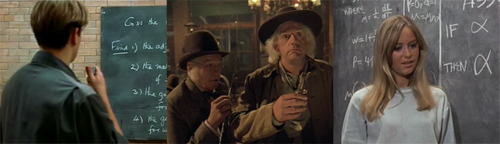
Basically, this is mathematical pornography, where handsome people in movies use the same math I’ve been telling you kids that people in the real world use all the time.

For example, check out the Straw Dogs clip in which a blackboard with some astrophysical equations appears! Or the time that Doc Brown uses the term “googolplex” in Back to the Future III! Even Matt Damon enjoys solving linear equations!

Like I said, there is value here, I’m sure, but I’m looking for fruit on higher branches. Because every single one of those clips begs the question:

What do the students do with it?

If you can’t build an interesting activity out of the a/v material, something to challenge and perplex your students over a sustained stretch, I have little use for it. The thesis of both this post and the last is that we have to make the really useful stuff ourselves.

What Won’t Work: FlickrCC

What Can You Do With This? is the most fun I’ve had this school year. I could do week after week of times table review if my students and I were allowed just thirty minutes per week to sharpen our minds with mathematically rich multimediaIf you’re the sort who sees potential in these blog things for professional development then the fact that I developed this classroom fixture organically, spasmodically, like a wobbly baby giraffe, here on this blog, in full public view with full public input, might be a useful data point..

I have received two suggestions recently I wanted to address, two suggestions that would put us off a useful trail and into the bramble. Here is one.

FlickrCC Won’t Work

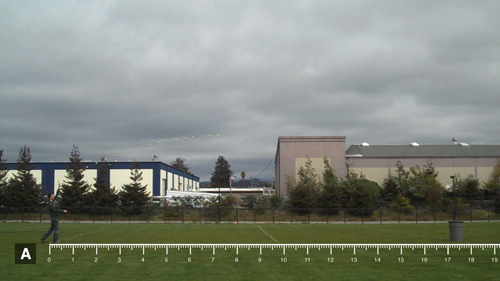
Scanning Creative Commons-licensed photography databases for math media simply isn’t a scalable solution. These media must be unaffected. The student must lift the heavy weights. The student must decide for herself what is important about an image, audio sample, or video. Most photographers, meanwhile, are very interested in artistic expression, in affectation, in imposing their own point of view on a scene, rather than stripping the scene of their point of view entirely, which is essential for classroom work. So instead of something unaffected, and artistically value-neutral like this:

You get expression like this:

… with the camera positioned at an artistically interesting but academically unhelpful angle. You can’t model a parabola onto this. You can’t model a circle onto this. The photographer was (naturally) unconcerned with measuring the scene, which rules out basic photogrammetry. It begs the question, “who shot this?” rather than an interesting question about the parabola itself.

This is a generalization, true, but a useful one. You can’t find the really effective WCYDWT? media. You can derive surface-scratchers like “what shapes do you see here?” from Creative Commons-licensed Flickr media but if you’re looking to propel a meaningful discussion or a rigorous activity, you have to make it yourself.

Will The Ball Hit The Can?

I pick up a huge static charge whenever six words, paired with the right a/v material, can motivate an hour of mathematical exploration.

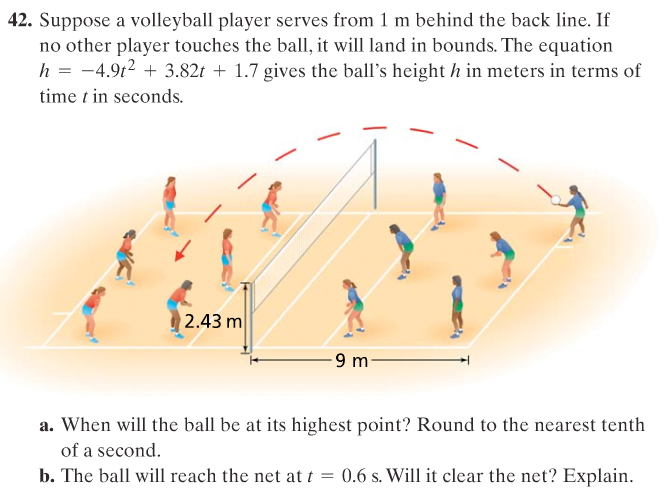
Here is the opposite of that static charge, a loud sucking sound as my brain deflates, the old way of doing real-world relevance:

As a student, I’m like “cool, volleyball, volleyball’s fun” but the problem is already dumping questions and formulae and mathematical structure on top of me before I have ever once considered the reality that projectile motion follows a parabola.

You have to earn that.

So I shot four of these images [partial, full] โ€“ร‚ย one that ultimately went long, one that went short, one that went in, and one that looked like it went in, but really veered to the side, provoking a discussion of errors in 3D projections onto a 2D plane.

I shot ’em plain. Nothing fancy, plenty of room along the edges, no soundtrack, no narration, nothing overtly helpful. I set them up so I could ask the students a clear, visceral question: “Will the ball hit the can?”These guidelines are all in the manual.

Because this is a question which everyone wants to answer, regardless of mathematical ability. Everyone has an opinion. Everyone gets invested. It’s also a question that has a visual answer, one which we can compare against their predictions. So the first thing I had the students do after they paired up in front of laptops was divide a piece of paper into quarters and make a bet on each throw. I gave them the digital files, next, on top of which they modeled parabolas in Geogebra, revising their guesses afterward.

Then we played the answer videos and called it a pretty good day.

Perhaps now that they’re really, really invested into the idea that projectile motion follows a parabola, now that they’re comfortable with Geogebra, we’ll take Geogebra away. We’ll change the constraints now, superimposing a grid or a protractor, deriving the parametrized equations, but I just want to impress upon you, if nothing else, that this is a very deliberate, very sacred (to me) process, a process which most textbooks desecrate whenever possible.

If one of my students could successfully answer that scanned textbook problem above, but hadn’t on her own wondered, “What if we knew the equations of the parabola, what then?” I really don’t know how accomplished I’d feel.
Tell Me Why We Don’t Do This, Again

Henry Abbot:

The NBA is working on something truly splendid. A video rulebook. The idea is that, eventually, there will be an online, multimedia showcase of what is legal and what is not. It will help to settle many an argument.

Until that’s ready, there are all kinds of video clips available and the NBA uses them all kinds of ways. As part of ongoing training, the NBA recently sent referees a series of clips showing different kinds of travels.

The idea that a teacher could call up a gallery of, short clips of say, “classroom dialogue” or “authentic questioning” or “silent, sustained reading” โ€“ examples both good and bad โ€“ probably shouldn’t seem like the vainglorious pipe dream it does to me right now.