Category: digital instruction

Total 80 Posts

Golden Gate Suicides

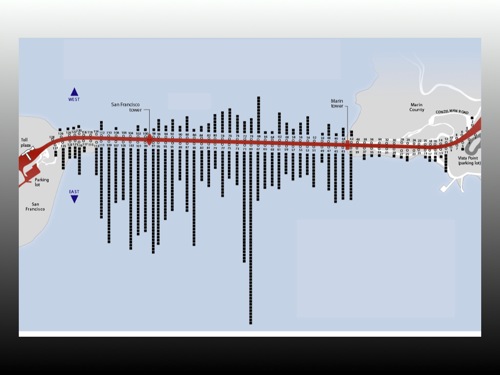
This series and the accompanying infograph make for fascinating class discussion. I stripped the graph of most of its identifying features โ€“ captions, legends, and titles โ€“ tossed it onto my students without introduction or fanfare, and had them intuit those features back to life.

This year, more than any year before it, I am comfortable leaving an interesting question unanswered. This is to say that my students will debate a question like, “Where did people commit suicide most often? The 69th what?” and, as the conversation exhausts itself, they can’t count on me to step in with the answer. This is to say the opposite, that as the conversation exhausts itself, I will shrug and advance the slide to some new work, content to leave the question unanswered.

I don’t have any evidence to suggest this approach to learning will a) increase your Algebra test scoresIn fact, if you apply this detached stance to core curriculum โ€“ adding fractions or solving the quadratic equation, for instance โ€“ I can guarantee you the opposite., b) help the US compete with the Indian subcontinent, or c) any of that. I only know that i) my students seem less afraid of wrong answers and more patient with irresolution, ii) they seem, as learners, less certain and more curious, iii) I enjoy teaching more, and iv) the next time we attempt to define an Unknown 1) I will hear from more new voices while 2) the old voices will be all the more eager to kick the Unknown in the teeth before it limps away yet again.

A Fifth-Year Teacher’s Creed

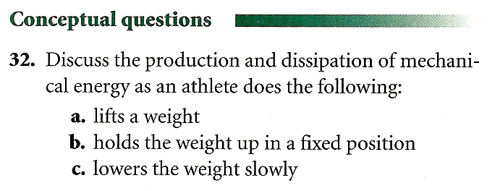
I checked out a copy of our Holt, Rinehart, Winston Physics textbook and the situation is grim. The text stabs forcefully at conceptual development with questions like this:

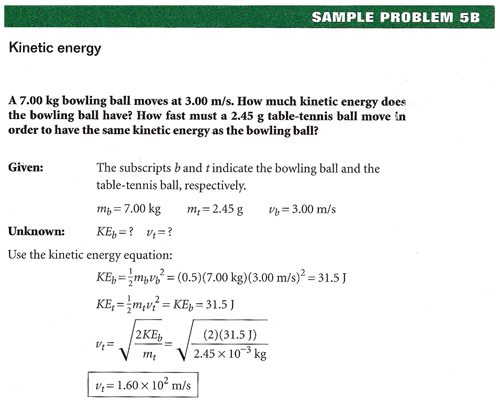
But these interludes of open-ended, critical inquiry are preceded by example problems like this:

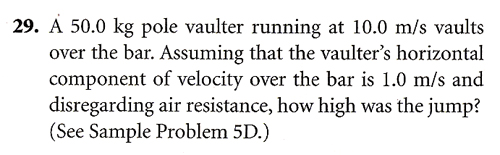
… which are meant to drive practice problems like this:

Which kills me, of course. Basically, the students are taught to identify the relevant formula, match the given information to variables in that formula, and solve for the unknown variable. Helpfully, all the given information will find its way into the formula somewhere. Helpfully, the practice problem will reference the relevant sample problem in case the student forgot the relevant formula.

What we have here, essentially, is a compelling passage of conceptual development thoroughly undercut by practice problems which promote thuddingly linear and literal inquiry. Essentially, we have Holt tossing cupfuls of water onto a raging fire while Rinehart and Winston dump gallon after gallon of gasoline onto it from the other side. I mean, we aren’t even pretending to prepare our students to apply this stuff creatively, to the world around them. Because out there, in the world, no one will helpfully tell them what chapter of the book they’re looking at, no one will helpfully reference the relevant sample problem.

And so I tell myself:

Be less helpful.

Diversifying My Portfolio

There was the struggle between classroom management and engaging instruction. I invested myself equally in both until the depressing day I realized that my investment in engaging instruction also paid off certain dividends in easier classroom management. I spent that day re-evaluating my assumptions about teaching and re-balancing my investment portfolio.

Then there is the more current struggle between teaching skills (multiplying two exponentials) and teaching concepts (proportional reasoning). I figured, until recently, that in a 120-minute classroom, any time we spent on goofy conceptual digressions was time away from skill instruction we’d have to make up later.

So it’s strange, then, that after a semester of frequent digression, my classes are still on pace with every other Algebra 1 class and my kids set the curve for the semester final exam.

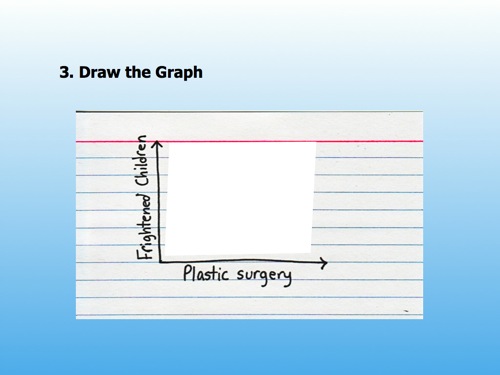
We spent thirty minutes on Friday, for example, investigating Jessica Hagy’s infographic work. I cherrypicked some interesting relationships, covering up Hagy’s graph in each, and asked the students to draw the relationship, also labeling each “direct” or “indirect” variation because, why not.

By the end, we were disputing Hagy’s graphs on technicalities, altering the intercepts ever so slightly to reflect the fact that (eg.) plastic surgeries could, at first, make someone less frightening to children.

After digressing for fully 25% of the period, we got down to the new business of adding and subtracting polynomials. And it struck me as I put an example up on a slide and asked them “what can you do with this?” how little time I spend “teaching” anymore, how these goofy conceptual digressions have trained my kids to look for connections, not just between “plastic surgery” and “frightened children,” but between “old skills” and “new skills.”

I realized, Friday, why we lost dozens of hours in the first semester to goofy conceptual digressions but still outpaced the school.

We didn’t need those hours anymore.
Check For Understanding

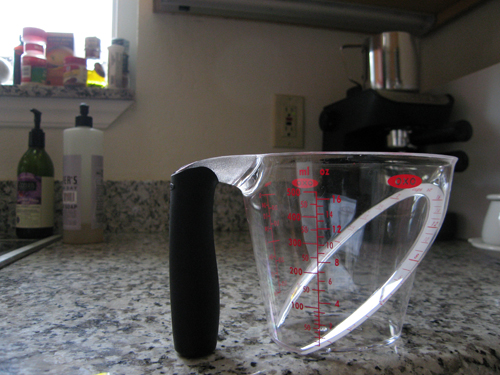
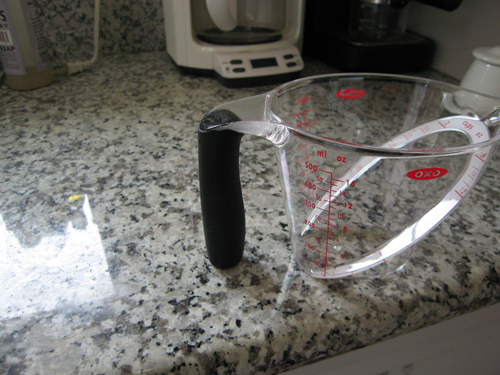
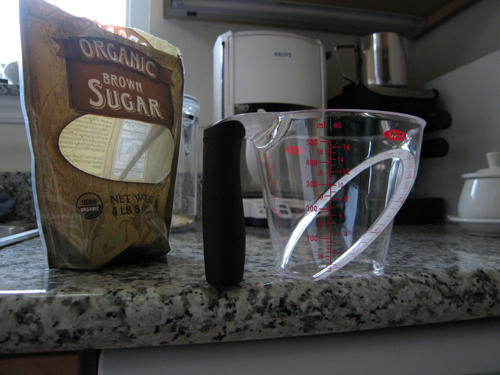
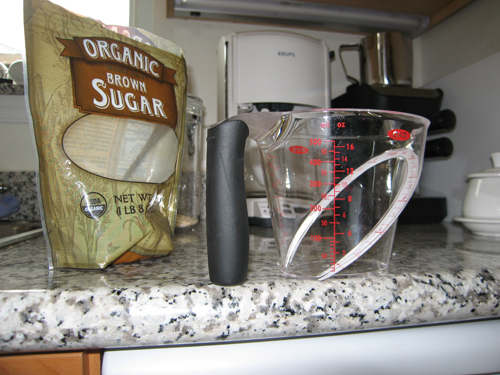
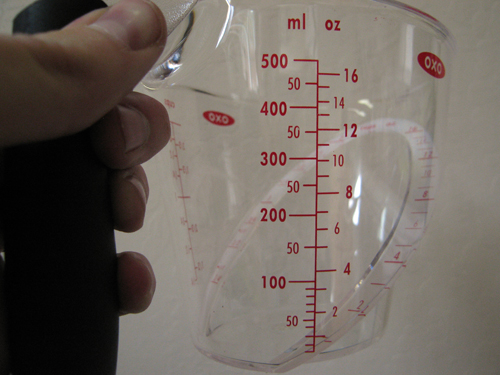
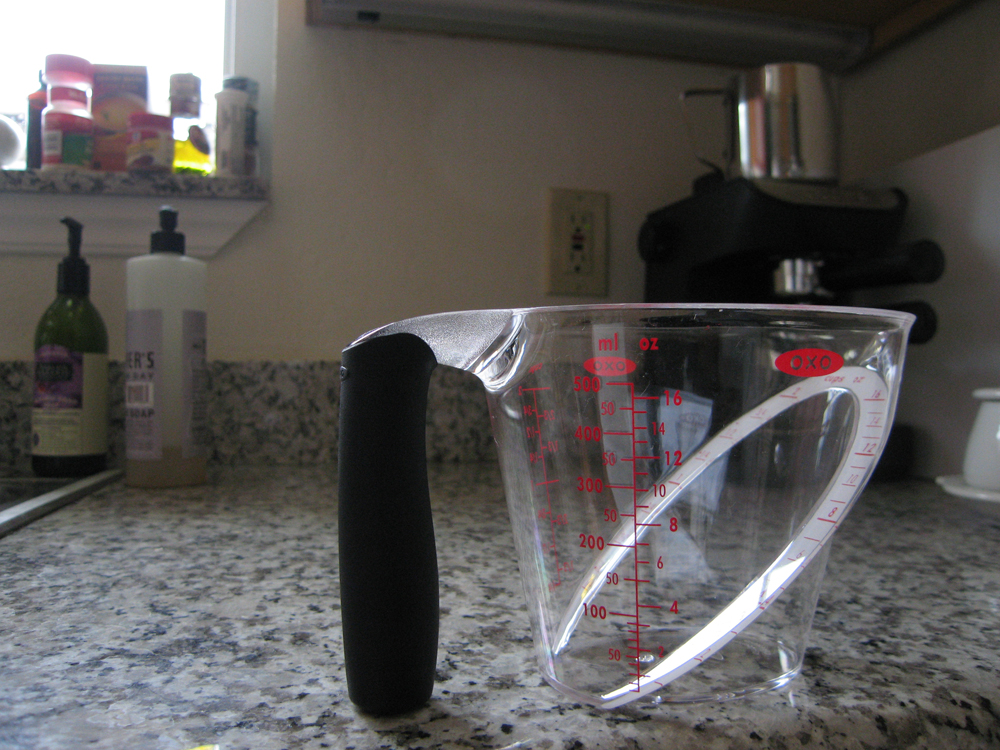
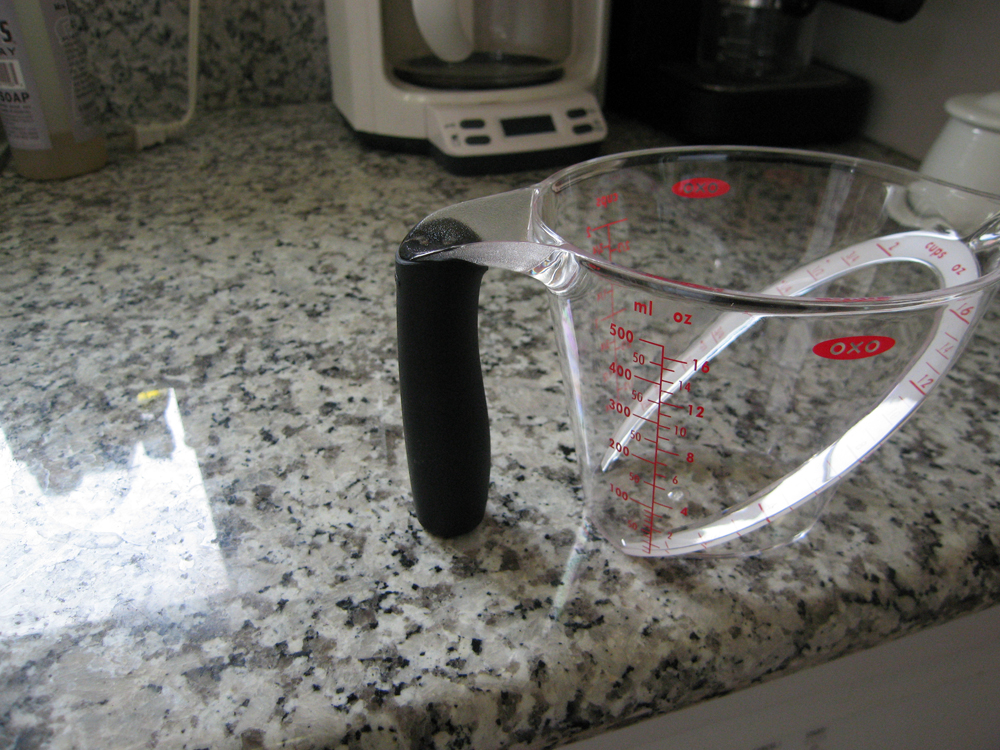
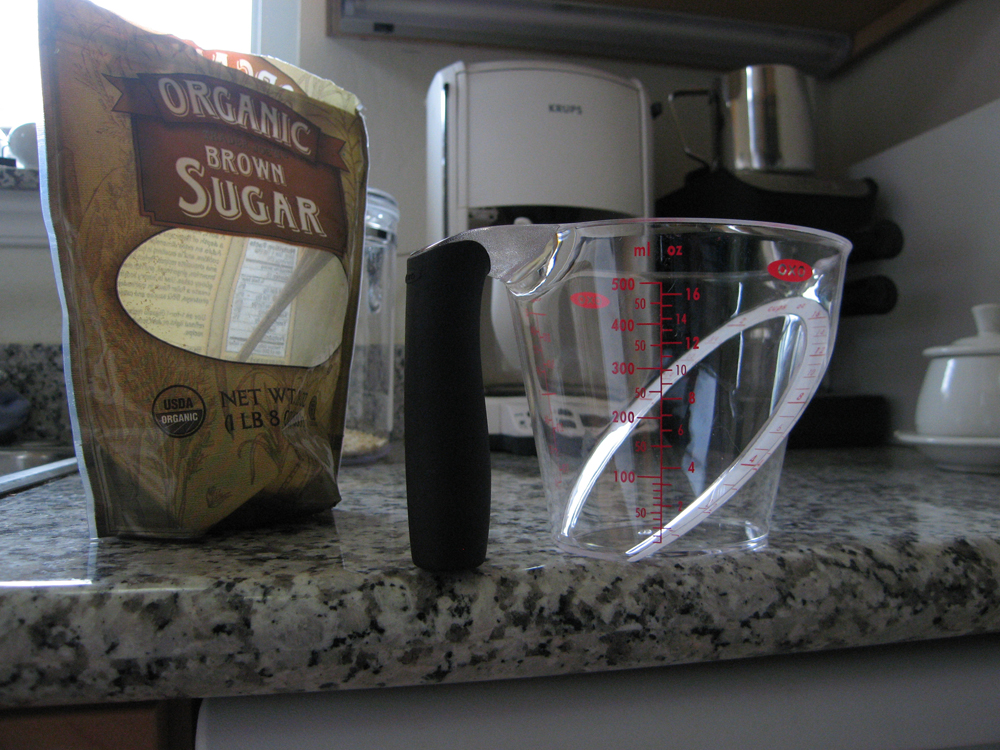
Which of the following five images would best drive a rigorous, analytical, mathematical discussion between a teacher and students, leaving the students best prepared to interpret the world outside their school? Defend your choice.

A. [larger]

B. [larger]

C. [larger]

D. [larger]

E. [larger]

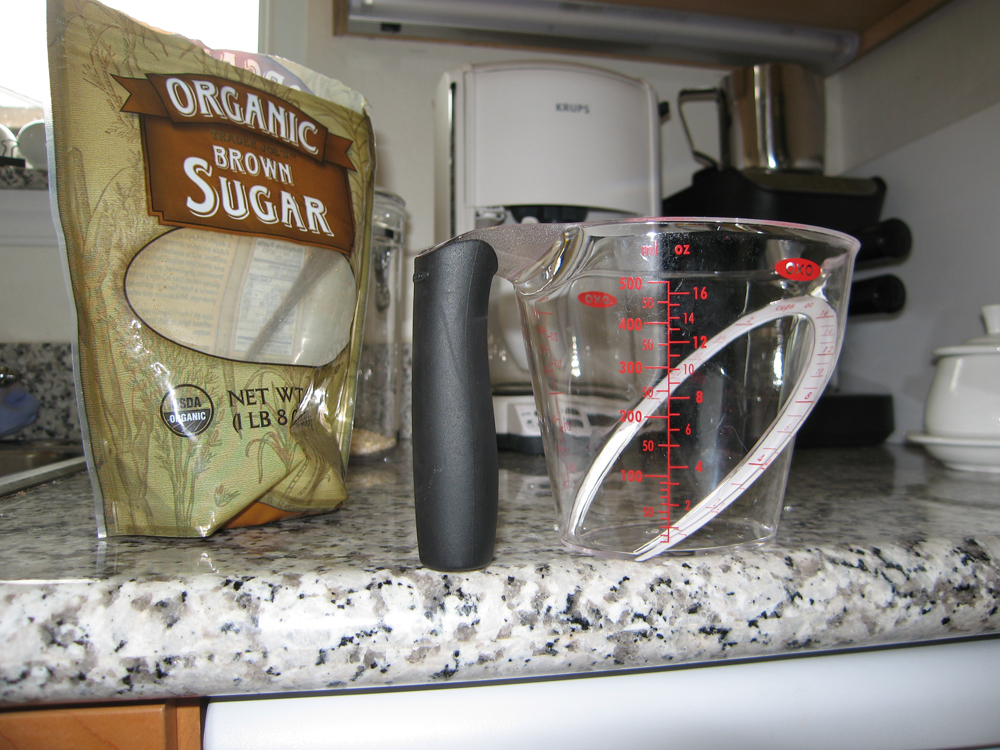
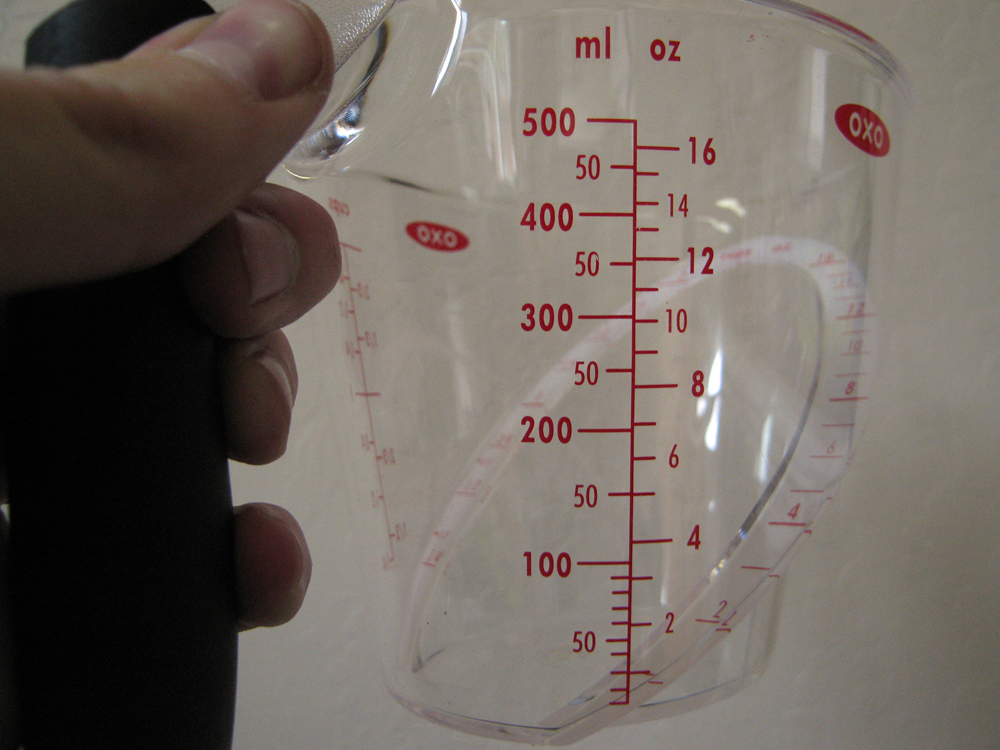
[If you have never found a standard-issue measuring cup utterly mesmerizing, it’s possible you haven’t satisfied some of the prerequisites for this course.]

A Framework For Using Digital Media In Math Instruction

When we teach math we are helping our students establish a framework for interpreting the world. One of the worst ways I know to help them establish that framework is to print an illustration of a real-world scene in a textbook, write in only the relevant measurements, and tell the students in the text of the problem which formula or strategy to apply. This leaves a student helpless and unprepared (in the mathematical, analytical sense) should she ever encounter the world that exists outside the pages of her textbook.

So we instead bring digital media from the world into the classroom, simulations of the world as students experience it, artifacts which students can discuss and to which they can apply frameworks of their choice. In order to leave students capable and prepared for their encounters with the world, this media must be captured and presented very intentionally.

Capture

We must capture this media โ€“ an audio clip, a photo, or a video, for example โ€“ so that it most closely approximates the student perspective, so that the media appears as nearly as possible to be the world as the students experience it, rather than as some audio, photo, or video that has already been interpreted for them by a photographer or a cinematographer or an editor. It must be captured to allow for the most possible classroom uses, the most possible interpretations, and the most possible framework applications โ€“ allowing even for the application of useless frameworks.

  • Frame wide on the scene rather than narrow. Capture the entire scene inside a static frame and add 5% to the margins. This forces a useful question on the student, “Where do I focus my attention?”
  • Compose the shot parallel to the plane of action. Extravagant camera framing makes mathematical photogrammetry difficult but also makes the camera operator an interloper on the scene. An extreme low angle, for example, begs the question, “Who shot this?” when you’d rather the student forget about everything but the scene itself.
  • Record ambient audio only, exactly as the student would hear at that scene.
  • Use location lighting only, exactly as the student would experience at that scene.
  • Maintain a fixed camera position. Use a tripod. A handheld camera allows the camera operator to impose her point-of-view on a student’s interpretation of the scene. We want the student to decide for herself what parts of the scene are relevant, important, or useful, not the camera operator.
  • Record several alternate takes, changing variables, illustrating different iterations of the scene.
  • Take a photo of a ruler or meter stick within the plane of action for reference.
  • Do not edit the video. Edits invalidate timecodes, and, again, they impose an outside party’s interpretation of a scene on the student when we’d rather the student interpret the scene for herself. There are, of course, two unavoidable edits โ€“ where you start the clip and where you end it.
  • Allow at least five seconds on either end of the scene, though more time is preferred. This will force students to decide when something relevant has begun and ended.
  • No narration. This allows the teacher and students to determine the dialogue.
  • Shoot the highest-definition video possible.
  • Shoot at the fastest possible frame rate given the location lighting.

Presentation

The goal with classroom presentation is to eliminate the presence of interlopers, to eliminate everyone from the scene but the student, including the teacher, to whatever extent possible. The teacher exists here to scaffold and curate the artifacts, not to suggest, explain, or gesture.

  • The artifact must beg an obvious, compelling, seemingly unsolvable question, a question which begs for more questions and for more information. If the teacher has to suggest, explain, or gesture in order to persuade the student of an artifact’s interest, then it isn’t compelling or obvious enough for classroom use. (This is the most challenging criterion in this framework. This is the criterion that begs most loudly for open sourcing. The technical aspects of this framework are fairly intuitive but the creative aspects of this framework are extremely challenging and demand collaboration.)
  • Declare nothing and ask only two questions: “What is the next question?” and “What measurements do you need to answer that question?” Again, our ideal digital media shouldn’t require any introduction or explanation.
  • Impose a mathematical framework on the scene only as students request it. This is where textbooks fail, imposing a grid or labeling points or establishing measurements before the student has even begun to process the scene. Once the overarching question has been introduced (eg. “will the water balloon land on the target?”) the students will see the need for measurements. (“We don’t know how high it was dropped.”) The teacher then plays the exact same clip with a measurement grid superimposed on the footage. The ideal digital media artifact consists, then, of multiple remixes of the same video or picture or audio files.
  • It is essential to add a timecode, if for no other reason but for student reference (“Can you scan back to five seconds in? I thought I saw something.”) but also because the timecode will allow for time-based calculation. The timecode needs to take the format Minutes:Seconds:HundredthsOfASecond not Minutes:Seconds:Frames.
  • Invite the students to estimate the answer to the chosen question. Take five student estimates and post them on the wall. This offers the students a low-stress opportunity to consider a correct range for the answer. It also invests them in the problem.
  • Offer the students something tangible to manipulate or measure. A hard copy of a video still, for example, or a digital copy of a video still they can import into a dynamic Geometry system like Geogebra.
  • The final element in one of these digital media artifacts must provide the payoff for the mathematical work. It needs to confirm, for example, that the water balloon did or did not land on its target, or it needs to flashback to the moment the water balloon was dropped, revealing the height of the drop. The classroom discussion can then turn to possible sources of error or calculations of percent error.

This isn’t gospel. Please edit the wiki if you feel so led. This simply makes the most sense to me of my last three years teaching.