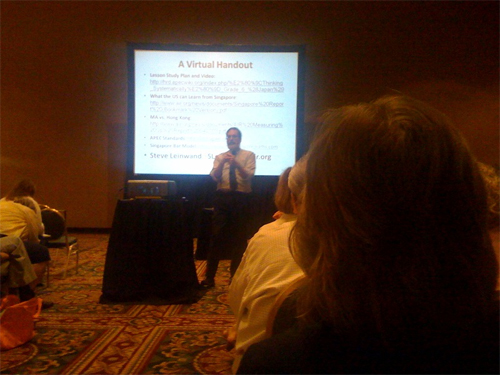
I just finished facilitating “WCYDWT: The Workshop” over four days in Kannapolis, North Carolina. Maybe this should’ve been easy. I had three years of posts and a handful of presentations to draw upon for material. I had to condense the former resource, though, and expand the latter while adapting both formats for a workshop. The preparation lasted the first half of 2010 and was – hands down – the hardest work of my professional year. The facilitation was the most fun.
I learned a pile, both about facilitating workshops and about a model for instructional design I thought I had pretty well figured out. This is my usual debrief, then: notes that are useful to me, posted on the offhand chance they’re useful to you.
How We Used Our Time
- 1.5 days — towards better conceptual problems
- .5 days — towards useful tools for creating better conceptual problems
- 1.5 days — towards better skill development problems
- .5 days — towards lab work, as you like it.
Sessions
I can clarify that schedule and save myself some bandwidth at the same time by directing you to the session sites, which include more detail.
The Opener
If we did nothing else right, we opened our time together well with some highly combustible mathematics. Per Brian Lawler’s suggestion, we began with the ticket roll and the water tank (which, for the record, I had never attempted to solve until last Tuesday with those teachers in Kannapolis).
I tried to lead them through those problems as the best version of myself, by:
- asking them what questions interested them about the multimedia,
- soliciting their intuitive guesses towards those questions and encouraging a competition around those guesses,
- asking them to describe an answer they’d reject as too low or too high (ie. “give me a wrong answer.”) in order to set their parameters for an upcoming error check,
- asking them to tell me the information they’d need to solve their question,
- checking in with groups as they worked, bringing student work beneath the document camera, asking them a lot of questions that began with “why,”
- asking them to check their obtained mathematical answer against their error parameters from [2],
- comparing our mathematical answers to our intuitive answers and then to the actual, no-joke real-life answer,
- discussing possible sources of error, since nobody’s answer was exactly correct,
- extending the problem and differentiating between learners by offering what we came to call “sequels,” (eg. “what would the ticket roll’s diameter measure if it had 1,000,000 tickets?” or “how long would it take to release all the water from the tank?”, a problem which every group missed by a margin well above 200% but corrected quickly, which was awesome to witness. (Thanks, Steve.)
The moment of combustion came when I asked them to create the comparable problems they might assign out of a textbook. It’s always been true for me that I grow most as a teacher when I try to reconcile the exhilaration I often experience, personally, as a learner, with the tedium I often inflict upon my students, professionally, as a teacher.
The product of the first day was a sturdy rubric describing the beginning, middle, and end of “great application problems,” a rubric that arose naturally from those opening activities, a rubric by which we navigated the rest of the workshop.
What I Learned About WCYDWT
- In terms of technical skills relevant to this kind of instructional design, a black rectangle and the pause button will take you 70% of the way. Exemplar forthcoming.
-
Storytelling is the technique by which one problem can be made simultaneously more engaging and more challenging than another problem that assesses the exact same content standard. For instance, consider the difference between “What is the area of the circular lawn?” and “How long would it take you to mow this circular lawn?” The difference between the two is an instructional bonanza. You’re getting so much for so little. (Thanks, Kyle.)
-
Graphing Stories is really boring, again, except for storytelling. Consider a fixed shot of a math teacher walking down two flights of stairs over fifteen seconds. That’s boring. But attach to that boring video the framing device “graph height against time” and suddenly we’re throwing pencils at each other, arguing over the effect of the curb at the thirteen second mark, etc.
Do Better
-
Send along a list of required software in advance. Day two slowed down quite a bit when we couldn’t install Handbrake, QuickTime, or Geogebra due to access restrictions on the teacher laptops. I should have made that list known to my liaisons a lot sooner. (Any experienced facilitators have a tip for me here?)
-
Lecture less. I initially tried to lecture my way into the rubric for great application problems and into the connection between storytelling and teaching. Clearly, I should have packaged that material as fodder for table discussions and then share-outs.
-
Stick tighter to the rubric. We had a good list. By the last day, we were evaluating every product against it, even ones I brought to the workshop. That should have been our m.o. all the way through.
-
Develop a rubric for great skill development problems. Those techniques are more abstract. The rubric would have been much shorter. It would have been a useful exercise, though.
-
Do more math. Do more teaching. During our lab time, I should have insisted that we actually teach each other and actually solve the math because a) that’s the fuel, teachers exhilarated by learning in a way that their students should be also, and b) merely describing a lesson or describing a solution allows you all kinds of fictions that only become obvious once you try them out.
-
Clarify misconceptions about my own WCYDWT workflow sooner. Unless you correct them explicitly, your workshop participants will assume you do all the awesome stuff you’re describing every period of every day. One participant called that effect “demoralizing.” I need to put it out there as soon as possible that this is a model for instructional design that I only aspire to every day.
-
Find an opening for Google Reader and Delicious. That’s the Swiss Army Knife right there. I couldn’t find the right moment, though.
-
What do you do about error? I reckon this question is worth half a day on its own, and I’m nowhere near qualified to answer it. What do you do when you see a student in the middle of an error in reasoning or computation? The answer to that question is somewhere central to this WCYDWT thing, but we didn’t address that one directly at all.
Meaningful Quotations
Paula, a workshop participant:
I don’t know if I’m creative enough for this. I think it probably just takes practice, though.
Dr. Tom Sallee, not in attendance:
A good problem announces its constraints quickly and clearly.