Category: design

Total 257 Posts

Twitter Math Camp 2014 Keynote

140727_1

Two quick meta-items about blogging from the last week:

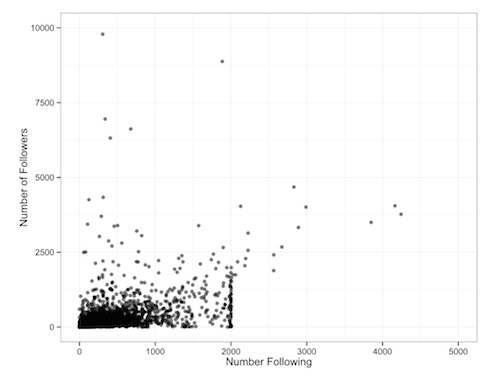
  • I attended Twitter Math Camp 2014 in Jenks, OK, in which 150 math teachers who generally only interact online get together in person. I gave a keynote that could probably best be described as “data-rich,” in which I downloaded and analyzed details on 12,000 blogging and tweeting math teachers. Here are links to my slides and speech as well as the CSVs if you want to analyze some data yourself. (Who doesn’t!)
  • A doctoral student in Canada is interested in blogging as “unmediated professional growth” and sent me a survey about my blogging. Here is a link to my responses. How would you have answered?

Speaking To New Teachers At Their Graduation

I was invited to give a few remarks to some newly minted math teachers at San Francisco State University last night. I had two things to say.

Hi there. It’s nice to be here with you as you get kicked out of the nest. It’s an honor, in fact. I’ve met a few of you. Smart, thoughtful people each one. And it makes my decision to become a math educator seem smarter that you would make the same call. That’s real.

I’d like to say two things briefly about what happens next and then I’ll be done.

I’ll quote the first from someone I met a few weeks ago in New Orleans. He said to me, “Your first year teaching is about growing as a teacher, sure, but it’s mainly about getting to know yourself.” That’s wise. You go through life looking for mirrors. Literal mirrors at first and then figurative mirrors. Surfaces that reflect at different angles revealing more and more about your appearance and your character. At a certain point, a lot of us try to position those mirrors so that they reflect back only our best angles. The most valuable people in my life refuse to let me position them. My best friends notify me of my worst angles and refuse to accept them.

That’s what your students will do for you. They’ll reflect back at you the spot on your chin you missed with the razor. They’ll reflect back the parts of you that are insecure and afraid and small. Eventually all that reflection takes a kind of marvelous toll and you either decide that teaching kids isn’t any fun or you realize that you aren’t the spot on your chin. That isn’t who you are. And then your students start to reflect back generosity and humor you didn’t know you had. I hope you enjoy that. My first three years teaching were basically a bonus adolescence. I could tell you stories. But that’s number one. Enjoy learning about yourself. Enjoy self-study. Apart from whatever my teaching was doing for the kids I taught, teaching showed me the angles where I needed lots of work. It made a better person out of me

Here’s the second. It’s tempting to compare the job of teaching to other jobs you could have taken, jobs your college classmates took, jobs taken by the people you grew up with. I struggled with this for a long time. Friends of mine made more money working fewer hours and their profession wasn’t ever ripped a new one on national television. (Except for the ones who went into financial services. I dodged a bullet there.) Overall, that wore on me. I asked around about med school prereqs. I filled out an application for film school here at SFSU.

In case you ever feel the same way, here are two helpful ways to look at the job of teaching. The first is that you don’t have to worry, as many of my friends still do, that their jobs don’t really matter to anybody except the family they feed. You don’t have to worry that youโ€™re insignificant to other people. You’re in the profession of developing humanity, one class at a time. That’s no small credit you get to claim. I can’t imagine how hard it would be to doubt your jobโ€™s value to humanity for thirty or forty years.

The other reason to love teaching when people try to convince you not to is that teaching has the best questions.

Me, I came to realize that past a certain baseline income, what I need most in my life are good questions. Questions that aren’t so small they crack easily. Questions that aren’t so big โ€” like rising inequality or climate change โ€” they put me in a fetal crouch. I need questions between those two. Questions at just the right size. Questions that crack after weeks and months not hours. Questions I can roll around in my head on long road trips or standing in line at the DMV or in some boring lecture. Lately I’m in the market for a ten-year question. Something that’ll take me through my thirties. I know I’ll find it in teaching.

See, there’s profit in answering a good question. The profit isn’t cash. The profit isn’t even answers. The profit is more questions. The best questions yield more questions once they’re answered. And teaching has all of them. For me, teaching has all the best questions. And most of them are timeless. Questions about human learning will endure even after questions about typesetting and carriage manufacture and driverless cars have expired.

You’ve signed onto a job that’ll yield the best version of yourself, one that offers you endlessly fascinating questions and the growing awareness that a lot of little people’s lives would be less without you.

I couldn’t be happier for you and I couldn’t be happier for myself that I get to count you all as colleagues.
My Opening Keynote for CUE 2014

I opened up the Computer-Using Educators annual conference in Palm Springs last month. That talk made its way online this week.

I started by describing why edtech presentations often make me aggravated. Then I described my “edtech mission statement,” which helps me through those presentations and helps me make tough choices for my limited resources.

BTW. I was also interviewed at CUE for the Infinite Thinking Machine with Mark Hammons.

Featured Comment

Michael Pershan:

LOL. Funny stuff!

High praise.

Great Lessons: Evan Weinberg’s “Do You Know Blue?”

If you and I have had a conversation about math education in the last month, it’s likely I’ve taken you by the collar, stared straight at you, and said, “Can I tell you about the math lesson that has me most excited right now?”

There was probably some spittle involved.

Evan Weinberg posted “(Students) Thinking Like Computer Scientists” a month ago and the lesson idea haunted me since. It realizes the promise of digital, networked math curricula as well as anything else I can point to. If math textbooks have a digital future, you’re looking at a piece of it in Evan’s post.

Evan’s idea basically demanded a full-scale Internetization so I spent the next month conspiring with Evan and Dave Major to put the lesson online where anybody could use it.

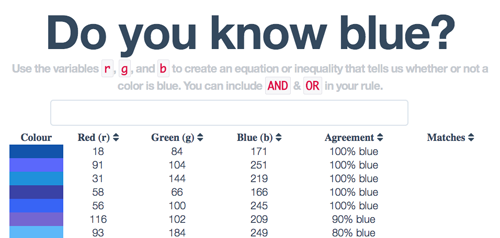
That’s Do You Know Blue?

Five Reasons To Love This Lesson

It’s so easy to start. While most modeling lessons begin by throwing information and formulas and dense blocks of text at students, Evan’s task begins with the concise, enticing, intuitive question “Is this blue?” That’s the power of a digital math curriculum. The abstraction can just wait a minute. We’ll eventually arrive at all those equations and tables and data but we don’t have to start with them.

Students embed their own data in the problem. By judging ten colors at the start of the task, students are supplying the data they’ll try to model later. That’s fun.

It’s a bridge from math to computer science. Students get a chance to write algorithms in a language understood by both mathematicians and the computer scientists. It’s analogous to the Netflix Prize for grown-up computer scientists.

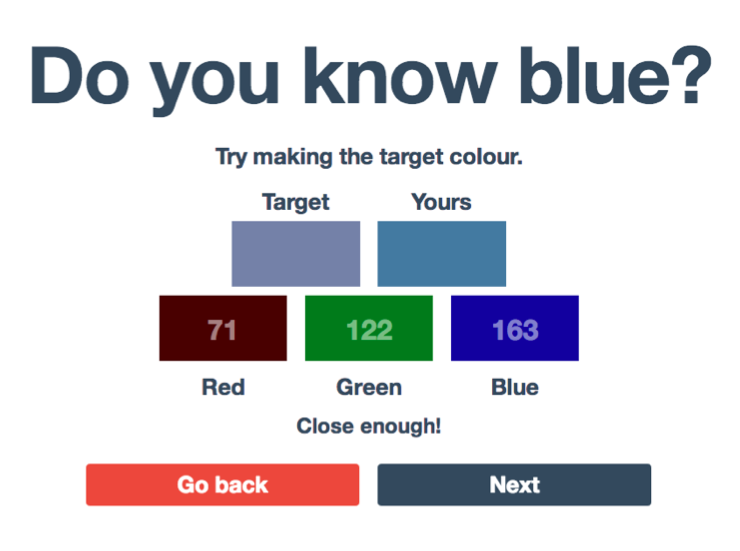
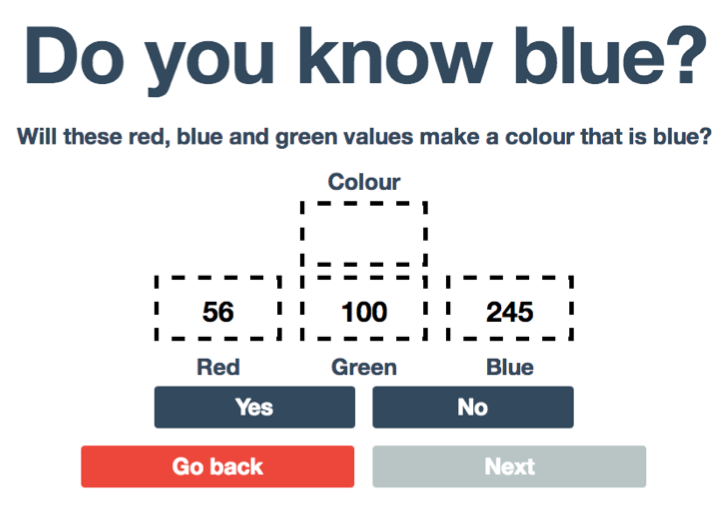
It’s scaffolded. I won’t say we got the scaffolds exactly right, but we asked students to try two tasks in between voting on “blueness” and constructing a rule.

  1. They try to create a target color from RGB values. We didn’t want to assume students were all familiar with the decomposition of colors into red, green, and blue values. So we gave them something to play with.
  2. They guess, based on RGB values, if a color will be blue. This was instructive for me. It was obvious to me that a big number for blue and and little numbers for red and green would result in a blue color. I learned some other, more subtle combinations on this particular scaffold.

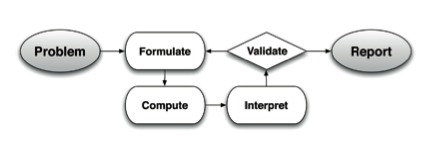
This is the modeling cycle. Modeling is often a cycle. You take the world, turn it into math, then you check the math against the world. In that validation step, if the world disagrees with your model, you cycle back and formulate a new model.

160518_3

My three-act tasks rarely invoke the cycle, in contrast to Evan’s task. You model once, you see the answer, and then you discuss sources of error. But Evan’s activity requires the full cycle. You submit your first rule and it matches only 40% of the test data, so you cycle back, peer harder at the data, make a sharper observation, and then try a new model.

The contest is running for another five days. The top-ranked student, Rebecca Christainsen, has a rule that correctly predicts the blueness of 2,309 out of 2,594 colors for an overall accuracy of 89%. That’s awesome but not untouchable. Get on it. Get your students on it.