I’ll be giving a public talk at the University of Cambridge 25 March at 5:30PM on the state of math modeling in print curricula. The event is free but seating is limited. Grab your ticket and I’ll look forward to seeing you there.
Category: design
Total 257 Posts
I was walking with my wife along the River Corrib in Galway last weekend when we got into an argument that lasted the rest of the walk. I’ll present our two arguments and some illustrative video. Then I’d like you or your students to help sort us out.
Argument A: It would be much harder to swim to the other side of the river in the fast-moving water as in still water.
Argument B: It would be just as easy to swim to the other side of the river in the fast-moving water as in still water.
I hope this gets as out of hand for you and your students as it did for me and my wife.
Featured Comment
This excellent question exhibits a quality that is not found often in math curricula: it has the “specificity sweet spot”: it is specific enough for a student to answer, but non-specific enough for every kid to agree on the answer. Students making different assumptions will have different responses, thus creating a real mathematical argument.
A supercut of moments in cinema and television where characters hate on math.
In fairness, people hate math. Hollywood just turns on the cameras.
BTW. Here’s the behind-the-scenes. I went to SubZin, searched for “math,” crossed off the (few) movies that had anything positive or neutral to say on the subject, queued up all the other movies in NetFlix and ripped those scenes over the course of a few months. Then I wrote down all the lines and started moving them around like an essay. The supercut was easier to edit knowing I had some large passages where kids talked about flunking math or adults referred to their own trouble with math. I was also able to make the movies talk to each other, like the dialog between Jamie Lee Curtis and Megan Fox.
Featured Comments
Great supercut, but there are also Hollywood movies that celebrate math. A Beautiful Mind, Mean Girls, the TV series Numbers, Good Will Hunting… Maybe fodder for another supercut. :)
Mathematical genius appears in too many of those pro-math movies. Good Will Hunting, Numbers, Real Genius, Beautiful Mind – everyone watching those movies recognizes that the protagonists are far outside the norm.
Worse yet, the math geniuses often aren’t even really doing math. They are math like Buck Rogers is science. Numb3rs is a particularly horrific example of this.
Yup, we are the academic equivalent of dentists.
I disagree with the title. I suggest: Hollywood Hates [School] Math.
2013 Apr 24. Nick Douglas of the Slacktory as a nice rundown of the supercut business.
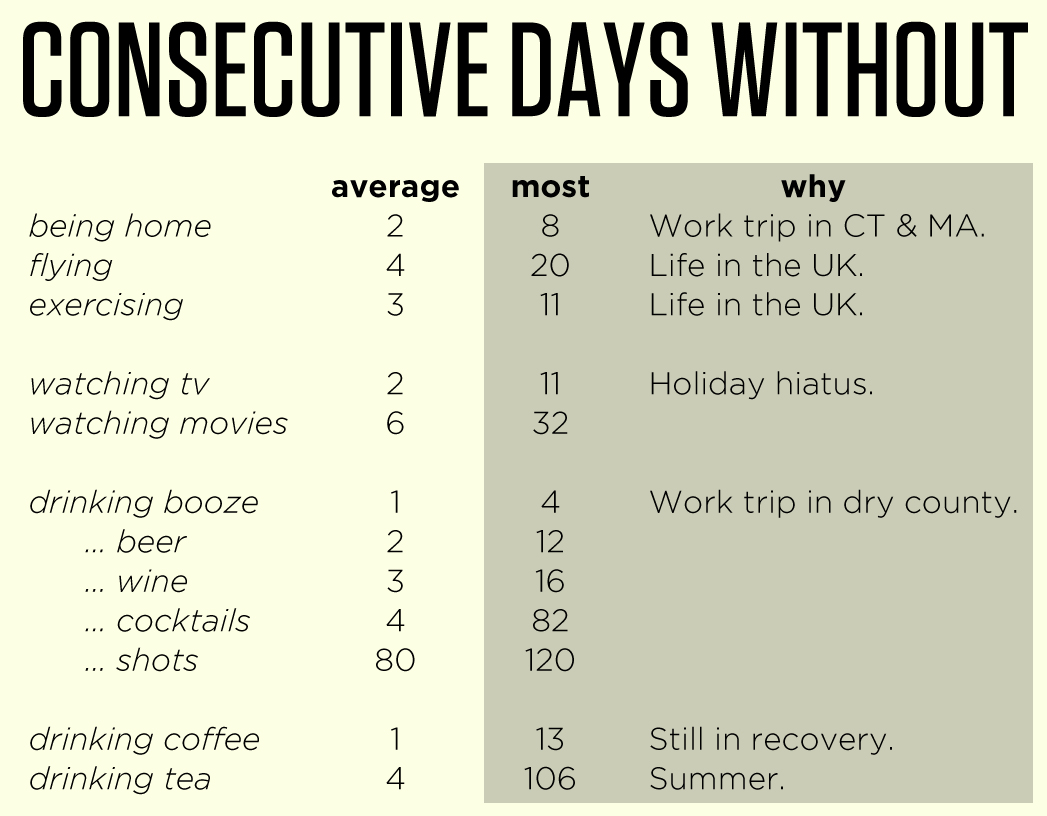
I’m still recording dozens of vital statistics like alcohol, coffee, and media consumption, geographical location, sleep habits, and some others that are no one else’s business, really. For the sake of time, I’m only visualizing one of them. The graph of my coffee consumption tells an interesting story about my 2012, the year my body decided it hated caffeine:
I spend about a minute each day recording statistics on my phone and an hour each month transcribing them to Excel. That takes time. But your devices are collecting a lot of those data passively all the time. If you’d like the excuse to learn data visualization and pivot tables in Excel, here’s your assignment:
Log into your wireless carrier’s web page and download your voice and messaging data for as long as you want but at least the last two years. Then prepare the data in Excel, getting your columns uniform and labeled. Then figure out the top five people you’ve a) called or b) messaged over those years. Do they change? For extra credit, are the people you call most and message most the same people? If not, what accounts for the disparity?
Leave your work in a comment once you’re done. We’re looking forward to it.
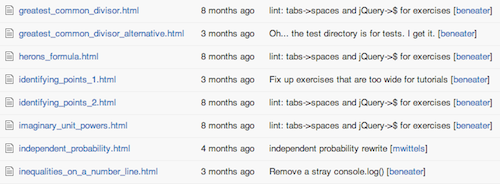
It’s great, first of all, that Khan Academy has all their student exercise code on GitHub for everybody to see. I don’t know any other adaptive system that does that. I figured there had to be a better way to reward them for that transparency than the criticism and judgment I’m about to post here, so I made them a badge also.

Their code illustrates the different ways good math teachers and good programmers try to figure out what students know.
Take proportions, for instance. Here is the code that runs beneath Khan Academy’s proportions assessment.
In each of the dozen files I’ve reviewed, Khan Academy first generates some random numbers that meet certain criteria. In the proportions assessment, they call for three random unique integers between 5 and 12. No decimals. No negatives. No zeroes.
var numbers = randRangeUnique( 5, 12, 3 );
Then they use those numbers to generate exercises. With proportions, they insert an “x” randomly into that list of numbers. The final order of that list determines the proportional relationship that students will have to solve.
numbers.splice( randRange( 0, 3 ), 0, "x" );
But good teachers are more than random number generators. They create exercise sets that increase in difficulty, that ask students to demonstrate mastery in different contexts, all because proportions are conceptually difficult but procedurally simple. It’s extremely easy for students to get by on an instrumental understanding of proportions alone. (eg. “All you hafta do is multiply the two numbers that are across from each other and divide by the number across from the x.” Boom. It’s badge time.) It’s especially easy when the only thing that changes about the problem is the random numbers.
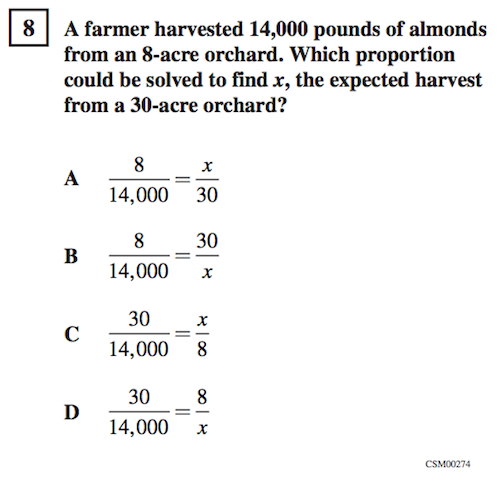
But forget good teachers for a minute. Let’s look at the bar set by various standard-setting organizations. Here is what you have to do to demonstrate mastery of proportions on a) Khan Academy, b) the California Standards Test, c) the Smarter Balanced Assessment.
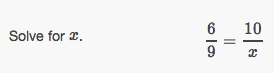
Khan Academy
You’ll do a handful of problems just like this, with different random numbers in different places.
California Standards Test
Smarter Balanced Assessment
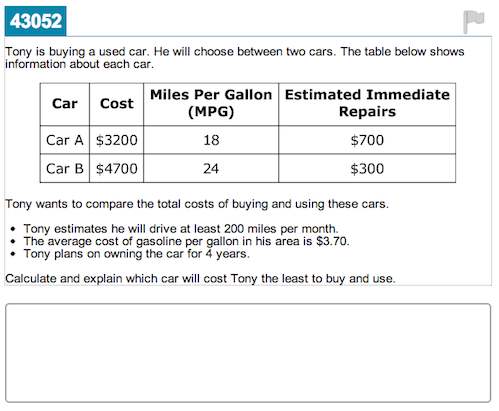
The difficulty and value of the assessments clearly increases from Khan Academy to the CST and then Smarter Balanced. (I’m hesitant to guess how well a student’s score on the Smarter Balanced Assessment will correlate to all her practice on Khan Academy.)
Here we find a difference between good math teachers and good programmers. The good math teacher can create good math assessments. The good programmer can make things scale globally across the Internet. The two of them seem like a match made in math heaven. Just get them in a room together, right? But the very technology that lets Khan Academy assess hundreds of concepts at global scale – random number generators, string splices, and algorithmically generated hints – has downgraded, perhaps unavoidably, what it means to know math.
2012 Dec 13. Peter Collingridge points out in the comments that Khan Academy has a proportions assessment comparable to the California Standards Test. If they have anything similar to the Smarter Balanced Assessment, please let me know.