Category: design

Total 257 Posts

Watch Students Watch The Answer To Their Math Problem

Sadie Estrella’s class worked on Pixel Pattern and then watched the answer.

I’ll try not to be ideological here about photos and videos in modeling tasks. If you have another way to achieve the same cathartic reaction we find 38 seconds into the video, drop me a note in the comments. I’ll take it.

Previously

GraphingStories.com Is Open For All Your Graphing Story Needs

Five years ago I released a collection of 10 fifteen-second videos that helped orient my students to abstract and graphical representations.

Kids like them.

Last year I asked you guys to submit your own graphs and stories which I edited together by hand.

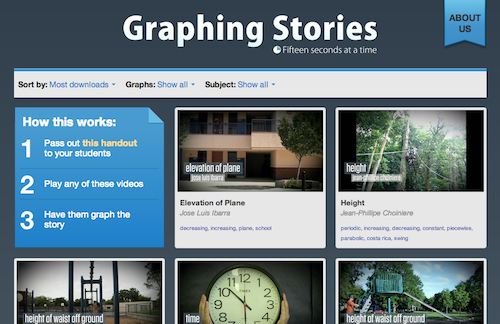
Today, in a joint collaboration with the BuzzMath team, we’re releasing 24 of those videos for immediate download and use in your classrooms, all tagged by content and math. (ie. “a step function about ponies”)

You guys were way more creative than I had anticipated:

Call for Submissions (Sort Of)

I’m never gonna do what I did a year ago ever again. Editing all those videos by hand took months of my time and probably a year off my life. But I would like to know what holes you see in this library and what we can do to plug them.

Do we need more videos with periodic functions? Do we need more videos featuring bacon? Suggest them in the comments. If it’s a good idea and you can film the video, I’ll make your graphing story on a case-by-case basis. This thing will grow larger and awesomer.

BTW. Be sure to drop a tweet @BuzzMath thanking them for their killer work here.

Riley Lark’s Red Dot

We know there are important steps [pdf] you can take to ready students for an explanation of key concepts. Riley Lark is helping you do several of them very easily with his open source ActivePrompt project. While Dave Major and I continue to bat around very specific implementations of digital curricula, Riley has created an extremely open framework, useful for all kinds of purposes.

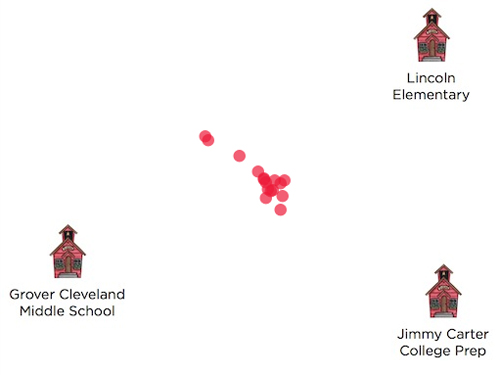
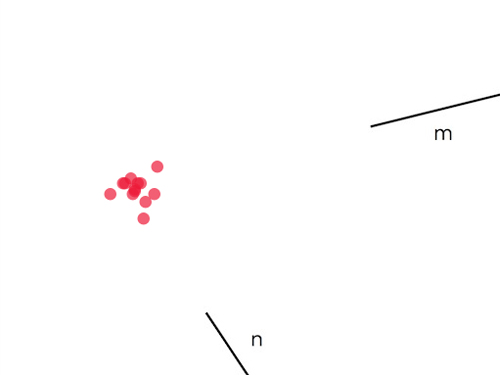
This is everything: the student sees an image and has to place a red dot somewhere on top of it according to instructions given by the teacher. It sounds too simple to be of any use.

Two Uses

Drag the red dot to where you put the cafeteria so that it’s the same distance from each school.

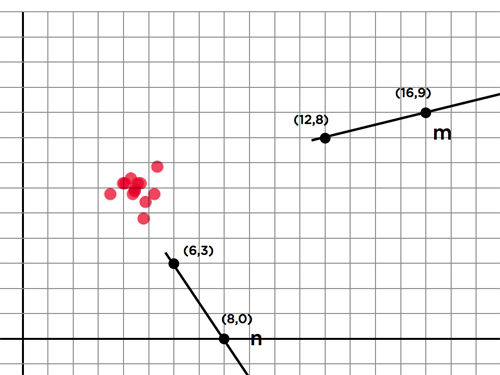
Drag the red dot to where line m will intersect line n.

You see where this goes, right? Even with the second prompt, which isn’t explicitly “real world” in the sense that we usually mean it, students now have experience with the context, which makes it real to them.

Then we start to abstract it and help students work with these concepts:

These brief experiences help immensely to set up and motivate the explanation that follows. It would be great (note to Riley) if the teacher could establish the correct answer at the end of the task (a teacher dot) which would then inform the students how close their guesses came. Also: student names on mouseover, mobile compatibility, vertical lines, and horizontal lines.

You can play with it immediately on Heroku. Be sure to link up your creations in the comments so we can all play along.

BTW. My hope in sharing Dave Major’s work and Riley Lark’s ActivePrompt and my own experiments is that you will become agitated and unhappy with whatever curriculum you are currently using, and that you will express that agitation and unhappiness to the people who publish and sell you that curriculum. None of us are anywhere close to nailing the question, “What do you do on day [x] with concept [y]?” for the entire set of x and y. But before we answer that question, we need to define the modern digital textbook. So here’s my pullquote definition, heavily informed by Dave and Riley’s work:

The modern digital textbook isn’t a collection of content to be consumed. It’s a collection of experiences, of which content consumption is only one part.

Riley Lark’s red dot is one of those experiences.

2012 Nov 29. Riley Lark takes you behind the scenes and shows off several creative ActivePrompts.

2012 Dec 4. Learning Catalytics (a for-profit product) seems to have done a lot of good work in this area already.

Five Design Patterns for Digital Math Curricula

The Center for the Study of Mathematics Curriculum invited me to give a talk last week on digital math curricula. I described how print curricula limit the experiences we can offer our math students and then I made five recommendations for designing experiences digitally:

  1. Show, don’t tell.
  2. Introduce the task as early and concisely as possible.
  3. Climb the entire ladder of abstraction.
  4. Crowdsource patterns.
  5. Prove math works.

Any questions or criticism, please don’t hold back in the comments. I also have limited availability for consultation on these kinds of projects. Drop me a line at dan@mrmeyer.com.

2012 May 1. Here’s the feedback [pdf] from the academics at the conference.

“It’s Killing Me. I Gotta Know.”

Frank Noschese, on last week’s ceiling fan:

I’m dying to see the third act.

Ginny, a participant in my qualifying study at Stanford, on the water tank:

I’m dying of curiosity. Is that anywhere near the right answer?

Andrew Stadel’s student, on the path of the basketball:

Can we watch the video to see if he makes it? It’s killing me. I gotta know.

All three describe the experience of not knowing the answer to a math problem as something like death. A math problem. How does that happen?

My best guess? You start with a credible document of the world your students live in. That could be an actual water tank in the classroom or a representation of a water tank on video. It has to be credible. Then you document something happening โ€“ the tank filling, the fan spinning down, the ball sailing through the air โ€“ long enough for a learner to have a sense of what is happening and what might happen next.

That’s where you end the document. Then work happens. The work is motivated in part by the student’s knowledge that the answer actually exists, that the teacher talks a huge game about math being everywhere and in everything and we’re about to put that to a test.

Then you show the answer.

Please watch this video of Ginny watching the answer to the water tank problem. This moment was incidental to my actual research question. I have no way of knowing if Ginny would have experienced the same mixture of suspense, elation, and catharsis reading the answer to the same problem in the back of her textbook. I only know that if you had told me in my first year teaching that suspense, elation, and catharsis were possible reactions to a math problem, as much as I loved math myself, I would have thought you were crazy.

Previously: You Don’t Have To Be The Answer Key, Handle With Care.

2012 Oct 2. Rachel Kernodle writes about Bean Counting: “… the 4 groups that correctly got the extension with no help from me literally SCREAMED and high-fived each other when I played the answer video ….”

2012 Oct 2. Chris Robinson writes about Taco Cart: “More student comments from @ddmeyer ‘s Taco Cart #3act: I’m losing sleep over the answer, this problem is killing me. Teachers, #3act works. Students made me replay the answer to @ddmeyer’s Taco Cart #3act so they could provide play-by-play in the style of a horse racing announcer.”