Hola, amigos. I’m back from Spain, back in the game after sidelining myself for a helluva comment thread. It turns out that NCTM President Michael Shaughnessy designed the task that I critiqued in a recent post and he stopped by with a few notes on my redesign.
Michael Shaughnessy:
Not all math problems have to be posed everytime in a a high tech environment. Sure, it’s ‘cooler’ that way, but i completely disagree with your comment on this one, about ‘how the problem was posed.’ It’s only boring in the beholder’s eyes, depends on how it’s pitched to a group.
The last line seems to contradict itself, though. Either boredom is in the eye of the beholder, in which case we should just pose the task however we like and accept that it simply won’t engage some students or engagement depends on how the task is posed, in which case we can discuss productive ways to pose it. They both can’t be true, though.
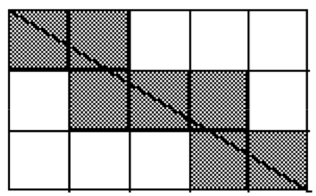
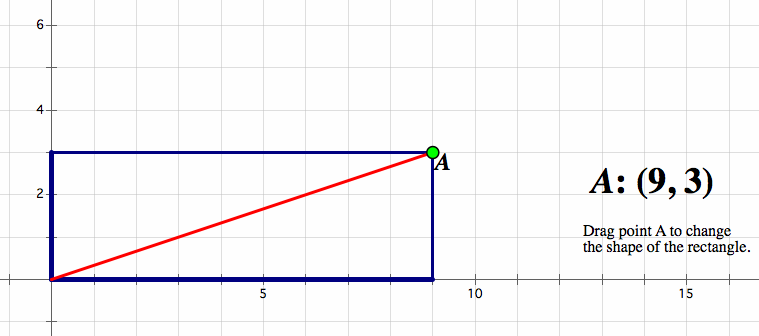
I figured there were three productive ways to pose that task, three revisions to Shaughnessy’s original problem that would open it up to a few more students. I’m quoting my original post here:
- Show how this new, difficult problem arises from an old, easy problem.
- Make an appeal to student intuition.
- Introduce abstraction (labels, notation, etc.) only as a necessary part of solving a problem that interests us.
What’s interesting is how many critics, Shaughnessy included, saw a video and assumed I was aiming at something “high-tech,” “cool,” and “hip.” But those are beside the point. The point is helping more students access an interesting problem. Video was the means, not an end.
Shaughnessy also reports having “gotten a LOT of mileage out of this problem with middle school kids, high school kids, perspective teachers [sic]” without anything fancier than the paper the problem was printed on. I don’t doubt that’s true. But if that brief video opens the problem up to even one more student, my only question is why not? Why not get a little more mileage out of the problem? What’s the downside?
While most critics decided early on that I was just trying to buy off the YouTube generation with something shiny, I was grateful that Tom I. critiqued the redesign on its own terms:
… it seems like Dan is always recommending that we (more or less) apologize to our students for the abstractness of math. The abstractness makes it hard, but must we assume that it makes math pointless and uninteresting for our students?
Abstraction doesn’t make math harder. Abstraction makes math possible. It’s one of the most powerful and satisfying tools in the mathematician’s box. The trouble is that you can’t abstract a vacuum. You start with something concrete (not necessarily “real-world”) and then abstract its essential features. Again: you start with something concrete and then abstract it. Over and over again, though, math curricula provide both the concrete and the abstract simultaneously, one on top of the other. This is unnatural. (R. Wright puts it artfully: “This is a charming problem when posed simply and innocently, not flayed alive by terminology, labels, and notation.”) Unnatural abstraction is boring and intimidating. When we put abstraction in its rightful place as a tool for simplifying the concrete, it’s interesting and empowering.
Other Featured Comments
Debbie:
By starting off with a very familiar problem-style and seeing you apply your approach to it I think I’m finally convinced that this isn’t a one-trick pony but something that can work with all sorts of maths.
Bowen Kerins:
I also want to point to some language used in the discussion here. The initial problem is “insultingly easy”, while the later problem is “trivial” (Alexander’s comment). This is in the eye of the giver of the problem, not in the eye of the recipient.
This is a strong point and I’ll mind my manners going forward. Rephrasing: the goal isn’t to start with a problem every student will find easy. The goal is to show how something relatively simple quickly turns into something relatively more complex.
Tom I:
I bet 9 out of 10 readers of this blog thought [Shaughnessy’s original] was a fun problem and felt an itch to solve it. Why wouldn’t students feel that way?
Because there isn’t a one-to-one correspondence between things math teachers like and things students like. They aren’t like us. Please: do whatever you can to imagine what it feels like to walk into a math class as a high school freshman who’s been convinced since fifth grade she’s stupid, who’s now on her third year of the same Algebra class. She isn’t thrilled by the same mathematical investigations you and I are. She’s threatened by them.
If I cut my teeth teaching honors kids in Fairfax County, I imagine this would be a very different blog. I’d have a very different career. As it is, they tossed me to the wolves in my third year teaching and I had to make friends in the wild. I couldn’t be more grateful for the empathy that experience required.
Carlo Amato:
What program do you use to construct this video?
Dvora:
On the tech side of things… how did you create the video? What programs did you use?
All Keynote. Let me see what I can put together for Keynote Camp.